Software
Houzz Logo Print
bandjzmom

Black Swallowtail Parasite Revelaed

12 years ago

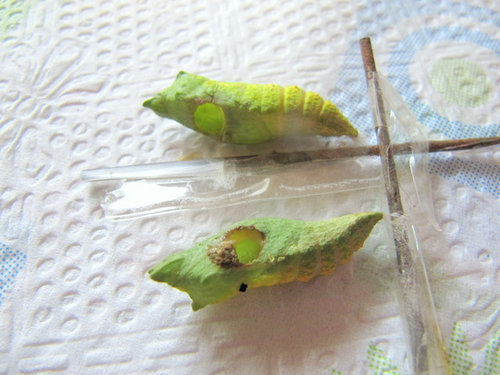
This is the first time I have ever had anything other than a butterfly emerge from a Black Swallowtail chrysalis, and I have raised a lot of Black Swallowtails. This is the Parasitic Ichneumon Wasp, and I had 2 of them emerge from my pretty green Black Swallowtail chrysalides today. I caught the one pictured just after it had emerged, and its wings were still wet. Look at the perfectly round holes they made in the chrysalides. I collect my cats as soon as I find them on the fennel, and that is normally when they are still very small black guys with white saddles. I never saw any sign of parasitization, and I am wondering about when it occurred. I usually raise the cats inside a mesh tent out on my porch. Some of the cats will attach to the mesh and pupate. Do you think that the female wasp laid her eggs into the chrysalides through the tent mesh? Thanks. ~~Angie

P.S. Wasps squished. :)

This post was edited by bandjzmom on Thu, Jun 5, 14 at 16:44

Comments (17)

  • 12 years ago

    Here is the wasp.

  • 12 years ago

    I'm glad you squished those danged wasps, Angie, but I'm sorry they were in there in the first place.

    Parasitic wasps must be able to parasitize/inject an egg into a caterpillar when they're VERY tiny. I've wondered if maybe they do it through the egg, because I've brought in so many very tiny red admiral cats that were parasitized - those little white cocoons would show up in the nest with the dead cat lying beside it.

    I don't know how you can get cats soon enough. Let's just hope it doesn't happen too often!!

    Sherry

  • 12 years ago

    I had a bunch of Ichneumon wasps come out of two of my polyphemus cocoons this year. I froze everything and they are being shipped off to the Cleveland Museum of Natural History to be part of their research/collection.

    By size of the hole, I'm guessing the wasp is close to the size of the chrysalis. That is a little big to be laying an egg on a butterfly egg. Might have stabbed the chrysalis through the mesh but more likely it nailed the caterpillar as it crawled on the mesh.

    Other possibility is someone chewed a hole in your mesh that you have not found. I'm currently repairing all my sleeves and socks. Almost all of them need some hole repairs. A lot more damage than usual. My memory is mole crickets seemed to have been doing most of it.

  • 12 years ago

    Thanks Sherry and KC. Helpful comments.It makes sense that it could very well have laid the egg into the caterpillars through the mesh as well. I don't know why I never thought of that happening. So then, would the egg have been injected entirely into the body of the cat? I would have noticed any exterior cocoons and euthanized the cats that had them.
    As I said before, this is the first time that I have ever had this happen here, and I have raised a load of BST's over the years. The mesh tent is pretty new and is intact. I have just bleached it and looked it over carefully. ~~Angie

  • 12 years ago

    Those wasps patrol the host plants and can lay on pretty small caterpillars.

    I use butterfly farm net containers outside. I buy them from eNasco. They are the only ones that I know are parasite proof.

    Here is a link that might be useful: Butterfly Farm Parasite Proof Net Containers

  • 12 years ago

    If it is an Ichneumon, most of them inject their eggs into the caterpillar.

    I'm familiar with the external cocooning wasps you're talking about but I find the ones that pupate in the lep's pupa to be much more common.

    Butterfly Farming Supplies sells some fabric that they claim is parasitoid proof.

    Here is a link that might be useful: Parasitoid proof screen

  • 12 years ago

    Ichneumon on Emerging from Black Swallowtail Pupa - Trogus pennator
    http://bugguide.net/node/view/770006/bgimage

    I have a few of these wasp and their victims (the Black Swallowtail pupae with the hole) in containers for show and tell. I do a few butterfly programs.

    Here is a link that might be useful: Red wasp attacking black swallowtail caterpillar - Trogus pennator

  • 12 years ago

    I am familiar with the Butterfly Farming cages. I hope they have taken my recommendations and redesigned the cage so it opens more easily. I have not tried their cages outside so I do not know if they are secure.

    The Butterfly Farm cages from eNasco meets APHIS (USDA division that handles butterfly permits) requirements for secure enclosures with a 60+ threads per inch. I recommend that you ask the Butterfly Farming owners about the thread count on their screen.

    That's confusing isn't it. Butterfly Farm(ing) as apposed to Butterfly Farm.

    Here is a link that might be useful: Parasitoid Proof Netting Another Seller of Bulk Material

  • 12 years ago

    Well, I know Butterfly Farming did not fix their rearing sock. Instead they posted my workaround on the product page. Not what I had in mind.

  • 12 years ago

    Raising Butterflies is the company to contact to talk to about changes to those sleeves. Raising Butterflies and Butterfly Farming sell the same cages/sleeves. My guess is hopefully with a reorder (new shipment) they will correct the problem.

    Click on the store top right of the website below.

    Here is a link that might be useful: Raising Butterflies

  • 12 years ago

    eNasco is where I order my tents, and the one my BST cats were in was the Butterfly Farm⢠Square Pop-Up Cage. Seems to me that a Wasp would be able to inject a cat through that mesh if the tip of the ovipositor was firm and sharp enough.
    I don't know why it never occurred to me that this was a possibility. I do prefer raising my caterpillars outside on my porch where they are experiencing the normal changes in temp and humidity, but this event has me rethinking that choice.
    I had a few more wasps emerge. Now up to 6 wasps.
    Angie

  • 12 years ago

    I think it was parasitized by the time you brought it in. I have seen those wasp patrolling the fennel in my yard. I hope the rest of your caterpillars will be okay.

    I've used those butterfly farm cages outside for many years and never had any caterpillars harmed. I did have problems with the LiveMonarch sleeves. An assassin bug pierced one of those to kill a small Monarch caterpillar. I saw this and was horrified.

  • 12 years ago

    "Posted by ladobe 10 (My Page) on Wed, Oct 19, 11 at 18:59
    "How could it have gotten there? I got the caterpillar while it was in its 2nd instar stage--very, very little and it has been indoors ever since. Could it have been attacked by the wasp that early?"
    Wasps can parasitize lepidoptera in any stage, but most commonly from egg to pupa, by either ovipositing inside them or on the outside of the choosen host. Their larva can then grow within them without killing them until they themselves pupate or emerge. Almost all wasps worldwide are parasitic in one form or another, not just those commonly associated with Lepidoptera. Some years here on the desert the infestations are so heavy in lepidopteran livestock it's nearly impossible to find untouched livestock. I can't begin to count the number of times I've traveled great distances to obtain wild livestock, and reared robust larvae only to be rewarded with parasitoids in the last instar larvae or pupae. In part why I learned very early on how to "hand pair" any species of lepidoptera, and built my own controlled habitat rearing cages with glass sides and a tight fitting very fine mesh net top and cover for the water bath under the cage. With that I seldom had to deal with parasitoids again.

    Larry"

    Here is a link that might be useful: Link for search on wasp (post by Larry)

  • 12 years ago

    Thanks a bunch runmede. I do see the wasps patrolling a lot of my host plantings in the yard, so I know that they are out there. You are thinking that they injected the eggs or the very small cats, or maybe both? I had planned to take my Giant cats outside at some point, but the speculation about the injecting through that rearing tent has me worried. ~~Angie

  • 12 years ago

    Butterfly Farming is part of Shady Oak. Edith is who I was dealing with last year when I found the socks had a problem (they don't sell sleeves, unfortunately). From our conversation, I could not tell what Shady Oak's relationship was with the source (Does Shady Oak tell them what to make or do they just buy what someone makes?). I saw Raising Butterflies had the same socks but they were pricier.

    Forward to 2014. Shady Oak now has them in two sizes but Raising Butterflies does not carry the second size. The new larger sock has the same problem as the original sock so fixing the problem does not seem to be a priority.

    As for parasitoids, my polys are the ones that get nailed every year. When I catch the wasps in the act, they are laying eggs in the 5th instar cats which are wandering around the sleeve looking for a place to build a cocoon. The cats don't crawl on the material when they are still in eating mode.

  • 12 years ago

    As far as I know Todd Stout of Raising Butterflies bought the material, contracted the work, and partnered with Butterfly Farming. But, I could be wrong. You will have to ask Edith.

    A butterfly farmer in Maryland used to get a paint company to make sleeves for him out of painter strainer material, but those sleeves had to be doubled to avoid predators. That Skeeta company that I posted will do custom work, but I have no idea what they costs.

    I'm having trouble looking up stuff and then coming back to post the message. I get thrown off with an error message. I will look up some stuff and post it. I use sleeves for some species that I raise. Last year a large group of RSPs.

  • 2 years ago

    ?

Sponsored