Software
Houzz Logo Print
gwynne2006

Another passiflora question

19 years ago

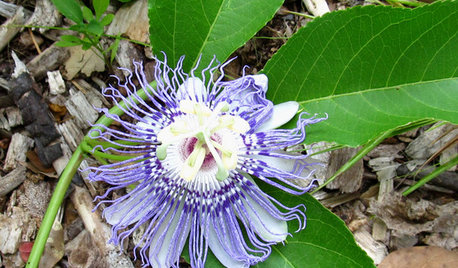
I bought some passiflora incarnata off a seller on ebay. It was shipped bareroot and one of the three vines died. The plant was doing very poorly and someone suggested root growth hormone. The plant is doing very well now, though it hasnt flowered yet. It does have a lot of leaves.

I bought passiflora caerulea from a different seller. It arrived in dirt and already had some buds. It had been grown in partial shade and therefore though it was about two or three feet long, the leaves are at the top and middle. When I go ouside during the day, sometimes I will see an open flower. It is very pretty! However, the leaves have not taken grown at all. There doesnt seem to be anymore leaf growth then when I got it. Since this is a different problem I am wondering if root growth hormone would help this plant or if there is something else I can do to help promote leaf growth.

Comments (13)

  • 19 years ago

    Have you fertilized it? If it has plenty of roots, then it should be growing on its on, assuming that it's getting plenty of water, sunshine, good drainage, and is growing in fertile soil. I fertilize my passionvines every spring and sometimes again in the summer - I use chicken manure alone or chicken manure with chemical fertilizer mixed in. Butterflies like to lay their eggs on new growth, so you need to keep it growing as much as possible to attract ovipositing females.
    MissSherry

  • 19 years ago

    No, I havent fertilized it. I am not really even sure what that means though a lot of plants say to fertilize regularly. I believe it may be planted in the miracle grow soil, but am not even certain of that.

    I dont know of any place to get chicken manure, does fertilizer automatically mean manure? Or can I get something liquid to add to the soil?

  • 19 years ago

    I've never looked fertilizer up in the dictionary, but to me it means anything that you apply to the soil mix around the plant or in the water that you water the plant with that adds nutrients that the plant roots take up and use to the betterment of the plant. Now that I think about it, there is a such thing as foliar feeding, but that's something I've never tried - too odd.
    Fertilizers can be natural - like manures, fish emulsions, guano - or chemical, like the mixtures you buy in stores - I use both.
    If you go to a garden center, like the ones in Walmart or home improvement stores, you'll find lots of chemical ones and maybe some natural ones - package directions are included.
    MissSherry

  • 19 years ago

    Foliar feeding is great! Mix up a liquid fertilizer, put it in a sprayer - a little hand sprayer if you don't have a lot to do - and spray the leaves being sure to get the undersides thoroughly wet as well as the tops. Best to spray early in the morning or in the evening after the sun is down as you (1) don't want to burn the leaves and (2) the stomata, a.k.a pores, of the leaves are open to take in the fertilizer.

    Foliar feeding works well because the fert. gets right into the plant and is available to it quicker. Pour whatever is left over on the root area. Fish emulsion works well this way even if it does smell and so does Superthrive. Wal-mart has both.

    Suzanne

  • 19 years ago

    Is this fish emulsion harmful to the caterpillars? And does it stimulate new growth faster than fertilizing the roots?
    I also had a question for missSherry...since you seem to have the most experience with passionvine and raising gulf frits on them... I am having a really hard time with ants on mine. I guess they're attracted to them for some special reason. But mine is full of cats, and chrysalids, several of which have been eaten by the ants. Someone else suggested using ant bait with spinosad, which I did with no effect. Do you have any other suggestions? I hate that they're eating my cats, and I can't do anything about it. Do you just bring them inside and raise them?

  • 19 years ago

    I've never used fish emulsion, so I can't answer that question.
    My passionvines also have tiny ants crawling all over them, but I've never seen them eat a single caterpillar! I bring most of my cats in to raise myself, but even later in the GF season when they're so numerous that I leave a lot of them on the vines to raise themselves, I don't find the little ants doing any harm. I've read that the ants really stay on the vines for the nectar they get from the nectaries, the little round bumps you see around the flowers. I've never had any luck with ant poisons either, even for ant hills - they just move their hills somewhere else.
    My only advice would be try something else and/or raise the cats in a cage yourself - that's what I do.
    MissSherry

  • 19 years ago

    Maybe our ants are different than yours? These are not little ants. I actually saw them eating a little cat. There was a hole in a chyrsalis and it was empty. What else burrows a hole and eats the chrysalis? It seems we're having more ants than usual because of all the rain we've had.
    I'm really frustrated because I don't want them all to die, but I'm not sure how to raise them inside. I've got 2 potted rue plants inside in a pop up hamper with cats all over them. That seems to be the easiest way, no mess to clean up, or fresh foliage to give everyday. But how do you do it with the passionvine? How do you keep the foliage fresh?

  • 19 years ago

    I think you're right - we're talking about different ants. The ones that stay on my passionvines all the time are extremely tiny. You're talking about bigger ones, which WILL eat chrysalids - I think these are types that live in hills. Rain scatters ants like this from their hills, so they wind up everywhere.
    I raise mine in reptarian cages or reptariums, which were originally made for raising reptiles like iguanas, and use florist's waterpicks like "vases" to keep the leaves fresh - I attach these to the cage with florist's wire. Waterpicks don't hold much water, so you have to check them frequently to see if they need refilling. I put a foam rubber pad on the bottom of the cage, cover that with paper towels, and change the paper towels as needed.
    I'd like to leave all my cats outside to raise themselves, but I just can't stomach what I see nature doing to them! Even my previously untouchable pipevine swallowtails were victimized by a new (to me) predatory stinkbug!
    You can order reptariums/butterfly cages from Educational Science in or outside of Houston or LLL Reptile.com.
    MissSherry

    Here is a link that might be useful: LLL Reptile

  • 19 years ago

    I forgot to tell you that PetSmart used to and may still carry reptariums, but they charged a good bit more for them. If you want one today, you could call them and see if they have any.
    MissSherry

  • 19 years ago

    So what is the verdict? Can I get some plant food or something?

  • 19 years ago

    I am a little reluctant to foliage feed host plants, no matter whether it is organic like fish emulsion, kelp, or whatever, the cats will be consuming it. IMHO I would stick with soil feeding, unless you have a few cats you just want to experiment with to see how they tolerate it. I would think something plant-based, like kelp, might be the best for this. Read the ingredients to make sure there is nothing else in it that might be harmful. Cats are herbivores, even though they do sometimes eat their own kind by accident, but the cats have only been eating the host plant, so they don't provide any protein source for them, I wouldn't think.

    Rhizo will probably come in here and chastise or correct me on this, but that's just my opinion.

    Susan

  • 19 years ago

    Get some bagged manure - preferrably chicken, but cow will do - mix some slow release fertilizer in with it according to package directions, work this into the soil, then water it in good - water the plant when it begins to dry out.
    Susan, I agree! In order for a fertilizer to be a fertilizer, it's got to have concentrated amounts of N-P-K, which couldn't be good for the cats to eat. That's my common sense opinion, which has proven successful in raising caterpillars.
    MissSherry

  • 19 years ago

    With regards to foliar feeding: here is MY opinion.

    We use organic fertilizers in our garden (for obvious reasons! Also, for those of you new to the forum, be careful if you own 4-legged pets because many of the 'other' fertilizers are harmful to them. Dogs and cats absorb stuff through the pads of their feet.) and I can tell you that I've found that foliar feeding MILKWEED has been disastrous.

    How do I know this? Let me tell MY story. :) (yes, this is one of those tdogmom stories...)

    My husband likes to foliar feed and to help my butterfly sanctuary out, he went and did this to my Milkweed. He does the front yard on different days from the back since I have host plants in both and he knows I need to be able to 'feed the cats.' WELL, I found that when had used anything on the leaves, my Monarchs did NOT do well. Later instars often may have had a spot of yucky frass but then when fed non-foliar-fed leaves, went back to 'normal frass.'

    Early instar larvae, however, just did not make it. Nope, they died. In fact, what is really interesting to me is thisÂthe caterpillars would develop this odd odour. I would open the bug cup and I'd stick my nose in and take a whiff. Whew! at least I noticed this unusual odour...if your nose was stuffy you may not notice it ;P

    We experimented to see if it was the foliar feeding or not. It definitely IS. When fertilizing directly into the soil, this does NOT happen.

    Keep in mind that I raise a lot of caterpillars. I didn't TRY to kill any on purpose! The experiment was important because initially, hubby was insistant that his foliar feeding wasn't causing any problems. Now, he can see that it indeed is an issue and he no longer sprays the leaves of any host plants in the butterfly sanctuary.

    OH, as far as kelp and fish emulsion? We DO use both. But, the are going directly into the soil from now on instead of on the leaves.