Software
Houzz Logo Print
harmonyfarms_gw

Climbing Vine for New Trellis?

19 years ago

We are installing a trellis over our gate of our new fence. It faces south but really doesn't get sun until the later afternoon so it's HOT. I want something to grow over and think I would prefer something evergreen if this is possible. I'm 7b in upstate SC. The soil in this area is not great. Eventually it will be redone so I've thought about temporariliy planting something in two large pots and letting it climb.

So I guess I have two questions.

1. What would be a good long term plant?

2. What would do well in pots for the short term.

Comments (34)

  • 19 years ago

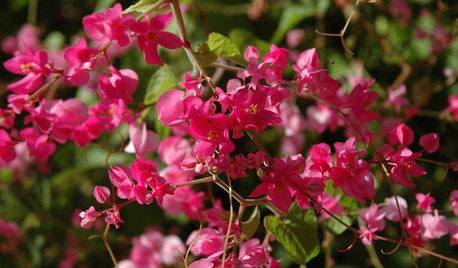
    Take a look at five leaf akebia - I have two planted up against a fence w/a lattice topper (one on each side of the yard) and they are amazing. They can be aggressive - my crepe myrtle almost got eaten up last year because I wasn't paying attention! - but in short order will form a beautiful, dense lattice cover.

    Semi evergreen (maybe full evergreen in your zone) w/lovely early spring flowering. Right now they are totally beautiful w/the spring green new growth and flower buds ready to burst.

  • 19 years ago

    Mine is in bloom right now and produces berries for the birds.

    {{gwi:560004}}

  • 19 years ago

    BTW, my experience with five leaf akebia is that it is extremely hardy and seems to thrive on abuse, or at least benign neglect! Last summer it really got wild & wooly, so last month, while the leaves were mostly off, I literally hog tied it w/twine back against the lattice - unphased, it's happily sprouting new buds everywhere. Of my two, the one with the most brutal afternoon sun, full west, is the most lush.

    That's pretty, byrdlady, mine blooms in a creamy white. I just picked up two tall fan trellises for a blank back wall on my house. Am going to try the annual route w/moonflowers and two colors of morning glory. Can't wait to see how it works !

  • 19 years ago

    another vote for five leaf akebia. Our favorite vine -- it never disappoints and is easy to prune and train because it doesn't have those horrible suction cups like some vines. Our experience is that it covers an arbor in one year.

  • 19 years ago

    Just be aware that if, like Zigzag, you plant morning glories, you will have them resprouting for years. The babies are easy enough to pull, but come up by the hundreds.

    Another vine to think of is Carolina jessamine, which is also slightly aggressive, needing pruning back and tying in several times in the year. But it is evergreen or nearly so, and flowers profusely in the spring. Clematis armandii may be TOO big and agressive, but is another possibility.

  • 19 years ago

    I would like to get a couple of those 5 leaf akebia vines. dose anyone know where in the durham area that sells them? I would also like to find some candlestick plants or seed.

    thanks jeeper

  • 19 years ago

    I'm pretty sure I saw them at BB's in Sanford. Adele? You there? Theresa.

  • 19 years ago

    Another evergren or semi-evergreen vine is bignonia or cross vine. Again, it may need pruning to keep it civilised. It comes in red/orange shades of flowers and blooms most of the summer. Growing it in pots might help keep it in check. It is a native, so hardiness isn't in question, nor is really good soil needed.

  • 19 years ago

    Jeeper, I haven't looked for five leaf akebia lately (no need!), but expect Homewood Nursery, Honeycutt Rd in Raleigh would have them - not sure about your other wants, but I think Homewood is pretty nifty.

    Also, I'm not sure how many different akebias there are, but I have read of some that bear 'fruit' that is not too desirable (smelly) - mine don't, but did produce a few seed pods this year that were pretty ugly. But, since they were hidden in the leaves, no harm. My plants have had four full growing seasons - the seed pods just appeared last year for the first time.

    (Hope mentioning Homewood isn't a no-no 'round here - if so, sorry!)

  • 19 years ago

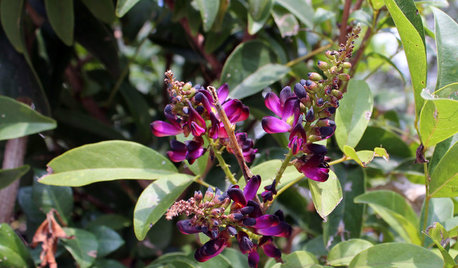
    thanks guys iwill check out both of these. I like the purple above.

    jeeper

  • 19 years ago

    the jelly-like substance around the seeds in the fruit is actually edible. i haven't tried it, but it's touted in some of the edible landscaping nurseries catalogs. i'd think if you picked the fruit before i got overripe it wouldn't get smelly. they are a pretty good size- as long as a hnd and big around like a fat cuke. the jcra used to have a whole arbor of them- about 6 different 5 leaf varieties, from white through rose and purple, and one variegated leaf, plus they also had a 3 leaf type. very cool.

    if you choose to do bignonia- do grow it in a pot. ditto for some of the more vigorous clematis (like autumn blooming), trumpet vine, jessamine and passionflowers. they all spread via runners and can get out of hand. i have bignonia, autumn clematis , trumpet vine and jessamine pop up all over from runners and seeds. i've heard akebia can get a biit aggressive, too.

  • 19 years ago

    These are great suggstions! Thanks! Also, should I plant two? One for each side of the trellis? Or let one grow up and over?

  • 19 years ago

    Two. Most of these plants grow up, and while you can train them over and down, it would be a struggle to keep them aimed as you want.

    If you do decide on pots, make sure your chosen pots are big enough to be in proportion to the trellis/arbor. And do give thought to having an annual vine planted to fill in for the first year, if needed. You might have to weed out seedlings next spring, but ... Also, having something growing down over the edges of the pots might be rather attractive. Just be sure you can water the pots as neded.

  • 19 years ago

    if you don't want to invest in decorative pots, you could always sink regular black ones nearly into the ground to contain unruly viine suckers.

  • 19 years ago

    That is a beauty.

    Carla

  • 19 years ago

    I googled Akebia vine, and found out that it's a very invasive plant -- maybe something else would be a better choice:

    ECOLOGICAL THREAT
    Fiveleaf akebia is a vigorous vine that grows as a groundcover and climbs shrubs and trees by twining. Once established, its dense growth crowds out native plants.

    HABITAT IN THE UNITED STATES
    Akebia is shade and drought tolerant and can invade many types of habitats, preferring lighter, well drained soils and sunny to partially shaded environs.

    BACKGROUND
    Fiveleaf akebia was brought to the United States in 1845 as an ornamental which eventually escaped from cultivation and has since become naturalized in warmer climates.

    BIOLOGY & SPREAD
    Akebia spreads primarily by vegetative means and is capable of growing twenty to forty feet in a single growing season. In the mid-Atlantic region, fruits are not always produced. Seeds of akebia may be dispersed by birds. Long distance spread of akebia is largely through human activities.

  • 19 years ago

    Points well taken, red clay, but like everything else there's always a "yeah, but ....."

    As I termed akebia above, in a garden setting it can be aggressive and left to its own devices, I certainly can see the invasive aspects. The rapid growth & hardiness so attractive to a gardener trying to finish a trellis could, indeed, be problematic in the wild. Am sure that in some areas, if let loose it could be like a fancy kudzu!

    Last summer one of mine worked its way high onto the backside of a crepe myrtle - I didn't notice it until the CM dropped leaves .... but was still all leafy green - w/akebia! It didn't hurt the CM, but I can see how it could have choked it out over time if allowed to progress. Took some fancy cutting & pulling to get it all out! This year, I'll pay more attention to what it's up to and snip tendrils heading that way. My other one, starting w/one little tendril up a bird feeder support pole, has literally formed a green grotto encasing the feeder extending 4' on each side along the top of the fence. It's gorgeous, but this year I had to tie it back to keep it from totally enclosing the feeder (and providing the squirrels w/too comfy sit-down dining!).

    As to the groundcover aspect, I've not seen any indication it wants to ground root & spread, but have many new buds right at the base this year, so will watch them carefully.

    So .... good, bad & ugly all considered ..... it's still a keeper for me!

  • 19 years ago

    Zigzag and Byrdlady, if your akebia sets seeds, that is another means of dispersal, as birds eat them and drop the seeds far and wide. Seeds are also "vegetative"...

    I know there have been many discussions, shading toward arguments on occasion, on the various forums, about whether the general public should worry about a plant that has been declared invasive in some area or other, never mind whether that area includes "your" neighborhood or not. Me, I tend to think about these things as carriers of a disease that can be debilitating, if not fatal, and want to get them out, and not plant them myself, no matter how attractive they are! But, that's my take. If you haven't seen any popping up in your neighborhood, and if you keep a watchful eye out for runners spreading, then it should probably be safe for you to keep. And I can't tell you that you should get rid of it, that's certainly NOT MY PLACE!!!

  • 19 years ago

    I think all this discussion on invasive-ness has been a good one. But are there any vines that AREN'T invasive? And still grow? ;)

  • 19 years ago

    If you don't mind an annual in pots for the short term Clitoria is a nice vine. The vegetation is kind of sparse but the flowers are real pretty. I grew it with the climbing rose "Old Blush" (which is evergreen) last year and they got along together really well.

  • 19 years ago

    Well, the natives were here already, growing in the "wild", before they found their way into our gardens, so they don't qualify as invasive, exactly. Some of them might be classified as - to quote the British - thuggish, and want to take over their vicinity, but I think what is regarded as especially "bad" is the exotic invasive. These don't have natural predators or other means which keep them in check, at least not here. They might have, in their native environment, and sometimes, with GREAT care, that "predator" is imported to keep the invasive in check.

    There are vines which don't set a lot of seeds, or which don't spread by runners, which can't be accused of being "invasive". I have heard of sweet autumn clematis being regarded as invasive, due to reseeding, but not C. armandii, which will grow to 20' lengths. Most of the other clematis aren't especially invasive either, even if they aren't ever-green, and even if they only grow to a certain point. The native honeysuckles wouldn't qualify, not would a few of the other varieties, but then there is Japanese honeysuckle. So you can't accuse an entire species of being invasive, nor can you excuse all members of a species because one variety is well-mannered. It all just depends.

    I do think that we owe it to the beleaguered environment to be careful about what we plant. Even if a given plant hasn't yet become invasive in "your" area, that it has in another area is grounds for caution. No matter how pretty it is, nor how much the birds like the seeds or fruit, if it spreads, takes over a niche in the local ecology, and crowds out the plants that would normally grow there, then I think gardeners should refrain from planting it, and maybe from growing it at all. This, of course, is my opinion, which no one else need follow.

    I just wish that growers and nurseries would pay attention to the exotic invasive lists and not grow and sell the plants listed. Just because it's easy to grow doesn't make it a GOOD plant to grow. Long familiarity with some of these plants has removed some of the 'edge' from the necessity to control them, as well. And the fact that local nurseries do sell them makes some people disbelive in the nature of their "invasivenesss", along the lines of those who believe all that is printed is the truth.

    I will now get off my soap box.... Thank you all who read their way through my long screed.

  • 19 years ago

    actually, the native clitoria(aka butterfly pea) is a perennial with clematis type roots and would be a wonderful companion to any of the evergreen spring bloomers. it doesn't get so dense it will shade anything out, but produces lots of lavendar flowers from midsummer through late fall. it does reseed- so watch for the babies and pull when they are little. i usually bring some to the swap. it's another of those i have in abundance. thanks for that thought, alicia!

    dibbit, i can testify that autumn clematis, even with as much as i enjoy it, is definitely invasive or thuggish on our prop. it pops up everywhere and is very hard to kill (ditto trumpet creeper, jessamine, bignonia and jap honeysuckle). i do love the look when it blooms, the light anise scent, nicely variegated foliage and the seed pods, but don't like having to pull it out all the time, all over the place. all the vines i mentioned above were here when we bought- and i doubt they were planted. that's exactly why i suggested either planting in pots or sinking pots in the ground. which of course doesn't help with seed dispersal, but at least she won't have to dig so many daggone suckers. i love love love vines, but as a general rule, they do tend to be a thuggish lot. i echo your concerns about nurseries selling known exotic invasives. too many people buy without knowing what they are doing.

  • 19 years ago

    Thanks to all for broadening the learning curve on invasives - I know it can be a hot topic and appreciate all opinions.

    On another trellis cover note, I"d appreciate some advice on my planned planting. Have two 90" tall fan trellises for a blank house wall. Location is a southwest (hot)niche corner, proven to be its own microclimate. Really want moonflower for night interest & fragrance, but also want day blooms so am going to add morning glorys too (and rev up to pluck seedlings for the next decade!). Have nicked seeds soaking now and am going to start them in a planter, transplanting the seedlings when their size and weather permit.

    Question: How many seedlings per trellis base to get lush cover? (I have a bad rep for the 'if a little is good, a lot must be better' mentality)

    Question: The verticals in the fan, especially at the top section, look so far apart - any value in 'spiderwebbing' more vertical support w/twine? I did one and it looks really cool, but am I asking for a tangled mess?

    I hope to get the trellises in place this weekend, and plant as soon as weather permits - thanks for any advice!

  • 19 years ago

    zigzag- i'd add some extra support up there. just figure on using something you can cut off along with the vines after frost and it'll be easy. usually jute or cotton twine is pretty soft after a season or 2 outside anyhow. otherwise what may happen is lumps along the vertical risers. more than 8"- a foot is a lot to ask them to span until late in the season.

    moonflowers i'd do 1 or 2 vines (so maybe 3 seeds) at each fan, and depending on which mg you pick, probably 4 or 5 of those. 'picotee' i'd do more, as it isn't as vigorous. you can trim them back midseason if they get out of hand. you'll sacrifice a week or 2 of bloom, but they come roaring back. as for the seedlings, you could plan to put down heavy mulch next year to help smother the seeds, or lay down landscape fabric and mulch this year, knowing you'll pull up and discard the mulch after the season's done. the seedlings are very easy to pull and identify, so it's not the end of the world, but i'd take extra steps since you have a clear area around them and it'll cut down on the grief next year. the mulch will help them get through the hot, possibly dry season. a tip on getting the seeds a head start- don't start them too early- they like warm earth, but do soak them inside for a day or 2 til they swell before you plant them out. they don't transplant super well, so it's better to just poke the presoaked seeds into the ground. since you're already plnning to start pots, try lining them with newspaper or something that you can lift out without disturbing the roots as much. it'll be beautiful!

  • 19 years ago

    Ok, so now I am more confused. I do think I will use pots. I have two large nice ones that I could use. I don't know that I have to have something evergreen. Someone mentioned "Winter Jasmine". Any more thoughts?

    I hate decision! ;)

  • 19 years ago

    Since you said that the plants don't necessarily have to be evergreen, I would suggest any one of a multitude of the type 3 clematis especially the viticellas. Depending on the size of your containers, they would be okay for a couple of years before they would need to be planted into the ground but the best bet would be to get them in the ground as soon as possible since establishment of the root system is paramount in anything that you plant. Repotting from a pot to the ground will put most plants back for a while so getting them in the ground asap is important.

    There are a variety of type 3 viticellas or viticella hybrids that I could recommend including Betty Corning (has tons of subtle fragrant blooms), Polish Spirit, Julia Correvon, Blue Belle, Kermesina, Minuet, the list is endless and so are the color possibilities.

  • 19 years ago

    Thanks, Tamelask! I will go ahead and 'spiderweb' the second one now, am using jute ..... moonflower seeds are Giant White Calonyction and morning glory Star of Yelta, they have been soaking and have all swollen and opened. Since they're ready and the ground is not, I'm going to put them in newspaper 'slings' in a planter and hope they don't mind the move when it happens. Appreciate the reminder, I'd forgotten their propensity to transplant shock.

    Their eventual home is rotted leaf mulch, refreshed yearly so keeping newbies in check should be manageable. Before I can place the trellises or plant, I have three other plants to relocate so have to wait for some muscle to help me - think my sons will be putting in a command performance this weekend! Thanks again for your help!

    Harmonyfarm - many of my neighbors have Carolina Jessamine on mailbox posts & front porch pillers - they're beautiful. One thing to consider about flowering vines is the bee attraction quotient. You probably don't want a vine that's abuzz constantly in a walkway area. Just a thought.

  • 19 years ago

    Sigh...
    Why is this such a hard decision. I don't want tons of bees either. Anyone used Kiwi vine? Does it flower much? Something with lots of greenery would be nice (other than ivy).

  • 19 years ago

    Ok, like a broken record, here I go ....... five leaf akebia. I mentioned the bees just cuz I'm seeing lots now, but w/the early and short blossom time of the akebia, they're not a problem. I would not hesitate to put them on a walk-thru trellis arbor like you're working with. But, I would hesitate w/many others. Just my opinion.

    You want greenery - check. Hearty - check. Low maintenance - check. Fast to fill - check. Drought tolerant - check.

    So, that's 'bout all I've got to say - except for YEA, for FIVE LEAF AKEBIA - :o)

  • 19 years ago

    i have hardy kiwi growing. i can't speak as to how much the actinidia kolomikta (arctic kiwi, nice variegation) kind flowers, but it may not be as much as the regular hardies, and i don't think they get as big, but they do prefer partial shade. you probably don't want a regular hardy (a. arguta)- they are large vines that like to take over. they only bloom for a couple weeks in spring and i haven't noticed them being especially bee magnets. they do smell good, but you'd have to prune them 3x a summer to keep them in bounds on something that small. the fruit is yummy, though. issai would be the exception for the argutas- it's less vigorous, and as a bonus bears edible fruit without a mate. there's another kind called silver vine or something like that but i don't know much about it. fuzzies are as large and hardies, but more prone to frost damage. the vines have nice heart shaped leaves with red petioles. the problem is they put out around 20' of growth a year, and need a strong trellis- they are heavy. kiwis are not evergreen, either.

    aristolochias have nice foliage and neat flowers when they come, as does hydrangea vine, but i think both prefer partial shade and both are deciduous. remember, not everything that blooms will draw tons of bees. have you considered a rose? they are semievergreen here, there are lots that rebloom and are less care, and even some that are not so thorny (like lady banks, but i don't think it reblooms). i have a trellis that i walk through all the time with pink pillar, work of art and a rose colored honeysuckle on, and bees have never been an issue for me (and pink pillar is quite thorny). my conditions are similar to yours- it gets hot late aft sun and they've done well. vines & blooms will tend to be on the outside to get more sun, so i don't think that's as much of an issue as it could be, especially if you plan for it to be wide enough to accomodate the width of the vines when they've bushed out and still have room to walk. consider that you may want to mix a few things to get a variety of blooms, bloom time and foliage. that way you can kinda have it all. try to look at it as a fun choice, not a hard decision.

  • 19 years ago

    I have a Kiwi vien that does not bear fruit. The leaves get green/white/and pink once the plant matures. They do prefer a little shade but a great plant once they mature. The pink on the leaf is breath taking.

  • 19 years ago

    I have had my akibia for 10 years and have never seen a baby!

  • 19 years ago

    Me too, byrd. But it is growing up to the treetops. Its flowers are dark purple and not very visible unless you're up close.

  • 19 years ago

    What about a hyacinth bean vine? I think they look similar to sweet peas, unless I have them mixed up with something else...

Sponsored
NME Builders LLC
Average rating: 5 out of 5 stars2 Reviews
Remodeling Company in New Albany, Ohio