Software
Houzz Logo Print
johnorange_gw

Air Layering Citrus

12 years ago

Has anyone here had experience air layering citrus? One basically makes a few cuts part way around a branch to encourage root hormones, wrap the branch with peat and plastic to hold moisture, and you keep the peat moist until roots form in the peat. You cut the rooted branch from the tree and plant it. Obviously, this would not work well if the root system from the branch wood is not compatible with my local soil. After all, that's part of why we plant grafted trees, but it would be a fairly low labor thing to play with, especially for some trees like my ponderosa lemons which are seed-grown. Would air-layered branches fruit soon since the wood may already be old enough to fruit? Any other thoughts, successes, or challenges to air layering?

Comments (38)

  • 12 years ago

    There are lots of step-by-step instructionals online for air layering. Most recomment fully girdling the branch and indicate use of a rooting hormone at the inujry site will speed up the process.
    Here is a cool recipe for home-made rooting hormone for folks who have willows.

    Here is a link that might be useful: Homemade Rooting Hormone Recipe

  • 12 years ago

    Air layering works for most plants, if you have the patience to do it; but yes, the root may not be the resistant type you need for your soil. When I have a choice I always opt for a grafted tree with the rootstock selected for my area, soil, and growing conditons.

  • 12 years ago

    I did some research on air layering and decided to give it a try. One source said you can make a rooting media by making a tea from fresh green willow twigs so I am trying that. I did two branches on Ponderosa lemons and I did a fig branch. If the fig won't root with my technique, I surely can't hope to root anything else!

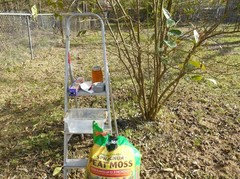
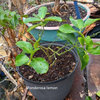
    Here are some supplies I used (willow twig tea in the jar). I read some people use mud for the packing to keep the branch wound wet. I used a commercial peat.

  • 12 years ago

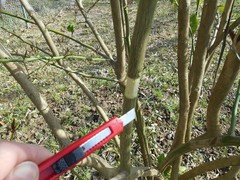
    This is a vertical branch I tried on a young lemon tree. I read that air layering works best in early spring, right when new leaves are beginning to bud out.

  • 12 years ago

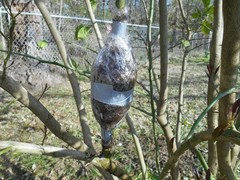
    The branch wrapped....the saran wrap holds in moisture and is clear so you can monitor for roots.

  • 12 years ago

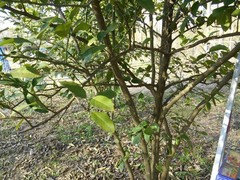
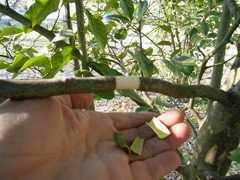
    Here is a lateral branch I tried. It has a flower bud so it will be interesting to see how long it takes to fruit if the air layering works. I doubt the bud will take this year but at least the wood is old enough to fruit.

  • 12 years ago

    The bark peeled nicely but the camera focus wasn't as nice!

  • 12 years ago

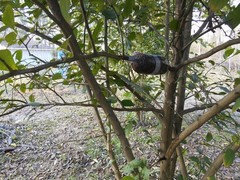
    Done wrapping the lateral branch. If I'm lucky enough to have done this right, I might get roots in 4-6 weeks. If I get roots, the next step will be to cut the limb below the rooted area and pot the branch and the peat ball around the new roots.

  • 12 years ago

    Picking a branch to air layer may work out better and with more roots developing when there are lots of leaves above the bark gap and lots of Sun hitting the leaves. Packing the peat tightly and densely inside a ridged structure that encases the branch may also be beneficial. A removable "lid" or cap can be opened after 6 weeks or so to see if roots have started and grown all the way to the top of the structure's peat contents. Pvc pipe that is slit along the sides, and capped on the ends with slit caps, can be duct-taped together after being placed around the branch. Branch-sized holes are drilled in the center of the 2 slip-on caps before slitting them. Cap on top can be removed after a few weeks to add more water if needed, and then taped back in place.Dried out peat is a no-no for roots.

  • 12 years ago

    coping, thanks for the input. My trees have lost quite a few leaves during the freezes this winter so this may not be a good year to try air layering. I actually thought having only a few leaves would be beneficial and help reduce water demands by the branch. I wondered how to add water and I like the PVC suggestions!

  • 12 years ago

    i am going to try air-layering too. just to practice and also to shorten the trunk on one of my seed-grown calamondins in a pot - the tree got too tall and i don't want to just prune it down. especially if i can get another little tree to play with.
    it's going to be indoors for another 4 weeks at least, but it already got it's 1st flush out. it's 6 yrs old but never bloomed yet.

  • 12 years ago

    Here is an update on the lemon branch layering project. I clipped one of the two branches and planted it about a month ago but it just barely had root buds and died. I waited another month for the second branch and here is what it looked like yesterday.

  • 12 years ago

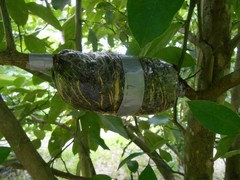
    I cut the branch off and removed the wrap. I wouldn't recommend duct tape that I used because it's difficult to remove without disturbing the root ball.

  • 12 years ago

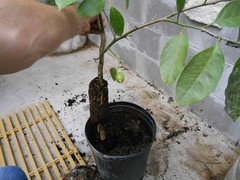
    The branch looks really nice potted but will probably shed a bunch of leaves until the roots catch up. It has several baby lemons so the wood is of bearing age. It will be interesting to see if it blooms next season...if it survives on its own. I will keep the potted branch in the shade of the tree it came from until the roots develop further.

    Bottom line, my technique worked, but, like JohnMerr said, it requires patience!

  • 12 years ago

    This works for figs and I have been told it works on anything

    {{gwi:570346}}
    Each container has a pot with dirt to the top. There is a hole in the side of the cup that the branch fits through. The fig branch roots in the dirt. No need to girdle the branch.

    Steve

  • 12 years ago

    Steve, you are right. I did a fig branch at the same time and it, being a fig, did really well. I posted a thread on the fig forum for it. I have already re-potted the fig to a more permanent location. The lemon took about a month longer to make a good root ball.

    In retrospect, I wish I had pruned off some of the lemon branch several days before cutting it from the tree. The roots might have been better matched to the leaf load. This was an experiment so I guess we will see what the more difficult route looks like.

  • 12 years ago

    i air-layered my little 7 yr old calamondin seedling too.
    i waited for the first flush to harden and kept it indoors in very sunny and warm place in hopes of speeding up the root development.
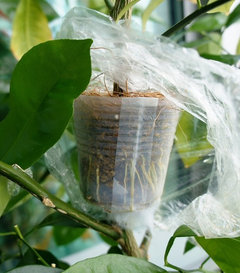
    i girdled the trunk and used a little plastic cup (side cut vertically and hole in the bottom) with synth wool in the bottom so it won't rub the trunk. sealed the whole thing with cling-wrap. now 5 weeks later i got pretty good roots.
    but i want MORE roots before i cut it off: it's the top of the plant, it's pretty big compared to the root-ball. i will rig a larger plastic cup with light soilless mix around the old cup and then just lift the old cup out and insert the plug into the larger one.
    when i cut it off in a month, i'll tent mine in the shade for awhile to help keep the leaves.
    interestingly enough the 2nd flush started on the bottom half of the tree, below the girdle. but very few tips on the top, just one or two.
    here's a pic of roots in a cup.

  • 12 years ago

    Air layered gold nugget Mandarin today have had it a year no growth at all.
    Company will not make tree good so what I got to lose.
    Trace

  • 12 years ago

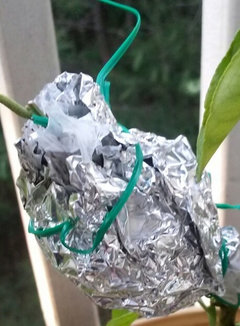
    Peat pod under plastic and foil cut back bark and put rooting compound on cute. So we will see in 4 weeks I guess.
    Trace

  • 12 years ago

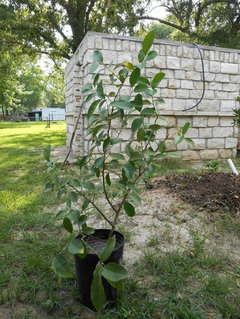
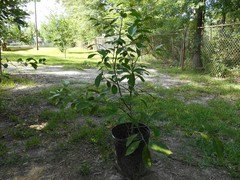
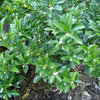
    Here is an update photo for the air layered lemon. This is about two weeks after potting. I have kept it in the shade and I don't think it's lost a leaf. Lately, I have been easing it out to get more sun.

  • 9 years ago

    Can someone please help?

    If we do air layering on a grafted tree (on one of the branches of scion portion) then the roots generated will be of the grafted (scion) variety or of the root stock variety?

    I am mostly sure that stem cutting propagation of the grafted citrus tree (cutting taken from scion portion) will result in the own roots of the scion type which will have shallow root system.

  • 9 years ago

    Any air layered branch will have roots of its own.

    6b Steve

  • 9 years ago

    Thanks poncirusguy!

  • 9 years ago

    Great thread John! I'm glad it was resurrected. I may try it this summer when my trees go outside.

  • 9 years ago

    Thanks Laura. I have a wayward limb on a tree now that needs to be pruned off. I may try air layering it rather than snipping it and tossing it over the fence. It's a great way to get a "free" tree but, as per the more recent comments here, the roots are native to the wood and might not be suitable for the local soil. The nice thing about air layering vs. planting seeds is that, if you layer a branch that is old enough to fruit, you can get fruit much quicker than planting a seed.

  • 9 years ago

    Hello all,


    If I air layer a branch from a dwarf myer lemon tree, would the result be a dwarf as well? When is the best time of the year to do air layering? I live in the south (Atlanta, GA). Can other trees be air layered as well? Peach? Apple? Persimmon?


    Many thanks

  • 9 years ago

    Any fruit tree can be air layered but the dwarfing will be lost. I don't know the size of meyer lemon but think you can keep it small with pruning. If you are planning to plant in ground you might be better off grafting the Meyer.

  • 9 years ago

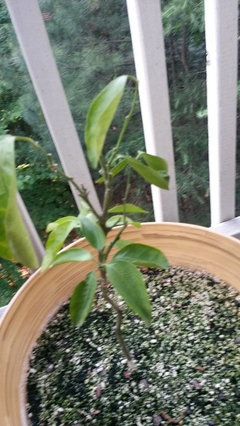
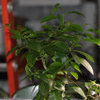
    Now should be a good time to air layer. This is a lemon branch I recently air layered, took roughly 3 weeks.

  • 8 years ago

    hello All,

    If airlyring is good and simple method then why professional plant seller ( plant nurseries) use grafting method ? Mostly the fruit plants we buy are grafted.

  • 8 years ago

    The overwhelming majority of citrus trees are sold for in ground planting for home owners Orchards get theirs whole sale for a bucket 2 per tree and buy them in 5000 tree crates. What we northerners buy is a fraction of a pitons to the total number bought by home owners.

    The sad facts about us northerner citrus'ers is there are less active citrus weber than I have bones in my hands. Many of the old timer and gone citrus web'ers have given up and gotten rid of their trees. Growing citrus up north is time consuming and difficult at best. It is a labor intensive and expensive hobby. We don't hear about the 10's of 1000's of trees sold to home owners to go in ground that must be on good rootstock for that area.

    Steve

  • 8 years ago

    I forgot to add it is much faster to bulk grow rootstock seedling and graft to them than to bag up an air layer branch. It take 1-2 minutes to graft a rootstock with a desired scion from cutting the scion twig, extracting each bud, slitting each rootstock, inserting the bud, taping the graft.

    Steve

  • 8 years ago

    The only advantage is that a rooted cutting can be bigger and stronger (= faster fruiting) then a grafted one. or am I wrong?

  • 8 years ago

    You are probably correct as long as you do your own cutting vs own grafting. The bud has to take and then start growing and the airlayered cutting is already of some size. Small shops that can't graft will be better with cuttings.

    Steve

  • 8 years ago

    Thank you all for your replies but my question is why nurseries prefer grafting than airlyring ?

  • 8 years ago

    if some have book about grafting, cutting, seedling or airlyring please send me at

    arain313@gmail.com. thank you

  • 8 years ago

    Shoaib - I think as a simple answer to your question - nurseries often opt for specific techniques to increase production of saleable product from limited quantities of scion stock, which also gives the benefit of being able to choose to use a variety of seedling rootstocks that are targeted to work well in different planting sites/conditions.

    So you can create many new trees to sell by grafting the buds from a single larger branch onto many rootstocks versus air-layering a single branch to create only one new tree. I.e., a typical sized 12" - 18" cutting might have 6 - 8 good buds (more or less) on it to "make" 6 - 8 new trees vs only getting 1 tree from the same-size rooted branch that was air-layered. Even if you air-layer multiple branches from a large tree to make several new trees, you are reducing your future stock from that tree many-fold due to eventual removal of those branches.