Software
Houzz Logo Print
bleudolphin

How long?

19 years ago

3 of my clematis' had yellowing leaves. After getting feedback from this site I determined that they were lacking nitrogen. I got some fertilizer high in nitrogen as well as phos and potassum. I fertilized them yesterday. Will lose leaves regain their color? How long till I notice a difference. I got some liquid and well as slow release. I was hoping by using the liquid it would work quick and the slow release would be able to maintain. Thanks for any help you can give me.

Comments (17)

  • 19 years ago

    At least a week if not two, most likely.

    FYI, If the leaves are turning brown and falling off after yellowing, the problem is not lack of Nitrogen.

    Nutrient deficiencies don't happen overnight and changes are usually gradual.

  • 19 years ago

    On 2 of them the leaves have just stated to turn yellow. The other one has quite a few yellow leaves. The leaves closest to the ground have turned brown, but the others are yellow with a little bit of green. I noticed that the leaves were yellowing about a 10 days ago. It was only on one of them. Now 3 out of the 11 have leaves that are yellowing. If it is not nitrogen deficiency then what could be causing them to turn yellow and what do I do to correct it? I planted them last year and I did not have this problem. I am very new to gardening.

  • 19 years ago

    This can be such a difficult problem to assess from a distance. One easy cause could be lack of iron, nitrogen or magnesium. Adding any of these over time could change them back, but a foliar spray (spraying tops and undersides of leaves) would be quicker.

    But it could also be something environmental - bad drainage and the plant is rotting? Compacted soil and the plant is suffocating? Finding a fertilizer that can be used as a foliar spray that contains the above elements in plant-ready form would be a good first shot.

  • 19 years ago

    There are many reasons for foliage to yellow and nutrient deficiencies of some sort are only one of them. I'd look to cultural causes first.

    We have all been brainwashed by advertising that fertilizing is the cure-all for most plant problems. It simply ain't true :-) Improper, too frequent or unnecessary fertilization creates more problems than it solves. If you have relatively decent soil with a good organic content or mulch with OM, supplemental fertilizing is not all that necessary. I'll go out on a limb here and include the reputed "heavy feeders" such as roses and clematis in this statement. With only container-grown plants as an exception, I don't fertilize other than to apply rabbit manure or other organic matter (compost) as a mulch. Fertilizing should be done only after a soil test indicates a need and formulated to specifically address that need. And a plant under stress for whatever reason - and that includes improper cultural conditions - should never be fertilized.

    Personally, I'd consider inadequate drainage/excessive moisture as the first item to be investigated.

    And unless it is a case of chlorosis on an evergreen plant, yellow leaves generally do not regain color, although new growth will emerge and hold green once the problem is corrected.

  • 19 years ago

    Not all my clematis' are in the same spot. They are planted all over my front yard. I can't believe that I have a drainage problem all over. We have had alot of rain lately but I live in Oregon so that is not unusual for this time of year. My clematis are not the only plants I have with yellowing leaves. My snapdragons, poppies, columbine also have yellowing leaves. I am not sure what is going on. This is the first time I have had this problem.

  • 19 years ago

    Quote= "If you have relatively decent soil with a good organic content or mulch with OM, supplemental fertilizing is not all that necessary. I'll go out on a limb here and include the reputed "heavy feeders" such as roses and clematis in this statement."

    I concur gardengal. I disagree that all the extraneous additional fertilization often touted in most clematis books is not required for clematis. Last year as test, I did not fertilize a single clematis except for the type IIs that I cut back, and to be quite honest, I couldn't tell a lick of difference in their growth or number of flowers. Also, I have seen some reference books on clematis saying that they are not such heavy feeders at all.

  • 19 years ago

    Thanks, Miguel! It's very satisfying to have some outside confirmation of my hypothesis :-) This is a concept that is pretty well accepted on some of the other forums that pertain to trees and shrubs, although there are still lots of fertilizer fan holdouts. If one has taken the time to prepare a organically rich, freely draining soil, it will supply all the nutrients plants need to survive and thrive with only the need to periodically replenish organic matter in the form of a mulch. Other than the methods I referred to above, I haven't fertilized my garden in years and it consistently produces healthy, robust and freely flowering plants. I sometimes wonder just what additional fertilizer might do to my garden, as it verges on a jungle-like quality now - the plantings would consume all the walkways and seating areas and you'd need a machete just to get through it!

    bluedolphin, if yellowing foliage is that widespread in your garden this early in the season, something is amiss. If you are sure drainage or overly saturated soils are not the cause and there hasn't been any chemical issues (neighbors out there with the spray pesticides), then I'd suggest you get a professional soil test done. Your local extension office will help you with that.

  • 19 years ago

    In your zone gardengal, I bet fertilization would turn your yard into a tropical rain forest.

  • 19 years ago

    I don't fertilize much either, except annual topdressing with compost and any potted annuals. I did topdress my newly planted Clems with manure early this year and do fertilize with Rose-Tone when I hard prune the Type 1's and 2's.

    I have hundreds of plants that have never had chemical fertilization.

    In a previous post, Iron or Magnesium Chlorosis was already ruled out. Now that we know leaves are browing and falling off, Nitrogen deficiency is ruled out.

    Bleudolphin, Have you used Weed N'Feed on your lawn???? Has your neighbor? 2-4D, the active ingredient, has a tendency to drift and can cause damage to neighboring plants.

    It is also possible these plants have been over fertilized, I believe I read in a previous post that they had been fertilized with a rose fertilizer and a liquid.

  • 19 years ago

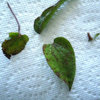
    Here is a link to what 3 of my clematis look like. The yellowing started about 2 weeks before I put fertilizer. I did put liquid fertilizer on on wed. and then mixed in slow release on Thur. The guy I talked to at homedept said that this would be fine. Should I consider digging them up and putting them in pots till I can figure out what is going on? Or would that cause more problems? I have a total of 11 planted around my front yard, 7 of them now have yellowing leaves to some degree. I did weed and feed my backyard about 3 weeks ago.

    Here is a link that might be useful: yellowing leaves pics

  • 19 years ago

    sounds a lot like it might have been the weed and feed reaching your clematis through water runoff.. i've only experienced the effects of weed killer on my daffies, which ended up stunted and with yellowing tips. i hate that stuff. it's so senseless. maybe hand-weed your lawn next time - or rather go organic, fertilizing your lawn with corn gluten can achieve the same thing except corn gluten doesn't overdeliver on nitrogen and it is a pre-emergent weed control rather than a weed-killer.

    if it is not your weed and feed, then the next thing i would consider would be checking for insect pests. when i've had spider mites on my clematis, it causes the brown stippling i see in the leaf edges of your picture IMG_0311 as well as the yellowing of infested leaves. you can detect mites but putting a piece of white paper underneath an infected leaf and shaking it - if you see black or red dots on the paper, then you have mites.

  • 19 years ago

    Spider mites aren't very common here on outdoor plants. It is too wet for them.

    Except for one photo that shows a couple of leaves that look a bit chlorotic doesn't look like any nutrient deficiency.

    I would NOT dig them up. That would just make it worse.

    Could be drift from the weed n'feed.

    Could be older leaves dying off naturally, making way for the new growth of which it looks like you have a lot of.

    Could be that they are annoyed with all the rain or got dry during one of the rare sunbreaks.

    Really doesn't look like that big of a deal to me.

  • 19 years ago

    OK, now we're getting somewhere! If there is any chance the weed 'n feed was applied close to (within 6 feet) of these plants, that could very well be the problem. Weed 'n feed is a terrible concoction - not good for the streams and groundwater, not good for pets or kids and if applied too close to ornamental plants, not good for them, either. The only distinction the "weed" part of weed 'n feed makes regarding what may be a weed is that it is not a moncot or grass-like plant - everything else is fair game. And it does readily leach and spread in the soil, so it can easily travel and contaminate neighboring plant roots. These types of products are very expensive compared to their efficiency also - you are distributing the herbicide over a very broad area rather than directly on the weed where neededm so you use twice as much. Far better to use just a standard lawn fertilizer (organic is always preferred) and use manual weed removal or spot weed as necessary. Better yet, reduce the amount of lawn and develop a tolerance for a few weeds - monocultures are not good for the environment any way you look at it.

    I agree with buyorsell - no big deal with the clems, they'll outgrow.

  • 19 years ago

    I went out and looked at mine and I have similar yellowing on a couple. Not worried about it. It is older leaves. I've got one with leaves that look like your picture 311 too.

    No weed n'feed products allowed at my house. I wish that carp was banned.

    I am sure what I've got going on is just normal leaf drop as the plants grow. I bet yours is too.

    If your backyard is higher elevation, fumes from the weed n'feed can drift a lot farther than you'd think or if it was windy but they will outgrow it. Nothing in your photos makes me think you should be worried.

  • 19 years ago

    Thanks for all the input. I guess there is no need to worry. If you all don't use weed n Feed what do you put on your lawns to keep the weeds down? My front lawn butts up against my neighbors and he lets his weeds grow wild. I would love to know some other options.

  • 19 years ago

    We spot treat with Round Up and my husband likes to burn them with a welding torch.

  • 19 years ago

    Create a planting buffer between your lawn and the neighbors (way better to have more room for plants and less lawn!). Spot treat or manually remove large perennial weeds like dandelions. Apply corn gluten meal in spring and fall - it is a natural pre-emergent herbicide that also provides a low nutrient source, so acts as a lawn fertilizer as well preventing annual weed seed germination. And encourage your lawn to become as healthy as possible. Avoid the chemicals, core aerate annually, overseed as necessary and mow often and high and water infrequently but deeply. A healthy lawn will successfully outcompete most weeds and learn to live with the few it won't.

    Lawns take work and a good healthy lawn is a high maintenance item. It is not nearly as simple as spreading a weed 'n feed product a few times a year despite what Scott's would like you to believe. That's why many gardeners are removing all or portions of their lawns in favor of lower maintenance and more environmentally friendly alternatives.

Sponsored