Software
Houzz Logo Print
redshirtcat

noid Lemon tree with some issues

15 years ago

Hello everyone. This lemon tree has been in the family for quite awhile. It is own-root and has been fruiting for man years now. It is the last citrus tree that has not been transferred into the gritty mix. The last very large tree I tried to repot into the gritty mix just barely made it out alive (I believe I took away too many fine roots in the process of bare-rooting - it has slowly been recovering and months later seems like it has made it).

Anyway - I do not know what type of lemon tree this is - it was purchased as a tiny seedling in an airport long ago. It is in what I am sure is terrible soil. I will probably repot it when the 42 lemons mature. In the meantime I am seeing some odd things that maybe someone can help with.

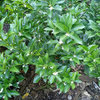
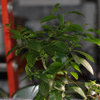
It is in its 2nd growth flush and the new growth has this copper kind of tone to it - I would say brown but it doesn't look dead at all:

{{gwi:598847}}

{{gwi:598849}}

In addition there are some more mature leaves with odd coloration. These *could* be from the first flush but I'm really not sure - some of them look older:

{{gwi:598851}}

{{gwi:598853}}

On the whole the tree does appear to be doing reasonably well. As I said above it is holding about 40 1" diameter lemons but I'm just worried about these colors as I haven't seen them on any of my other citrus at all...

Perhaps I should note that even though this is not in the gritty mix or the 5-1-1 but what I am sure is solid-core clay that doesn't drain well - I have been fertilizing it once a week with FP at 1 tsp per gallon. Might those colors be fertilizer burn of some kind? I have been flushing it relatively often insofar as I can.

Just to reiterate: I do intend to repot this in the future but I'm not really looking for an answer along the lines of "repot this immediately and your problems will be solved!" - I want to get this crop off the tree first and would like advice on how best to treat it in its current situation.

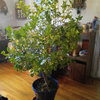
Here is a wide angle pic of the tree:

{{gwi:598855}}

Also how would you guys describe those leaves? Are the larger ones with the yellow "mottled?" "speckled?" - I ask because I have been trying to figure this out online and with books but haven't seen a great picture that looks like mine and am having trouble getting the right search terms to find advice I guess.

Thanks!

Comments (13)

  • 15 years ago

    For instance: I don't see any pictures that look like mine at this website:

    http://www.ipm.ucdavis.edu/PMG/C107/m107bpleaftwigdis.html

  • 15 years ago

    The new leaves on my lemon tree, much like my avocado tree, do initially have a reddish tint before greening up. I'm not an expert but I think that's normal.

    Someone who knows more than me could give you a definitive answer.

  • 15 years ago

    Lemon flush is usually purple-tinged. That is completely normal and in fact, one of the identifying features of lemons. The speckled looking leaves to me is an indication of spider mites. I would look very carefully underneath your leaves with a magnifying glass to see if you can identify spider mites underneath. They are actually pretty easy to treat, but you should treat right away, as they can do some significant damage to your new flush, as well as cause fruit drop.

    Patty S.

    Here is a link that might be useful: UC IPM: Spider Mites on Citrus

  • 15 years ago

    I will check again for mites today.

    I have several lemon trees - one that was purchased along with this one in the airport many years ago. It is getting it's 2nd flush now as well (in the gritty mix). None of the new leaves on that one are purple/copper/reddish. I also don't believe I've seen that color before on any of my lemon trees. If you say it is normal then I accept that since I've seen that written before on the web I just hadn't seen it before on any of my trees...

    Thanks

  • 15 years ago

    While I was out today I took a few more pictures of some suspect coloration on the same tree. They appear to be dead-ringers for magnesium deficiency (according to this website: http://members.fortunecity.com/pjsauber/Citrus%20deficiencies.htm ) - but I just want to verify with you all before I start adding epsom salt.

    It looks like it *could* be iron or zinc related as well - maybe you have some insight?

    {{gwi:598857}}

    {{gwi:598859}}

    {{gwi:598860}}

    Also here is a closeup of the undersides of leaves with the speckled yellow patter. It does indeed look like spider mites from the back side:

    {{gwi:598862}}

    Do you concur Patty? When I shook the leaf over a white piece of paper nothing fell off but maybe they have already moved on to another leaf or something.

    If it *is* spider mites what would you suggest for the best outdoor treatment? Indoors I use insect soap and water sprays and neem - is there anything available that is better for outdoors?

    Thanks.

  • 15 years ago

    I think the neem/soap mix is a great treatment for your citrus, too.
    I spray in the evening and rinse the following morning, and repeat every three days.

    Josh

  • 15 years ago

    Josh which soap do you use? I've been using "Safer" which is a potassium solids fatty acid soap - but the label says I should only use it 3 times a season?

    Can yours be used more often on edibles?

  • 15 years ago

    Neem and soap is great, and should take care of the mites (and will take care of knocking off aphids too, while you're at it). The yellowing could be magnesium deficiency, and it can be more pronounced after a cold, wet winter. I am actually dealing with this myself. So it wouldn't hurt to hit your citrus with a good citrus fertilizer with micronutrients and make sure you acidify the water a bit, to help the uptake of micronutrients if you're dealing with alkaline soil. You can also try a foliar spray using 1 to 2 Tbsp. of Epsom Salts dissolved in water and sprayed over the leaves. That will tell you pretty quickly if you're dealing with a Mg deficiency, as the younger affected leaves will green up pretty quickly.

    Patty S.

    Here is a link that might be useful: Mr Texas Place: Magesium Deficiency in Citrus

  • 15 years ago

    Patty nailed it! ;-)

    Redshirt, I'm pretty sure I used "Safer" brand....but I'll check later today.

    Josh

  • 15 years ago

    It's important to use a fertilizer with the miner elements (micronutrients) for citrus. Magnesium is one of the elements that can be deficient, especially in potting mixes which offer nothing in nutrition but what WE add.

    Also, the word that is often used to describe spider mite damage is "stippling". From what I can tell, that foliage looks 'stippled'. :-) An inexpensive magnifying lens will allow you to easily see the darned little things, though if you watch real closely you can see them move around.

    Be certain to direct your sprays to the underside of the leaves, where mites are found in the largest numbers.

    Read and follow the directions on whatever you decide to use. Don't make a solution stronger than directed, though you may be tempted. Using a bit vinegar in the water when using the insecticidal soap can be VERY helpful in making it work better.

  • 15 years ago

    Good adjective, I have always called it "speckling", better to use the official term! It is a very distinctive appearance - literally looks like the juice is being sucked out of the leaf. And, not sure if it has been mentioned, but be sure to spray in the very early morning, or better, in the later afternoon to prevent sunburn. And, don't spray if you know you're going to have some intense sunshine and heat.

    Patty S.

  • 15 years ago

    Thanks everyone. I have been using FP at 1 tsp per gallon once a week on this tree and also have Osmocote Plus in the pot (both contain minor and micronutrients).

    I will give it a few treatments with the Epsom salts and see what happens. I'm still not sure about the timing of the insect soap - the label says 3 treatments a year which I am already over so maybe I will just stick with neem for the mites.

    There is, however, a more ridiculous problem. The periodic cicadas are out and whenever I see any on any of my citrus I always shoo them away but I noticed this today:

    {{gwi:598864}}

    One got by me. She has cut slits in the branch and laid eggs inside. This is very upsetting. That branch will die within a few months and the eggs will hatch and nymphs will travel down the trunk and into the roots where they will feed on the roots.

    I'm not at all worried about this on any in-ground tree as they have roots to spare. But this is a large tree in a very small pot with no roots to spare.

    I'm considering using Bifenthrin on this tree now to hopefully kill the eggs and nymphs. It is not labeled for foliar application in the US (it is in Brazil with a PHI of 7 according to this document).

    I don't know what to do. Ideas?

    The thought of 500 nymphs sitting in that pot for 17 years eating roots (have you seen the size of full-sized cicadas?) is pissing me off. They will almost surely kill this tree that I've worked so hard to keep alive. Even if I have to sacrifice this crop of lemons (ie throw them away because of a chemical pesticide) I would rather that than lose the tree....

    anyone have any experience with container fruit trees and cicada damage?

  • 15 years ago

    Hmm. Sevin (Carbyl) is listed for Citrus and cicadas. Maybe I will use that instead.

Sponsored
The Creative Kitchen Company
Average rating: 5 out of 5 stars52 Reviews
Columbus Area Kitchen Remodeling and Refacing Professional