Software
Houzz Logo Print
laidbackdood

Leaves dropping one by one

16 years ago

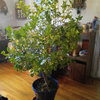
Hi,I bought a clementine mandarin which is a good size and then transplanted it into a terracotta pot....I have kept it evenly moist and have fed it slow release fert...thats all..

The mix drains well and i added pummice to the potting mix also....Since doing this there had been a steady lose of leaves from the bottom up...they curl and go yellow towards the tip and then drop....The tree has put out plenty of new flower buds but now all the leaves are starting to go pail...any idea whats going on there? was thinking of feeding it seaweed....I did the same process with an orange tree and that is flowering and going well...so i am at a loss?

Do you need to water a lot after transplant?I will try to take a pic..cheers

Comments (16)

  • 16 years ago
    last modified: 11 years ago

    How long have you had it in this pot since transplanting it..?
    Where does this pot reside now? Does your container have pumice and peatmoss? Have you checked for insects very closely?
    If there is absolutely no pest attacking it, then it is a root issue..
    How did you do the transplant process? Did you wash the old soil out? Did you bareroot it? Did you cut roots? Does the mix stay wet very long? How long?

    Mike

  • 16 years ago
    last modified: 11 years ago

    Sounds to me like it's rootbound; I always understood that leaves (of any potted plant) dropping off/turning yellow from the bottom up means it needs a bigger pot -----

    Or perhaps in the case of citrus, root-pruning.

    If it were mine, I would take it out of the pot, cut back the roots some, knock some soil off and put it back in (or better, in a larger pot if that's doable) with refreshed soil.

  • 16 years ago
    last modified: 11 years ago

    More information needed!

    Yellowing leaves is often caused by excess moisture/over-watering...

    Older leaves that turn yellow and gradually fall off the plant could indicate a nutrient deficiency.

    Or it could be some other cultural factor causing a disruption in the stream of nutrients,
    rather than an actual deficiency.


    Josh

  • 16 years ago
    last modified: 11 years ago

    Its not too small a pot...the root ball was not very big...Its not too wet as the pots stays evenly moist all the time...The tree had been in the pot for about two weeks before it started behaving like this...I think it might be transplant shock...Its in a 31 cm terracotta...I will try to take a pic tomorrow.
    No insects having a go...Gave it kelp today....see if that helps...Havent been over watering at all.Has been putting out buds since i transplanted it.cheers

  • 16 years ago
    last modified: 11 years ago

    How do you measure the moisture in the pot?

  • 16 years ago
    last modified: 11 years ago

    Moisture meter...down to the root zone...leave it ten mins to get reading...all my other trees seem to go well.Lift the pot up also.Cheers

  • 16 years ago
    last modified: 11 years ago
  • 16 years ago
    last modified: 11 years ago
  • 16 years ago
    last modified: 11 years ago

    The inexpensive moisture meters don't measure moisture - they measure EC (electrical conductivity) of the soil solution. If you insert the probe in a cup of distilled water, they read 'DRY'. Add a little fertilizer, and they read wet. A sharpened dowel is a better choice to measure moisture. Insert it deep into the soil & remove, if it's damp or cool when you touch it to the inside of your wrist, or comes out with moist soil particles stuck to it - no need to water.

    It looks like it might be a light issue. I talked a little in another thread about the flow of auxin being needed across the abscission zone to prevent an abscission layer from forming (to keep leaves from shedding). Simplified: if you move a tree from high light conditions to lower light conditions, it changes (diminishes) the flow of a growth hormone/regulator (auxin), the end result being the tree will often shed foliage, primarily from low on the tree or the interior of the canopy - areas receiving the least light.

    Al

  • 16 years ago
    last modified: 11 years ago

    Hi Al....Thats interesting....The tree is north facing(which is the equivalent of south facing over my neck of the woods)But the trees further down do receive more light....However,I have one that doesnt get much light at all and is growing really well...I will try the dowling stick for sure and move that tree so it gets more sunlight on it then.
    Should i conitinue to feed it with seaweed? foliar spray too? Thanks

  • 16 years ago
    last modified: 11 years ago

    Just out of curiosity, how are the leaves separating from the tree? Citrus leaves are attached via a short stem (the petiole). The leaf can separate either at the base of the petiole, where it joins the tree, or at the junction between the petiole and the leaf. In the latter case, the petiole may remain attached to the tree for a week or more before it falls off separately.

    Do you happen to know where the separation point is on your tree?

  • 16 years ago
    last modified: 11 years ago

    LBD asks: "Should I continue to feed it with seaweed? foliar spray too?"

    Two questions that seem to beg yes/no answers, but in any case need qualifying.

    I look at nutrition methodically. I prefer to use the least number of nutrient mixtures that will ensure my plants are getting all the essential nutrients they normally take from the soil. The reason is, supplying more of any one element than a plant can use can be as limiting as supplying too little. 'How did he get THERE?' you might ask. Seaweed emulsion usually lists K as a nutrient, and not much else, even though we know it contains other trace elements. So - you use it ..... then what? Obviously, it is going to be entirely inadequate in supplying the major elements, N P K Ca Mg S. So what do you do .... you fertilize. Since you have no idea what you supplied with the fish emulsion, you still need to be sure all the bases are covered. You maybe reach for the Miracle-Gro to supply the needed NPK. So you fertilize - then what? Did you cover the plant's need for Ca and Mg? No. So now what? You still haven't covered all the bases.

    The point is, if you're using fertilizers that only cover a few of the elements required for growth, additional fertilizers are required to fill in the gaps, Almost always, there will be overlaps, where you are supplying the same element in both products, or the same element will be missing from both products - gaps. Why not choose a fertilizer that supplies ALL the elements required for normal growth, and in a ratio to each other that is favorable, thereby eliminating gaps, overlaps, and potential antagonisms? [Antagonistic deficiencies occur when an excess of one element in the soil solution prevents adequate uptake of 1 or more other elements. Common antagonisms exist between Fe/Mn, P/Fe and Mn, Ca/Mg, others.]

    I'm not saying the seaweed emulsion is harmful, only that if you're employing a fertilizer like Foliage-Pro 9-3-6, it's probably redundant. This question in another form often comes up when discussing the use of aquarium water as a nutrient source. We know the aquarium water is not a complete fertilizer, and since you have no idea what you DID supply when you used it, you will certainly need to fertilize anyway - thus making the aquarium water of little or no value.

    ******

    From the perspective of getting nutrients from outside the plant, inside the plant, foliar feeding is generally extremely inefficient. In those plants that benefit from foliar feeding, fertilizers in ionic form are far more effective than various emulsions/suspensions at providing supplemental nutrition, but roots are still, by far, the more efficient and reliable pathway. If your plants actually NEED foliar feeding - by default, there is something wrong with your basic nutritional supplementation program and your efforts are best concentrated there.

    Foliar feeding is usually only used effectively to supply a few elements in ionic form (mainly N,Fe,Cu,Mn,Z), and only when plants that are able to provide a foliar pathway into the plant are growing so rapidly the nutrient stream cannot supply certain nutrients fast enough.

    Remember - over-supplying a nutrient the plant doesn't need can be as bad as, or worse than a deficiency. If you have a genuine deficiency, it's better by far to address it via the most efficient pathway - the root system. You can't make plants grow at beyond their genetic limitations, no matter what you do, and supplying more of this or that than plants need is counter-productive. Trying to ensure the 12 elements you have control over are available in the soil and in the right ratio is about the best you can do.

    Al

  • 16 years ago
    last modified: 11 years ago

    Nice one AL....will use a complete fert then....starting using a wooden chopstick to measure moisture levels and works pretty good....
    Displacer=The the leaf starts to go yellow at the end of the tip...curls and then the whole thing falls off with the petiole(spelt wrong) still attached...>I have over watered trees in the past and the leaf falls off leaving the petilole behind...so its different.
    I think Al is probably right with the light but i am still suspicious of shock or loss of root hairs when i transplated it...I heard seaweed was good after transplanting...especially for the roots and to help get over transplant shock...Thats why i fed it that....I have since noticed the buds have started growing some...There was no growth while the leaves were going funny.Only time will tell i suppose.

  • 16 years ago
    last modified: 11 years ago

    If you are getting bud break, then I would treat it like a normal plant. The base of the petiole is the normal spot for citrus leaves to break away from the tree. The junction between the leaf and petiole is the abnormal place, the place where it breaks off when the tree is stressed, and when you see that it is time to worry.

    Drop of older leaves (and the occasional younger leaf) is normal during the spring. Since it is spring, give it fertilizer the way you would a normal plant in the spring and let it grow. It may be that the tree was stressed in the past, lost all its leaves at once, and then re-grew the whole batch. Now the whole batch is getting elderly and dropping at once - the normal working life of a citrus leaf is 1 to 2 years, after which it is shed by the plant.

    Do watch out for overwatering, though. A plant without many leaves doesn't require much water, so be mindful that you don't drown it on accident.

  • 16 years ago
    last modified: 11 years ago

    laidbackdood...I posted a direct link to your pictures. Just click below. Love the blossoms!

    Here is a link that might be useful: laidbackdood's Pictures

  • 16 years ago
    last modified: 11 years ago

    Thanks for everyones help....I am also a little suspicious of fert build up.....I have tended to over do it in the past...so i will ensure i flush it in between feeds to prevent build up.