Software
Houzz Logo Print
token28001

Rooting outdoors.

16 years ago
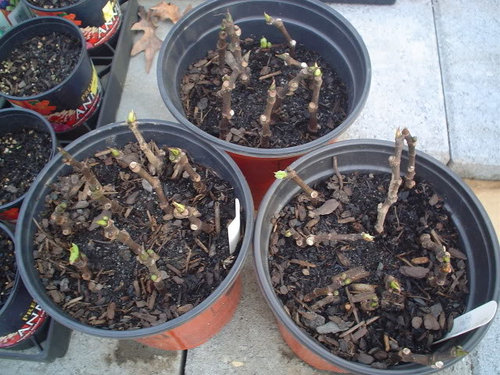
In early January, a friend gave me cuttings of a Black Mission. I stuck a few in the fridge and put the tips in soil in the hoophouse (a large coldframe outside made of pvc pipe and plastic). They're now showing new growth and the couple I've pulled out have tiny roots. No bags. No containers. Just freezing temperatures, sunlight, soil, and water.

I'll be potting these up in another couple of weeks.

Comments (14)

  • 16 years ago

    FWIW: A commercial nursery in my area just uses 'tall skinny pots' for rooting figs. The pots are paper thin, black plastic, and about the size of 2 liter soda bottle with the top cut off.

    The root stock is just a ~3' long branch trimed of side branches and the tip cut off so it will develop a trunk and a crown. They stake the cutting and use garden ties about every 4" to make sure the trunk is straight.

    I can guess why they do it this way. In a single season they can get a hard wood tree that sells at a premium. Cutting to tree with minimum labor. They can take some fallout since the only thing they lose is a branch and some plastic tie. At least one retail nursury just repots them in 5 gal containers and raises the price $30 per. They have a huge yard they do this in, almost looks like a converted airport.

    Bit of off topic but when I trimmed my peach trees last year I stuck one of the cuttings in a pot I was growing a tomato. This was a spring pruning of a rogue branch. The condition of the tomato helped me judge moisture levels so I keep it wet during the entire summer and rain took care of it in the winter. The cutting rooted and is in bloom right now => cutting to peaches in one year.

    I have two apple cuttings and a plum that I just stuck in the ground after my normal winter pruning that have taken off this spring.

    Soap box attack warning! hehe

    You've probably seen some of the science of altruism/cooperation. The movie 'A Beautiful Mind' and this forem are good examples of it in action. It's obvious that the rise of civilization that came with agriculture wasn't all about hitting someone else over the head with a club and stealing their crops. While surely the shady side, sneaking into someone's orchard and stealing cuttings, has gone on too the tradition of exchanging cuttings has probably gone on for 10,000 years. Kind of organic to do it on the low tech level.

    But then maybe I just read to much into sticking a couple of fig cuttings in pots and having them root.

    Rick

  • 16 years ago

    I love this method! Last December I bought some cuttings from a guy that sells on Ebay - his Ebay ratings were good and he claimed to have what I wanted. Then, 2 months later, I ran across a posting on this forum warning of this guy. So, here I am with 40 cuttings of who knows what. I am trying to build my own fig collection and I thought that it would be fun to sell some trees at the farmers market. With limited time and resources I have been wondering what to do with these cuttings. I will try this method - nothing to lose and better than throwing them away!( I have also purchased very nice cuttings from highly regarded forum members so I will still have some nice figs!)
    Thanks.
    Susan

  • 16 years ago

    Hi Susan, don't feel alone. This "eBayer" screwed over a bunch of us before we knew better. On the bright side, I'm growing them anyway, for now. They may turn out to be delicious figs even though they are unknown. A name doesn't make them taste better! Tim

  • 16 years ago

    After talking to two of the larger fruit nurseries north of Atlanta, the method Rick and token are talking about seems to be a common mass-production commercial nursery method around here. You don't get 100% success rate, but it requires the least possible effort and maintenance, and still produces a high strike rate on a large scale. If I remember correctly, both said they used "propagation sand", and one was putting cuttings in pre-cut PVC tubes burying it in sand.

    I like this 'rooting outdoors' method. I took a big wishbone-shaped stick from a very weird local unknown and stuck it in the ground back in December. We've seen snow, sleet and all kinds of other things.... just started warming up, and it's getting ready to crack buds. I really expected the snow would've killed it.

    Since starting on fig propagation, which is easier than anything else I've propagated, I've had a couple others tell me about this 'bury in sand' and leave outdoors method. Small-scale, I still prefer working with chunky perlite mixed with enough potting mix to dust the rocks with brownish color, along with a few 'pine fines'. ~99% success rate, but man.... lots of effort.

  • 16 years ago

    Last year I tried unsuccessfully to root indoors. All of my cuttings whithered and died within weeks of putting out nice roots. I think it was perched soil. So this year, I decided to test these outside since they were left overs from a large haul of Black Mission cuttings. I also have the one from last year putting out new growth. I don't winter protect mine in the ground. I just leave it be and pruned it back a couple weeks ago. I want a large, sprawling shrub rather than a tree. I have three nice stems right now. I'll do the same with these next year.

  • 16 years ago

    token,

    Like you I grow my Black Mission in a bush form rather than as a single trunk tree. Black Mission is tender in my area and growing in a bush form gives me better assurance my tree won't get completely winter killed. Besides, I don't want to use a ladder to harvest my figs.

    Dan

  • 16 years ago

    Black mission is supposed to be hardy to about 12*, right? We might get down that low once in a while. This year was exceptional and we saw several nights around that temperature with days never going above freezing. Again, that's rare. I did have some dieback on the tips of each branch. I cut off about 18" worth leaving nearly 2' of budding branches. I hope they all grow new branches this year and not just leaves. I'd love to get a breba crop too, but I'm expecting a late frost.

  • 16 years ago

    I've buried cuttings in the vegetable garden each of the past couple years and had great success rooting during the late spring-early summer period as well as late summer periods.

    I do have drip and sprayers on timers in my garden, which might improve my changes.

    ~Chills

    Makes me wonder why I struggle so to get cuttings to root in the DRY cool winter?

  • 16 years ago

    I did the same thing this season though I used one and two liter bottles with one or two cuttings per bottle. Three out of twenty three died.

  • 16 years ago

    @Chills, I like rooting in the cold, dry winter because there's like...little to no gardening I can be doing. ;)

  • 16 years ago

    You guys are talking about the original rooting method that has been in existence for thousand of years. No surprise there.
    Then some crazies (like us) decided to grow figs in zone 6 or 5 or even zone 4 with cool short summer that needed head-start with rooting and so came along the baggie and similar other technique to root during the dry winter season. No surprise here either.

  • 16 years ago

    ottawan, I'm starting to think that for me, in my warm zone 7b garden, rooting outdoors is the way to go. I've been sticking all sorts of cuttings in the ground the past week or more. Mostly shrubs and tree prunings, I'm hoping a few of them take. If not, I'm out a couple hours time. It was 70 degrees when I was doing it, so I won't complain. :)

  • 16 years ago

    token28001
    Yes, why not if possible. Compare to our Zone 5a and 4, your Zone 7b is like a gardening heaven.

  • 16 years ago

    Nothing wrong with using propagation methods that our ancestors used........they were no fools and knew how to get the job done. Long ago they understood and developed practices to handle the fertilization of their fig trees that needed the fig wasps in order to produce fruit. They were in touch with nature. Given all of the technology that is around us today, would we be able to use the COMMON SENSE approach to solving problems like they did? The older I get the more I admire the accomplishments of our ancestors given the limited resources that they had.

    Dan

Sponsored