Software
Houzz Logo Print
quebec_lab_border

soil depth for perennials

20 years ago

Hi again: I have another question for anyone willing to help. Living in zone 3; what would be the required depth of soil for certain perennials? Examples: black eye susan, holly hocks, cone flowers, lupins ect. Presently my flower beds are only about 6 to 8 inches deep.

Ricky

Comments (9)

  • 20 years ago

    Are you asking because you are mostly gardening on top of rock there? If so, I haven't experienced that, but I think your plants will probably find their way... plants have an incredibly strong "life wish" and are danged hard to kill!

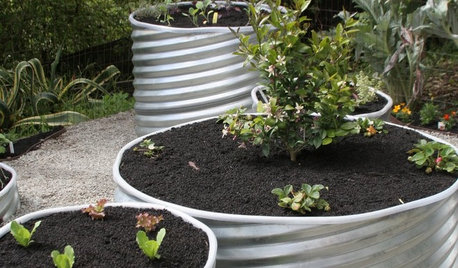
    On the other hand, if possible, I'd probably prefer my own beds to be deeper than that. We created beds here on top of wretched clay just by piling compost up 8"-10" overtop - it is not necessary to actually build sides of lumber or railroad ties in order to make raised beds. Could you just add more soil on top of your existing beds? It works just fine, really.

  • 20 years ago

    "We created beds here on top of wretched clay just by piling up compost 8"-10" overtop- it is not necessary to actually build sides of lumber or railroad ties in order to make raised beds"

    That was just what I needed to hear! Thanks! I don't have the bucks to get that sort of stuff and being somewhat pregnant I don't feel inclined to set it up myself either. (My darling husband is just not that way inclined-the handyman type that is. sigh)

    I will just keep dumping stuff on top. Maybe put a rock edge around it, boulder by boulder.

  • 20 years ago

    Yes, the reason I was asking is because under the soil I put in the beds is a clay that is more like potter`s clay. Last year I planted some holly hocks and lupins; both grew beautifully last summer but died over winter. They were well covered with a 4 foot snow cover. I was thinking that the depth of the bed was too low. Again, are there some plants that will only need 12"of soil and others that require more?

  • 20 years ago

    quebec_lab_border could it be that because of the clay underneath that the soil stayed too wet and the plants root systems rotted?
    Thats what I am worried about here this spring. After such a wet summer last year (my yard never did dry out, the water literally just sat on top of the clay) I am obsessively watching to see what might come back. I am pretty sure I lost a bunch of clematis for . When I made my bed, I scraped off the top layer of grass and all I found was about 2" of soil with the grass roots in it, then a layer of sand (someone's idea of amending or loosening the soil) then clay...all the way to China it seems.

    We..(when I say we, I mean me but hubby helped because there was heavy lifting involved..LOL) were making holes for vine poles with a power auger so what I did was dig a few areas with the auger to a depth of about 18-24" (we had the thing so I figured I might as well use it) beside where the poles were going so I could plant the clems in them (and a rose bush too). I then piled about 18" of soil on top (I got a 10cu yd truck load dumped in my driveway last spring). I planted the clems in the holes beside the poles and quite a few of them took off early on, but as the rainy summer wore on...they seemed to stop. I think the holes just filled up with water and they may have been drowned. Anyway...thats my story about the dreaded clay. Its so bad here that you could never amend it by hand...you would have to use some sort of machine (I don't think even a rototiller would be strong enough) to loosen it up and mix compost, sand and peat in...and I for sure didn't have that much time or money to spend. I figured that by putting the soil on top and making a nice home for the worms that may be they'll do the work down there for me!

  • 20 years ago

    Well, I have to ask... are you a beginner gardener, or have you been at it for some time, there or in different places? Not meaning any insult here but just looking at this realistically...

    Okay, exploring the former possibility first... What I'm getting at is that sometimes plants die for no obvious reason, or none that seems apparent at the time, and sometimes the best advice is just to get some more hollyhocks and lupins and try them again. There are many possible explanations - hollyhocks are generally biennials, and perhaps yours were second-year plants? And some lupin species are annuals. Aside from that, people seem to have trouble getting lupins established, for reasons that are a mystery to me (pH may be part of it but chances are your soil is acidic there, which is suposedly what they favor; on the other hand, it's alkaline here but they do fine too). Without actually being there to experience gardening in your conditions, your bed sounds fine to me from your description (yes, plant roots will penetrate into clay, though it is certainly not pleasant to garden in), so I'd say just try those species again. Be sure to get first year hollyhocks, or let them seed, and watch for seedlings in spring, and be sure to select perennial lupin species...other than that, keep trying,

    Okay, exploring the second possibility.... assuming that you are an experienced gardener and have been gardening in that area for some time, and that this is the only "problem" bed in your yard, and that various perennials perform well in all the other beds in your yard... then I would start to wonder if there was something unsuitable about that particular bed... but is that bed any different than the substrate through the rest of your yard (i.e. does the clay only come to surface there?? Seems very unlikely...) So, I guess we'd need more info on your specifics to judge, long-distance, whether "something is wrong" with your bed... which seems unlikely.

  • 20 years ago

    Lori's got some good points there. Hollyhocks have a taproot like a jackhammer, they should get down into the clay.

    It's not unusual for soils to vary just a few feet away. In my garden, there is an area that is such bad clay when I try to amend it, it just eats it up, burps and goes back to being clay. I found out that there used to be a dry stream bed that ran through that part of the garden before the city built up. I just try to avoid it and planted some non-picky daylilies there and mulched around them with cedar chips so I don't have to work the soil.

    There's another possibility, that your perennials just haven't come up yet. My lupines and hollyhocks didn't show up until a couple of weeks ago, and the weather has been very warm here. There are still slower plants showing up daily, such as peonies, bee balm, pulmonaria, etc. If you wait awhile they might still turn up for you. :0)

    BTW hollyhocks are long-term perennials for me. I actually don't like them much and try to weed them out but they keep coming back.

    Another plant with deep roots that might do well for you is sunflowers. They will root through clay and into subsoils. A friend of mine who is a soil scientist told me that sunflower have been shown to root twenty-five feet down through hardpan and into gravelly subsoils. They also extract a lot of phosphorous from deep soils which makes them a useful crop for fields that have been incorrectly fertilized.

  • 20 years ago

    Gillian, re. your comment about clay "eating up" organic matter...

    You are absolutely right. That's why I tell people around here not to bother amending clay, but to simply pile compost on top of it... (though honestly, I think no one takes the advice because, first, it doesn't fit their preconceived notions... and, second, even our method, though much easier than attempting to amend, is still TOO MUCH WORK for them, LOL! And, thirdly, people don't realize how much organic matter has to be added to clay to make even the tiniest bit of difference. Yet, they always think adding a bag or two of manure to a 20'x50' garden plot will change the world...sheesh.)

    As you've indicated, it takes years of concerted effort and vast amounts of organic material to really improve clay by amending... but you can have "chocolate cake" soil in a few hours if you create a raised bed by dumping 10" compost on top. (Kill or dig out the grass or perennial weeds, first.) the, you can plant in it with your bare hands. Add a layer of mulch over top, plant it up, and then just keep adding to it over the years (as the organic matter gets worked in and eaten up by earthworms, fungi, and other soil critters) and eventually, slowly, even the substrate improves. Okay, end of rant.

    Yes, another good observation, too - maybe the plants in question just aren't up yet in that neck of the woods...

    As that 4 feet of snow melts, the water doesn't stand in that spot, does it?

  • 20 years ago

    Hi Everyone:
    Yes abgardeneer I am a new gardener. No insult taken. I truly appreciate the advice from all of you. Maybe the perennials will return. Hopefully! By the way my hollyhocks are only from last year, so is everything else since I am a new gardener. Sometimes I wish I could have one of you "life longers" sit down beside me for an whole days so I could drain all the information out of you all at one time. Any one planning to vacation in southern Labrador this summer? Oh yes, we have a lot of black flies around here in the summer. Do you have any ideas of how to repel them? LOL!!

    Ricky

  • 20 years ago

    Rancid bear grease applied topically to the skin is what the aboriginals used :0) Dunno if it works, I've never let my bear grease go bad. LOL

    I really hope it works out better than you thought. And I know it would be really hard for you to get a lot of compost since you are so remote, but if you started a little household compost it couldn't hurt.

Sponsored
Peabody Landscape Group
Average rating: 3.5 out of 5 stars8 Reviews
Columbus' Reliable Landscape Design & Contracting