Software
Houzz Logo Print
bjs496

Propagation by Root Cuttings

18 years ago
Hi All,

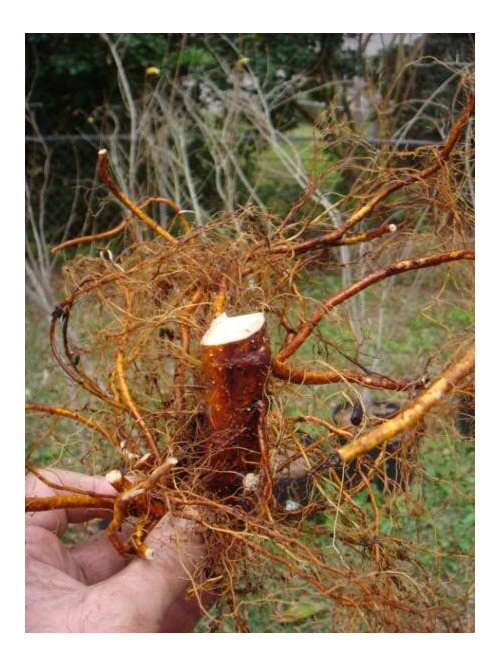
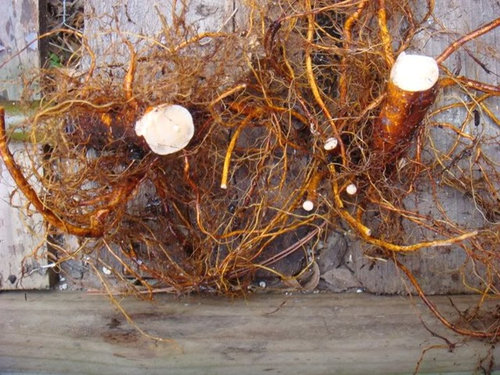
As I repotted a Green Ischia tree on 01.15, I realized I needed to cut about 3 inches off the very bottom of the roots. I ended up with a piece like this:

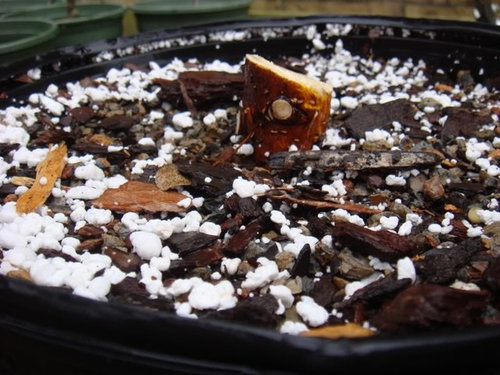
I pruned the long roots and potted it up.

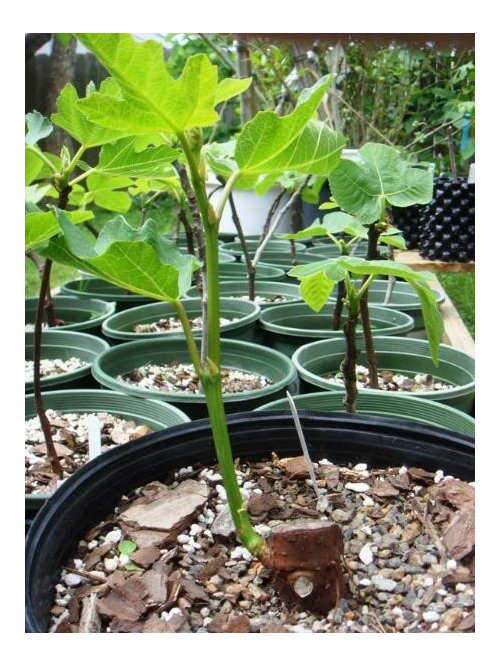
I checked on it today (03.27) to see if it had grown. This is what I found:

For those who have asked about propagating from roots, it can be done. I'll try playing around with this type of propagation more next year to learn some of the ins and outs of it.

~james

Comments (21)

  • 18 years ago

    Keep up the GREAT work James,

    You have for sure got a green thumb.

    Cecil

  • 18 years ago

    James,

    Is it really a root? If so great news!

    Is it possible that it may be part of the original
    rooted woody twig (with dormant buds)?

    George (NJ).

  • 18 years ago

    Hi, James. In bonsai, large roots with interesting 'movement' are often used to create bonsai trunks quickly. We simply pot the root just as you did, with the interesting part exposed (the norm is to expose much than you did, but the intended goal is different, too) and start developing the top of the tree when shoots form. Success is always near 100% because the root cutting is already established (has lots of viable roots). We simply wait for root tissues in the vascular cambium to dedifferentiate then redifferentiate into branch/foliage buds. Early spring, before leaf-out is the best time. Strong work! Good job. ;o)


    Al

  • 18 years ago

    James, Good thinking! I wouldn't have thought to try it. But in hindsight, figs that die back send up suckers - from the roots - makes perfect sense, LOL. Be interesting to see what gives the best results.

  • 18 years ago

    Hint:
    Think of (maybe winter killed) fig tree suckers
    and/or any other fig seedling.

  • 18 years ago

    The trunk on this tree is 1 1/8" in diameter, the portion I took would be considered part of the original cutting. So it is very much like a sucker growing from the tree (I just gave it some incentive). I had to cut the piece off to be able to repot the parent tree. So I saw it as a freebee.

    I have a tree that I know to have "true roots" as thick as this piece. I am planning on excavating a few of the roots, after the tree finishes fruiting, to see if I can recreate these results. I don't know how thickness effects the results, so I'll play around with a few different sizes.

    Cecil, to say I have a green thumb is an overstatement. My trees usually seem to fair better when I am not around than when I am. I guess I am curious to see how far I can push things and not kill the trees. I was worried about cutting the callous off of the parent tree, but it came out of dormancy as well.

    ~james

  • 18 years ago

    Would a tree that is a product of root propagation be considered coming from a basal source and thus take a lot longer to fruit (as compared to a rooted cutting from a branch end)?

    -Steve

  • 18 years ago

    There you go James!

    >>> the portion I took would be considered part
    >>> of the original cutting.

    Pardon me, but my 'questioning' was for the following reasons
    (mostly I still wish that I am wrong):

    I was one of those who had asked the original question
    whether figs (F.c) can be propagated (easily) from roots.

    I tried a couple of real roots (~1/4" thick), no success.
    May try more this year after I 'till' up the soil where
    my 'bucket-potted' figs were last year.

    Bought an RKN infested sample. Cut the root mass off for
    disposal, on second thought I said, I maybe can save
    the 3" 'main root' extending from the main branch (aka)
    part of the original woody twig (no longer looked as such).
    It grew like a weed, as compared with other salvaged
    regular cuttings from up branches. Shaved all roots as
    smooth as my morning's face shave! As whether RKN
    is gone, I will find out this spring upon inspection...

    Mature fig trees only sucker from the immediate base
    (as far as I know). Other species may sucker far far away,
    and can be reproduced easily.

    Your picture shows the root diameter ~same as the main
    branch, meaning that there is no way it being a tap root
    unless it was a fig 'seedling'. In that case, you would
    not have dared call it (used name) Green Ischia.

    Regards,
    George.

  • 18 years ago

    Very cool James. I have a piece of root that looked a lot like yours but a bit smaller (1" diameter). A friend sent it to me. I potted it up about a month ago. Yesterday I noticed a green bud peeking out of the soil. I'll try to take some pictures of it this weekend.

    Henry

  • 18 years ago

    Had 2 friends, they tried to kill a fig tree via cutting and digging out the root ball. Well, to their amazement it came back & one of them is coming to my place in about 2 weeks.

  • 18 years ago

    George,

    This is an 'Alma' tree in my neighborhood:

    Some of the suckers were over a foot away from the base of the tree. They were growing out of the tops of the thicker roots. This gives me some hope it can be done.

    You are probably right (I hope you are not, as well) that it is difficult to grow from roots. Given the ease of rooting cuttings it may not be worth the effort to pursue this type of propagation. But then again, this is the kind of stuff that I think is fun to play with between repotting and ripe fruit.

    Steve, I don't know if this will fruit any faster than a rooted cutting or an air-layered limb. I potted this one on 01.15 and it leafed out at the same time as my other trees (including the parent treee). Based on private emails from Henry, it seems his is breaking dormancy very shortly after the rest of his trees.

    ~james

  • 18 years ago

    Good grief James!
    How on earth did you ever find such a fig bush?
    Tons of suckers and more tons of what at first
    seem as seedlings, but probably not, i.e more
    (close) suckers!

    Yes, we should experiment some more with fig root-rooting
    (aka) leafing!?... maybe we will kiss 'mold' good-bye.

    Pl note that Alma is not a true F.carica fig, but a
    hybrid of F.c x F.palmata. It may behave different,
    such as its famous resistance/immunity to FMV property.

    George.

  • 18 years ago

    Everything is bigger in Texas! There are several fig trees this size in my neighborhood. One is a single trunk about 35-40 feet tall with its first branch about 10-12 feet off the ground

    {{gwi:53495}}

    For reference, the fence is just over six feet tall.

    Were the roots you experimented with branched?

    ~james

  • 18 years ago

    George,

    "Pl note that Alma is not a true F.carica fig, but a
    hybrid of F.c x F.palmata"

    I think I remember reading this at one time, but I had totally forgotten it. I was actually thinking about starting a new thread about Alma regarding what follows below. Could Alma's parentage have something to do with how "weedy" it is? I have a 5 yr. old Alma, and last year was the first time I thinned out the new growth. Previously I had pruned it then just let it do its thing. However, what I got was too much new growth and not enough figs. Last year when I thinned out the new growth I got a lot more figs. Is this something everyone else already knew about Alma and I just figured it out? :)

    Do you other Alma growers out there thin out a lot of new growth from your trees each year?

    Henry

    P.S. I took a picture of my root cutting similar to James' that has pushed up new growth. I'll post it later today.

  • 18 years ago

    Darn it James, you should have posted this a month ago! I root pruned some of my RARE portugese figs and had thrown away roots as thick as carrots! ARRRRR. ITS LIKE THROWING AWAY GOLD BARS!! Now I feel guilt... Like abandoning a close friend.

    At least I know for next time :)..

  • 18 years ago

    Here are a couple of pictures of a 1" diameter root cutting (about 2 1/2" long) from an Italian fig called Succhetta. Before I potted it up about 3-4 weeks ago the root cutting looked a lot like James' but with somewhat fewer smaller roots growing from it. I have a second one (potted at the same time) that hasn't yet pushed out leaves.

    Henry

  • 18 years ago

    James,
    >Were the roots you experimented with branched?
    By 'branched', I take it 'branched' from the main
    trunk, (aka) 'true' f.c roots. Yes (no success).

    Anybody who practices the famous pot/bucket
    summer-dirt/cut-roots(for)/winter-in-garage method
    see any suckers coming up the severed roots
    the following year?

    George (NJ).

  • 18 years ago

    Gorgi, I have a Celeste which now has a twin about 18 inches from the main tree. I use lots of mulch and this Winter some of the mulch washed away and exposed the root on which this twin tree grew. So, this tree, which began as a sucker, did NOT grow from the base of the original tree. I must quickly add that this is the only instance of this in my little orchard of 22 trees. But, its occurance should encourage us to experiment more with root cuttings.

  • 18 years ago

    Henry,

    Yes, I do think that F.c x F.p may be (somewhat) weedy!
    Maybe just the plain F.palmata is?!

    Have another similar hybrid (DFIC 0023), VERY vigorous,
    no suckers yet, big leaves (typically, min lobes), drops
    fruit, a one more season chance to my 'death-row' list.

    My Alma came as somewhat mature from ingroud via Herman,
    as a reject, mostly for lack of produce. I potted it in
    a 16" big pot. First year, it only produced 2 figs. Next
    year (2007) it gave me ~50 quarter (USD coin) sized
    roundish non/splitting with a honey drop on the eye,
    and very sweet tasting figs. A keeper for me!
    So far no big significant amount of suckers and not
    particularly vigorous.

    Herman figured that the 'potting-up' may be the trick
    (at least here in the NE) for Alma. After some convincing,
    I sent him a rooted portion for a (potted) re-trial.

    Henry, this seems consistent with your trimming method,
    helping your Alma to fruit (more).

    George (NJ).

  • 18 years ago

    Thanks George.

    I actually have several Alma trees in large pots that are in early stages of leafing out. I'm going to take some pictures of them and post here in the next few days. I want to show the amount of new growth they are pushing out (and I mean the number of potential new branches). It's very imbalanced compared to other trees of similar size, age and "potting history".

    Henry

  • 18 years ago

    I see the search function in Gardenweb isn't working again today...

    I have been at it again. While repotting a Black Jack in NJ on 04.12.08, I removed this piece of root. This is not from the original cutting, rather it is the end of one of the primary root branches.

    It sat in a ziploc back wrapped in the paper towel for eight days. I think it started forming new root initials during that time... if not, perhaps someone knows what these are:

    I potted up the piece of root on 04.21.08:

    Hopefully, I'll know in a few weeks if this works.

    ~james

Sponsored
NME Builders LLC
Average rating: 5 out of 5 stars2 Reviews
Remodeling Company in New Albany, Ohio