Software
Houzz Logo Print
dclegg_gw

Summer Squash

15 years ago

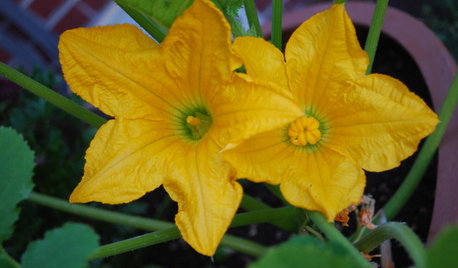
I know it is too early to start them, but I have had terrible luck, well actually no luck growing yellow or green summer squash. I get a few blossoms that turn into to squash, but they only get about 2-3 inches long, stop growing and turn to mush. I have tried several kinds and they all do the same thing. I put them in my earth boxes. Thanks for your help.

Comments (19)

  • 15 years ago
    last modified: 11 years ago

    Too wet. Mix some sand in (that's what I do, wouldn't suggest it for raspberries though....nematodes)with the potting soil. I use EB's too.

  • 15 years ago
    last modified: 11 years ago

    delegg,
    I use a 50/50 mixture of Miracle Grow potting soil and Black Cow in my earthboxes for squash & cucumbers.
    The black cow has lots of sand. Sounds like you need to plant parthenocarpic (female) squash seeds.
    The squashes will grow without pollination and wont mush up on you half grown.
    So far only cukes and zukes are parthenocarpic. They have light green almost yellow zucchini.
    That's what I use as my straight neck summer squash replacement.
    This is my list of parthenocarpic seeds and who sells it.

    Diva Hybrid Cucumber (Park 5516)

    The Most Delicious Burpless Cuke Yet!
    Heavy-yielding plants resist just about every pest and disease!
    58 days from sowing, 32 days from transplants. Diva is simply
    delectable, with thin, tender skin, crisp flesh, and a flavor
    that combines sweetness with a genuine cucumber bite impossible
    to find in the bland supermarket varieties today. It arises very
    abundantly on vigorous, disease-resistant plants, giving you a
    huge crop of the finest burpless cucumber I have tasted in a
    long time! No wonder it was a 2002 All America Selection!
    These 6- to 8-inch-long cukes look as good as they taste.
    Spineless and forest-green, they are plump, well-shaped, and
    packed with crunchy texture and sweet flavor. Don't even think
    about peeling the semi-glossy skin -- it's thin, tasty, and full
    of nutrition! Diva is parthenocarpic -- it needs no pollinator
    to flower and fruit -- and is renowned for its big yields. We
    recommend harvesting the fruit before it reaches maximum size.
    the smaller cukes are especially succulent! Despite her name,
    Diva is no temperamental star but a rough-and-ready garden
    performer, tolerant of Scab, Powdery Mildew, Downy Mildew, and
    Angular Leaf Spot. The vining plant reaches 5 to 6 feet tall
    and 1 to 2 feet wide, with very prolific fruit over a good season.
    Burpless cucumbers are known for their tasty, non-astringent flesh,
    small seed cavity, and crisp, thin skin that never needs peeling.
    They are premium cukes for eating fresh. Direct-sow seeds in a
    sunny spot after all danger of frost is past or start indoors and
    transplant when the first true leaf appears. Cucumbers can be
    allowed to grow on the ground, but for longer, straighter fruit
    and to save garden space, grow them in a cage or on a trellis,
    allowing 1 foot between plants. Keep them well watered and keep
    the fruits picked promptly. Pkt is 30 seeds.

    Cool Breeze Hybrid Cucumber (Jung 02013)

    An outstanding French Cornichon pickling cucumber.
    Sets fruit without cross pollination, a term called
    parthenocarpic, resulting in early yield sand buckets
    of fruit under just about any reasonable growing
    condition. The dark green cukes are smooth with fine
    white spines, at their best when harvested at 4 to 5
    inches, and will be seedless unless grown near other
    cucumbers. They make excellent pickles and have great
    crunchy sweet flavor for eating fresh. Strong,
    vigorous plants are very disease resistant. Can also
    be grown in a greenhouse for a winter cucumber treat.
    **Cool Breeze was a crop failure for the 2010 season.
    We recommend sku s02013 Amour F1 Cucumber as a substitute.**

    Diamant Hybrid Cucumber (Jung 02014)

    A disease resistant pickler with great taste. This
    early ripening cuke has crisp texture and fresh,
    mild flavor that's a delight for both fresh eating
    and pickling. The dark green 4 to 5 inch fruits are
    nearly smooth with barely noticeable spines. Space
    saving, compact plants are parthenocarpic, so they
    don't require pollination to set fruit. Their
    resistance to downy and powdery mildew, cucumber
    mosaic virus and cucumber scab keeps them bearing
    all summer. Yields are amazing.

    Iznik Hybrid Cucumber (Jung 02019)

    A gourmet mini-cuke from Germany. Thin-skinned,
    smooth, crisp cucumbers are prime when harvested at
    3 to 4 inches. Short-vined plants have small leaves
    and, because they are parthenocarpic (do not require
    pollination to set fruit), they are extremely high
    yielding even under adverse conditions or without bee
    activity. Grows well in containers, trellis gardens,
    greenhouses and regular gardens. Great used fresh or
    for pickles.

    Amour F1 Hybrid Cucumber (Jung s02013)

    Recommended as a substitute for Cool Breeze Hybrid
    Cucumber. A parthenocarpic variety producing extra
    early yields of spiny, 4 to 5 inch dark green fruit
    perfect for fresh use and pickling.

    Caveli Hybrid Zucchini (Jung 03526)

    The light green partner to our popular Perfect Pick
    Hybrid! Caveli is also parthenocarpic and has all
    the great qualities of Perfect Pick, but has light
    green, tender skin and nearly seedless white flesh
    with outstanding flavor. The leaves of the bushy
    plants are curiously mottled with light green, making
    them almost ornamental. If you like Perfect Pick,
    you'll love Caveli.

    Perfect Pick Hybrid Zucchini (Jung 03561)

    Just about the most perfect zucchini you can grow!
    This superb summer squash has the unique feature of
    being parthenocarpic, it doesn't require pollination
    by insects to set fruit. As a result, it produces
    high yields even when weather conditions aren't
    favorable. It can even be grown under row covers or
    in greenhouses successfully. The fruits are very high
    quality with glossy dark green skin and nearly seedless
    flesh that has excellent flavor. Optimum picking size
    is when fruits are 6 to 8 inches long. The fruits in
    our picture are nearly 12 inches long and still are
    very high quality and nearly seedless.
    Sure Thing Zucchini Hybrid (Burpee 54841A).

    This Burpee zucchini bears fruit early in cool, cloudy
    conditions even when there are no bees or male flowers
    around. Its medium-size fruits are long and very tasty.
    Strongest flavor, good with other vegetables. 48 days.

    Lou

  • 15 years ago
    last modified: 11 years ago

    Thanks for the help. I did try the ones that do not need pollination and still not good. I will try changing out the soil. Thanks again

  • 15 years ago
    last modified: 11 years ago

    Summer squash is one of those veggies that I just have not been successful growing in a container. Oh sure, I get 4-5 squash from container culture but in-ground I'll get 5-6 times that much. Don't get me wrong, I'd rather grow them in a container but it's just one of those things I've not been successful with in a container.

    Lou, do you do better with container squash?

    Tom

  • 15 years ago
    last modified: 11 years ago

    Tom,
    I agree that planting in the ground is better but planting outdoors in the wilderness here I get myriads of hungry critters so I sequence plant the EB's in the screen-house to make up for the rapid decline in pots. I'm thinking of building some sort of garden cage with 1/4 inch mesh wire for certain crops and the Aquaponics for other crops. It looks like 'one size fits all' wont work here and I'll build whatever I need to make specialty grow areas. Maybe the wire mesh attached to the inside of the 12' by 26' tent greenhouse frame. I'm still toying with different ideas and testing what works best. The huge pastures around here are a breeding ground for the locust lubbers. The dense woods are full of 4 legged hungry critters.

    Lou

  • 15 years ago
    last modified: 11 years ago

    Try hand pollination with a small paint brush. Sometimes you need to be a bee.

  • 15 years ago
    last modified: 11 years ago

    cfldoc,
    Been there done that... I even have the buzzing noise down pat now(with occasional backfires from my hind end).

    Lou

  • 15 years ago
    last modified: 11 years ago

    I understand Lou, I keep forgetting your critter problems....

    Doc, where you been? Seems you fell of the face of the earth...I wondered if we'd hear from you again. Like Silvia, you came here with a unique ability and a definite veggie green thumb, nice to see you posting again.

    Tom

  • 15 years ago
    last modified: 11 years ago

    Tom,

    I am growing monsters now, lol.

    {{gwi:12601}}

    Silvia

  • 15 years ago
    last modified: 11 years ago

    Sylvia,

    I see you bought those seeds too, they sure are strange looking broccoli heads.

    On a site for apple trees they say the marcoun apple tree is rated zones 5 - 8 and I'm wondering if I could grow it here because I'm not really a zone 9 according to my temps.
    I'm sorely tempted because those apples are the best tasting apples ever!
    Lou

  • 15 years ago
    last modified: 11 years ago

    Lou,

    Please, please get one of the Macoun apple trees!!!

    Silvia

  • 15 years ago
    last modified: 11 years ago

    Hi Tom. I'm still plugging away at the veggie thing and adapting to FL growing conditions. Everything is going okay and I've got tomato seedlings ready to go in ground soon including an Indian Stripe you gave me seeds for...thanks! I agree it is harder to get zuchs to set fruit here. My biggest challenge here has been sweet corn..the worms here are unbelievable in their fondness for that even with BT or spinosad. May try to cover some for a while with fabric row cover as an experiment. Thanks again for the seeds.

  • 15 years ago
    last modified: 11 years ago

    Sylvia,
    I just ordered two Marcoun Apple trees, I'm not sure if they will fruit here in my zone but those apples are well worth a try.
    They said it will be 2 to 3 years before they will fruit.
    I searched everywhere for larger Marcoun Apple trees but these trees were the only ones I could find online.
    I might have to overwinter them in a refrigerated Plexiglas dome to set fruit. LOL

    I keep looking at my original northern apple trees I planted here a few years ago and they are staying dormant from all the cold this year. I removed the leaves on them last November's first frost so they would go dormant early. This spring I will hand pollinate the flowers as the bees here are very scarce. I also planted two crab apple trees which are very good apple pollinators.

    Lou

  • 15 years ago
    last modified: 11 years ago

    Lou

    That is very good news! If you get some fruits from the new trees, I might plant them too. From what I heard we are going to keep having extreme winters and summers, your apples should be fine. I am only planting hardy plants or in pots if sensitive. I will try to order the box of apples in the fall when they are available. I will keep you up dated on my heirloom apples...

    Silvia

  • 15 years ago
    last modified: 11 years ago

    Neat broccoli Silvia. How can you stand to eat such a beautiful geometric thing?

  • 15 years ago
    last modified: 11 years ago

    Thank you Amber, I don't know what happen this season but everything is huge!
    I had to get creative to use some of the produce that I am getting, the Veronica variety in the picture I take it apart like a cauliflower, it looks like a little trees. And since I have so many I have been making refrigerator pickles, I had company over the weekend and serve that, they were impressed! I made two kinds of the pickles one hot and one regular, I like them both.

    Silvia

  • 15 years ago
    last modified: 11 years ago

    cfldoc. About your sweet corn. I live in Lakeland and I grow two fine small sweet corn crops a year. You can defeat the corn worms with spinosad! Walk in the rows and spray every growing point at the first brown powdery sign of activity, including the lower sucker shoots. Small amounts will do. You have to do this every time you see new activity. Spray the silk as it grows also. If it rains hard you'll have to do it all over again. Worth the effort!

  • 15 years ago
    last modified: 11 years ago

    Thanks Richard I'll have to give that a shot. I have used spinosad, but maybe not enough often.

  • 15 years ago
    last modified: 11 years ago

    Hi Sylvia, it's taken me a while to get back to this post, could not see the pictures from work, a Big Brother thing....Beautiful veronica! I have some seed, will definitely try it next fall.

    Doc, the butterstick squash was prolific in the ground but a marginal producer in containers.... I don't have room for corn but looks like you've found the solution. I had a problem with tomato worms this past fall that BT didn't touch, but spinosad did the trick so I'm sure Richard is right and maintenance spraying with it will work.

    Tom

Sponsored