Software
Houzz Logo Print
konrad___far_north

Winter project....

20 years ago
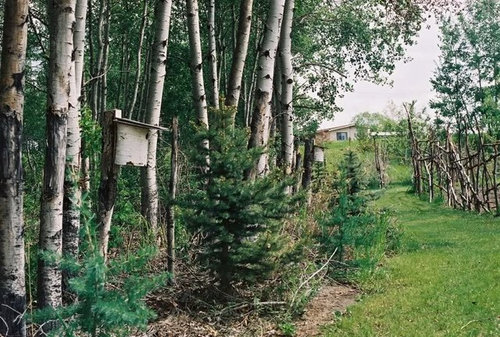
Thinking about Birds......

This is the Nesting box I was talking about some time ago, finally I can post a pic.

I'm going to build some more this Winter.

Konrad

Comments (12)

  • 20 years ago

    Looks like an ideal setting for wrens... Is that what you were hoping to attract? How nice to have natural woods on your property!

  • 20 years ago

    Yes, mostly wrens but also have tree swallows and chickadees, in one box, out near the road, fence, I had one year a pair of blue birds. In a box at home a pair of woodpeckers.

    I'm thinking to hang some higher to attract some other species... perhaps?
    Any suggestion?

    Konrad

  • 20 years ago

    Well, if you have good-sized sloughs on or very near your property and have woods nearby, it may be possible to get buffleheads and common goldeneyes in your nestboxes. (It came as a surprise to me, many years ago, to see ducklings jumping out of a nestbox in Riding Mountain N.P.!)

    It's not too hard to find the proper box and hole dimensions on the 'web or in books, e.g. Naturescape Alberta is an interesting publication for all sorts of nature subjects, and includes nestbox dimensions. I was just reading in it that nestboxes for the cavity-nesting ducks can be placed quite close togethere, since the males only defend territories on the water, not around the nest. It also says that female goldeneyes will outcompete female buffleheads for nestholes, so if there is a chance to attract both, put out two nests (or more) - even one right above the other on the same tree! Interesting!

    It also says that northern saw-whet owls (if there is enough habitat for them to occur in your area), kestrels and flickers will use nestboxes.
    Anyway, that particular book is a good read and I'm sure you could find it at libraries...and there are many others too.
    We've kept a couple of bluebird trails, but other than that, have only had chickadees use our nestboxes in the yard a couple of times.
    Good luck! Sure sounds like an interesting project!

  • 20 years ago

    Wow, those are really nice, Konrad - so wonderfully natural.

  • 20 years ago

    They are very nice! What a good idea. Wood ducks are lovely and very receptive to tree trunk homes if you make the hole big enough. And if they are in your range, I don't know. There was a nesting program for them at a local oxbow lake park when I was a kid.

  • 20 years ago

    Thank you all! also for your suggestion!

    My pond is small [man made]....not sure it I could attract some ducks.
    There is a large slough about 100 yards from my place no trees at all there...
    would they still nest this far away?

    this is my small pond
    Konrad

    {{gwi:782884}}

  • 20 years ago

    Konrad, if you already see buffleheads and/or goldeneyes using your pond for feeding, or for stopovers in spring/fall, then it is possible you may get them to nest on your property, particularly if your pond edges onto woods. If you haven't been seeing them there, then probably not.

    Wood ducks are not native to Alberta (and only sneak a little bit westward into Saskatchewan). Those that one may see occasionally are escapes (from zoos, game farms, people who raise waterfowl for "ornamental" purposes) and strays, so the chances for them are slim.

  • 20 years ago

    There are always ducks and geese in our beaver pond in spring and fall, but no evidence of any of them nesting there. I'm wondering if it's because the water levels flucuate depending on if there are beavers there at the time or not, or maybe the presence of our dog (the notorious robin-catching bird dog).

    Ian, what do you use your pond for? We have a pump in the beaver pond and use the water for watering the gardens.

  • 20 years ago

    Konrad,

    How did you hollow out your log for the nesting cavity? I had some problems with flickertails drilling holes in some of my arbors and things. So I took a very large log and using a wood drill bit kept drilling about fifteen holes in the back until I had a large cavity, they I drilled a hole in the front until I broke through to the area I had cleared out. I then hung these where the Flickers were being a pest and this has eliminated any more problems from them. Is there a better way of hollowing out a log? I made two of these and each took me an entire day and my hands were numb when finished.

    Thanks...

  • 20 years ago

    Oh sorry - i said Ian and meant Konrad!

  • 20 years ago

    Thank you all!
    ABgardeneer
    I will defiantly observe more what's going on with waterfowl!

    >>I had some problems with flickertails drilling holes in some of my arbors and things

    What's that?....some kind of woodpecker?

    >>How did you hollow out your log for the nesting cavity?

    Being a machinist, tool & die maker..... it makes it allot easier.
    Have made a very large spade drill, app. 4 1/2" in diam. the tip of the tool a radius, [makes the basic shape of the nest]
    I machine the cavity on one of the Lathe in the shop.
    It's a very dusty task, even with a shop vac....but ones a Year I can handle it.
    Was thinking of doing it outdoor, all I have to do is make a special adaptor on my home build electric wood splitter.....just never got around.

    Have sold some of these Nesting boxes to a local Birdhouse Store, but really not profitable enough.....with this new Idea, [wood splitter] it could be a nice outdoor project for winter and perhaps sell a few.
    Had no problem selling it at the bird store....I think it's a "hot Item"...nothing like it.

    Here, this pic the roof, [cedar shake shingles] swings out of place by undoing one screw for easy cleaning.
    The other pic, size of the hole nesting cavity...


    This pic, the hole entrance is being carved open larger, I think it was a wood pecker but not sure?...Does anybody know why birds do this......is it to fit there needs?
    Konrad

  • 20 years ago

    "Flickertail" is a name used in some areas for Common Flicker (or Northern? Flicker - whatever they're calling 'em now), a very common and widespread woodpecker. They are mostly migratory but a few always spend the winter.
    Yes, some of the cavity-nesting birds will enlarge holes in nestboxes to fit their needs (i.e. make the hole big enough for them to use) - even house sparrows will do it. Some birds are primary cavity nesters - they make their own cavities in trees; others are secondary cavity nesters - they use pre-existing holes in trees or mud banks or whatever, or cavities other birds have excavated (though some species may alter the holes). Anyway, I highly recommend the book I mentioned earlier - I'm sure you'd find it very interesting.
    There is an interesting comment in it about flickers - they are secondary cavity nesters, but they like to work on the fronts of nest boxes. If you fill the nestbox with wood shavings, then they'll "excavate" the shavings, instead of working on the box itself. So, who knows, but maybe the hole enlargement in your picture was done by a flicker?
    The book I mentioned has pictures of commonly-seen birds of Alberta, but, in addition, I'd recommend a good bird guide, specifically The National Geographic Guide.

Sponsored
Hope Restoration & General Contracting
Average rating: 4.7 out of 5 stars35 Reviews
Columbus Design-Build, Kitchen & Bath Remodeling, Historic Renovations