

Kaempferia rotunda - Fragrant? (Peacock Ginger/Asian Crocus)
Kaempferia rotunda, also known as one of the Peacock gingers, Resurrection ginger, or Asian Crocus, is a plant I have been excited about for years. Having read about them, I never understood what really attractive foliage the have. After seeing pictures of them for the first time online, I am certain I have actually seen them as foliage gift plants for sale in supermarkets many times before. How many must be thown away when they go into dormancy and their the recipients, assuming they are some sort of prayer plant (calathea) imagine them to be dead. Far from this though, in early spring, before the foliage unfurls, they will produce stemless purple and white flowers, at soil level.
What has drawn me to this plant for so long is the reported fragrance - lily, pure and carrying. But is Kaempferia rotunda in fact fragrant? I finally broke down and purchased one Kaempferia rotunda and one K. rotunda "Raven" yesterday from Gingerwood Nursery, and in spring 2011, with any luck, we shall see. Everyone seems to think so, most importantly the Fragrant Plant Maven, H.V.P.W., although I have heard a few opinions to the contrary. Significantly, Dave Skinner of GingersRus.com
writes that while Kaempferia rotunda is invariably described as a plant with fragrance, he has never been able to detect any.
What do you think? Some help from the school of first hand experience would be greatly appreciated. Do you grow Kaempferia rotunda, and are the spring flowers fragrant?
Best wishes,
Matt Di Clemente
Comments (11)
 16 years agolast modified: 11 years ago
Hi Matt,
I cannot answer your question since I have never grown Kaempferia rotunda, but I have always been curious about it as well. I have been on the verge of ordering it several times over the years to try it out, but I always seem to get distracted by something else in the end. I hope if no one here is able to answer your question that you will give us a report once your plants produce flowers.
I suspect that it *is* fragrant, but that certain noses just aren't capable of smelling it, just like with all flowers said to be fragrant. Some people can't smell tea roses or osmanthus, and I'm sure others can't smell kaempferia. I believe that another member of this forum once posted that Calathea concinna, another common foliage gift plant, also has pleasantly scented flowers. That might be another good one to try.
What other fragrant plants and flowers do you grow? It is nice to see a thread about one of the lesser known fragrants.
- 16 years agolast modified: 11 years ago
I grow kaempferia roscoeana, which isn't fragrant, but that's just one species -- I hope you let us know when it blooms!
Related Professionals
Pine Bluff Landscape Architects & Landscape Designers · Vicksburg Landscape Architects & Landscape Designers · Athens Landscape Architects & Landscape Designers · Auburn Landscape Architects & Landscape Designers · Bloomington Landscape Architects & Landscape Designers · San Francisco Landscape Architects & Landscape Designers · Lubbock Landscape Architects & Landscape Designers · Ogden Landscape Architects & Landscape Designers · Plainfield Landscape Contractors · Potsdam Landscape Contractors · Harrisburg Landscape Contractors · Flagstaff Landscape Contractors · Miami Kitchen Remodelers · Bangor Kitchen Remodelers · Albuquerque Kitchen Remodelersmattdiclemente
Original Author16 years agolast modified: 11 years agoDear Ispahan,
Thanks for the follow up.
I hope you will try Kaempferia rotunda too. Let's live life a little, and smell the gingers, roses not withstanding. And I will certainly share my results with the fragrant plants forum. I like your explaination. I only hope that I am one who CAN smell Asian Crocus!
Many plants are of controversial fragrance, but you are right - in the case of some, the difference of opinion stems not from the quailty of the fragrance, but from there being any at all. One such plant that comes to mind is the netted Iris, I. reticulata. Does it smell like sweet violets, or no?....Thank-you for the tip on Calathea concinna! It is now duely noted on my list.
As to other unusual fragrant plants I grow, I shall only touch on a few, but they are good ones. Each is easy to grow, and would never shame you even if you never saw a single bloom, the way, say a yellow, bare-stemmed gardenia bush might!
All of the "gingers" have fragrant foliage, roots, or both, and even the the common edible ginger (Zingeber officionalis) is worth growing for its corn stalk like foliage. Many have stunningly exotic blooms, each more enticing than the next, and wholly different from any flower you know. If I were ever to submit, and collect a certain type of plant, the various fragrant rooted genuses called gingers might be it. (This incedentally is a very worthwhile pursuit for those who garden along the gulf coast.) Of all these though, besides these Kaemperia Rodtunda, the only gingers with fragrant flowers are the white gingers, or butterfly ginger lillies Hedychium coronarium, and kin. These are must have plants. Famous as lei flowers, they will reward you with fragrance for months, and are as easy as cannas to over winter. The other ginger I cannot be with out is Alpinia Galanga - the Galangal ginger. It does not have fragrant flowers, but the tubers hold one of the scents of Shangri La. Ginger is there, but also, lemon, pepper, in smaller dilutions flowers, wintergreen - could it be vodka too? You must smell it for yourself. The Galangal is an edible variety.
My other reccomendation is the asparagus fern. Yes, the one they sell in Walmart for $2 to fill in with window box impatiens. Bring yours in this winter, and you will have green little friend all through cold months. If you repot it, let it grow large, and grow it on for a year or so you may be rewarded with little non-descript white flowers. They are wonderfully fragrant, and you heard it from me.
Afterwards, they produce attractive red berries.
It seems an old plant, that is potted a little tighter than it would like, well cared for, and that gets a little bit of sunlight, is the one that will flower. My tip is to prune out the oldest stems each season though, as these tend to get thorny, just like the wild edible asparagus.Finally comes, Sansevieria trifasciata the common Snake Plant, or Mother-in-Law's Tongue. Does this surprise you too? Given similar care to the Asparagus Fern (although it will tolerate just about any, or none at all) it will blossom The flower spike apears from the soil and are decked with dainty finger shaped buds. These open from bottom to top over a week or so, and look like little honeysuckles with yellow-green curled ribbons for petals. They are just as worthwile to smell. Sansevieria Parva, called the Kenya Hyacinth, has the typical snake plant leaves, but looser, narrower, and more strap like - a different plant form entirely. Their flowers, white, or washed out mauve are fragrant in a different way to S.trifasciata, but also good.
I hope you enjoy these.
And you are right. We should start a thread about the more unusual fragrant plants.Best wishes,
Sincerely,
Mattmattdiclemente
Original Author16 years agolast modified: 11 years agoDear Jim,
Thanks for the reply.
You are right. Kaempferia roscoeana does not have fragrant flowers. The flowers come in the Summer among the foliage and are pink. For that matter, none of the oher peacock gingers (Kaempferia) I have seen or heard of are fragrant. In the Gulf States they are so well adapted and well liked that they are considered a substitute for Hosta!K. Rotunda on the other hand blooms in spring, before the foloiage emerges, or just as the the spikes brake the surface, well before they unfurl. K. Rotunda seems to be the maverick of the family in every way.
Incedentally, how do you find the fragrance of the leaves and roots of your K. roscoeana. Although I very much wished to in order to determine for myself, it is not polite to go around pinching the roots of other a friends porch plants - at least not while they are watching.
Best wishes,
Mattmattdiclemente
Original Author15 years agolast modified: 11 years agoHere is an update on Kaempferia rotunda
Shortly after writing the above posts last summer, I broke down and ordered two Peacock Ginger plants from Gingerwood Nursery when the weather began to cool in late August. I ordered both the species and the more bold foliaged "Raven". The species plant came as a good size plant, and "Raven" was a just a little plant. Both took a goodly while to recover, but when they did, I was impressed. They are both excellent, and very ornamental foliage plants.
I allowed them to go dormant in the very late fall, leaving them out until the frost was about to come in late Novemeber. Then I took them in in their pots, and stored them as I do my Angel's Trumpets (Brugmansias) and Butterfly Gingers (Hedychiums). That K. Rotunda is dormant over winter was an important inducement for me in purchasing them, since I find window space to be at a real premium in winter, as I know it is as well for many of you, my fellow fragrant plant enthusiasts.
Well, the upshot is, both plants died. They did not sprout peacock flowers this March when I began watering them, neither did they sprout foliage when I put them outside later in the Spring. What a shame; they were one of my true extravagances last year at eight dollars plus shipping a piece. Nevermind though; what I would do next time is firstly, order them early in the Spring to assure getting the highest quality plants, and be able to give them the very best care over summer building them up going into winter. After giving them this good care I would not allow them to go dormant. Rather, I would bring them inside and give them prime positions in the light next to my jasmines and gardenia plant. This is no great hardship however, since unlike the two aformementioned in many instances, Kaemepheria are prime foliage plants. If they decided to go dormant anyway, I would let them, cutting back on water, but NOT reducing it absolutely to none. As I have discovered, Kaempheria are not plants for casual overwintering in the way of Cannas or Hedychium.
But, now I suppose this will all wait until next Spring.
Perhaps I will report on the fragrance of K. Rotunda's blossoms in March or April of 2013.Has anyone else had experience with Peacock Ginger?
Was anyone perhaps so fortunate as to be treated to fragrant flowers this spring by their plants?Best wishes,
Sincerely,
Matt- 15 years agolast modified: 11 years ago
In Costa Rica this is known as the 'Resurrection plant', since the blooms appear before Easter.
I grow lots of it, and the blooms look very pretty, but are visible for such a short time. I have never noticed a perfume from them.
The leaves are attractive, too.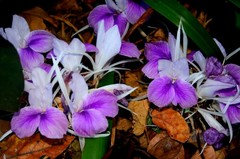
 7 years ago
We have these rhizomes growing in mid of coffee tree plantations in south India and they are the most fragrant flowers I have come across. They just fill about 1000 ft area around them with beautiful fragrance
- 2 years ago
I grew up in Colombia and as a child I remember the unique fragrance of these flowers which would come up before the foliage. I haven't seen them since then. I live in the US now.
 2 years ago
Thank you for your reply, Bluecaribe. Thank you for sharing memories from Colombia. What a beautiful climate! Knowing that they do, in fact, have a unique fragrance, has inspired to me to revisit these intriguing plants, and perhaps aquire some, if I can, this Summer. How would you describe the fragrance, if you can remember back? Sweet, like honeysuckle? Perfumy like orange blossom, or jasmine? Lemony?
- 2 years agolast modified: 2 years ago
Thank you for your reply, Bluecaribe. I suppose you mean it is a unique fragrance, in the same way sandalwood or ylang ylang are unique, not that its fragrance resembles either of those. Violets are recreated in many perfumes, but enfleurage or true essential oil is very rare and hard to come by. More common is violet leaf extract, which smells different. Violets themselves are one of the principal fragrances, that is to say, one we use to describe and categorize scents, along with balsamic scents, almond, rose, citrus, sweet, and heady scents. Violets are no longer very widely grown though, so I am not surprised that some have never smelled them to learn their fragrance. There are many types of violets that flower in gardens and lawns in April, that have no fragrance at all. Violas, meanwhile, like small pansies, have a warm, dry honey fragrance, a sunny scent. But this is not what is meant when we speak of violet fragrance. The true violets are the sweet violets. The best are the parma violets, and you can order these from Logees, and other sources. Sweet, in the sense of the older usage, simply meant fragrant, but indeed, sweet violets do smell sweet. If you know what viola smells like, you have a start. They are sweet, floral, feminine and romantic. It is a dry scent, with notes of green. Soft and powdery are terms often used to descrbe violets. Soft is a good term, because the smell is soft, and so is the effect. After sniffing a few times, your nose become unable to pick up the scent for a few minutes at least. If I had to compare violets to any other scent I know, it would be to purple irises, dry, warm, sweet, powdery, and slightly grapey or fruity. In the same way old rose smells powdery and tends toward citrus, violet smells powdery and tends toward fruit. Violets are somewhere between violas and iris, but closer to viola, I would say. Incidentally Chowards Violet candies, are artificially flavored, and they do capture some of the scent of violets, but they have much more herbal lavender flavor to them. I hope this helps!


bluecaribe55