Software
Houzz Logo Print
luvtosharedivs

What is this DL doing?

19 years ago
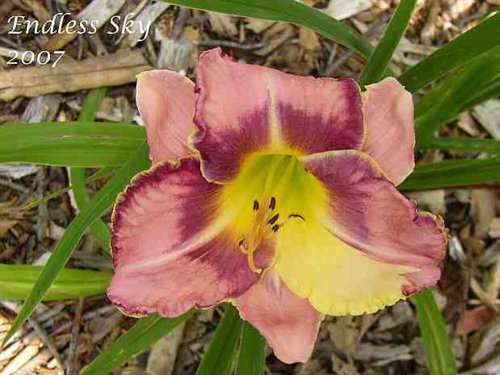
Is there a name for this phenomenon? Or is it just a fluke?

Julie

Comments (17)

  • 19 years ago

    That is bizarre!Is this the only bloom on the plant that did this?

    Betsy

  • 19 years ago

    I don't know any anawers, but I recall seeing a intro with half cream consistantly on all petals. I can't remember where I saw it though. :(

  • 19 years ago

    No Idea, but see who the parents are and if there might be a solid yellow in its past. Maybe the ancestors came to visit.

    Our rains have been almost nonexistent, and I am getting polka dots, and who knows what else.

    Just a thought. Jane

  • 19 years ago

    Jack Carpenter has a seedling with this trait.
    Ed

    Here is a link that might be useful: Jack Carpenter Seedling

  • 19 years ago

    From Wickipedia

    plant chimera

    Variegated plants
    The best-known plant chimeras are those cultivated for their variegation. Generally the genetic difference is due to mutation in meristematic tissue of a normal plant. For most variegation, the mutation involved is the loss of the chloroplasts in the mutated tissue, so that part of the plant tissue has no green pigment and no photosynthetic ability. This mutated tissue is unable to survive on its own but is kept alive by its partnership with the normal, photosynthesising tissue.

    ***
    Usually this is a one time occuring event and doesn't reappear on every bloom. The same thing happens on Caladium leaves, half will be one pattern the other half will be a completely different pattern. I's interesting but not unusual...

    Jerry

  • 19 years ago

    Thanks for all your responses.

    Betsy, yes, this is the only bloom on the plant that has shown this "behavior". The other blooms before it were normal.

    Jane, the parents are Creative Edge X Seedling. Who knows what color the seedling was! But Creative Edge had one parent, Plum Candy, which is yellow w/red eye & edges. So maybe the yellow is from a grandparent. Sorry to hear about your polka dots!

    Ed, that Jack Carpenter seedling was very unique!

    Jerry, thanks for the Botany lesson. A mutation of some sort.....every year it's something new and odd to add to my observation notes!

    Thanks again, all!

    Julie

  • 19 years ago

    Variegation has to do with plant foliage. This plant's foliage is not variegated. Chloroplasts are responsible for the green in the throats of daylily flowers but that's not what this flower exhibits.
    The mutation shown here has to do with petal or tepal color pigmentation, and from the looks of it, anthocyanin type only.
    Ed

  • 19 years ago

    I think Jerry is right "CHIMERA" Iris do this all the time, one fall or standard, on the Iris will have part of it a different color. Usually just the one flower and a one time thing.

    Ted

  • 19 years ago

    Wow!

    We're getting deep here, Ed!
    I think I will clip your post, too.

    Ted, I've never seen it happen on my Irises, but now I'll have some understanding if it ever does.

    Thanks, both of you, for your input.

    Julie

  • 19 years ago

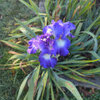
    Here's what CHIMERA usually looks like in Iris;

    The one on the left is a normal fall the one on the right is called a CHIMERA. I thought you would find this enteresting.

    Ted

  • 19 years ago

    A picture speaks a thousand words!
    I will add this post to my clippings too.

    Thanks, Ted!

    Julie

  • 19 years ago

    Here's a picture of a daylily chimera of mine. It has neither variegated foliage nor petals with differing colors.
    Daylily Chimera


    Ed

  • 19 years ago

    Your flower OP, looks more like a case of very mild flower fasciation. It is very unusual to be so defined if it is a simple 'throw-back' to a parent plant.

  • 19 years ago

    In people,chimeras have 2 separate sets of DNA.So are you saying,Ed,that bicolored daylilies have 2 separate sets of DNA and that the term "chimera" is used more loosely in the plant world to describe what happened to this bloom?

    Betsy

  • 19 years ago

    What I'm saying Betsy, is that this aberrant flower does not necessarily make this plant chimera, even though a chimera may have aberrant flowers. Or variegated foliage, or layers of differing ploidy for that matter.

    I learned that "chimera" was a plant with two genetically different tissues growing side by side. And I am reluctant to pronounce ENDLESS SKY chimera just because it has one aberrant flower. If tomorrow its bloom is normal, is it no longer chimera?

    And, if a flower with uneven color distribution makes the plant chimera, then what about bitones and bicolors, or even banded flowers? Are they chimera? Seems like one could argue so.

    To me, the term chimera is inappropriately applied to this flowering condition. Fasciation may be better suited, although I have seen it used more to describe aberrant form, rather than color. But at least it deals only with flowering. And just because someone in the iris community may have used the term chimera to describe aberrant color behavior, doesn't mean we have to follow suit.

    I think there's a better answer out there.
    Ed

  • 19 years ago

    I think that fasciation can be the only answer to this puzzler as it only occurs in the flower parts of a plant. Extreme examples are the ones usually described where a flower's structure is distorted. There are more subtle examples such as yours where color pigmentation is affected in some way.

  • 19 years ago

    Well now, you all have my head spinning. I never took Botany in college, so this stuff is really a challenge for me to understand.

    If this flower has a mild case of fasciation, wouldn't the form be altered or distorted? It's hard to tell in the photo, but when I saw the bloom, there was no change in form, only color pigmentation.

    So, mutation, or fasciation, not chimera?

    Julie