

Hellebore pronunciation?
Hi there Hellebore-lovers,
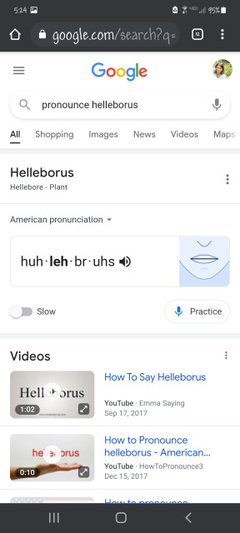
Simple, silly question: I'm wondering how to pronounce the name hellebore. I always thought it was "hell'-boar" but I was reading Fine Gardening magazine and they have a pronunciation guide which says that helleborus is pronounced "hell-eb'-or-us". If so, how do you pronounce hellebore? I guess I must be gardening in a bubble not to have heard other people say it.
Thanks!
Comments (23)

Onion
Original Author22 years agoThanks for responding Doris!
So is the 'e' pronounced 'eh' or 'ee'?
I know it must seem obvious to everyone else!
Related Professionals
Waterbury Landscape Architects & Landscape Designers · Dubuque Landscape Architects & Landscape Designers · Gainesville Landscape Contractors · Emporia Landscape Contractors · New Orleans Landscape Contractors · Raleigh Landscape Contractors · Bartlesville Landscape Contractors · Tulsa Landscape Contractors · Knoxville Landscape Contractors · Lawrenceburg Landscape Contractors · San Francisco Landscape Contractors · Montréal Landscape Contractors · York Architects & Building Designers · Nashville Architects & Building Designers · Laconia Architects & Building Designers- 22 years ago
I saw that article in FG and nearly died laughing. What a snobbish attempt to define a marvelous garden plant that generations of gardeners, horticulturists and botanists pronounce as "Hell'-uh-bore" or more likely "Hell'-uh-bore-us"
- 22 years ago
I didn't see the FG article, but the pronunciation they give is actually how someone who spoke Latin would pronounce the word, with a stress on the second syllable. However, there aren't too many Latin speakers around any longer to keep us on our toes, and most folks pronounce Latin words according to the rules of their native language. It seems pretentious to talk about our garden plants as if we lived next door to Julius Caesar, unless we are at an international botanical conference, and trying to communicate clearly in scientific Latin.
Onion
Original Author22 years agoHi there,
I like your style, woadwoman. Know the details but stay grounded in reality. :)And thanks Georgia Rose - at least I know I'll be understood the next time I say the name...
Woadwoman's response reminds me of another pronunciation I got from FG - I always thought nicotiana was pronounced similar to nicotine - "nick'-oh-tee-an-ah" but then FG says it's "nick-oh'-she'-an-ah" or something like that. So in a nursery I wanted to ask where it was and i struggled to remember it's 'proper' pronunciation and when I asked, the woman looked a bit puzzled and asked a fellow worker where the nick'-oh-tee-an-ah was... So I guess I'll give up reading the FG guide, it only gets more confusing!
Take care,
Onion- 22 years ago
Very well said!!!!So very often others are slow to ask questions because they fear being less than intelligent to others. This is how we learn by asking questions. Took 3 years of Latin and good grief, what real use is it now? Even the medical field has allowed it to fall by the wayside. Went to school in S.C. moved to TN. with my new husband, found out very quickly in the hospital environment, words are pronounced, many times, depending on the local influence and place of educational training.
Hellebore is Hellebore and I just think it is so very beautiful!
Just enjoy! - 22 years ago
I always thought Nicotiana was pronounced nee-cot'-e-ay-nuh.
Back to the "old drawing board" for me! How am I to pronounce Heuchera? hoy-ker'-uh, as the Brits do or hew'-kuh-ruh as most Americans do? I think we should empanel a comittee of 1000 gardeners only and straighten out this problem that Latin was supposed to solve. Now which Latin was that?
Rb - 22 years ago
"HELL-eh-bore," "nick-oh-TAY-nee-ah," and "hew-CHERR-ah" (the way you'd say "chair").
 22 years ago
Sorry, but botanical Latin is a far cry away from classical Latin although many of the same conventions apply. FWIW, the emphasis is intended to be on the second syllable (hell-EH-bor or hell-UH-bor) - that's why cotoneaster is pronounced as ko-TOH-nee-aster rather than cotton-easter. And 'ti' followed by 'a' is pronounced as 'she' (nih-KO-she-an-a) and the sound of 'ch' is always hard (hyoo-KUR-a or hew-KUR-a, kam-UH-sip-a-rhis [Chamaecyparis]) and 'g' followed by 'e' is always soft (jee-UM, ber-JEE-nee-ah). There are many guides to the correct pronunciation botanical Latin and FG does a pretty fair job of presenting it.
- 21 years ago
Enjoyable posting! I'll have to refer to it again to remember how to say Nicotiana properly.
Onion
Original Author21 years agoHi again,
Thanks for all of the input, everyone.I finally went to the link listed in Fine Gardening to actually listen to latin names being pronounced. It's very handy and kinda fun.
Hmm. That sounds a little crazy, sort of like my recent realization that many of my favorite books are reference books! Yikes! Well, at least they're GARDEN ref. books -- of course those aren't geeky at all! :)
Here is a link that might be useful: Fine Gardening Mag's Pronunciation Guide
- 21 years ago
Helleborus is the genus, hellebore a common name. An unfortunate practice that seems to have arisen - and is making an appearance on this thread - is using the common name for the genus, as in Hellebore hybridus, Hellebore niger and so on. This shouldn't be any more kosher than Rhody 'Vulcan' or Pel x hortorum.
- 21 years ago
So I've been okay with nik-KO-she-anna and hoo-CUR-ah, and only a little off with hella-bor.
But I don't think I'll ever live down the first time I asked about cotten-easter at a garden club....
- 21 years ago
As a newbie to the forum and fellow survivor of high school Latin, I'm glad to see this discussion taking place. The first real blow to my ego came years ago when I discovered that there was indeed a difference between Classical Latin and the Early Latin pronunciations we were learning at the time.
Since then, the successive introductions to Ecclesiastical Latin, Medieval Latin, Humanist Latin, Germanic Latin and others have allowed me to take quite a number of "mispronunciations" with a grain of salt (hahaha... "cotton-easter"!!). :) :D ;)
Thanks to gardengal for illuminating the lingua franca botanica in this instance, and to everyone else branching out and getting to the roots of perennial pronunciation pet peeves.
- 21 years ago
Althouth I'd never tried it myself, literature says that it is possible to take cuttings from Hellebore x nigercors and Hellebore Foetidus (Wester Flisk)
- 17 years ago
Just to further refine things, it's the Greek "ch" that is always a hard "C". If the word is not derived from Greek, a "ch" might have a "ch" or even "sh" sound.
The stress in a Latin or Latinized (as in Botanical Latin) word is not always on the second syllable (although you often find it IS on the second syllable in 4-syllable words. English speakers commonly want to stress the third syllable.) The stress falls on the syllable that is a "strong" syllable and is closest to the end of the word. A strong syllable has a long vowel or ends in a double consonant - which is why you want a Latin dictionary or some other reference work. Of course, there are some good resources out there, where you can simply check out the pronunciation of plant names and/or you can check out the rules of Botanical Latin, but these resources can and frequently do disagree with each other. So I say, learn something about Botanical Latin and learn to hear the common patterns people use when pronouncing plant names. Choose what sounds pleasant or makes sense to you and helps you to be understood.
- 17 years ago
As I was approaching my front door today coming home, this plant was a pleasant sight standing out from the rest of brown plants that were in a process of transition to a "plant winter heaven". And I thought: what a delight! Got to plant more of those, regardless of their name. Who the h... came up with such a name?! Any way you pronounce it, it is ...different :).
So, seeing this post made me smile.
~Natalie  5 years ago
or hell-of-a-chore when you have to cut back 20 of these plants. haha! they really are beautiful


rusty_blackhaw