Software
Houzz Logo Print
iheartveggies

nematodes?

12 years ago
Hi all,

Enjoying my first fall/winter gardening season in FL, though it still seems so backward for this VA girl!

It's sooo much easier to grow veggies in the fall/winter here than in the summer (yes, my stubborn self gave it a go this year :/ ) EXCEPT for one thing...I can't seem to grow root veggies!

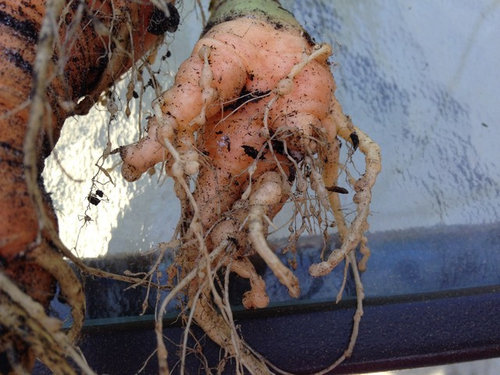
I grow in raised beds and dug up the second round of carrots the other day. Just like the first round, the tops are beautiful and lush, but the root is stunted, branched and has nodules on it. I THINK I'm looking at a root-knot nematode infestation. I've read all the nematode stuff on GardenWeb, but nobody really posted any pics.

So I thought I'd turn to my trusty fellow FL gardeners. Can anyone confirm? And is my only hope to not bother planting any more root veggies this fall/winter and to solarize over next summer? Will I never have the beets, carrots and sweet potatoes I want from this plot? Thanks!!

Comments (20)

  • 12 years ago

    Sure looks like root knot nematodes to me as well. They are mostly the reason I have never been able to grow root veggies other than radishes.

    You might try growing a nematode-resistant or -impervious crop for a season. I've had good luck growing nematode resistant tomatoes & I know there are plants they won't bother @ allâ¦.

  • 12 years ago

    Thanks, carolb_w_fl!

  • 12 years ago

    Don't give up!!! this is why so many gardeners here use cans and pots and grow-boxes... you can make a great grow-box out of old totes and tubs and deep dish-pans, anything you can punch holes in for drainage and fill with potting soil..just do not use any of your ground-soil it has the nematodes and you don't want to introduce them into your grow-mix.... folks here have posted pics of their various takes on suitable methods, and they all seem to work....also, nematodes don't like compost or enriched soil, so you need to start saving egg-shells, coffee grounds, tea bags, peels, banana skins, etc. etc. all that stuff is GOLD when you bury it out in the garden and nematodes hate it.... good luck, sally

  • 12 years ago

    Sorry to hear about your carrots and yes it looks like you have a bad case of nematodes. Solarization in my opinion don't work that well after what I have seen in other gardens that did this. The only thing that helps is to use fresh soil and rotating crops. I am very successful growing root crops and had very good harvests of carrots, beets and especially sweet potatoes, tomatoes I always grow in pots.
    I don't know much about your garden or your set up so I cannot advice directly to the problem. Adding a lot of organic amendments is always a good idea.

    Some beets

    Carrots

    Sweet potatoes

    Silvia

  • 12 years ago

    saldut: Thanks for the reply! That's one reason I'm so disappointed...I constructed a raised bed, put a serious barrier between the ground soil and my grow mix and used a premium grow mix (incl. mycorrhizae) that I amended myself. I mix in my own compost and do my best to keep the soil healthy and my tools clean. In other words, I was SO careful, but I must have introduced the nematodes somehow :/

    Anyway, I was thinking about trying to grow my carrots in big pots on the patio. I did that with the sweet potatoes - some in the raised bed and some in pots - and the potted ones did just as well as or better than the raised bed guys. I'm far too stubborn to give up that easily!

    Have you ever had to solarize or do you grow exclusively in containers?

  • 12 years ago

    whgille: Wow! Those beets, carrots and sweet potatoes are gorgeous!

    There's a little more description of my setup in my reply to saldut...my raised bed is 4 x 10. I'm attaching a picture, though it's from last May...haven't taken any decent ones more recently that show the whole box.

    I'm not sure how widespread the problem is - 4 x 10 isn't very big, so the infestation may have spread over the whole thing by now - but I know it's in the corner with my radishes and carrots.

    Do you think it would help to reduce their numbers if I removed the soil in that corner and gave the whole thing a dose of compost?

  • 12 years ago

    Very nice looking bed but I see trouble brewing from the beginning, did you follow the square space planting? it works for other climates I suppose but here in Florida with the fungal diseases and nematodes there is a need for growing crops under different methods and give them more space. The nematodes probably got introduced with the roots growing very deep, deeper than the raised bed like the tomatoes and sunflower who has massive roots.
    For now I would clean the whole bed, add organic materials and let it sit for a while. You can do containers in the meantime, there are variety of carrots that are shorter and just as good, lettuce and greens will be good in shallow containers, coming spring time you can also do tomatoes, peppers, cucumbers in containers.

    Silvia

  • 12 years ago

    double post

    This post was edited by whgille on Tue, Dec 10, 13 at 9:35

  • 12 years ago

    There is some research going on now into the use of mustard plants (and some other brassicas) as natural biofumigants to reduce nematode populations, as well as control soil-borne disease. When mustard plants are allowed to decompose in the soil, the decomposition releases natural chemicals that reduce the populations of nematodes and pathogens.

    One method discussed is to grow Indian mustard as a green cover crop, then work the plants into the soil. Tee plants need to be worked in before they set seed, so as to not introduce a new weed problem. In the studies, the researchers disked the mustard plants into the fields. (Those of us with small plots and no power tools would need to manually chop them and dig them in by hand, I guess.) After disking, the mustard plant remains need to rot in the soil for at least four weeks before planting a new crop.

    Supposedly the results of the studies are very encouraging and this practice is used in Europe. I wonder how well it works in small backyard plots?

    Silvia, if I may be nosy - I have seen pictures of lovely greens and brassicas in your garden over the years. Do you return the brassica plants' remains to the soil somehow? I'm wondering if that is part of the secret to your lovely carrots!

    Here is a link that might be useful: USDA article on mustards as biofumigants

  • 12 years ago

    A little off topic but I am wondering if you use a liner in your raised bed. It matters especially in the bed because of your hard work on amendments. Nitrogen is a seek and destroy chem as well as plant food. It will rot your bed from inside out. Also it speed the depletion of nitrogen. I know because I lost my first bed prematurely. Be carful with the liner. Make sure it is food safe. I used a polyethylene film. Good luck with those damn nemos, I hate them.

  • 12 years ago

    L in FL, I don't use the brassica plants after the harvest because the whole plant is used for cooking for my family and my dogs but what I do is after I harvest something, I put more soil in there. It does not matter what to use be it compost, ready to use soil or anything that you have and is fully decomposed. Think of the soil as a bank, if you only take money out and don't put more money back in, eventually it gets depleted.:)

    Harvested big radish roots and more carrots today, when everything is harvested, more soil will go in and I will try to rotate the crops between the beds, if you only have one bed you can still rotate the spaces.

    Silvia

  • 12 years ago

    Thanks, everyone, for the replies!

    whgille: The first planting (the one pictured) after building the bed I did sq. ft., but not even as packed as Bartholomew recommends. I thought, "There's no way there's going to be enough air flow." And even then, there wasn't. After that, I've just been using the squares to help me keep track of where I planted things so that I pick out weeds and not seedlings! I've also been rotating the spaces...def. more of a challenge in such a small bed.

    The sunflower was a mistake: It was labeled as a bell pepper, and the bell pepper was labeled as a mammoth sunflower...lol. BUT I've realized since my OP that the source of those initial plants is probably where the nematodes came from. :(

    L_in_FL: That IS very interesting. I know the nems don't like broccoli, so it kind of makes sense. I'm def. going to read that link...thanks!

    shavedmonkey: I did use a liner, as I'd read that the bed lasts much longer, esp. here in FL, if you do. Thanks for the nitro. info.!

  • 12 years ago

    Definitely nematodes. But don't give up hope. I'm way too lazy to build a raised bed, I'm growing my veggies direct in ground. I'm having pretty good results minimizing nematode damage. Before planting seed in the fall, I spray with sunniland nematode control spray - it is essentially humic acid and sesame oil, and really makes a difference. Then I lay down a fresh layer of mushroom compost. About 6 weeks after planting, I spray again. In the summer, I plant marigolds in the area, as nematodes don't like a chemical secreted by their roots. Oh, and I don't plant until the weather starts to cool and nematodes are less active. I have successfully produced good carrots in the same spot where they looked just like yours on my first try.

    Very interesting about brassicas - I didn't know they could help eliminate nematodes, but they are absolutely nematode resistant. The mustard mizuna does great planted into spots I know to be heavily infested with nematodes. So does arugula. I wonder if that has inadvertently been helping me reduce nematode populations?

  • 12 years ago

    Looks like root knot to me, too. I garden year-'round intensively and "organically" in raised beds and containers in West Pasco County. Root knot nematodes are a chronic pest and ubiquitous in this sandy soil and, even in raised beds, the addition of locally obtained compost, manure, etc. reintroduces them into the garden despite ones best efforts to control the beasts. EPA removed the only effective chemical nematicide from the homeowner market years ago.

    I have found the most effective control, and certainly the only one worth spending money on, to be the predatory nematode Steinernema Feltiae which I purchase online from a California vendor.

    Due to the expense, I apply them only when root knot damage to the most susceptible plants (okra, eggplant, for examples) becomes unacceptable. In my garden, that seems to work out to about every third year (not gardening seasons).

  • 12 years ago

    Thanks for the replies, sun_worshiper and jamesbrownlives!

    I'll definitely be looking in to Sunniland spray and predatory nematodes and using some of the control methods you've suggested. Thanks again!

  • 12 years ago

    I struggled for years with nematodes (and other problems) using a raised bed and the square foot system. I tried solarization (didnt' work at all), tried various ammendments said to help (chitin? cottonseed meal, etc.) Didn't work. I tried adding tons of mushroom compost. Didn't work. In my experience the only thing that works is strict crop rotation (as Silvia said) and working lots of nematode resistant and "nemacidal" cover crops into the rotation scheme. At any given time about half my veggie garden is planted in cover crops (and my garden isn't big). I plant beds solid with sunn hemp or big old fashioned french marigolds or cereal rye, depending on the season. I avoid things like buckwheat which actually attract nematodes (as I learned the hard way.) For me anyway it works better to have more beds than it seems like I need, even if the soil (sand) isn't too good, and have half or more of them planted solid in cover crops, than to have one bed with rich soil but not enough room to rotate.

    Bill

  • 12 years ago

    Castrop,
    I'm trying sunn hemp for the first time. It only got 3-4 feet tall before blooming. A few are setting seed. How has it worked out for you?
    Are you able to produce your own seed?
    They say it wont set seed above 28deg. I'm at 28.8.
    I'm hoping it does a good job on reducing nemitodes and adds plenty of organic matter to my soil.

    I'd like to hear how it has worked for you.

  • 12 years ago

    sunn hemp has worked great for me, though only in the warm season. For me it does not grow vigorously in the cold.

    I don't try to save seeds. It's just not worth it. I sow it thickly, so I use a lot of seed, and what's more if you let it get past the flowering stage it loses much of its value as "green manure." If cut when green and soft but tall (just before the flowering stage), it will decompose much more quickly, and add more nitrogen to the soil. The seeds are a bit pricey, but not outrageous or anything, but then I have a small garden so I only use a pound or two a year.

    For me it works as way of keeping the soil (sand) healthier by broadening the rotation scheme. I don't expect it to suddenly make the sand rich and humusy, nor do I expect it to eradicate the nematodes and other problems on it own. That said, sunn hemp the key summer cover crop for me.

    Bill

  • 12 years ago

    castorp: Thanks for the reply! Especially interesting to know what did and didn't work for you. I'll definitely be looking into sunn hemp as I plan to use a cover crop this summer. Thanks!

  • 12 years ago

    A nusery gave me a grafted tomato last year. Worst case of nematodes I ever seen developed on the root stock.
    Super growing root stock but zero resistance to local nematode strains.

Sponsored
Peabody Landscape Group
Average rating: 3.5 out of 5 stars8 Reviews
Franklin County's Reliable Landscape Design & Contracting