Software
Houzz Logo Print
jean_luc_gw

An individual solution to regulate nutrient temperatures

15 years ago
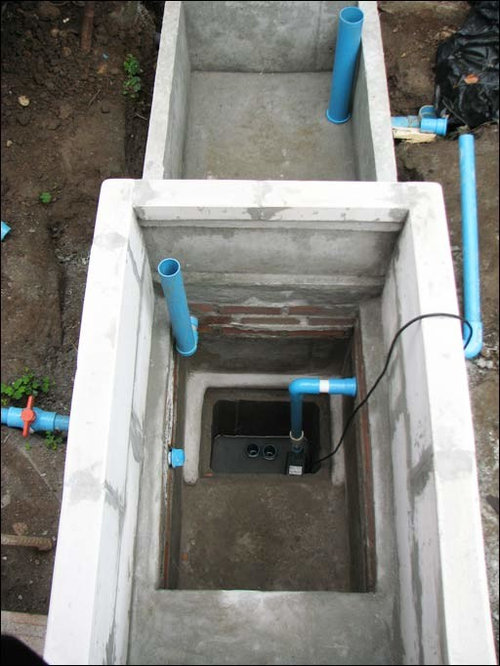
Actually tired and even a bit annoyed with "forum debates" about something that actually calls for action and application, - I gave "nutrient cooling" another thought and figured out something of my own concept, design, - and most importantly executable with small space, by my own efforts and skills and most importantly in reasonable time. As I needed a backup for my 2000 Liter tank , I had one more reason to go to action ;-)

Question was: how can I achieve sufficient volume, buffer and performance, without digging deep and extensive trenches, nor moving enough earth to fit a small cellar in. And yet going deep enough and having enough contact surface to achieve the wanted results.

Here is what I came up with , did actually build during the past week and like to refer to as an individual solution to regulate nutrient temperatures.

It is not finished yet (of course) but already fully functional for first testing purposes.

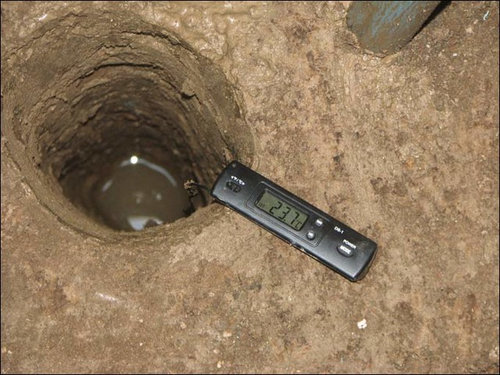
1. I've started to dig out JUST large and wide enough to have a comfortable stand for working deeper and deeper until 2'+. After that I went one step deeper (4'), from where I only started to drill until I reached 10'! At around 7-8' I already reached ground water level but continued until 10'.


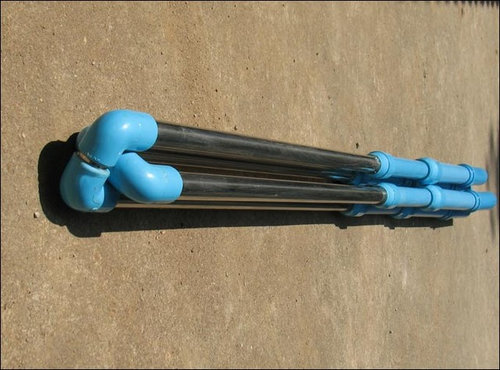
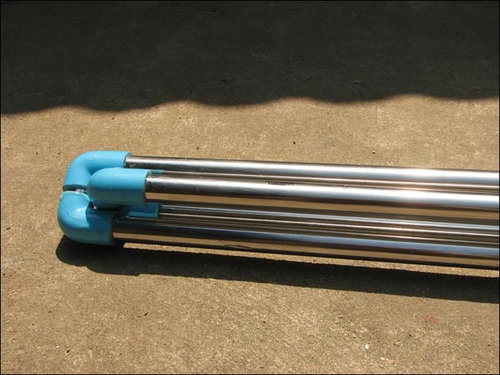
2. The system has got what is called a probe (over 6' long/deep) and it goes 2' deep into the ground water level and (obviously) reaches down to the deepest level of 10'. The water that runs through the probe is just fed by gravity between 2 connected reservoirs (out and return). The probe is assembled from PVC tubes of various diameters and 1" 8/18 (304) stainless steel tubes. A special tubing system actually connects both reservoirs through the probe itself and (re)circulates the nutrients as soon as the supply line (and pump of 50 w) is put in train. The system is not using any supplementary energy, but the actual energy that is anyway needed to recirculate the nutrients with any connected system. It can also be operated as an indirect cooling system, running with tap water and cooling individual reservoirs. But in this case it needs a supplementary pump and is consuming its own extra energy.

To be continued if there is interest in more construction details and if the comments keep well-mannered and non-biased. No disrespect intended - but in case of individual boycott or collective bystander boycott I do prefer sharing the construction details through a more welcoming and progressive channel. ;-)

Cheers to all,

Jean-Luc

Comments (5)

  • 15 years ago
    last modified: 11 years ago

    Personally I don't see anything new in concept and/or design. That's still using geothermal energy for cooling. Basically instead of going lengthwise, you dug your trench straight down. That's called a geothermal well design, and is common in some locations. Using the metal tubes is fine, but nothing new. Everybody knows that metal will conduct heat much faster than poly or pvc tubing. But it's also much more expensive too.

    That's still nothing new to me, I have seen the same type of thing in commercial setups. Both in using metal tubes, and vertical design. Only on a larger scale. Using a central connector, and and an array of metal tubes connected to it, going out at something like a 30 or 45 degree angle. The mental tubes allows the system to be smaller because it conducts heat faster, but that's nothing new at all. I could still get much more efficiency out of that 10 foot hole. Unfortunately I would need a jackhammer, or commercial drilling equipment to get that deep and narrow here. That's what makes it difficult for me to put a reservoir in the ground. Also our water table is deeper here as well.

    The no added electricity needed isn't new either. Putting a pump inline with the cooling tubes , so it runs through them at the same time as it feeds the hydro system is simple, and again nothing that I haven't already considered the pros and cons of. Gravity feeding the cooling tube inlets, and pumping out from the exit side is only thing possibly new, but also poses it's own issues (like the fact water seeks it's own level).

  • 15 years ago
    last modified: 11 years ago

    So you are saying that it's all well chosen, tried and tested components all in all? Thanks!
    As for the "nothing new" part, well yes I did my homework and played indeed safe with good reason. Actually because all I needed is a reliable work horse. Thus I haven't exactly intended to be part of any avant-garde movement with this project and do not exactly recommend it to others either. ;-)

    Actually, when people try to be too innovative and overestimate their competences, deductive powers and skills, - they often tend to bungle and end up with something odd and non-remunerative.

    I guess I made my point about the meaning of INDIVIDUAL in this context very clear as well. It's supposed to serve as an example (only) how everyone has to use and also deal with individual conditions, like configuration of the soil, space, available toolsets, own skills - advantages and limitations.

    Btw: Nice attempt to trivialise the best and truly innovative part. But using gravity feeding to pass water (or nutrient solution) through the probe using the energy from the feeding pump in combination with gravity only, isn't just a gimmick but making all the difference to other known solutions here. There is no single issue with liquid seeking it's own level here either: on the contrary, I am taking full advantage of gravity only. Although, generally speaking, their might be some - with this concept and construction (having considered this particular fact and thought it all ends up through) there simply is NO issue nor disadvantage with it!

  • 15 years ago
    last modified: 11 years ago

    What are you digging with? I was wondering that about the other pic of the cylindrical pit with the sludge in the bottom, too. Is the ground fairly easy to dig in?

  • 15 years ago
    last modified: 11 years ago

    Yes tubes have been used in Geothermal energy systems from the beginning. So yes that's definitely a tried and tested component, That's where I got the idea myself from. But the choice of tubing, size, length, temperature difference, volume of water being cooled, as well as placement are the deciding factors in the overall efficiency of the geothermal system. That doesn't even take into account the cost of the materials, and or the best way to get the most efficiency.

    For the cost of those 4 stainless steel tubes alone, I could get about 700 feet of 1/2 poly tubing. The same stuff used in commercial geothermal energy applications, and again both the fact it's a tube, and made of plastic poly tubing are both tried and tested components as well.

    "when people try to be too innovative and overestimate their competences, deductive powers and skills, - they often tend to bungle and end up with something odd and non-remunerative"

    Well true to form it didn't take long before the insults, and superiority complex comes out. You clearly were trying to take credit for inventing the geothermal well design, your exact words were "something of my own concept, design." You didn't come up with either the concept or design, just wanted to take credit for it like everything else. But your "LACK" of skills leaves a lot to be desired in overall efficiency you could have achieved in the same 10 foot hole/space (especially if that was your focus). Even playing off tried and true concepts (not your concept/design).

    ""I haven't exactly intended to be part of any avant-garde movement with this project and do not exactly recommend it to others either"

    Fact is, your statement something of my own concept, design suggests quite the opposite, or at the very least trying to take credit for a concept someone else came with. I haven't tried to be a part of any "avant-garde movement" (another one of your stupid sarcastic insults), or trying to reinvent the wheel with my trench design concept.

    Fact is the type of tubing, the depth of the tubing, the placement of the tubing in lengthwise coils, as well as in a trench are all "TRIED AND TESTED CONCEPTS AND COMPONENTS" TAKEN FROM COMMERCIAL APPLICATIONS. Nothing "avant-garde" about it what so ever. As for the size tubing, it's a well known fact that smaller volumes of water heat an cool faster than larger volumes of water do. The only thing that's not exactly taken straight from tried and true geothermal systems is the exact length of tubing needed top cool the water. That's simply because I haven't found any "tried and tested charts" to go by, probably because there are so many variables that affect the system in general for such a chart to be reasonably accurate.

    I wasn't trying to trivialize anything. In fact I was actually trying to give you credit, or I wouldn't have even mentioned it in the first place. I'm just simply not as impressed with the thought, as you are with yourself. Fact is water does seek it's own level. We did experiments in school in the 8'th grade proving so, and I have been proving it ever scene. Weather it's going to be an issue, depends on many factors such as water level in the reservoir (both flood and drain cycles), type of pump (submersible or not), placement of the reservoir (in ground, or above ground etc. and ultimately water level), water level in a secondary smaller holding tank/reservoir at the exit end with the pump needed for submersible pumps (or considering the cost of a different pump), type of hydro system and it's location from the cooling system etc. etc.. Just because you think it's the answer to everything, doesn't make it so. Weighing the pros and cons of placing the pump on the exit end would need to be considered first. I'm simply just not impressed with any of it like you are.

  • 15 years ago
    last modified: 11 years ago

    Hi Joe,
    >>What are you digging with? I was wondering that about the other pic of the cylindrical pit with the sludge in the bottom, too. Is the ground fairly easy to dig in?Perhaps sounding kind of trivial- but in fact crucial questions.
    Because in the first step it's all about digging with such project. Anyone who really will go to action must be aware that "heavy work and lifting" is involved.

    To the points: 1. I in fact use traditional "thai tools" like lightweight an narrow spades with a shorter shaft. They may look kinda uncommon and (perhaps) little practical to foreigners but are in fact fine tools. You dig slower with those but do not tire yourself up as quickly as with heavy tools.

    2. I fought my way in through several chewy, tougher and stony layers before reaching an ancient layer of a former rice paddy. Finally uniformly sandy-loamy so to speak. The site had something of an archeological excavation at that point.

    3. Anyway, once I reached the deeper, uniform and "stone-less" layer I could only start to drill. The actual drilling of around 6' deep was performed with the sole use of common PVC pipes (4" and later only 2"). The challenge here is not to drill, but to get the dirt out of the hole. ;-)

    The next part is the construction of the 3 leveled tank. Here I used various building techniques and materials like pre-casted concrete boxes, bricks & mortar and the upper (and largest) compartment is in fact build from Cellular Light Wight Concrete Blocks.

    PS: folks who are not used to hard physical work will probably exhaust themselves early when choosing to go for a solo performance of that scale. Whatever tools you choose, go easy if you want to keep a stiff upper lip all day long ;-)

Sponsored
AIS Renovations
Average rating: 4.5 out of 5 stars15 Reviews
Custom Craftsmanship & Construction Solutions in Franklin County, Ohio