Software
Houzz Logo Print
bevinga

Hydrangea not growing

18 years ago

Hi,

I have two small hydrangea that were already planted when we bought our house. We've been here four years, and I think these hydrangea have been here at least 6 years, but they are extremely small. Every year, I wait for them to grow and it just doesn't happen.

What could be the reason?

What kind of fertilizer should I use on them? I have slow-release Miracle Gro for Flowers and Vegetables. Is that the best kind, or is there something else I should get?

I also have a blue lace-cap that was huge two years ago. Last year, we had a late freeze in April so we didn't get any blooms, and the drought that we're in didn't help any. It died back over the winter, but I didn't prune it because I was afraid to do anything to further traumatize it. Of course, the leaves have always died back every winter and it has come back just as big as the year before.

This year, it has come back, but is much smaller than ever before; however, it does have blooms. I've left all the older branches, wondering whether or not it is going to go ahead and put out leaves sometime later this summer.

Do I need to go ahead and remove the dead and just let it grow from where it already has new growth?

Does it need fertilizer (I've never fertilized it before and it's been gorgeous until last summer) and if so, what kind for it?

Thanks for all your help!

Beverly

Comments (3)

  • 18 years ago

    There are some varieties that stay small, like Hydrangea Preziosa (3-4' tall by the age of 10 years old) for example. How much 'small' are we talking about, Beverly?

    And yes, they need fertilizer but they do not require much or often. The old adage of 'less is more' works fine here. You can fertilize them in May and July with 1/2 to 1 cup of manure or cottonseed meal or a general purpose slow-release chemical fertilizer. Then add some weak fertilizers throughout the growing season (coffee grounds, liquid fish or liquid seaweed). Then stop all forms of fertilizing by the start of August in order to prepare the plant for dormancy.

    The also need about 3-4" of any type of acidic mulch through or past the drip line to conserve moisture.

    The lacecap looks like it got hit by the winter weather if it lost all stems and started growing new stems from the crown but it is hard to give you an opinion why this happened without knowing the variety & other information.

    For example, it may not be able to withstand Zone 7 winters (it was planted out of zone); or the winter was dry and it did not receive enough moisture; or it needed more mulch for proctection from the drying winter winds; or it got too much fertilizer late in the year and it stayed in 'growth' mode when it should have been dormant; or, or, or...

    Maintain the ground moist by watering early in the mornings and do not forget to spot check the soil during dry winters. If you can, water the soil and not the leaves. If the soil feels almost dry or dry (you may to check this specially in winter or the hottest part of summer), then water 1g of water or so.

    Hope you get some blooms from the lacecap next spring,
    Luis

  • 18 years ago

    Thank you, Luis!
    I wish I did know the variety of any of my hydrangea, but unfortunately, the man who planted them has died and there's no way for me to know for sure unless someone can identify them from pictures.

    My small hydrangea are about 1'X 1' and only once have I seen any blooms on either of them. They are the round, blue blooms. They just never seem to thrive.

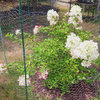
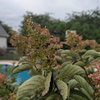
    Here is a picture of the lacecap two years ago:

    Approximately the same angle, but taken today, June 14, 2008:

    Again today:

    Lacecap two years ago:

    Lacecap today,same angle:

    Lacecap Top View Today:

    Small hydrangea #1:

    Small hydrangea #2:

    Thank you for your advice!
    Beverly

  • 18 years ago

    Luis, by not disputing anything you said about hydrangea's care I would like to say that using Preziosa as an example of a 'small hydrangea' is a bid of a stretch of word 'small'.
    I have total of 6 of Preziosas growing in a different lighting conditions from almost full shade (6'+H x 7'W) to almost full sun (5x5') and by any stretch of imagination couldn't call them small :-) None of them is older than 6-7 y.old.

    I don't know the definite answer to question of original poster about her 1x1' hydrangea, but from my own experience could tell that some cuttings taken from the same plant are inferior (stunted growth) to another cuttings taken from the same plant.
    3 years ago I propagated several cuttings from one of the my NB and year later planted 6 identicaly looking small plants as a group about 30' apart in order to cover wide area. 5 took off and now become 3' tall shrubs, but one, being in a ground for two years already is still the same size (8-10") as it was planted.
    What cause this phenomena I don't know, but it happens to me before with different hydrangea. In that case cuttings were planted in a different conditions and I thought that the soil/watering made the difference. In NB case everything was inentical and this happened again.

    In any event, by looking at the pictures, I could say that it's something wrong with a small one if it stays like this for 6 years. I would of relocate it and see what happens.