Software
Houzz Logo Print
seif26

Possible tomato overwatering?

18 years ago
Long time lurker in this forum but first time poster :)

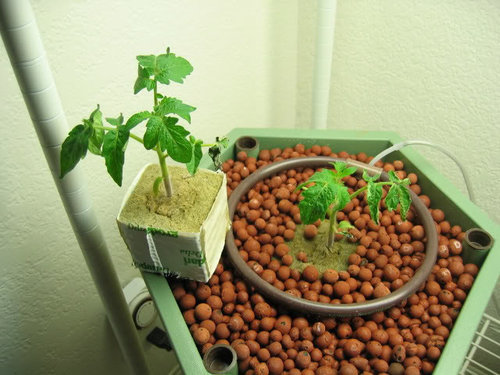
I had a couple pepper plants in the past that I grew in a GM power grower and wanted to do the same thing with tomatoes now. I started the seedlings in grodan blocks, transferred to the ~3" cubes and they started to take off once they got about 3"-4" tall. I then transferred the strongest plant to a power grower eco and that is when the problems started.

Lights - VHO Flourescent. 4 bulb system.

Hydro - power grower eco.

Nutrients - 0.9 EC with Ionic Grow

Light for ~18hours a day with water cycle during that time.

30mins on then 60 mins off for the 18hours.

The plants are called patio tomato or something similar I bought as seeds. I was hoping for a smaller plant. The lowest leaves on the plant started curling up and the plant growth has all but stopped. I had two other plants in the grodan blocks which are doing better. 1 of those has a couple wilting leaves but the second plant which may have actually been underwatered (drooping) seems to be doing the best.

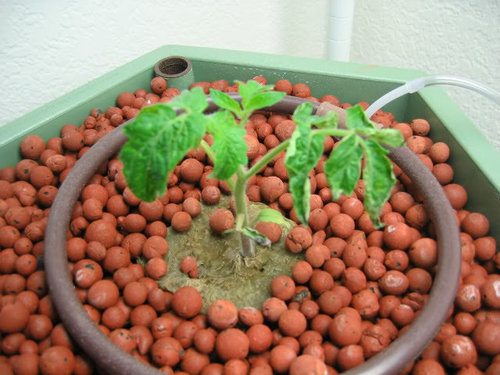
I have a couple pics attached. Any thoughts?

Thanks in advance!

power grower with plant -

pg plant and one in grodan -

Comments (13)

  • 18 years ago

    My first thought goes towards this 0.9 EC value. Surely that can't be correct for tomatoes? Tomatoes are heavy feeders.
    Comment?

  • 18 years ago

    Hmm.... I thought it was normal to go half strength until the plant was a bit bigger. I can up the nutrient solution but the non-hydro plant that looks the strongest is getting straight tap water at the moment. The water from the tap is ~7.0 ph.

    I thought I may have stressed the grodan cube a bit when I planted it but I really wasn't very rough.

  • 18 years ago

    Half strength is fine when the plants are still shoots, but these are young plants. Your EC should be a minimum of ± 1.5 The max for tomatoes is about 2.5 (bearing fruit)
    Tomatoes also like a slightly lower pH. About 6.3

    Look, these are my impressions . . . perhaps you should consider making these changes and see what happens.

  • 18 years ago

    I will definitely make those changes asap. I have knocked the watering down to 15mins on 90mins off and that still keeps the rockwool fairly moist.

    I will let the plants go with the new EC and pH changes for a couple days and see what happens.

    Thanks again for the info!

    Seif

  • 18 years ago

    I actually came here today to post this exact same question, and I'm also using the clay pebbles. I mention that because Jason, at the AutoPot factory, told me today that they had trouble with these pebbles increasing the pH level. I'm not sure how to measure this. My reservoir water is fine at about 6.0, but how do I know if it is increasing when the water hits the clay pebbles?

    Also, I'm getting leaf curl, too. I think my roots may be sitting in water too much. I have other plants where I left the potting dirt around the roots when I transplanted them, and those plants seem to be doing better. I posted a photo of the leaf curl on hydroponics blog here:

    http://kennyshydroponics.blogspot.com

    I'm wondering if I would benefit from dumping out half the clay pebbles and adding a compost/perlite mixture?

    Here is a link that might be useful: Kenny's Hydroponics

  • 18 years ago

    hey Kenny,

    One thing I will mention is that my EC and pH values were for when I first put the stuff in. I checked again after a few days of running and the pH was 8.0+ and the EC was 1.8 or so. I rinsed the clay pebbles for 10mins or so but I guess I didn't rinse them enough :(

    I redid the solution and they are back up running. I will let that go for a few days and see what happens.

    Seif

  • 18 years ago

    I basically skimmed the posts, but a pH of 8.0 is going to be locking out some micronutrients. I believe that is the cause of the leaf curl.
    The clay pellets should not be affecting you pH levels. I would wager the Ph in the pellets is increasing because autopots work by flooding the system then not reflooding until all the liquid is gone. you're probably getting a salt buildup in your medium.

  • 18 years ago

    ty for the response grizzman but I will admit I am not sure I understand your post.

    I have been measuring pH and EC in the nutrient reservoir underneath the clay pellets. After setting everything up the first time I measured a pH of ~6.0 and EC of 0.9. After about 1 week of running the system I checked the reservoir (which had a layer of dust from the pellets at the bottom) and the pH was 8.0 and EC was about 1.9.

    Some of the water evaporated but maybe only 10%. I was attributing the spike in pH to runoff from the pellets. I cleaned the system, started it again and after the next week the pH only spiked to about 7.0. I lowered the pH with pH lower but since the EC was solid I didn't do much else. The plants are growing but still exhibiting signs of leaf curl.

    I will change out the solution again in the next couple days and report back any interesting findings.

  • 18 years ago

    A few suggestions. I keep the solution weak when the plants are young. The biggest issue with tomatoes when small is that the roots really do not develop that well. Additionally, the roots need a lot of O2. If your plant sits in a solution, and you have a bubbler, its likely that the roots are not getting any O2.

    The PH must stay between 5.8 - 6.3. If not, tomatoes do not do well. In fact I like to keep them between 6.0 - 6.3. What I do is check the PH twice a day. I check it first thing in the morning, and then before bed. I find that the plants will change the PH from 6.3 - 5.8 in just 12 hours.

    The higher the PPM, the greater the shift can be in PH. Also, change out the solution every 5 days and not 7 days.

    If your plants are hanging in the media and the solution drains off the media drying out the roots, then I would suggest that you flush the media out every time you change out your solution.

    Here is what I do every 5 days on my tomato plants.

    Day 1: Dump existing solution. Flush out the media with a small dose of hydrogen peroxide (about 500 ppm). I flush for a min of 10 minutes with the hydro-proxy solution at a PH of 6-6.3. I then clean the solution holding area with soap and water. Once clean I fill with the appropriate solution PPM amount and set the PH to 6.3. I will check it about three times and make sure it holds at 6.3 before running the system.

    Day 2-4: Check the PH twice a day. Setting the PH to 6.3 each time. I find that the PH fluctuates depending on the type of tomato plant. I have some cherry tomatoes that only drop the PH about .1 per 12 hours. I have some Tumbling Tom's that drop the PH from 6.3 - 5.8 in 12 hours. I also check the PPM or EC every few days to make sure the solution is strong enough.

    I start out with a PPM of about 500 for baby plants increasing up to 3000 PPM when fully grown and covered with lots of tomatoes.

    Hope this helps.

  • 18 years ago

    mhargraves, you're using a solution of 3000ppm? Seems a tad bit high. My truncheon doesn't even measure that high. I've never heard such an extreme for any plant. That would have to be an EC of 3.9 or so. I'm assuming you are using a 700 scale since the 500 would put you at an EC of 6.5 or 7.

    As far as pH, rockwool is pretty good about raising pH, too. That's why they have you soak it in lemon per the instructions. Don't know for sure if that is your problem, though. I have one tomato plant with a bit of leaf curl. I have a dual autopot going on these two plants and the one with leaf curl is growing faster, but the one without leaf curl appears to have healthier leaves. Both plants are in the same medium, on the same reservoir, under the same light, and from the same tomato's seeds. I was concerned about white flies since the leaves are taking on a different texture, but upon close inspection with a microscope I found nothing. I had this problem before with another variety of tomatoes and they got all distorted and grew these yellow ridges that looked like small yellow caterpillars. All of them I was growing came from plants I seeded from the same packet and so I contacted the seed company to see if they had ever heard of this with this variety. No. I sent pictures to the horticulturist. He was so intrigued he wanted me to send samples to the University of Minnesota for study because the symptoms didn't match a deficiency, viral or fungal attack, or an insect attack he had ever seen. Unfortunately, I didn't take the time to mail a plant out. If this variety gets the exact same symptoms, I'm sending a plant to Minnesota.

  • 18 years ago

    I strongly suggest to everyone to use an aeroponic rooting chamber to grow their seedlings in. Two weeks in this type of system will give you 6 inches of roots hanging from the cubes. The plants are then moved into a hydro system and they take off like crazy.

    I use a 20 hole unit called a "Clone Machine". They now have a 25 hole one for sale. It's worth every cent!

    http://www.horticulturesource.com/product_info.php/products_id/2442

  • 18 years ago

    I believe you, but have no idea how that relates to the topic. I made an aeroponic system cheaply and my peppers in it grow better than any other plants.

  • 18 years ago

    I'm sorry, I got myself side-tracked and didn't finish saying what I should have. I think it's possible that the problem with the plant shown, is that it's root system isn't large enough to compensate for the timing of the feeds it's getting. The root system should *always* be sufficient on the outside of the grow cube to allow the plant to gain enough nutrients and water before the system drains or stops feeding. I don't think the plant in question is large enough to have that much root growth.

    In this case, I think the feeding frequency should be increased to compensate for the other factors I mentioned above. The system being used looks like it may be an "Ebb and Flow" system. Perhaps a drip ring hybrid...I'm not sure. It really makes no difference in the feed timing for those types of systems. I would increase the feeding time to one hour on, one hour off, until the plant has enough root mass to stand longer intervals.

    If the increased feeding times don't help within 24 hours, then that is not the problem.

    Good luck!

Sponsored
Peabody Landscape Group
Average rating: 3.5 out of 5 stars8 Reviews
Columbus' Reliable Landscape Design & Contracting