Software
Houzz Logo Print
hayseedman

hydrangea cuttings propagation

21 years ago

I mentioned before that I had taken some cuttings of Blue Billow in the early, early spring. Totally contrary to the usual recommendation to take cuttings in the mid summer when the stems have hardened off a bit.

They have done just fantastic. So much for the textbook. They're the ones in the picture at the left. I had stuck about four cuttings into soil in a gallon container. The soil only came up to about half way in the container. I've taken the plants out of the plastic pot so you can see just how well they've rooted. I like the idea that the plants are well rooted and fill up the container as I put it away for the winter.

A few days ago I'm playing with some of my hydrangeas (Summer really is finally over), cutting them back, transplanting, dividing, and I begin to wonder if I could take cuttings this late in the year. (Where's that textbook?) Again, totally against what the book would say. And although I have never really tried it, I'm a little aware of the technique of taking dormant wood cuttings and placing them in sand and then they callus over and ....But this isn't exactly the right time and I certainly don't intend to do anything more than put these into my mound and hope for the best. So I take all these long canes that I know are going to get zapped by the winter and cut everything to the ground. I must have about 60 cuttings, each of them a foot or so in length, and I stick them all really close to together in the bottom of a fifteen gallon plastic pot. Stuck them into five or six inches of soil. This will end up in my mound with all the other hydrangeas. (Not exactly like a nice cozy greenhouse.). I'm encouraged by the thought that a few years ago I took some cuttings of a Viburnum, (long cuttings), and

did nothing more than stick them into the ground in the fall. Keep in mind that this is zone 5. Now, I have no experience doing this, but I'm excited to think that I could possibly have 60 baby plants well started by next spring, ready to put on a lot of new growth over the summer. We'll see. That's the picture on the right which I had just watered in and the perlite and water are still sitting on top of the soil as I quickly took the picture.

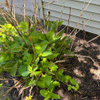
Finally the textbook version of taking cuttings in the end of July. That's the pitiful picture in the bottom. Probably rooted, but if the Fall version works, then someone is going to have to write some new books.

Hay.


{{gwi:1024205}}

Comments (7)

  • 21 years ago

    Hay,

    I do hope you document all of your experiments and observations. You may just end up being the author of that new book one day!

    The bottom pic looks familiar, not unlike my (foiled) attempt at cuttings this year. Quite the contrast, the early cuttings look fantastic!! Do you think they will make it through the winter? Bloom next season?

    I have heard many say they have stuck a broken stem in the ground and up came a plant. So far this method has not worked for me but I can't wait to see what becomes of these stems. Is it imperative to do it in the Fall?

    Gosh, I love it when you play with your hydrangeas, because we always get good tidbits of info out of it. Play on!!...yg

  • 21 years ago

    Hay,
    What textbook was that? Obviously, I haven't read it! I take cuttings anytime there are green leaves on the plant and sometimes when there aren't. Potted up about 100 cuttings yesterday and they will be rooted, overwintered outdoors and potted up at first sign of Spring. Many will bloom next year. I'm in a warmer climate, of course, but with some protection, yours should do fine. For the old hardwood canes, I remove them from the plant in late fall after frost and layer those,uncut,1-2" deep in one of the flower beds. In the Spring or early Summer when new growth appears and roots have developed, I cut the canes on each side of the new plant and place in pots. Works for me. I have a good friend that is a Botanist(PhD) and he is always rooting cuttings of something, I sort of follow his lead.
    Good luck!
    Rb

  • 21 years ago

    I'll keep you posted, yg. I have so much fun with these hydrangeas. I think the ones I rooted in the early spring will have a very good chance of surviving the winter. They'll be inside my mound and I've had pretty good luck with ones this small and with only a few roots. I would expect that they'll flower, too, but I'm not so interested in that for these Blue Billows. They're very reliable for me in this zone without any winter protection, so I've been working on propagating them for a while. I did very, very little with the Billows to get them to root. One nice thing about taking cuttings early in the spring is that you don't have to deal so much with the heat of the summer. I almost did nothing more than stick them in the soil and then put them in a shady location for the rest of the summer. They were watered just like the ones I had around in pots, but with very little extra care.

    Razorback, what you said is very encouraging. Thank you so much for sharing your experiences. When I was cutting back these long stems the other day, I thought about the possibility of doing what you do. That is, laying them down without cutting them into pieces and, in my case, since I'm in a cold zone, I would have mulched them super, super heavy and hope they would root. Then come back in the Spring and hope to find that they had rooted up and down the stem and new growth would be coming from the pairs of buds all up and down the stem. I think that is pretty close to what you say you do in the late fall with the hardened off canes.

    I wonder though if I wouldn't be encouraging mice and voles and other critters to come in and make a home under all this mulch. No problem with the critters as long as they didn't keep my plant from rooting, but I suspect they wouldn't help. That might be a difference for you and me with our different zones. It just occurred to me that I could easily enough put a piece of wire mesh over the area before I mulch it to keep the critters from burrowing in the area.

    I hadn't even considered the possibility of doing this with the old hardwood cuttings later in the fall. More fun ahead. Thanks, Razorback.

    Now I'm really excited. I thought I was moving into uncharted territory here, but Razorback has made my day a little brighter. Now, if only he could send up some of that Georgia warmth...

    Hay

  • 21 years ago

    Would be more than willing to send some heat calories your way, but haven't determined yet how to package them. I sure could use some of your chilled air for my Hostas. Our winter low temps for the past 4-5 years has been in the upper teens(borderline Zone 9) and they sure aren't thriving in that environment! Can't apply much Nitrogen to them, as that, plus warm, wet winters promotes the onset of a fungal disease, commonly referred to as "Southern Blight"

    Might I make a suggestion re covering your canes with hardware cloth or small mesh? Bend about 3-4" of the edges at a 90 deg. angle and insert that in the soil. Otherwise, voles will tunnel under the mesh and feast on whatever tasty roots(or bulbs) they find. Learned that lesson the hard and expensive way. They tunnelled under a mesh covering and ate all of my rare Lycoris species one winter. Found that they love Bletilla sp. Orchids also!
    Rb

  • 21 years ago

    Just wanted to say "Hey!" Hay. I'm doing a little propagation myself...at least I hope I am. Just doing the basic layering technique, though. I tried to root some very early cuttings myself, but they didn't make it. They weren't really cuttings, they were bits of cane that snapped off when I was covering the plants because of early spring frosts. I'm feeling confident that my layering is going to work, I wounded my stems and applied rooting hormone, then weighted them down with a rock so the wound touches the ground. I'll check on them in the spring. Anyway, glad you're having fun with your babies! (BTW, I'm not going to do any winter protection for ES this year...I have too many and I don't think it's really necessary. I'm more confident in their flowering ability now.)

  • 21 years ago

    Thanks, Rb. That's a good suggestion about the mesh. The voles and moles don't usually go very deep with their burrows, so three or four inches might just do the trick.

    Interesting, with my mound, and with the hydrangeas in them, I've never had a problem with anyone eating the plants. Pretty remarkable considering the environment I'm creating for the critters. I see lots of signs of activity: they'll burrow all in the space, and even disturb the soil in some of the containers, but I don't think I've ever lost a single bud to them. I've seen hydrangeas on some poison lists and I remember seeing that the poisons of many plants are more concentrated in some parts of the plant. Sometimes I wonder if the buds, the bark and the roots might be more loaded with poison or loaded with something that tastes awful.

    I would think the critters wouldn't actually eat the stems, but maybe their burrowing would expose and disturb them.

    One thought I had was to just bury the stems a lot deeper than the few inches that you do. If I were to go down more than six inches, then the critters probably wouldn't create too much havoc with them. And after I posted last time, I realized that I could bury them inside my mound. Keep everything together. I may be trying something like that as an experiment.

    Thanks for your insights.

    Jen, good to see you. I've made a point of not doing anything to overwinter a planting of five Endless Summers for the past two winters. Last winter was a good test since they had become pretty established. The plants all got killed back to the ground, but, from the crown, I got a few flowers early in the summer.Very few, but still enough that I was happy. Better than years and years of never seeing even one flower from my Nikkos, All Summer Beautys, and Dooleys. And I would see a few blooms come along later in the season. I have not been able to see any flowering in the fall. Mine are in the shade and I don't deadhead them.

    Layering is a tried and true way to propagate. Easy, too. Taking cuttings in the middle of summer turns out to be a lot of work. You've got to keep them misted, keep them out of the sun, not let them be touching or you get rot..... I hope my fall cuttings work. I won't use it for many of my hydrangeas. I took a lot of cuttings in August, knowing that the plants had not yet set the buds for next years flowers by that time. But I couldn't do that on November 1 ( I don't think). I do know that I've cut back some Nikkos on September 15 and still been able to get buds to set, but would that be too early to take these fall cuttings should it work out? I've got a lot to think about.

    Good luck, everyone. Hay.

  • 21 years ago

    I have been successful with my Nikko Blue rooting itself when a branch lays on the ground for a while. I like them easy like that!

    I have a hydrangea that my boss bought for me from the grocery store a few years back. I put it in the ground and it has been growing ever since. I always cut a bloom to show her it is still alive. This year we put it in water and it rooted after a month or so. I potted it up and now it is putting out new growth. The wonders of nature!