

Blue Marbutt
Wouldn't it be nice to have a couple threads open for discussion of specific varieties?
Here's one variety which I've heard of, but all I know is that it's offered by Sandhill Preservation Center and highly recommended by DarJones (fusion_power).
Who had grow this bean? What do you like about it?
Any pictures?
George
Tahlequah, OK
Comments (25)
 17 years ago
George, I grew a test row this year. They were planted about 3 weeks late, due to the heavy June rains in my area. It impressed me immediately by the speed with which it climbed - the vines are very aggressive, and require no training. It is heavily foliated, and has beautiful purple flowers, followed by rounded, 6" pods in clusters of 4-6. The pods are green, with a purplish caste.
I had sampled some raw, and they were OK, but not exceptional. Unfortunately, I left my garden unattended for a week, and missed the prime stage for snaps; they had mostly toughened up when I returned. Because of that, I did not record the DTM for snaps... but it was fairly late.
The dry seed was also fairly late, beginning at 95 days & continuing until frost. The seeds were small & black, and production was heavy, albeit drawn out - they never did all mature for me. The night before the frost, I harvested a huge amount of shellies, which the wife & I ate for several days. They were pretty good used as refried beans.
I have not yet grown "Cherokee Trail of Tears", but have seen it on Heritage Farm during a visit, and the two varieties seem to be similar. I have a package of CToT seed, and compared it to "Blue Marbutt"; they appear identical.
Macmex
Original Author17 years agoDoes Blue Marbutt have strings or is it stringless? I take it isn't a tender hull variety. One could leave a tender hull variety on the vine an extra week and, generally, it would still be good for a snap, just more filled out.
Perhaps someone can post a picture of this bean (vine, pods, seed).
When you say that production was drawn out, does this mean that it produces over a length of time? I would consider that to be an advantage.
Thanks!
Related Professionals
Worcester Landscape Architects & Landscape Designers · San Luis Obispo Landscape Architects & Landscape Designers · Reno Landscape Architects & Landscape Designers · Miami Landscape Contractors · Sebring Landscape Contractors · Newport News Landscape Contractors · Hackettstown Landscape Contractors · San Bernardino Landscape Contractors · San Angelo Landscape Contractors · West Plains Home Additions · Waterbury Home Additions · Fort Wayne Home Additions · Pullman Home Additions · Wenatchee Home Additions · Yakima Home Additions- 17 years ago
I had a small trial this year. Like Zeedman's, mine were good climbers. I only tried them as young snaps, which were good. They set high on the vine, so many were out of reach.
The name is confusing. Being black seeded and green/purple podded, I don't know where the Blue comes from.
Also, there are several beans that are linked to Josie Cates Marbut Hawkins, so I wonder what the correct spelling is, Marbut or Marbutt.
Gary
- 17 years ago
"When you say that production was drawn out, does this mean that it produces over a length of time? I would consider that to be an advantage."
Yes, it produced dry seed over a long period. This might be an advantage - provided that the growing season is long enough. Mine was not; many (perhaps 50% of the pods) were not yet dry when the frost came. As mentioned, the late planting may have influenced this, and I might have had better results had they been planted on time.
- 17 years ago
They are named after a lady named Marbutt who gave seed to my MIL about 20 years ago. Mrs. Marbutt had grown them for about 50 years before that. The beans are good but not exceptional as fresh snaps. They are very good for home canning and are very well adapted to the humid southeast. They are also good producers in a wide range of climates across the country.
Of all the heirloom pole beans I have grown, only 3 are good enough to qualify for commercial use today. Please note that I have only grown about 100 heirloom pole beans so my sample size is still pretty small. Blue Marbutt does not turn a true blue color. It turns a funny pink/purple/blue especially when exposed to direct sun and high heat. They are semi-stringless, meaning that they have more strings than most modern varieties but if picked at the early snap stage, they are pretty much string free. The beans are relatively easy to shell out of the pods when mature. The green shellies have a mild buttery taste. The mature beans can be shelled and used as dry beans but to my thinking, there are better beans for this purpose.
DarJones
Macmex
Original Author17 years agoOkay, so this bean is good, but not outstanding for fresh snaps and very good for canning. So, if a person does a lot of canning, this should be one to really consider.
DarJones, what do you mean by qualifying "for commercial use today?" I'm not so sure that would make me want to grow a variety!
Okay, one more question. Here's a picture of Oaxaca Cream, a Mexican greasy. Is this the "blue" you're talking about with Blue Marbutt?
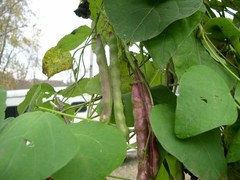
George
- 17 years ago
When I say good enough for commercial use, that means a variety is good enough that it could and should be sold for and used in gardens across the USA. It is a variety with wide adaptability and good production as well as good disease tolerance, and flavor. In other words, a variety that could beat many commonly available commercial varieties. As an example, Grandma Roberts Purple Pole beans are widely adapted, very productive, and have other traits good enough to make them a top notch bean beating out even Trionfo Violetto for example in terms of production and flavor.
The other traits do not match, particularly pod length, bean development, etc, but the color is close between your Oaxaca Creme and Blue Marbutt. The magenta is a bit too intense, should be a bit more of a lavender.
DarJones
- 17 years ago
The correct spelling is Marbut, she was my grandmother. I grew up on her garden. Sad to say she passed away in May 2000.
- 17 years ago
Thank you Cheryl, I had come to the same conclusion a few months ago when I did a records search for Marbut vs Marbutt. I've been growing these beans for 5 or 6 years now and have had excellent results each time. I grew them side by side with Alabama #1 and they are very similar but not identical.
George, I'll take a picture of the pods and vines tomorrow so you can see what they should look like.
As a side note, the Cherokee Squaw corn is terrific. This is the best open pollinated corn I've yet grown. I have a crop that is huge by any measure. In addition, it is excellent as a cut off the cob corn in the milk stage. With a little luck, I will send about 5 gallons of seed to Glenn at Sandhill.
DarJones
Macmex
Original Author17 years agoThanks all. Cheryl, to know the person behind the heirloom is worth gold. During the whole time our children were growing up, whenever I planted our family heirlooms, I'd tell the kids stories about the relatives who passed them on to us. We'd repeat this while eating the produce.
DarJones, it would be great to get a picture in here. Glad to hear about the Cherokee Squaw Corn. I have mixed feelings because this year, I ran out of time and didn't get that one in. [Insert low whining tones.] I got in a minimal planting of Mesquakie Indian corn. But next year Cherokee Squaw will have top priority.
George
- 17 years ago
I'm glad to hear I've been spelling it correctly.
Fusion,
Have you ever thought about trialing Buhl sweet corn for Glenn?
- 17 years ago
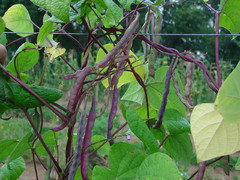
This is a photo of the Blue Marbut beans when they are mature and ready to harvest for shellies or for seed. When they are at the snap stage, they are much less intensely colored. In this photo, you can see why I call them "blue" marbut. The mature pods turn blue.
DarJones
Macmex
Original Author16 years agoDave, where do you live? Oaxaca Cream is daylength sensitive. Here in Oklahoma, I can only get mature seed by growing the in a container and bringing them in, a few weeks, at the end of the season. If you are further South, I might be able to send you some seed. But if you're not, I don't think you'd really want Oaxaca Cream.
George
- 16 years ago
i live in california by 30minute south of san jose
my family is from oaxaca, my mom is looking for this seed i think is the oaxaca creamthe color is like mexican pink
in the beans are blackis possible can you send me some seed
Macmex
Original Author16 years agoDaved,
drop me a note, via Gardenweb (click on "My Page") and we can make arrangements. You may well live in a place where this bean would grow.
George
 5 years ago
I have a question/comment for Fusion_Power. About 30 years ago, I responded to an ad in the Mississippi Market Bulletin and obtained some beans from a lady in Alabama who said her grandfather had grown the "Alabama Pole Bean" for many years. We grew that for about 10 years and loved it. The seeds were black, and the bean resembled a "Rattlesnake" bean, except the purple markings were finer and more vein-like. When we moved to a more urban location, we were unable to continue growing beans and lost the seed. Since I am now able to garden once more, I have been trying to find this bean. I ordered Alabama #1 from Sandhill two years ago, but that was NOT the bean we had previously grown. Do you think this could be the mystery "Alabama Pole Bean?" I think I will order these seeds and give them a try. My email is rickksmith1954@gmail.com.
Macmex
Original Author5 years agoI was just in communication with him yesterday. Will give him a nudge for you.
- 5 years ago
Following up that I got Alabama #1 seed out of ARS-Grin and started them a few weeks ago. They are now in the garden ready to produce a seed crop. One caution, I see visual differences in color of 2 of the plants. It is possible these may have been crossed to another variety. I will know by the end of the season. I separated the different color beans at the end of the row so I can cull them if they turn out incorrect.
Macmex
Original Author5 years agoCrossing is more common than most folk think. Still, hopefully you'll get a decent, uniform batch.
- 5 years ago
With beans, crossing runs about 1 or 2 percent. Since seed coat is maternal tissue, most crosses are not detected until the F2 seed are grown. This makes it very easy to muck up a good bean with unwanted crosses. On the other hand, I'm growing several varieties of beans this year that are the result of deliberate efforts to make crosses. Some of the crosses I've grown over the years turned out to be fantastic new varieties. Others were duds.
I really want to capture the good traits from Turkey Craw into a more acceptable snap bean. I'm attempting a cross with Emerite this year. Time will tell. :) Macmex
Original Author5 years agoI grew Spangler last year, and understand it may be a synonym of Turkey Craw. At any rate I thought it was FANTASTIC!
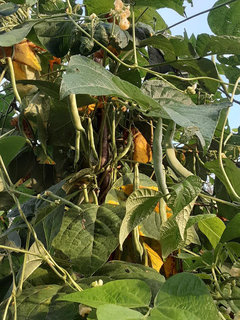
I'm a fan of tender podded beans that can be strung.


fusion_power