Software
Houzz Logo Print
avidchamp

Setting out Asparagus Crowns

17 years ago

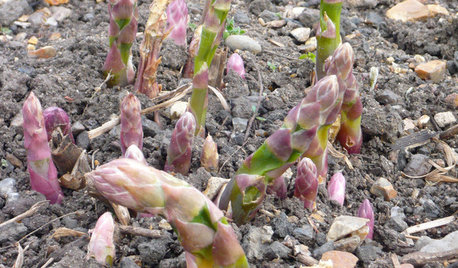
I just received my Asparagus Crowns in the mail and am wondering if I need to wait until later in the winter to set them out or if I should get them in the ground this week while we have some warmer weather to work with. I ordered the U-157 from Womack Nursery down in Texas.

These will augment the small patch of Asparagus that I already had. We had a wonderful crop of ferns from it this summer and I am told that this is necessary for them to make a good crop of spears this spring.

Bob

Comments (6)

  • 17 years ago

    Bob,

    You can plant them whenever you want. I'd do it now while the weather is nice. And, you purchased yours from my favorite Texas nursery too. : ) Asparagus can be planted in the fall (if you can find crowns) or in winter/early spring whenever crowns are available.

    And you were told correctly. Good ferny growth is essential in order for asparagus to produce a good crop the following year. Also, you don't harvest the first year (or two) that a new planting is in the ground. You want to let the plants get well-established so they will produce a good crop for you for many years. With newer plants, too, you have to restrict the harvest to a certain number of weeks so you don't sap all the plants' energy.

    I'll find and link the OSU factsheet on growing asparagus in the home garden. It is a little out-of-date as it references older varieties that have since been superseded by the all-male plants so popular now, but the "how to grow" info is great.

    Dawn

    Here is a link that might be useful: Growing Asparagus in the OK Home Garden

  • 17 years ago

    Well, the "sparrow-grass" is now in the ground and covered up. It was too pretty a day to waste not getting out and doing something productive outside. The bed looks so lonesum sitting there with nary a plant in sight so I am wondering what the harm would be in sharing the bed with something like radish or turnip and mustard greens since it will be a year before we can eat anything out of the location. Seems such a waste for nothing to be grown there and to be fighting the blown in weed seeds. Any suggestions?

    Bob

  • 17 years ago

    As a matter of principle, I don't like anything else in an asparagus bed except asparagus which is completely opposite from the way I prefer to grow everything else. My usual style is tons of companion plants (veggies, herbs and flowers) all crammed tightly into beds, but with a perennial crop like asparagus I don't like doing that. Asparagus plants are heavy feeders so they don't "share well" and they do better, I think, if they aren't sharing their soil's nutrients with any other plants.

    Maybe Dorothy or someone else could advise you whether or not they have ever companion-planted in their rows of asparagus, and, if so, whether it worked for them or not.

    With asparagus, the challenge is always to keep everything else out of the bed, so I'd just mulch it heavily, heavily, heavily and check it weekly, removing every single weed that sprouts in the bed. But, that's just me.

    The thing is, if you ever let grass or weeds or anything else into an asparagus bed, it can get out of control really quickly. Since a well-maintained asparagus bed can produce for 15-20 years or more, I believe in maintaining firm control and keeping everything else out, out, out. If you ever lose control of the asparagus bed, it takes an amazing amount of work to rehabilitate it.

    And, it goes without saying, if bermuda grass infiltrates the asparagus bed, hand-digging it out is the only viable option because any chemical that will kill grass will kill asparagus.

    If you are familiar with the concept of companion planting, then you know that some plants are "good companions" and like being planted together and othrs are "bad companions" and do not like being planted together.

    For asparagus, good companions are basil, parsley, nasturtium, calendula and tomatoes, but only if the bed is wide enough that the companion plants' roots won't compete too much with the asparagus roots. Bad companions for asparagus are garlic, chives, leeks and onions.

    Dawn

  • 17 years ago

    We have never put anything in with our asparagus bed, except for the few years when we couldn't get enough mulch to cover it well and then we had weeds in it. We let the lambsquarter get 3-4 inches high before pulling it for the greens. We hoed everything else out as early as possible. Now that we are covering the patch thickly with oak leaves, we have no winter or early spring weeds, but do have to pull annual grasses in midsummer. Dawn is right about Bermuda and Johnsongrass is almost as bad. We sacrificed several crowns to both of these back a few years ago and sprayed the Roundup.

    Like Dawn says, you want to get asparagus off to a good start and that means heavy mulch--no competition--and consistent moisture for the first couple years. After that you don't have to water--we don't but a very dry year will cut yields the next spring.

    The rule I follow about picking is to pay attention to size. Until the patch is very well established, pick no spear smaller than your pinkie finger. Now that our patch is well established, I clean pick it to deprive the nasty asparagus beetles of anywhere to lay their eggs early in the season. I start picking when the spears erupt of course, but let the weather be the guide to when to stop. In a very wet year like 08 I pick a little longer into the summer through midJune or so. But in a normal year the harvest stops from midMay to early June.

    Don't forget that asparagus likes alkaline soil. We live in an acid soil area and use acid oak leaves thickly for a mulch so sprinkle woodashes over the leaves throughout the winter. Radishes like acid soil, so don't know how good a companion they would be.

    And talking about mulch, I hope you mulched the area as soon as you got those crowns into the ground to prevent frost heave.

    Maybe more info than you needed but maybe others are interested. And UC157 is a great variety, more males than female plants which means you will have big fat spears and not a lot of seeds which can give you too many seedlings. Our old planting of Mary Washington only lasted 15 years and declined so that we destroyed it. But the UC157 is still going strong at 20 years.

  • 17 years ago

    Thank you for all the info.

  • 15 years ago

    Newbie Alert!!!
    I've decided on the spot, I've decided to splurge and get the 3-year-old crowns, now all I have to decide is what kind of mulch? I take it grass clippings are bad. My leaves are walnut and heartnut, which I've heard aren't good as mulch, but I don't want to spend a lot. Any thoughts?