

rat-tail radish, salad burnet, violets
Under what conditions do you grow rat-tail radish? When my mil grew them in dappled shade in tubs, they attracted flying varmints by the score.
I like to grow salad burnet and violets in 20 gallon tubs for salad greens in the summer. Don't know what kind of violets-- they were labelled as 'Confederate violets', but the flower is all wrong for those. Last summer I pulled the tubs under the trees when it was hot. It seemed to me those were somewhat drought tolerant. Does anyone else grow these plants for salad greens?
Comments (15)

merrybookwyrm
Original Author14 years agoThank you, Dawn, for the rat-tail radish information. Maybe my mil's problem was too little sun. She was frustrated, because the bugs from the rat-tails migrated to her swiss chard and mesclun.
I was thinking about the salad burnet and violets in response to Chandra's request for drought tolerant vegetables. I don't know if these two qualify as drought tolerant, but they do at least as well as the swiss chard here. They might qualify for the drought list. Salad burnet, swiss chard, and violet leaves make a pretty good summer salad! I grow mine in 20 gallon containers, so just hauled them under the shade when the weather went hot and dry last year.
I got the violets as 4" pot plants during a close-out sale at a local 'organic' nursery. They were labeled confederate violets there, but if you doubt them being confederate, then I'm really sure that's not what they are. They have deep purple flowers, and do better with addition of iron chelate in the alkaline soils in dfw.
Related Professionals
Pine Bluff Landscape Architects & Landscape Designers · Belleville Landscape Architects & Landscape Designers · Winston-Salem Landscape Architects & Landscape Designers · Fall River Landscape Architects & Landscape Designers · Lima Landscape Architects & Landscape Designers · Chico Landscape Architects & Landscape Designers · Richmond Landscape Contractors · Baltimore Landscape Contractors · Longview Landscape Contractors · Fort Dodge Landscape Contractors · Westerly Landscape Contractors · Oxnard Landscape Contractors · Pullman Landscape Contractors · Stamford Accessory Dwelling Units · Pueblo Accessory Dwelling Units- 14 years ago
You're welcome.
I wonder if the bugs were flea beetles? I see damage from them on regular radish leaves some years in February or March, but usually don't see damage on the rat-tails. I don't know why.
I think if the plants thrived or even just survived in last year's heat there in the D-FW metroplex, then they definitely qualify as drought-tolerant.
I'm not doubting that you have confederate violets, but I just am surprised they could thrive in last year's weather. I also didn't know that Confederate Violets were edible, but since other violets are, then why not them? Is the flower on yours not the purple-veined white that is typical of Confederate violets? I also think maybe they can cross with other violets or violas.
I don't grow Confederate Violets, but we have some woods violets growing in our woodland. I haven't taken a walk in the woods yet this year, so don't know if their foliage is up. They sort of ebb and flow in various years, undoubtedly in response to the weather of the previous year. Sometimes after a bad drought year, I hardly see any and assume they have died, but then in a wet year they pop up all over.
I'm going to link a photo of one so anyone else who's interested in them can see what they look like.Here is a link that might be useful: Confederate Violets
merrybookwyrm
Original Author14 years agoThe google images of flea beetles do look like the bugs described to me. Heh. I couldn't imagine what they were. Thank you!
I didn't know anything about violets when I bought these things; just thought the plants were neat, and took the label at its word. When they did flower, their flowers didn't look like confederate violet flowers in images. They look like the flowers of 'sweet violets'-- dark purple-- when you can find the flowers. They tend to hide under the foliage. Maybe they are a cross. That could explain it.
They do like water in containers, just like swiss chard does, and the ones I put in the alkaline ground here developed iron chlorosis until given a little iron supplement. (Regular fertilizer might have worked, but I didn't have that at the time and did have the iron chelate.)
It will be interesting to know if you find any violets in your woods. The little wild violets that live at my parents' and at a high school here haven't showed up this year. Maybe later.
- 14 years ago
I am afraid my woods violets may not have survived last year's drought. I guess time will tell. We used to have quite a few native ferns in one portion of our woodland, but they disappeared during the recurring droughts in 2005-2006 and 2008-09, and I haven't seen one since. I hope the violets haven't met the same fate.
- 14 years ago
I ordered rat tail radish on a whim just a couple of weeks ago. Do any of you eat the pods? I have no idea why I got them. LOL
Diane
- 14 years ago
I am glad see some discussion goring on the rat-tail-radish (RTR). Thanks you Dorothy. I never grown RTR here in OK, but I am very familiar with their long pods and flavor, there are two types in the local market one is green an another is purple. Dawn where you get seeds of RTR? I found green type from SSE. I am looking for the purple type.
Below is the picture of Purple RTR, long purple bunches in the picture they are called Lal Mogri in Hindi.
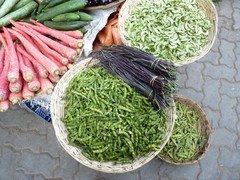
Diane, yes pods are edible, we make curry or dry subji, cook similar to beans.
-Chandra
- 14 years ago
Diane, Yes, we eat them. They are good added to stir-fry. Some people pickle them, but I've never tried that, and some people chop them up and add them to salads.
I've linked a really informative page below that will tell you a lot about rat tail radishes. There's a couple of recipes at the end of the article.
Chandra, I've only grown the green ones, and I obtained the seeds from Seed Savers Exchange, although other seed sellers (especially those that specialize in heirloom or OP varieties) carry them as well.
The purple podded ones normally are available from John Schleeper Kitchen Garden Seeds or from Bountiful Gardens.
Dawn
Here is a link that might be useful: Rat Tail Radish Growing/.Cooking Info
- 14 years ago
Thanks, Dawn & Chandra. I was reading that article Dawn linked earlier today. Lots of good info there.
Chandra, I ordered mine from Bountiful Gardens but they only had one variety. I don't think it mentioned if it was green or purple but, upon looking at it online just now, the photo shows green with purple tips.
I'll save seed to share if I don't kill them first.
Diane
Here is a link that might be useful: Bountiful Garden's rat-tail radish
- 14 years ago
Dawn thanks, I got purple variety from John Schleeper Kitchen Garden Seeds and Green one from SSE. Chandra
- 14 years ago
Diane, I don't think you can kill them. They are really huge plants and just keep growing and blooming and growing and blooming forever. I didn't grow any last year because of the expected drought. I cut my garden back to bare bones plantings, so didn't even plant winter squash. That probably was a good decision for 2011, but I am feeling better about 2012 (especially since my house is now surrounded by a lake of standing rainwater) and am going to plant less conservatively this year than I did last year. So, I think I'm going to companion plant winter squash and rattail radishes together again. The flowers attract a lot of little flying critters, but in a good way.
The rat-tail radishes are said to help protect squash from squash vine borers, and it is hard for me to say whether that is true (to really know, I'd have to have a separate area of squash in the same year with no companion plants to compare the two), but when I companion plant nasturtiums and rat tail radishes with winter and summer squash, I have fewer pests on the squash, so I keep doing it.
Chandra, Glad I was able to help.
Dawn
- 14 years ago
I forgot mention in the earlier post, last year we left few white radish plants to bolt, they produced heavy pods but short 1-2" we used them for regular cooking, it was really good. Since then, I started liking pods more than roots! -Chandra
- 8 years ago
Its an old thread but one that has the most information I am looking for. Does anyone have purple rat tail radish seeds for SASE or trade? Searched far and wide unsuccessfully. Most places that carry them are sold out or crop failure. I have my mind set on growing it after seeing beautiful pictured of those long purple pods.
Thanks!
 8 years ago
I have never seen these. This is fromJL Hudson:
Radish Edible-Podded Rat's Tail. VRAD-RT. Packet: $2.50
1/4 Ounce: $7.50
Raphanus caudatus. Grown for the slim, deep-purple seedpods, which reach 8 - 16" long. Pods produced abundantly. Likes heat and bears all summer. From Southeast Asia, the pods have a very pungent radish flavor, eaten raw, pickled or cooked. A popular garden vegetable in the U.S. in the 1860s, now rarely seen. No edible roots, only grown for pods.- 8 years ago
AmyinOwasso, thanks a lot for this link. I must have searched this several times over on Google but this result never showed up. They have a few other interesting veggies too. Just when I thought I am done seed shopping for this season :) LOL. Thanks again for the pointer.

Okiedawn OK Zone 7