Software
Houzz Logo Print
shekanahh

Front Yard Gardening

17 years ago

I downloaded and watched this video from the link I'm posting...."Edible Estates". I'd been wanting to do something like this. I like to grow LOTS of vegetables, fruits, berries, and fruit trees, now that I'm not working and a stay-at-home gardener.

It seems I never have enough room for everything because of the large expanse of lawn I have. And besides, I do get so tired of mowing bermuda. It seems like a waste of time, energy and space as well.

This idea really took hold with me, especially as the food prices on the grocery shelves keep increasing. I am trying to be more self sufficient, and not having to rely on a shaky economy for survival.

I think putting in a front yard garden could be done attractively, and it would be sort of like a modern day suburban "Victory Garden"....and would put food on my table and pantry without paying taxes on it, other than the seeds or plants that go in the ground and the property taxes I pay on that ground. Id' like to make the ground I have produce and work for me instead of it just laying there demanding water and upkeep, and yeah, those never-ending property taxes.

If anyone has any ideas for plants or designs I might use, I would appreciate it. I'm going to lay down some Visquane in the area I want to use, rather than incur the expense of sod removal. This may be unattractive for awhile, but I think I can deal with it. I'm just excited at the possibilities! There is still a small window of time for me to plant some dwarf fruit trees :)

Here is a link that might be useful: Edible Estates

Comments (5)

  • 17 years ago
    last modified: 11 years ago

    I find bermuda removal very liberating... and necessary for planting other stuff, flowers or edibles, or both.

    Bermuda has a way to always come back, unless every tiny speck gets removed. IMHO

    Check the link, for some neat ideas.

    Here is a link that might be useful: potager gardens

  • 17 years ago
    last modified: 11 years ago

    My garden IS in the front yard, but I live way out in the country and my "front yard" is a couple of acres since the house sits back quite a distance from the road. Ever since we moved here, my whole goal has been to (slowly) remove bermuda bit by bit and replant the area with something more desirable....from fruit trees to veggies to ornamentals. Little by little I am succeeding in removing the hated bermuda grass.

    Depending on what your front yard is like, you may want to put up a fence, or plant a barrier of shrubs to keep passers-by from helping themselves to your fruit, nuts (if you plant nut trees) and veggies. Everyone I know who has a garden out front or even in a side yard close to a roadway has had some problems from time to time with "theft" of produce from the garden.

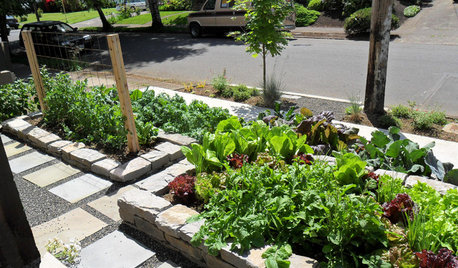
    To make my highly visible front yard garden as attractive as possible, I have a cottage style mixed border of flowers and herbs around the perimeter of the serious veggie garden. I also companion plant every row of veggies with flowers and herbs, and I mulch heavily and weed religiously so that it always looks really lovely.

    One way to make a front-yard garden beautiful is to carefully choose colorful plants. For example, if you're going to grow eggplant, don't just grow the standard green plant with dark purple fruit. You can grow eggplants that produce fruit in shades of white, violet, purple, green and orange. There's even some streaked, bi-colored eggplant too. For greens, you can grow Swiss Chard in several colors. Both the "Bright Lights" and "Neon Lights" Swiss Chard are a mix of extremely colorful plants. Lettuce and mesclum both come in many shades of green and dark red. You can have a lot of fun being creative with mixing the colors.

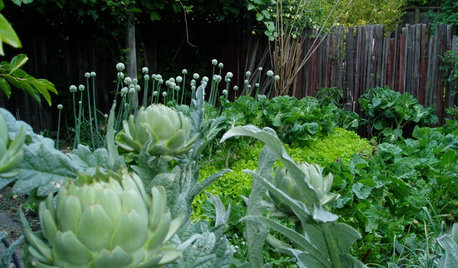
    One of my "old farmer" neighbors was visiting the other day and he commented on some gorgous round globes of flowers I had planted in a border with four o'clocks. When he asked what they were, I said "Onions--they've been there several years". He just laughed and said "Only you would put onions in your flower beds". I laughed and agreed with him. After all, I put flowers in my onion beds, so why not put onions in the flower beds too.

    When I first started mixing together veggies, herbs and flowers in my vegetable garden, I read and thoroughly enjoyed several of Rosalind Creasy's books. I'll link something about them below. My favorite (although I like them all) was called The Edible Rainbow Garden.

    Some of the standard garden plants that look gorgeous in a front yard garden include all kinds of sweet, hot and ornamental peppers (esp. the ornamental peppers with purplish-black foliage), eggplant, tomatoes in a whole rainbow of colors, Swiss Chard, mesclun mixes, lettuce and other greens, kale (green, black and red varieties abound), okra (esp. the red ones and the dwarf ones), black-eyed peas (the vines and flowers both are lovely, onions, potatoes (if healthy, the plants are beautiful and they flower too), etc.

    Corn is iffy in the front yard garden. It looks great while it is green and growing, but not so wonderful once you've harvested the ears of corn and the plants are browning. I usually companion plant pole beans and they climb the stalks and hide the ugly brown stalks while also producing a great crop of beans. I like to grow "stuff" on the fence that surrounds the garden, including morning glories, moonvine flowers, black-eyed susan vine, cypress vine, purple hyacinth beans, and (of course) regular pole beans and southern peas.

    And, because I am who I am, I always stick a few veggies into the mixed tree, shrub and perennial borders that surround the house too. So, when you're looking at the flowers, you may or may not realize that there's beans, tomatoes, peppers and sweet potatoes in those beds too.

    I know some people love the lawns, but to me a lawn is pretty much useless. It is a high-maintenance monoculture that does not sustain much life other than itself (and grubs). I'd much rather devote space to fruit, nuts, veggies and herbs that are useful in so many ways AND which support a healthy insect population (many insects are beneficial) as well as a thriving community of all kinds of birds, reptiles, amphibians, butterlies and moths, rabbits, etc.

    Don't overlook herbs. There are many, many herbs that you can grow and use not only for culinary purposes, but in many other ways....flower arrangements and wreaths, in lotions, cleaning 'potions', salves, teas, etc. Here's a few of the herbs I grow every year: garlic, chives, chamomile, several types of basil, lemon balm, lemon verbena, sage, oregano, fennel, pineapple sage, marjoram, rosemary, thyme, borage, parsley and cilantro.

    Finally, don't forget edible flowers! Nasturtiums are my favorite edible flower, but sugared violets look lovely on desserts too.

    One key to keeping your front yard garden especially attractive is to continually succession plant new crops to replace those that are finishing. For example, when my broccoli is harvested from Bed #1 next week, bush beans will go into that "empty space". Then, when the broccoli comes out of Bed #2 in about 2 to 3 weeks, black-eyed peas will go in there. A fully planted and well-maintained front-yard garden will be the envy of the neighborhood and it will give you lots of produce as well.

    One year I planted a "rainbow garden" in which every raised bed was a color of the rainbow (with the colors in the same order as they are in the rainbow). It was so much fun that I did it for three years in a row. The biggest challenge was the "green bed", but I found lots of green-fruited veggies (green peppers, green eggplant and green-when-ripe tomatoes, green okra) green-leaved veggies (chard, lettuce, cabbage), and even flowers with green blossoms (sunflowers, zinnias, amaranths and Irish bells).

    You can have a whole lot of fun with a front-yard garden.....MUCH more fun than you'll ever have with a bermuda lawn.

    Dawn

    Here is a link that might be useful: Rosalind Creasy Books

  • 17 years ago
    last modified: 11 years ago

    Oklamoni....Amen! Anytime you can get rid of that strangle grass, it is liberating, lol! Hey, thanks for that awesome link on the Potagers Gardens. Don't you just love to look at those pictures and dream? This has given me some great ideas and courage to move forward and plant, plant, plant!!And I am going to usurp that useless piece of lawn to do it in !!

    Okie Dawn,
    Wow! Now THAT'S what I'd call a real front yard garden and then some! Lovely advice, and I am going to save this info to refer to as I go along.

    Fortunately, I already have a pretty good barrier of decorative plants, flowers, and evergreens, between the road and my stretch of lawn, so hiding the goodies from would be veggie thieves shouldn't be too difficult. In fact, I have already incorportated some veggies they won't be too inclined or even able to rip off. In the very front of my border set back a ways from the road, I'm planting sweet potato slips, (edible kind of SP), that, as they vine, should act as a sort of ground cover, and sort of spill over a slight slope.

    Then, earlier this spring I tossed out some Mesclun for micro-greens that I am beginning to harvest the babies from for salads. I also tossed out some zinnia seed, Cosmos, Marigolds, and planted nastursiums which I figured would fill in after the micro-greens were gone by summer.

    You gave me a lot of ideas for the part I plan to kill off. I've used black 4 mil. Visquane before and let the sun bake the burmuda and surface seeds to death. It works great, but the problem then is creating a barrier so the burmuda can't find a new way to invade the garden space. Looks ugly during that process, but you shout hallaluya afterwards!

    My backyard garden is burmuda free from this practice, thankfully. But if you have any little strands of burmuda on your tiller tines, look out, because they're looking for a free ride and a new home. Sometimes I wish we had Augustine here....but oh well, what we do have is wonderful sunshine, great soil and a long season.

    I have quite a few items I will be able to transplant into the new front yard garden. Egyptian Walking Onions I think would look interesting planted in a circle, and I also found 5 baby Red Russian Kale I thought I'd lost. These started up from an old dried out stalk from last year. This will grow up to have gorgeous purple leaves with red veins.

    Oh, and purple basil and Red Amaranth I have volunteering. It's all about contrast and texture and mixing things up, one color next to another veggie or flower of a complimentary color, size, or texture.

    I get the idea...

    My gardens usually evolve rather randomly instead of ridged planning, but it's all in creating beauty as we go, and there are only a few set rules that one must follow.

    Wouldn't it be wonderful if America would adopt the English or French ways of gardening that are so beautiful and productive? Well, looks like some of us are :)

    Every morning, I just can't wait to go outside to the garden and make the tour, and I'll bet you do the same! What a joy and pleasure that is.

  • 17 years ago
    last modified: 11 years ago

    Shekanahh,

    More and more Americans are getting into raising at least some of their own food. My hope is that people who start small, with maybe a couple of tomato and pepper plants, or maybe just some herbs in a pot, will enjoy it so much that they keep expanding their edible gardening and shrinking the lawn.

    I so admire all the Europeans who raise a huge bounty of crops in their potager gardens. The Italians have made it an art form in the same way the French and British have.

    When I was a kid growing up in a small suburb of Fort Worth, all our neighbors had veggie gardens and fruit trees, and many of them had a few chickens or rabbits. It wasn't like Neighbor #1 was a gardener, and Neighbor #2 was a gardener, but Neighbor #3 wasn't. Everyone had something they grew.....if not veggies, then fruit trees and if not fruit trees, then blackberries, and if not blackberries, then chickens, etc. That was in the 1960s and the 1970s. By the time I was newly married in the early 1980s and moved back to the same neighborhood, most of the gardeners were gone and the people who replaced them didn't raise veggies or rabbits or chickens although some of them kept the fruit trees they "inherited" pruned and producing at least. It was sad to see how it all had changed. Of course, we planted fruit trees and veggies and flowers and carried on the old neighborhood gardening tradition, along with a couple of the old-timers who still raised veggie gardens in their ever-increasingly-shady yards.

    I'm even surprised at how few people here in rural Love County have fruit trees and raise veggies. Space isn't an issue because most folks "out in the country" have lots of room. I do see new gardens pop up from time to time. However, many inexperienced gardeners tend to become overwhelmed when the Johnson Grass and Bermuda take over their gardens a month or two after they plant, so often the "first garden" is their "last garden".

    One benefit of the current "economic hard times" is that more people are trying to raise their own food. Hopefully they'll get hooked on gardening and have a new hobby.

    Dawn

  • 17 years ago
    last modified: 11 years ago

    OkieDawn...I had been thinking in terms of "Victory Garden" gardening, when this idea of Front Yard Gardening germinated in my mind. Also, I was trying to overcome the problem I have in my huge back yard, in that during the spring rainy season, it's like the flooding of the Nile, and takes FOREVER to dry out enough to plant spring crops that have to end up being planted in raised beds on higher ground, as the Mesclun micro-greens, green onions, spinach, etc. Then too, this large back yard expanse is bordered by humongous trees. There's ALWAYS something to deal with, one way or the other!

    Anyways, yes indeed, we aren't standing in foodlines here and by the grace of God we won't be if we prepare now, and use what space we have available for growing, canning and preserving food. Frankly, the thought of being reduced to eating burmuda salads really doesn't appeal to me. Well, you know what I mean. But yes, hard economic times are upon us what with rising food prices, and approximately 1,500 miles from where the food is produced to our grocer shelves. Besides our own time and gas spent going to the store and paying for the items, we're being taxed on those items as well.

    My parents always had gardens, and even though I moved away for a lot of years to the Rocky Mountains of Wyoming and later Colorado and New Mexico, I never lost my taste and love for southern homegrown vegetables. So, I'm still trying to get up to speed on gardening now that I've settled down long enough in one place of my own where I can go wild :)

    I know what you mean about how times have changed and few people in suburbia or in rural settings are gardening nowadays. Many now buy 5 acres and a riding mower, and then if they garden at all, have only very small areas planted in vegetables. I suppose both husbands and wives work these days, and it's not like the old days when the wife stayed home and did all the planting, gardening, and canning, sometimes with the kids help.

    However, as you mentioned, times are changing and we may have some hard times ahead. I think some people are now seeing that, and are beginning to dig their heels in so to speak. It's not a matter of hoarding, but it's just good common sense. When jobs fail, and there's no money to buy food, then what? You know, back during the depression, it was in the cities that folks stood in bread lines, but the folks who had farms were self sufficient and had plenty of food for their families by raising vegetables, fruits, berries, chickens, milk cows or goats for milk, cheeses and butter. Farmers raised beef cattle and most of them had ponds they fished for catfish, crappie and bass.

    Since I've become a vegan convert, I've found that I can almost live entirely from what comes out of my garden, only having to buy a few things like olive oil, cheeses, and a few staples. I feel like I eat like a queen because I can grow things that I love that can't be found in local food markets, and if it could, the price would probably be prohibitive to my frugal nature. You know some of the prices you see on some of these items, and some are so wilted and anemic looking by the time they get to the market, they've lost half of their food value and most of their appeal.

    I don't know what people, and especially those with children are going to do if things get really bad, and they very well may. Things like crop failures, citrus failures, in other parts of the country, droughts, the honey bee's dying, all contribute to crisis in America's food supply, and as we know, America uses a LOT of food. Imagine if it just weren't there? I've read recently of food riots in India and various places due to quirks in the weather causing crop failures. It becomes a crisis, and that could possibly happen here. People go to stores expecting food to be there for them. What if it isn't? So, yes, growing as much food as we can in the space available is not only practical, but it may end up being a lifeline not too far down the road from now.

    Thanks for you kind, wise comments, which are always appreciated, and put to use :)

    Shekanahh