Software
Houzz Logo Print
tigerdawn_gw

tomato leaf questions

15 years ago
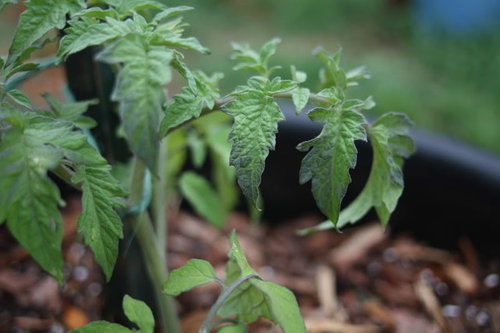
I'd like to learn to recognize tomato issues. I have included pictures of my plants in the hopes that some of the problems have names and can be fixed. I have identified thrips and adult aphids on some of the plants but the leaves are not so obvious.

Roger's Best Black has darkening on the outer portions of the youger leaves. It is pretty but is it dangerous?

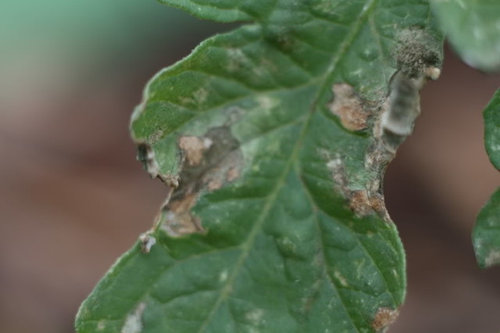
Black Cherry seems to have the most leaf damage of all the plants.

Yellow Boar is one of several plants with this going on.

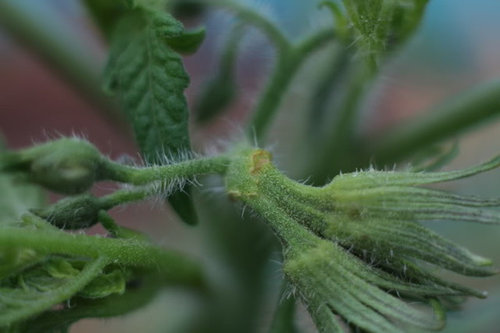
Dana's Dusky Rose. If this flower gets pollinated, it is going to make one heck of a tomato! But what is going on behind the flower on the stem joint?

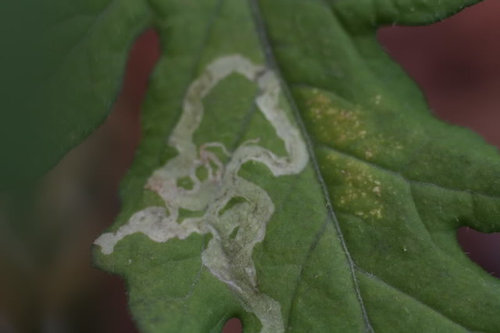
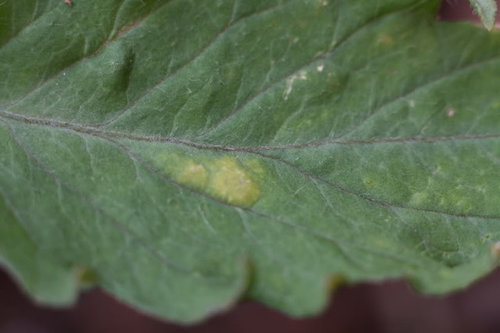
I'm pretty sure this was made by a bug, but which one? The yellow spotting to the right is common on the plants.

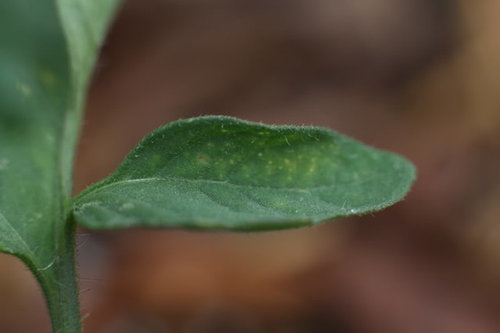
More yellow spotting on Strawberry Margarita

Cane River Paste has larger yellow spots than the others.

Green Zebra Cherry with strange white spots. They go through the leaf.

I read that dark veins can indicate a problem. Is this what they're talking about? Big Black Heart

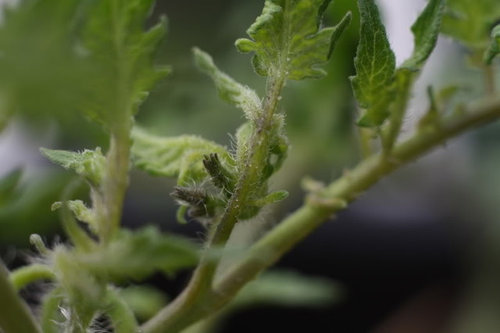
And finally, there seems to be debris on the stems of Wessel's Purple Pride. Is it insect damage or just from the wind and rain?

I know most tomato problems don't interfere with the overall productiveness of the plant but I'd like to know what I'm seeing so I can tell the difference between harmless stuff and real problems.

Comments (14)

  • 15 years ago

    Tigerdawn a few comments about some of your photos. The following link I feel could possibly cover your first picture and possibly the Big Black Heart. Hard to tell about it from the picture. http://aggie-horticulture.tamu.edu/publications/tomatoproblemsolver/leaf/phos.html As stated phosphorus deficiency this early in the year is usually caused by cool temps including soil temps.

    The white squiggly lines appear to be very similar to that of a leaf mine. http://www.dannylipford.com/what-causes-white-lines-on-tomato-plants/

    I will add one more link to some good pictures I consult when looking for causes of problems. http://www.google.com/search?q=tomato+leaf+fungus&hl=en&client=firefox-a&hs=9Fd&rls=org.mozilla:en-US:official&prmd=ivns&tbm=isch&tbo=u&source=univ&sa=X&ei=xSnXTdHAIujM0AHipYiTBw&ved=0CDEQsAQ&biw=1280&bih=659

    I will post some more about a couple of the other pictures later. I imagine some of the real experts will chime in soon. Jay

    Here is a link that might be useful: CSU -Recognizing Tomato problems

  • 15 years ago

    Thanks for the links! I had access to the OSU Fact Sheets but they weren't as inclusive as I wanted and I wasn't sure who else to trust.

  • 15 years ago

    Tigerdawn I use a combination as due to my location I see several diseases that most of KS and OK doesn't. Especially the disease borne diseases. I've experienced the Psyllid yellows, the curly top virus, cucumber mosaic virus and the Tomato Spot Wilt virus over the last few years. I imagine that growers in the western OK Panhandle might be the only growers in OK that would see these on a regular basis. It is due to the SW winds we receive and the insects riding the wind currents. There are a few more sites I visit but most of them have been linked in other threads recently on this forum. These were all sites I visit and trust I hadn't seen linked recently. The phosphorus deficiency should improve as temps warm up. Not something I worry about like some do. If I use a blue water solution I try to use one with a very high P number. I do it because it encourages a huge root system and blooming. And may help with lack of uptake from the roots early in season. Jay

  • 15 years ago

    I have the exact same problem as tigerdawn with her/his "Green Zebra Cherry with strange white spots. They go through the leaf." But mine is on a couple of tomato plants... They are:

    Arkansas Traveler (worst)
    Bush Celebrity
    Supersweet 100's.

    Does anyone have any ideas about this?

    I picked up the Arkansas Traveler in a garden center and they only had about 10 of them... each one had these white spots as shown in tigerdawn's Green Zebra Cherry.

  • 15 years ago

    Greengene,

    The strange white spots on your plants and on Tigerdawn's are not like anything I've ever seen before.

    Usually, if you have leaf necrosis occurring from some sort of splotchy bacterial or fungal infection, the area of necrosis is tan and not white.

    So, my best guess is someone splattered some sort of chemical on the leaves and it burned out the tissue and left those little white spots. It could have been a garden chemical or a cleaning chemical. It is hard to guess what it would have been. Most diseases that would leave something similar would give you tan to brown patches, often with darker tissue right around the edges and some leaf browning or yellowing that's more widespread.

    It also could be from a very small insect chewing holes in the leaves or sucking out sap but neither of you has mentioned seeing any sort of insect, so I lean towards the splatter theory. However, if the patches are continuing to appear on brand new foliage or if they are enlarging or prgressing, we'd have to figure it was some sort of disease or pest. Since the plants look otherwise healthy, it most likely is not a nutritional deficiency.

    Dawn

  • 15 years ago

    Upon further observation, spider mites might be causing it.

  • 15 years ago

    I have had a leaf and tomato problem for about 4 years. No or very, very poor production. Leaves on the plants are all skeletal, frazled and new leaves start out with a very rolled up waxy look. Leaves at this point have a skeletal look and are small. Another way of saying it is that they look electrocuted. I didn't see a picture that resembles my problem. What could it be?

  • 15 years ago

    Hi LeRoy,

    It is hard to guess without seeing your plants. Even when you can see them, it sometimes is hard to guess.

    If you can post a photo, I'll see if your plants resemble any of the photoes in my tomato disease book.

    Because it is an ongoing issue for you from year to year, I think it could be a disease, but it also could be herbicide damage or an odd nutritional deficiency. We are seeing increasing amounts of herbicide damage on plants that have been planted into beds either amended with or mulched with some type of soil amendment (cow manure, compost) or mulch (straw, hay) contaminated with a certain class of herbicides generally used on grassy areas. The herbicides in this class have been found to persist in cow manure, compost and some mulching materials at high enough levels that they devastate sensitive plants planted into them for up to 3 or 4 years.

    Have you tried comparing your tomato plants to photos at either the Texas A&M Tomato Problem Solver website or the Cornell University website? They have some of the best available photos for comparison on their websites.

    I'm going to link a site that shows photos of tomato plants that have a nutritional deficiency. You might try looking through those photos to see if anything matches your plants.

    Also, if you are growing plants other than tomato plants, is it only the tomato plants giving you trouble?

    Dawn

    Here is a link that might be useful: Mineral Deficiencies In Tomato Plants

  • 15 years ago

    So does this look like nitrogen deficiency to you? It's black cherry, the only one that looks like this. All my other tomates are full and lush.

  • 15 years ago

    Is 'probably' a good enough answer?

    I do think it looks a little malnourished. Is there any sort of plant food in the container. Espoma or anything else? Or pelleted fertilizer that is slow release? Anything?

    Also, is the pot draining well and not staying too wet? Sometimes when tomato plants are young and are transplanted into the pot they'll need when they get bigger and the summer gets hotter, they can stay a little too wet (not a lot of roots while they're so small) and stunt or stall. Once they're bigger and gulping down a lot of water daily, they don't stay too wet. There isn't a lot you can do for the first few weeks except wait for the plant to grow a bit. I'd feed it something and see if it perks up. I bet it will.

  • 15 years ago

    I put in Osmocote when I potted everything up. Last night I went ahead and added VegetablesAlive to all the tomatoes. Heeeeyyy wait...

    Black Cherry was one of the two that got VeggiesAlive initially because I ran out of osmocote! It isn't as long lasting I bet. Ha! That was one of the things I was testing this year! And the other VA tomato isn't looking too hot either. Well, they got another dose last night and I'll fertilize them more often now. I did go ahead and buy more Osmocote recently but I want to use up this other stuff.

    Thank you soooo much!

  • 15 years ago

    well while we are figuring out issues can I throw my hat in the ring.

    this is a Black Krim The whole plant seems to have this going on. Its growing very good about 3 feet tall and just as wide, not many flowers yet though

    {{gwi:1106745}}

  • 15 years ago

    The damage that you're seeing on the leaf looks like several different things. That's the problem with tomato foliar problems---they could indicate any one (or more) of dozens and dozens of issues and often the symptoms are not unique enough to tell us which one it is.

    Can you tell us a little about the plant? Growing in the ground? Transplanted when? Is it heavily mulched? Are the leaf issues moving in a specific pattern---for example starting at the bottom and working their way up? Or, showing up on uppermost leaves only or maybe everywhere uniformly? What has your rainfall been like for the last 2 weeks? Has the plant been exposed to hail or high winds? Are you seeing the grayish-tan lesions on the stems of the plant or only the limbs?

    After you answer my questions, I'll take a stab at a diagnosis, but off the top of my head, it looks like it might be a couple of things happening at the same time. I just hate to "guess" without knowing more about the plant and how the disease appeared. One problem with attempting to ID an issue from a photo is that a photo is static and captures one moment in time, but diseases, nutritional deficiencies and even environmental stress are progressive. For me, it is a whole lot easier to figure out what something is if I have watched it appear and progress than to look at a photo that captures it at only one stage.

    Also if you haven't already compared your photos to the photos at the Texas A&M Tomato Problem Solver website, you might want to give it a try. That's always the first place I look, and then if I can't come up with a diagnosis from that, I go to Cornell Univ.'s Vegetable MD Website, and if I still feel like I haven't figured it out, I drag out my tomato disease book.

    Dawn

  • 15 years ago

    Dawn
    Ill do my best to answer. Im over here in south tulsa.

    wind- way to much of it these are on the north side of the house in full sun but the south west winds have hit them hard. small hail once. No physical damage though from either. according to mesonet rainfall for the last 10 days has been roughly 2 inches.

    Raised bed native soil amended with black kow and potting soil. Never tested for PH or anything else
    transplanted april 15 started from seeds about 8 weeks
    prior, raised in my greenhouse.

    Lightly mulched with pine mulch.

    Today was the first time I really noticed the problems so I have no answer for when it started or how it has spread. Mainly on the older leaves.

    sorry thats ill i can add.

    thanks
    mike

Sponsored
J.Holderby - Renovations
Average rating: 5 out of 5 stars4 Reviews
Franklin County's Leading General Contractors - 2X Best of Houzz!