Software
Houzz Logo Print
simsedward

Home Made Grow light

14 years ago
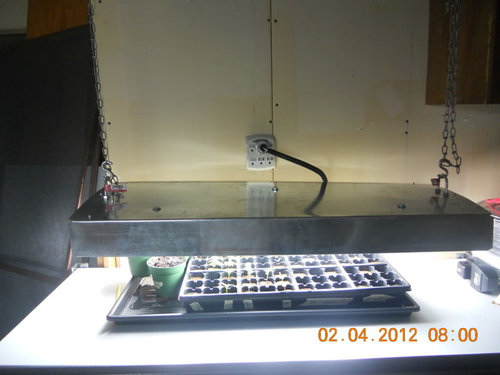
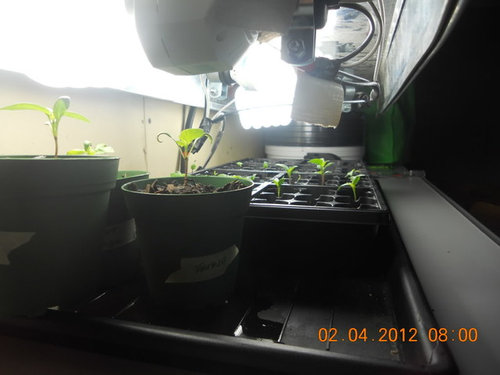
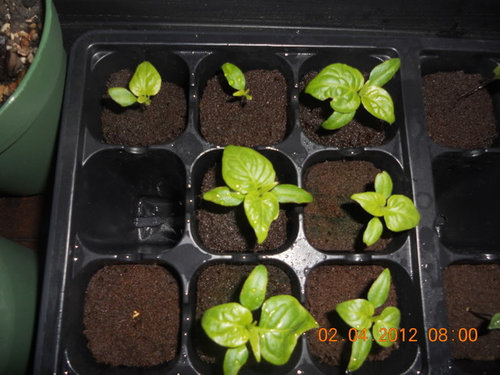
My buddy made me this grow light out of materials from home depot - reflective heat duct is the shield/base. It uses three CFL daylight bulbs. Plants seem to be doing well so far. I germinated the seeds using root riots in this small jiffy flat. I placed the flat of seedlings over a heat return in the floor (elevated on top of books) with a plastic greenhouse cover. They all started quick (even the bhuts). Off to a good start for 2012!


Comments (46)

  • 14 years ago

    Looks Awesome! I need a buddy like that lol nice work and the seedlings are off to a great start.

  • 14 years ago

    Geez, that is some industrial looking lighting. I am sure you can really crank up the light with that thing.
    The plants look great.
    Bruce

  • 14 years ago

    I am running it with these light bulbs
    http://www.1000bulbs.com/product/6052/FC65-S65.html

  • 14 years ago

    That is a lot of light. Never too much though. I was thinking that some day I would go to some kind of CFL type setup too. My kid just happens to be in the Welding and Fabrication program at the local tech college. I may have to hit him up for a custom setup. I like being able to customize the size and shape to fit your needs and you could add as many outlets as you can fit in the hood and just add and remove bulbs as required. Shop lights are fine but you are limited on bulb wattage selection and long and skinny isn't always the best configuration.
    Bruce

  • 14 years ago

    I use daylight CFL's just hanging over the plants with no reflector, works good.

  • 14 years ago

    are cfl's better than fluorescent bulbs.
    what are the best bulbs for growing indoors?

  • 14 years ago

    CFL stands for compact fluorescent light...I think it s the same....

  • 14 years ago

    I've been experimenting using two of the "300 watt" CFL's over the top of my seedlings this year....

    They're hanging from a light mover/rail so the light "flys" over the seedlings......

    doug

  • 14 years ago

    Looks like it is working well...plants look great!
    What is the material hanging behind them?

  • 14 years ago

    Holy smokes that is a lot of light (900w equivalent!)

    I use a 150w equivalent bulb from Menards (~ $9 each) and have had really good luck. I can't imagine 6x the light..

    Nice looking peppers for Feb. 4th.

  • 14 years ago

    "Looks like it is working well...plants look great!"

    Thanks....this is Florida so we need to start early....the tomatos, eggplants and some peppers have already been thru the lights.....and with this unusual season are "hardening" outside....WAITING to plant about March 1 ?

    I start the seeds in trays under flourescent tubes.... and move them to cups and under the CFL's as they grow.... the tomatos formed a solid canopy as they enjoyed the bright lights...The leaves will burn and crisp if allowed to contact the bulb...the light mover solves that problem...

    I'm using the off-the-shelf HD "Soft White" lamp at about $17

    What is the material hanging behind them?......An old mylar windshield sun shade.

    doug

  • 14 years ago

    Funny how people from down south say they "gotta start early" due to the climate and the people up north say the same thing due to the climate. I understand the rational of both lines of thought but it just seems a little ironic. Mainly the difference is that us up north need head start just to get one crop of rip pods. Down south, they need a head start so they can take advantage of the longer growing season and get two or three rounds of rip pods out of a plant.
    Bruce

  • 14 years ago

    I wish I was in their shoes....

  • 14 years ago

    I started some of mine back in October....

  • 14 years ago

    Hey everyone. This is Ed's buddy that built the light.

    Anyone interested in making one here's what you need. All found at home depot.

    2 sheets aluminum duct.

    3 outdoor light sockets (looking back, and now seeing the light in action I would actually go with 4 for more even light distribution. two at the ends facing the same way and two in the middle facing the opposite way of the bulbs at the ends)

    12 gauge electrical wire (I think i used 14 or 16 gauge on this one. It was difficult to bend and work with. lower than 12 and you run the risk of the wire burning up)

    Light socket clamps

    Plug of your choice to run the wires into.

    Various bolts and nuts (don't remember the exact sizes but it's not hard to figure out while you're there with the stuff in your hand)

    The two aluminum duct sheets are riveted together. That's it, no welding needed.

    The light sockets are all wired together, positives to positives and negatives to negatives.

    It cost me a total of $14 to build (minus the rivet gun and rivets if you need to buy them)

  • 14 years ago

    12 gauge wire has a larger diameter than 14, 14 is larger than 16. The higher the gauge number, the thinner the wire.

  • 14 years ago

    Either way, it sounds like a great idea :)

  • 14 years ago

    "12 gauge wire has a larger diameter than 14, 14 is larger than 16. The higher the gauge number, the thinner the wire."

    Correct, i had it backwards.

  • 14 years ago

    I'm thinking of doing something like this - buy 1 or 2 "baker's rack" style indoor greenhouses (plastic zippered cover) and use clamp-on work lights with daylight bulbs in them so I can get light to the lower shelves. Will it get too hot in there with more than 1 bulb?

    Oh, can't tell with backlighting in the pic, but 12 AWG is yellow, 14 is off-white. You probably used 14 - commonly used on 15A circuits (12 AWG is specified for 20A circuits). Anything smaller (higher number) is hard to find unless you're buying from an electronics warehouse ;-)

  • 14 years ago

    CFL lights dont put out a whole lot of heat. Not like an incandescent bulb but if it is getting too hot in your greenhouse, just vent it a little.
    Bruce

  • 14 years ago

    Yeah, I just have to find CFL grow lights. Couldn't find any free flats - local nursery is still closed for season and Home Depot hasn't started putting anything outside yet (too cold - back in the 20's and 30's) so would just be selling stuff. I ended up going to Walmart and getting the 72 cells with tray and dome for $4.50 but if I buy the "greenhouse" that's overkill so will probably use the cardboard cells.

    I'm waiting til this w/e to start - might even have some seeds from smokemaster by then!

  • 14 years ago

    Get the "Daylight" CFL bulbs. They are the correct light spectrum for plants. They should be labeled 6500K.

  • 14 years ago

    I agree make sure they are labeled DAYLIGHT and 6500K and you will have great looking plants.

  • 14 years ago

    Where can you find them? Home Depot? I'm kinda limited around here.

  • 14 years ago

    Home Depot will have them. Walmart has some. Just about any store that carries them but home improvement stores usually have the best selections. Menards, Lowes, Home Depot etc...
    Bruce

  • 14 years ago
  • 14 years ago

    Thanks - I'll check HD and Walmart the next time I'm in town, save the shipping fees but if they don't have them I'll try that link.

  • 14 years ago

    Getting the bulbs over 100W effective wattage might be tough. But a 100W daylight CFL puts out a lot of light and most B&M stores carry them. To get the 150W and higher, you may have to order online.
    Bruce

  • 14 years ago

    Use 1000bulbs.com. Anything you find at Home Depot or Lowes isn't going to be bright enough. It's not just the light color that's important, it's also lumens and sq. ft of growing space. Light dissipates with distance. ;-)

  • 14 years ago

    ajsmama - If you have a Menards nearby you can check them out.

    I use the 200w daylight balanced CFL, only costs $9.

    Here is a link that might be useful: 200w Daylight CFL

  • 14 years ago

    Wow, good find mbellot. That is a great deal. I may go pick a couple up just to have around. I use 4' shop lights right now for grow lights.
    Bruce

  • 14 years ago

    Watts or wattage equiv. is irrelevant. Lumens people! Lumens! It's entirely possible to have a higher wattage bulb produce less lumens than a bulb of lower wattage.

  • 14 years ago

    6500K would be "temperature" of light, not sure how that relates to lumens but I know watts are irrelevant. I will look for "daylight" or "grow light" for spectrum. But I'm limited to HD, Lowes, WM and Ace. No Menards around here (must be a southern thing?)

    Neighbor said they'd be putting up 10x20 hoop house soon so maybe I'll just do that, cousin said there's a heat mat (I was thinking of using heating pad if I can turn it down low enough) in his shed if I want to dig. I know light would help, but I'll have to see where I set up - heat mat in southern-facing bay window maybe no lamp required, hoop house no electricity?

  • 14 years ago

    Lumens are the actual amount of light output by the bulb. 6500k, yes the correct color. Under 6000 lumens and honetly, you're wasting your time. 6,000 lumens or higher is what you want to use. To produce 6,000 or better lumens you'll probably have to double, tripple, or even quadruple up on the cheaper bulbs to achieve 6,000 or more lumens.

  • 14 years ago

    Low-light plants
    Plants referred to as low light intensity plants generally should receive between 50 and 250 foot-candles. (A foot-candle is a measure of light intensity. A foot-candle is defined as the amount of light received by 1 square foot of a surface that is 1 foot from a point source of light equivalent to one candle of a certain type.) Under artificial light, a few plants in this group can be maintained at as little as 10 foot-candles. One way you can estimate the amount of light available is to calculate the number of watts available per square foot of plant area. Low-light plants should receive between 10 and 15 watts of fluorescent light per square foot of growing space. A single fluorescent tube, such as a 2-foot 20-watt tube or a 4-foot 40-watt tube without any other light provides only enough light for plants in this category (Table 1).

    Medium-light plants
    These plants prefer 250 to 1,000 foot-candles. Best growth occurs above 750 foot-candles unless plants also receive extended periods of direct sunlight. Give them artificial light in the 500 to 1,000 foot-candle range or 15 or more watts per square foot of growing area. While plants in this group can be held in the 250 to 500 foot-candle range, growth is best with more light. A fixture containing two fluorescent tubes is sufficient for plants in the low to medium light range. Adjustments in the number of tubes used may be made if you regulate the distance between the tubes and plants.

    High-light plants
    These plants generally are less satisfactory for growing under artificial lights in the home. However, if you want to try, use special high-intensity lamps. These plants need at least 1,000 foot-candles, or 20 watts per square foot of growing area, but should have higher intensities for best growth and flowering. Fixtures containing three to four fluorescent tubes are necessary for plants requiring high light.

    http://www.hayneedle.com/sale/hydrofarmdigitallightmeter.cfm?source=pla&adtype=pla&kw="keyword>&ci_src=17588969&ci_sku=HDR070&gclid=COCd66WVja4CFeEDQAodoHoHeg

  • 14 years ago

    No, Menards is a Northern (Midwest) thing. It is based in Eau Claire, Wisconsin. Way better than Home Depot IMO. Not sure on the rest.


    Bruce

  • 14 years ago

    LightGuy.......Welcome to the forum.....It's bad form to post Copyrighted material without listing where you copied it from.....Here's the original webposting including the referenced LightOutputTable1.......

    Watts and Lumens and Footcandles....OH MY !

    They're all useful measurements for comparing various lighting set-ups....

    Here is a link that might be useful: University of Missouri Education

  • 14 years ago

    GrowLightGuy - You need to factor area in to your "6000 lumens or you're wasting your time" statement.

    I'm using just one of those 40w CFL Menards bulbs (2800 lumens according to the packaging), but I'm only lighting an area just over a foot square.

    If your 6000 lumens is stretched across a 4' light fixture then you're looking at (ballpark) only 1500 lumens per square foot (or less, depending on how the light spreads from the sides of the fixtures).

  • 14 years ago

    Sorry Bruce - forgot to note who and where was saying go to Menards ;-)

    GrowLightGuy - I don't know what Table 1 was referring to, the link was just to a light meter. So what are peppers (and maybe tomatoes) considered? I would guess high light needs? And forget watts, I guess I can figure out how many lumens 1000 f-c/ft2 is?

    abnorm - thanks for the link, I'll check it out after I read DD her bedtime story (I just told her "No, you can't leave your foot-candles - oops, pigtails - in when you go to bed!")

  • 14 years ago

    I thought this site was interesting and educational.
    http://www.waynesthisandthat.com/fluorescent.html
    Enjoy your peppers!

  • 14 years ago

    I was at TSC this morning and grabbed their last pack of 4 daylight CFLs (100W equiv). 1600 lumens. So how close together do I need to put these (or how many ft2 of pepper seedlings will they cover)?

    The link doesn't really say anything much about starting seeds, or veggies - dedicated to house plants. I t talks a lot about watts - in particular a 40W fluorescent bulb - but not lumens.

    I found this interesting (and a bit disappointing, since I just bought the daylight bulbs) - "fluorescent tubes listed as white or daylight are less desirable for indoor plant growth. " Comments?

  • 14 years ago

    ajsmama: "fluorescent tubes listed as white or daylight are less desirable for indoor plant growth. " Comments?

    Those are the lights you want. They should be 6500K spectrum bulbs. Generally, the more watts, the more lumens (light output), especially when you are comparing with like type bulbs such as CFL or T12 fluorescent tubes. Basically a 100W "equivalent" CFL will put out more lumens than a 75W equivelent CFL.

    For a grow light setup, I would stick to 100W equivalent and above. If you can find the 150W or even 200W, all the better. But I am sorry, I cannot tell you how many of each bulb would be required per sq ft.

    I use the tube lights with 4' shop lights. It works well for me however, I am considering coming up with a custom configuration of CFL type bulbs. But that would be for next year.

    I hope I answered SOME of your questions but I am pretty new to starting seeds under lights too. Best way to learn is to just what your are doing. Ask questions, come up with a plan and then jump on in.
    Bruce

  • 14 years ago

    That quote was from the U of MO website that abnorm gave the link to. I just thought that interesting, since so many of you use the "daylight" bulbs, apparently successfully. Maybe since seedlings aren't under them for more than a few months, they're fine?

    I did get the 100W equivalent CFLs - say 1600 lumens on the package. I just don't know how many lumens pepper seedlings need - GrowLightGuy was saying 6000? So I should use all 4 for 6400 lumens, all in a row - how closely spaced? I had been hoping that I could get the "baker's rack" type shelving with the plastic and put 1 light per shelf (app. 2 sq ft?) so that I could squeeze more plants into a smaller footprint and have them all getting adequate light.

  • 14 years ago

    I see. As far as the number of lights required for an individual setup is going to depend on a number of factors and I don't have the knowledge to give you any real guidance on that. I dont really know how many plants you could grow under 1,2,3, or 4 of those bulbs or how they should be arranged. I have used only the tube type so far. With tubes it seems to take the guess work out. You just drop the lights down just above the plants, use the max 40W T12 bulbs and then just expand sideways with additional banks of lights as your plants spread out.

    I am sure others on the list can give you some detailed guidance on how to arrange the bulbs and set up the system to fit your needs the best. But it does seem most on this list use and recommend the 6500K daylight bulbs over the Grow Bulbs that are supposed to be designed for that very purpose. I have a couple of those tube bulbs and used them alternated with the 6500K bulbs last year but I am planning to go all 6500K bulbs this year unless it looks like the plants are lacking.
    Bruce

  • 14 years ago

    ajsmama -

    From the Wiki link (below), direct sunlight measures in at 32,000 - 130,000 lux. Lux is the measure of lumens per square meter.

    If you take one of your 1600 lumen bulbs and concentrate it into an area 500 square centimeters (1/20th of a square meter, 22cm square, or about 9" on each side) you will be lighting that area with approximately the same amount of light as direct sunlight at the low end of the direct sunlight range.

    Using the same approximations, you can get the high end of "full daylight, not direct sun" (25,000 lux) if the 1600 lumen bulb illuminates one square foot. Athe the low end (10,000 lux) you can illuminate ~ 16 inches square with just the one bulb.

    Here is a link that might be useful: Lux and lumens

  • 14 years ago

    mbellot - thanks, I might see how many flats I need to start. But 1 square meter is app. 10.76 sf, so if I illuminate 1(.076) sf with 1600 lumens it will be equivalent to 16,000 lux which is more of the middle of the "full daylight" range, right? If the shelf/flat is 2 sf, then 1 bulb will only provide app 8000 lux which is lower than the low end of "daylight" but if I also have natural light it might be OK.

Sponsored