Software
Houzz Logo Print
mrcrskater

What are 'Pueblo Peppers'?

18 years ago

This year, I'm looking to grow Poblanos, jalapenos, serranos, and cherry peppers. I'm also interested in something I've only known as "Pueblo" peppers, but I'm not sure what the "real" or technical name is. I've come across the term "mirasol" as well, but mirasol and other peppers I've seen labeled as "pueblo" are a mere 3-4 inches. What I'm familiar with is something that is more in line with Anaheim-type peppers, something that is 6-7 inches long and 1 1/2-2 inches wide. Almost like a hatch green chile. Does anyone have any clue what I might be looking for?

Comments (34)

  • 18 years ago

    Did you check out the New Mexico Chile Institute seed cataloge for seeds that might be close to what you want?

    http://www.chilepepperinstitute.org/

    Redwood city sells a pueblo pepper seed

    http://www.ecoseeds.com/pepperpics.html#anchor64

    Click on name to see picture.

    Maybe your looking for a green Pascilla(chilaca,or chilcostle).

    http://www.peppermania.com/capsicum_annuum.html

  • 18 years ago

    Pascilla (sic) = pasilla
    Pasilla is dried ripe chilaca.

  • 18 years ago

    Thanks for the links and advice. They are most helpful! It looks as though Redwood City may have what I'm looking for. . .

  • 18 years ago

    Too bad Redwood doesn't have anything but a picture.
    I wasn't sure if you were looking for an anaheim type pod or an ancho/poblono type.
    Redwood city looks like an ancho/poblono type pod.
    I think I have seen an ancho/poblono type pepper called a Pueblo but wasn't sure.
    Hope it turns out to be what you want.
    With everyone putting their own name on the peppers they grow and sell these days it's hard to tell what is what.Then it gets worse with the engineered plants and hybrids.
    So many crosses out there.

  • 18 years ago

    Super ancho hybrid-out of stock

    http://www.chileplants.com/search.asp?CategoryID=&Search=True&SearchButton=Go&StockStatusID=5

    you might try and find seeds for the super hybrid,Ancho Granada Hybrid,Andrea,or ancho sweet.They seem to be larger.

    The pack of seeds I have from Ferry Morse Poblano peppers says they are dark green measuring 6 inches long and 3 inches wide.turn redish brown when ripe.

  • 18 years ago

    Poblano is a Spanish word meaning "from Puebla", a city (as well as a state) East of Mexico City. It's like the word Jalapeno, which means "from Jalapa" (also a city and a state).

    Does that help?

    I realize that you are asking about Pueblo, not Puebla, chiles. But it is very close, just a difference of gender. I think Pueblo chiles and Poblano chiles are probably one and the same. Well, except for the fact that not all Poblanos are the same.

    Jim

  • 18 years ago

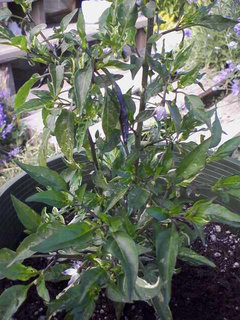
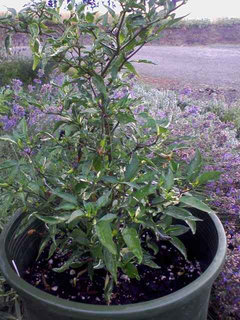
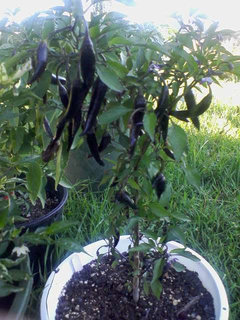
    I grew something called Pueblo Pepper that are sold by Pepper Joe (don't have the url handy) and they are not anywhere close to Poblanos or Anaheim peppers. A few of these Pueblo that I grew came out with variegated leaves and peppers mature from green to purple; flowers are white with lavender/purple tip margins. Pretty good production and quite hot!
    July 3rd


    July 17th

    August 28th

  • 18 years ago

    Kinda shoots my theory, doesn't it? :-)

    Jim

  • 8 years ago

    Found this in a Google search and I realize its as old as the hills on your grandmother's chest (and twice as dusty) but I would like to clear things up a little, in case someobe else stumbles upon this thread as well.

    Pueblo chiles are named for the county (and city) in southern Colorado, just like Hatch chiles are named for the valley in New Mexico. They are a type of mirasol pepper, growing upwards rarher than dangling down off the plant. They are a little smaller, pointier, and not lobed like the New Mexico pod-type (which many call "Anaheim"). Like Hatch chiles, these are usually picked green and fire roasted and sold by the bushel or the zip lock baggie full at roadside stands (and Pueblo's Chiles y Frijoles Festival) to make the best pork chile verde there is ;).

    The variety usually grown as "Pueblo" is actually called Mosco and was developed in Pueblo County from local peppers by a gentleman who was working for Colorado State University at the time. As far as I know it is an OP variety and currently the only only places I know of for seed are two local sources Burrell Seed out of Rocky Ford, CO and another, smaller outfit that I can't recall the name of but also from Southern Colorado.

  • 8 years ago

    Quite interesting! The name seems to make sense now, as the Pueblo group of native Americans are not too faraway posible there might be some connection? Just wondering!

  • 8 years ago

    You might contact nativeseeds.org and see if they know anything.

  • 8 years ago

    Thanks.

  • 8 years ago

    Pueblo is just the Spanish word for "town." The Native American peoples got their name from the Spanish/Mexicans who called them that because they lived in permanent settlements rather than being more nomadic, such as the Apache, Comache, Utes and other Native groups in the Southwest.

    Pueblo, Colorado (where the peppers get their name) was actually built as a trading fort by white Americans in the mid-1800's. Due to the cultural influence of their proximity to Mexico (the Arkansas River, which flows through the city, was the international boundry at the time) used a Spanish word as the name of their "town." To my knowledge there is no relation to the Puebloan Native American people which lived further south and west.

    Native Seeds Search is a great resource (I was actually just at their retail store in Tucson a couple weeks ago, really cool little place!) They do have several peppers that come from Native communities in northern New Mexico. Many of these communities do include "pueblo" as a suffix to their proper name, Santo Domingo pueblo, Jemez pueblo, San Felipe pueblo etc. Its sort of like saying "the town/city of..." These peppers are referred to by the pueblo's proper name, Santo Domingo chile, Jemez chile... you get the idea.

  • 8 years ago

    ZackS, thank you for the info, it's quite enlightening and interesting.

  • 8 years ago

    No problem Rosa! I was born and raised and lived in Denver until only recently, so green chile pretty much flows through these veins haha. And while Hatch chiles are good, Pueblo chiles are hands down the best ;).

  • 8 years ago

    Do you grow your own Pueblo Chilis? I so can you spare some seeds, I live in zone 8 and don't know if I can grow them here but I sure would love the challenge .

  • 8 years ago

    I do grow my own green chiles but sadly I lost my crop of Pueblo's (Mosco) due a move last year and the only seed I currently have is whatever is left in the packet I bought.

    However, you can indeed buy the seeds from a couple places:

    https://www.farmdirectseed.com/product.asp?specific=2058

    https://burrellseeds.us/product/mosco/

    Both of those companies are small outfits located in southern Colorado. Other places also sell this pepper, but I would trust these guys since they are right at the source. Burrell is actually the oldest seed company in Colorado, started in the 1890's.

    I started my chiles this year here in Phoenix but they don't look nearly as healthy as they did when I grew them in Colorado. I'm wondering if its the excessively hard water we have here in Arizona. If they do pull through however I should have plenty of seeds and would glady share, if you can wait.

    I will warn you though that part of what makes local produce unique is, well, location. The soil, the climate, the water, etc all have an effect on the end product and so growing them elsewhere you may end up with something thats not quite like the original. You can absolutely grow peppers in zone 8 however, amd while they may be a special variety, Pueblo peppers are still a Capsicum annuum, like bell peppers, jalapenos etc.. and growing conditions and techniques would be the same as for any other of these other guys!

  • 8 years ago

    Thanks so very much for the info. I certainly will keep all you told me in mind, I'm thinking it's getting a little late to start pepper seeds in my zone, our growing season is very short here in Northwest Washington state, I usually start my seeds indoors between Mid February to very early March so the plants are strong before transplanting outside. I think I'll wait till next year to start Pueblo Peppers. It be one of my new challenges .

    i traveled trough New Mexico, Colorado , and Arizona once in late summer (1968) and attended college for one semester in Chinle Arizona in 1971 and both times I've seen in trading posts and small local stores dried red chili peppers hanging in front , wonder if they were ore are Pueblo pepper.

  • 8 years ago

    So, what are your favorite things about the Pueblo (AKA Mosco) pepper? Production? Taste? Hardiness? Vigor?

    It's certainly true that growing plants in different locations, weather, or soil can have much different results (including taste/texture).

    I also find that store-bought seeds often produce fruits that taste or behave differently from the ones I grow from saved seed of those. Of course, sometimes that's due to crosses, but it seems true that acclimatization matters (as does the specific year) nonetheless.

    Potassium levels can affect the flavor of tomatoes quite a bit. I imagine it's similar for peppers. Many factors can affect potassium availability, including temperature, probably nitrogen/calcium levels, etc. I think I've read that copper can also influence taste. Sunshine seems to influence the taste of some things.

  • 8 years ago

    I think your thoughts and observations are absolutely right.

  • 8 years ago

    Well, you seem to have a lot of knowledge about gardening , condition od growing the best vegetables. I learned a lot from organic magazine (now organic leaving) and you just are confirming on what they advise, thank you for posting all the golden knowledge.

  • 8 years ago
    last modified: 8 years ago

    Thanks Zach and Rosa for all the good info. Have grown and enjoyed Hatch varieties (mostly Big Jim) here in SC and now I’m all fired up to grow Pueblo.

    i did a little research and found this article interesting:

    http://www.westword.com/restaurants/fired-up-for-chile-heres-how-to-avoid-getting-roasted-by-scams-8398440

    Here’s one thing it said:

    Colorado State University horticulturist Michael Bartolo developed the Mosco pepper in 2005.

  • 8 years ago

    Hey Rosa, no problem. I'm far and away from being an "expert" but I can get a decent crop of chiles every year (and when I was growing in zone 5 west of Denver where we could get snow any time between Labor and Memorial day thats a pretty good track record haha).

    I don't think you'll be disappointed Kentishman. It is definitely still an "obscure" variety, but who knows, maybe we'll kick start it into something as well known as a Big Jim or Joe E. Parker. I can see Pueblo peppers in the Seed Savers catalogue already haha. Good find on the Westword article, by the way. I couldn't remeber the gentleman's name who developed the pepper, only that he worked for CSU.

  • 8 years ago

    Yes it is a real good track record Indeed! You know how to grow those Chilies!. Congrats, and keep on growing.them.

  • 8 years ago

    In the costal area of Peru they make "Ristras " of a specific pepper called Aji Panca and you can find them all over the place in local markets they are widely used to color and flavor food rather than using artificial colors, there isn't much heat on those peppers but the flavor is superve. I finally got ahold of seeds of those gems. Have to wait and see how they do this year!

  • 8 years ago
    last modified: 8 years ago

    I didn't know that they commonly made ristras or colored food with Aji Panca. That's one I've been interested in, however. I forgot the reason. I've never heard of using peppers to color food before, though. That's cool. Does it make the food brown?

  • 8 years ago

    The dried pods are soaked in water and processed in a blender or food processor and then added to what ever you wanted color and good peppery taste, one can also buy already as a paste, the color is mostly dark red. Kind of like chili powder would do

  • 8 years ago

    Shule (SW Idaho) they use fresh Aji Amarillo to give flavor, some spice, and yellow color to meats also. But I haven seen ristras of ají amarillo at all.

  • 8 years ago

    Generically, Pueblo peppers refers to Chile varieties from the New Mexico Native American pueblos. For Example: Nambe, Jemez, Tesuque, Cochiti, San Felipe .... etc. Others include Mosco, Mirasol, Hernandez, Estaceno, Alcalde, Velarde, Chimayo .... to just name a few. Many are family varieties. All very similar.

    Shell 6A

  • 8 years ago

    Nice to know, now it's starting to make sense. The background of the Colorado Pueblo ( Mosco ) pepper is the end result of hybridng those native peppers. So if one saves seeds from the Mosco peppers you might come out with one or an other native pepper. So interesting ! Thanks Shall.


  • 8 years ago
    last modified: 8 years ago

    You could get peppers with a lot of the same traits, but they wouldn't be the same breed.

    Growing out hybrids, however many times, still results in a mix of both parents, however much it may seem like a particular one of them. It's like having a handful of a zillion dice, and expecting them to all roll the same thing as a previous roll (and even if they do, there are still going to be some differences, however subtle). True, you might get fruit shape, taste, color, days to maturity, etc. to be the same, on occassion, but those are far from the entirety of the genetics. In fact, you can find other pepper varieties that match those descriptions, often, but that doesn't mean they're the same. If you cross a coyote and a purebred daschund, no matter how much like daschunds the descendants are, they still won't be purebred daschunds. The same is true for crossing plant breeds. You can get new breeds, however.

    One exception would be if you got a pack of F1 hybrid seeds, and some of the seeds of the mother plant had been accidentally pollinated by the same plant as opposed to cross-pollinated—but then it was never an F1 hybrid in the first place. So, there was no reverting back.

    So, if you get F1 hybrid seeds and get something that doesn't match the description, you may want to save seeds, if you like it (because it may be the same breed as the mother plant, which variety is possibly not available to the public, and if so, it'll likely breed true). However, be careful as it may be PVP (if so, you couldn't legally share or sell seeds, although you could probably use it in breeding programs and then the F2+ hybrids in your program wouldn't be PVP).

  • 8 years ago

    I will have to respectfully disagree that the name Pueblo chile is simply a generic term for any chile variety grown in the Native American pueblos.

    Mirasol (which when dried are called guajillo chiles, and are one of the most popilar peppers in Mexico) is a well known and established pepper type that itself has different varieties. One of which is "Mosco." It was named for Dr. Bartolo's (from the Colorado State University research center in Rocky Ford, CO) uncle who farmed chiles and who provided the original seeds used to create what is likely the most widely grown chile in Southern Colorado at this time. But it is not the ONLY variety and so the peppers grown in this area are called Pueblo peppers, just like the different varieties of peppers grown in the Hatch Valley are collectively referred to as Hatch peppers.

    Mosco is not a hybrid of any kind. It is a pure open pollinated mirasol variety. The creator of the variety told High Plains journal “In 1994, I found a superior plant and saved its seeds. I continued to use the single plant selection process to develop more uniformity within the desired traits,” he said. “I asked a few growers and family members to try the seeds and took their feedback to adjust my selections in future years.”

    http://m.hpj.com/crops/researcher-devotes-years-to-developing-pueblo-chile-variety/article_c37bd3bb-51f5-5a79-8774-b1924703e0b8.html

    https://www.chilipeppermadness.com/chili-pepper-types/sweet-mild-chili-peppers/mirasol-chili-peppers

  • 8 years ago
    last modified: 8 years ago

    This is very interesting, good info. fascinating to read.the more I read, the more I learn about these peppers and I'm eagered to take the challenge of growing them in my short cool season.

    Thanks for sharing the information.

Sponsored