Software
Houzz Logo Print
slowpoke_gardener

My best looking plants

16 years ago
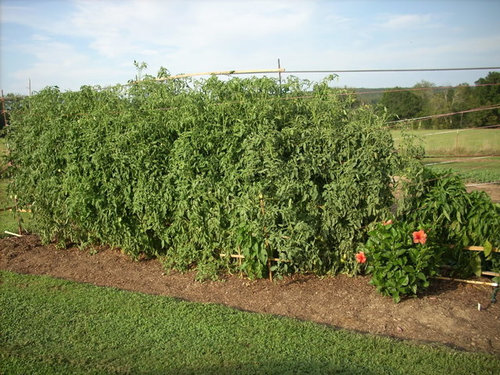
I have 22 tomato plants, 4 of them look much better than the others. They do look like they may have had too much nitrogen, but I dont recall giving them any. They are in very tight clay that has been amended for the past four years. All my other plants are in a new bed just started this year.

The plants were placed in the ground on 5-4. They are, from left to right, Better Boy, 2 of Roma Pompeii and a Porterhouse. The Porterhouse has produced some very large, and good tasting fruit. The Pompeii has produced well but no taste.

I will try to post a picture (will never learn to use a computer). The early fruit was very good but the newer fruit has a lot of BER. I am still having a very large amount of blossom drop.

Well, anyway I would like to know if you guys are having this much variation with some plants looking good, and others looking like they wont make it to fall?

Larry

Here is a link that might be useful:

Comments (9)

  • 16 years ago
    last modified: 11 years ago

    Larry,

    To answer your question, yes, I see a great amount of variation between plants. Some look great and dark green and lush, some have a color that looks more washed out and are showing a lot of heat stress. Some have some diseases. I see it every year. Most years, some make it to fall and produce well and others don't.

    This year, I may have fewer than usual make it to fall because hordes of grasshoppers are eating all of them.

    Dawn

  • 16 years ago
    last modified: 11 years ago

    I say grasshoppers be (insert an appropriate explitive)! I've NEVER seen them like this!!!! Makes me scared...very scared.

  • 16 years ago
    last modified: 11 years ago

    Paula,

    If I cannot do something to turn things around, my garden will be eaten to the ground by mid-August. I am sure you're seeing the same thing.

    Based on past experience, we have little hope of defeating them and you know why.....

    If we had a safe (or, lol, relatively unsafe) spray that we could spray them with or spray the garden with, and it killed 10,000 or 100,000 grasshoppers a day, what would happen next? Another 10,000 or 100,000 would show up a day or two later. We have a year this bad maybe once or twice a decade. Here it is again. (sigh)

    It was a good garden year while it lasted.

    Dawn

  • 16 years ago
    last modified: 11 years ago

    I had to pull some of my tomatoes that were in nematode infected beds. Other than that most of my tomatoes look good. One or two have some lower leaves yellowing. My biggest, best looking plant is the Brandywine, which ironically is also the only one yet to produce. It is probably 7' tall at this point and nice and full and green. Lots of flowers too, but it's too darn hot here to fruit. I think we are going to 106 for the next few days.

    Jo

  • 16 years ago
    last modified: 11 years ago

    Hi girls,

    The hoppers are everywhere at my house but they haven't found the tomato plants yet. This is because they munched on the tomatos that I had ripening on the front porch table. They have eaten my entire flowerbed down to the stems! I told my DH that there might be something I could use on them perhaps earlier when they were very small? Hadn't really thought about how many more there could be!

    Laura

  • 16 years ago
    last modified: 11 years ago

    The grasshoppers don't seem to be as bad this year as they were last year in my garden. Last year, they picked the Mexican Sunflowers to feast on, and not many were left flowering by the end of September. This year, they have picked the Orange Cosmos and Illinois Bundleflower that are growing together in one bed, and many of the flowers are consumed before the end of the day. These flower for a day or two and then petals fall off, and I remove the seedheads to encourage daily blooms. I have tons of them so the ones the grasshoppers are eating don't seem to be affecting the overall appearance of the Cosmos group.

    They have left the tomatos alone in favor of the flowers, and I'm happy about that! Such nasty critters, ugh!

    The Rutgers and the Jet Star will be gone soon - disease, and the Supersweet 100 may not be far behind as it has it, too. Plants are turning yellow and brown from the middle up now, and some very new foliage is being affected. I hope the other container plants will fill in for those that are soon to be gone. And it's just too darned hot to care much about them right now. Did I say how much I hate this heat????

    I'm so sorry about everyone's tomatos, too. Do any of you expect much harvest in September/October?

    Susan

  • 16 years ago
    last modified: 11 years ago

    Jo, Just keep the Brandywine well-watered and it likely will flower and set fruit in September. It is great at setting fruit late....then the real challenge is to get those tomatoes to ripen before frost arrives. They are the best tomatoes I've ever tasted and I've tasted plenty.

    Laura,

    I'll link the Planet Natural grasshopper page for you. Semaspore, which contains Nosema locuste, works great for me as a long-term control 8 or 9 years out of 10, but in a peak year like this (good heavens, this better be the peak year because I can't imagine having more next year), nothing works. The problem is that no matter what you do, they can migrate for great distances in great hordes and that is exactly what they do. They are relentless. I'm going to start a grasshopper thread to talk more about them. I hate them, I hate them, I hate them.

    Susan,

    I never experienced a bad grasshopper outbreak when I lived in the city. Then, we moved here during a drought period and had grasshoppers like you cannot imagine. That was in 1999. They also were bad in 2000 and in 2003 and somewhat in 2005, but this is the first year since 1999 that they've been at what I consider epidemic level (if they were a disease, which they aren't).

    You can stand in my driveway right now and look out at the back pasture and see the tall grass moving. It looks like it is gently waving in the breeze. Guess what? There's not that much of a breeze and it isn't the grass waving in the breeze. It is the weight/activity of the munching hoppers eating the grass and moving from blade to blade that makes the grass look like it is moving. If you try to walk in that grass, 10 or 12 or 15 hoppers fly up into the air each time you take a step in the tall grass. They'll even land on you. The really bold ones land on your leg and try to nibble at your clothing before you can swat them away. To me, walking through the pasture is a hideous experience. And, at this point, I'm not sure if their numbers are as high as they were in 1999, but they are close.

    The hoppers hit Maddie's garden last week and stripped 4 tomato plants and about 60 bean plants of all foliage overnight. Maddies' Peter Rabbit Garden is now beginning to resemble something scarey with bare stalks that looks like it is right out of the pages of a horror story. See, kids, this is where a garden used to be before the grasshoppers arrived and ate it all. It is so sad. At least so far the hoppers are not eating the Laura Bush petunias we planted as edging plants, so when Maddie comes to visit tomorrow, she'll still have something pretty in her garden.

    Oddly, at least so far, the hoppers haven't been eating any flowers at all....but maybe that's because there are so many veggies. Once they devour the veggies here, they might turn to the flowers. In the worst years, they even eat the tree foliage and tree bark and nibble on the holly leaves, but so far they haven't touched those either. Keep in mind that their major destruction usually doesn't begin until August though, and August is just beginning.

    It is hard to say if we'll have much harvest in Aug/Sept/Oct. I have hundreds of green tomatoes so I should have a great harvest, but it will all depend on whether on not I can stop the great hordes of grasshoppers. At this point, I don't think I can.

    Part of being an old, experienced gardener is that you learn to read the handwriting on the wall. This year the handwriting on the wall was written there by the grasshoppers and it says "We are going to destroy your plants. We dare you to try and stop us."

    There are few pests for which there is not a great solution of some type even if it is a chemical solution that I won't use, but grasshoppers are among those pests. My farmer/rancher neighbors use all sorts of chemicals in bad grasshopper years, including restricted pesticides that can be used only by registered applicators, and they still have as many, or more, grasshoppers as we have at our house. My chickens can eat grasshoppers 18 hours a day and not even make a dent in the population. That is scarey.

    Dawn

    Here is a link that might be useful: Grasshopper Control Page at Planet Natural

  • 16 years ago
    last modified: 11 years ago

    All right, now you're putting the fear of grasshoppers in me, Dawn! I don't like to see them or touch them....ewwwww! Guess there's not much to be done about them. They do seem to steer clear of my open garden area, I guess because they can't hide as well there.

    I do know they will eat anything because they have actually gotten on the porch and eaten my chrysalids from last year. I'm sure they've eaten caterpillars, too. They don't eat the milkweeds - too toxic? Nor the False Nettle for the Red Admirals, nor the passion flowers, Butterfly Bush, Joe Pye Weed, Helianthus, but they love Zinnias and Hibiscus foliage....just the foliage, not the flowers. Weird, huh? Course, they may like em next year.

    I wonder if the birds get some of them here? The Cardinals have sure been hanging out a lot in the garden. Ah, well, we could guess at grasshopper likes and dislikes and what eats them til the cows come home. Wonder if I could devise a grasshopper net of some sort, or put that old tennis racket to good use????? Hmmmmmm.

    Susan

  • 16 years ago
    last modified: 11 years ago

    Susan,

    I don't like to touch them either. Often, when I walk through a pasture or even in the garden, the hoppers fly up from somewhere near my feet and latch on to a finger. They hang on for all they're worth, and there I am waving my arm back and forth like a lunatic trying to shake off that danged hopper. It irritates me to no end.

    They seem to have a definite food preference.

    In my garden, they always go for the plants in a specific order. They start in May with herbs and Irish potatoes. Their favorite herb is lemon balm, but they'll eventually move on to other herbs, although they don't bother rosemary and lavender much. They do love catnip. After the herbs and Irish potatoes, they move to the ornamental sweet potatoes and then rapidly on to the edible sweet potatoes. Once they're getting tired of potatoes, they move to green beans first (they hit Insuk's Wang Kong much earlier than any other bean too) to tomatoes shortly thereafter. After that they begin hitting the peppers and okra. And, among green beans, they hit the scarlet runner beans first and then the ones that produce purple podded beans. This year they hit the Tanya's Pink Pod bush beans before they hit the purple beans, but it is my first year to have pink podded beans so I don't know if that is their general preference, a coincidence, or because the bush beans were old and tired and stressed. Stressed plants always seem more attractive to pests in general. In the big garden, they've stripped all the Louisiana Purple Pod beans of their leaves in the last 2 days, but have only eaten holes in some of the leaves of the other beans.

    Although the beans have had varying degrees of damage for some time, the peppers and okra are just starting to show damage this week. The tomatoes have lost about 50% of their foliage in the last 4 or 5 days, so my tomato crop may be lost to sun scald. In the next day or two I'll probably have to harvest green ones that I would much rather harvest a month or more from now as red ones--but that choice has been taken away by the hoppers.

    I've heard talk from old timers about big invasions of army worms marching their way across the countryside although I've never seen it myself, but after seeing how grasshoppers tear through my garden in a bad year, I get the general idea of how devastating such an invasion of army worms would be.

    In some counties in north central Texas not too far from me, recent rangeland surveys show over 16 hoppers per square yard. I think we have about that many here, but it is hard for me to count them because they hop away so quickly.

    I think they eat things in order, and in our landscape the move from tall pasture grasses to the veggies and then to the flowers, trees and shrubs. They don't eat many of the weeds. (Why, oh why, not eat weeds I ask? I never see them eat ragweed or pigweed or crotons or milkweed or, as far as that goes, Johnson grass or bermuda grass.)

    One thing that was good about this year is that the heavy rains in spring seemed to delay the hatch. That means they were still somewhat small, less mobile and less aggressive when the snap peas and fruit were in high gear. In years like 2003 when early spring was very dry and they hatched early, they ate the fruit before it ripened.

    As irritated as I am at all the hopper damage, I have bigger fish to fry. A very long, lanky, skinny bobcat with all the classic markings, coloration and tail (not an atypical ones like a couple of last year's little bobcats) is in our yard several times a day trying to make a meal of our kitty cats and poultry. This evening, around 6 p.m., he was on top of the 4' tall fenced chicken run trying to break into the banty chickens' coop through a window. Luckily, the window is predator proof, but he didn't want to run off when I yelled at him and ran towards him with a green metal fence post. Now, if he is so darn hungry, why doesn't he eat a couple hundred grasshoppers a day? Maybe grasshoppers taste like chicken? He crept into hiding in the bed of Four O'Clocks so I sent the dogs in after him. No one caught anybody, but the dogs had a wild and merry chase through the woods and pastures and were quite wound up for some time.

    I'd like one nice, normal day when no insects are devouring my garden, no snakes are slithering across the driveway and no bobcats are trying to eat our pets. It is unlikely to happen anytime soon though. August is a brutal month and you see it in the increased desperation of all the wild things. Their food supplies are dwindling and they know it. It is just one more thing that makes August a long, dreary month.

    Dawn