Software
Houzz Logo Print
jeffinok

best winter squash for oklahoma?

15 years ago

i was thinking about growing a winter squash next year .

i was wondering what others have had great productivity and storage from? of course taste matters but everybodys taste is differnt.

Comments (8)

  • 15 years ago
    last modified: 11 years ago

    Jeff,

    Well, I never have just one favorite of any kind of veggie, but if I had to pick only one winter squash to grow, I'd pick "Seminole".

    There are many varieties of winter squash which grow well, store well and have great flavor, but this is the one that, for us, also has the best disease-resistance and pest resistance. It stores practically forever, lasting many months in storage if properly cured first. The rind is very hard which can make cutting one open quite challenging.

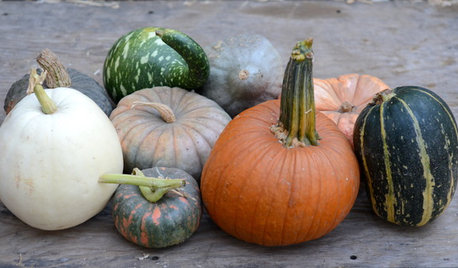
    Seminole is a smallish, mostly teardrop-shaped, buff-colored 'pumpkin' (all true pumpkins are winter squash)which originally is from Florida. I've never lost a Seminole plant to disease or to squash bugs or squash vine borers and it has been incredibly drought-resistant, producing massive vines and tons of winter squash even in 2003 when our rainfall was slightly under 19" and we had horrific drought conditions. It is one of the few winter squashes about which you can say "it won't die and you can't kill it". (At our place, cannas and four o'clocks fall into that category too.) Seminole is in the group C. moschata.

    I've linked info about Seminole from SESE below. If you look at the photo at that link, you'll see they can be somewhat variable in shape. We've grown them for years and almost always-get the teardrop shape although some are less teardrop-shaped and a bit more rounded.

    Because Seminole looks to roam and spread vigorously, I like to plant it near the garden fenceline so it can roam outside the main fenced garden area and when I do that, the vines often climb up into the nearby trees that are just a few feet north and northwest of the veggie garden.

    Other great winter squashes we like include (and we mostly grow heirloom types but many hybrids are available as well):

    Bush Delicata---this is an improved version of the old open-pollinated Delicata squash, which is C. pepo. It has fine flavor and produces well, but doesn't store as long as many other winter squash.

    Table Queen----this is another from the C. pepo group. It has great flavor and is a prolific producer.

    For the making of pumpkin pies, it is hard to find a better winter squash than the one known as "Winter Luxury Pie", which is C. pepo.

    In the Acorn squash (C. pepo) group, we like Thelma Sanders Sweet Potato which, despite its name, is a winter squash and not a sweet potato.

    We've also grown and liked quite a few in the C. argyrosperma group (formerly known as C. mixta and still thought of as C. mixta in my head because it is hard to teach an old dog new plant names) including green-striped cushaw, Jonathan neck pumpkin and Cochiti Pueblo. The winter squash in this group are more often grown as decorative winter squash, but we like the flavor of Green Cushaw and they reach astounding sizes.

    Buttercup squashes are C. maxima and among the best-quality winter squashes. Many, many named varieties are available. A couple of great heirloom buttercups are Warren and Essex.

    Burpee's Butterbush (C. moschata) is a butternut type that has fairly compact vines and good flavor, which makes it popular with many home gardeners. Waltham is another good butternut squash variety.

    Sibley (aka Pike's Peak)---this is one of our faves from the C. maxima group. It is long, has an odd medium-greenish-blue rind and belongs to the group of squashes commonly referred to as banana squash.

    Red Warty Thing (aka Victor)---this is our favorite type of Hubbard squash, being both tasty and attractive.

    Marina di Chioggia---this is a winter squash with a warted blue-green rind with a golden flesh. Marina di Chioggia is one of the first heirloom winter squashes I ever grew, and is one of the best-flavored. It is in the C. maxima group.

    Cheese pumpkins: This is a group that grows very well for us most years. They are called cheese pumpkins because most of them have a somewhat oblate or flattened shape that looks like an old-fashioned wheel of cheese. In this group, there are several great ones and we especially like Long Island Cheese and Musquee de' Provence.

    My favorite winter squash from the Japanese type group is Black Futtsu, which is neither a rampant grower or a heavy producer in our garden. They do have an odd appearance and if you give one away to someone, you have to explain to them that it is supposed to be that dark greenish-black color or they're likely to think you're giving the a winter squash that has gone bad and is about to rot.

    Great seed sources for heirloom winter squashes include Southern Exposure Seed Exchange, Seed Savers Exchange, Sandhill Preservation Center and Baker Creek Heirloom Seeds. Johnny's Selected Seeds is a great source for hybrid types and for some heirloom types.

    Dawn

    Here is a link that might be useful: Seminole pumpkin info/photo at SESE

  • 15 years ago
    last modified: 11 years ago

    I have only grew a few winter squash. Spaghetti squash is the one we grow every year. And the best of the few I've grown. One that we use some way almost every week. Jay

  • 15 years ago
    last modified: 11 years ago

    I have never grown Seminole, but strongly suspect that I'd whole heartedly agree with Dawn, if I did. It is from the c. moschata family, which generally has about the best insect resistance of all the families. Cheese pumpkins, butternuts, Musquee de' Provence, Tahitian Melon Squash are all from this family.

    In my collection I grow two strains of Warsaw Buff Pie Pumpkin and Old Timey Cornfield Pumpkin. Of these, Old Timey Cornfield Pumpkin seems to be the most vigorous. Though, this year, every squash in the garden basically fried to death, and that, even in spite of watering. Only one hill of Warsaw Buff Pie Pumpkin is still alive (and thriving, I might add). It was planted where it received several hours a day of shade.

    Due to my schedule I will probably be only growing squash per family, from now on. This is so I can produce pure seed. I'll freeze my seed and rotate what I grow, so I keep my seed from expiring and should be able to offer pure seed.

    George
    Tahlequah, OK

  • 15 years ago
    last modified: 11 years ago

    thanks for the replies!! i tried to grow Zucchetta Tromboncino this year because its a mocheta . the svbs are not supposed to bother it . it just didnt produce well .
    ill try it again next year because it tasted yummy!!

  • 15 years ago
    last modified: 11 years ago

    Conditions were so bad, this year, that this is the first time in MY LIFE that I had a winter squash crop failure 100%. I have a few which have recovered, which might mature, if frost holds off a few more weeks. But most of my winter squash died this year. We had too many factors working against them.

    Incidentally, my Moon & Stars watermelon died back, much like the squash, but revived with the rains. I picked a melon last night (first one for the year).

    I planted some zuchinni at the end of August and they seem to have escaped the bugs and heat to produce some summer squash. I never thought that eating zuchinni, at this time of year, would produce such feelings of pleasure!

    George

  • 15 years ago
    last modified: 11 years ago

    hopefully we have an indian summer .
    i lost all of my spring tomatoes to an unusual amount of rain . my fall tomatoes are 5 to 6 feet tall with lots of green tomatoes and i shared my first black krim with my wife. it made me want more!! but only one was ripe .
    they will be back next year!! comeon indian summer!!

  • 15 years ago
    last modified: 11 years ago

    George, It boggles my mind that you of all people had a bad winter squash year. I didn't think that could ever possibly happen. It was, however, a horrible year and I don't know if y'all will ever again have a summer as dry as you had this year, or one with as many pests. I didn't even have a good bean year here, although the grasshoppers apparently did because they ate all my beans....pods, flowers, leaves.....all of them. Their favorite? Insuks Wang Kong! None of the other beans were touched until they had finished off all of the Insuks Wang Kong.

    I am going to greatly overplant beans in 2011 because I feel bean-deprived. I don't have many in the freezer at all--maybe a dozen quart bags--and I am going to carefully "ration" them out this winter to make them last as long as possible.

    Jeff, Whenever your first frost occurs, if you can cover up your tomato plants and keep frost off of them, often we'll have 4 to 6 more weeks of marginally warm to even very warm weather and the tomatoes will keep producing.

    Our first year here, we had a night in late Sept. go down to 29 degrees but managed to build a quick hoophouse over a row of tomato plants and save them. Because we had 1 x 2 lumber left over from building our house, we used that to slap together a quick frame, and then we covered it with 6 mm clear plastic purchased in a roll from home depot. Right before we went to sleep, I ran outside and threw a couple of blankets over the top of the plastic structure because the foliage was touching it and I feared the foliage would freeze. Although the plants froze anyplace they touched the plastice (though not where the blankets covered the plastic), we only lost minor limbs and foliage to freeze damage and the plants themselves and all the tomatoes on them survived. In subsequent years when I chose to protect plants this way, I used PVC pipe for a curved hoop-type frame and made it far enough away from the plants that the plants didn't make contact with the plasctic.

    Another way to save fall tomatoes is to pick all the tomatoes that are breaking color....any with just the tiniest bit of color beginning to show....and line them up on a table or counter indoors, not touching. They'll ripen slowly over a period or days or weeks.

    Finally, if a freeze is unavoidable and the temp is going so low that even plants covered with plastic or blankets are unlikely to survive, you can pull up the entire plant, roots and all, and hang it upside down in your garage (esp. if it is well-insulated) or basement (I use our tornado shelter) if you have one. Many of the remaining tomatoes will continue to ripen. I've had them ripen for 4 to 6 weeks after I pulled up the plants, although this works better with smaller tomatoes like cherry and grape types than with really large tomatoes.

    Sometimes you just get lucky and the frosts are light and late. One year we didn't have our first killing freeze here until mid-December. You can imagine how thrilled we were to still be harvesting tomatoes in December. We had fresh garden tomatoes with our Christmas dinner that year. We've been here a dozen years now, and only had that extra-late frost/freeze that one year, so I know it doesn't happen often but it sure was wonderful that year.

    Black Krim, by the way, is one of my personal favorites. It is the first black tomato I ever grew and for years I thought no other tomato could come close to matching its outstanding flavor. Then I discovered many other black tomatoes, and have to say that Indian Stripe, Chocolate Stripes, True Black Brandywine and JD's Special C-Tex all have flavor as good as or better (to me, anyway) than Black Krim. And, if you've never grown Black Cherry, its flavor will blow you away.

    Let's hope for a long, pleasant Indian summer because everything is growing so very well now and I hate to see that end.

    Dawn

  • 15 years ago
    last modified: 11 years ago

    yep tried black cherry for the first time the other day
    my wife says they will be back next year !! i have seeds for jds to try next year along with sungold cherries that everyone keeps raving about.

Sponsored
CHC & Family Developments
Average rating: 5 out of 5 stars5 Reviews
Industry Leading General Contractors in Franklin County, Ohio