Software
Houzz Logo Print
foofght

Longevity of Redwood vs Cedar

12 years ago

Building my first raised bed and I had 3 questions I know the collective mindset will be able to answer: :)

1. Any folks have any experience on the longevity of redwood or cedar raised beds?
2. What about longevity experience with using Redwood Sapwood (not heartwood)?
3. Anybody have success using fence pickets instead of boards?

Per online research, these two wood types appear to resist rot and pests better than other commonly sold woods. The bed would be sitting on dirt here in Southern California where we get very little rain.

I read that heardwood is really what is best for rot and pest resistance, but I wonder if sapwood is still just as good?

Fence pickets are half the cost of the boards, but if the longevity and durability is significant, I dont mind spending extra.

Comments (14)

  • 12 years ago

    I'm about to build new vegetable beds again. Last time I used Pine because we had some to use up and only had to add a small amount more. But it's maybe only been 5 years since I did them, so that's not a long time.

    It was suggested cedar would be more rot resistant. I spent the morning yesterday calling about a dozen lumber yards looking for cedar. Only one had white cedar and they didn't have it in the dimensions I needed and it cost a fortune. I might as well build using gold bars.

    Then I talked to one person at a lumber yard who said he has been steering people to use Eastern Hemlock. He said it is not as rot resistant as Cedar, but Cedar might get 15 yrs out of it, and Hemlock might get 8-10 so it is better than Pine. The Hemlock was quoted as $9 per 2x6x16 board. I want 12" high beds, so I'd have to use two 6" boards on each side. But that is about 1/4 of the cost for what the cedar would cost, so I could build hemlock beds 4x over for what it would cost for building the cedar once.

  • 12 years ago

    Thanks Prairemoon2. I'll see if the local lumberyard carries hemlock as a possible option.

    Anyone else have experience with cedar or rosewood?

  • 12 years ago

    Wood beds last until either rot or termites do them in. Climate can play a big part in longevity. In a warm wet climate you might lose pine beds to termites in as little as 18 months.

    For both redwood and cedar, heartwood is much more durable than sap wood. Then there are two types of cedar, western red cedar (more common) and eastern red cedar. Solid heartwood of eastern red cedar can last 20 years in even adverse conditions, but it's hard to find, even where the trees are common. In my warm wet climate, western cedar might last 4 to 5 years.

    Wood of any type makes more sense in either a very cold or very dry climate. When you consider the combination of cost and longevity, poured-in-place concrete beats everything.

  • 11 years ago

    Redwood sap wood has no resistance to rot ori insects because it hasn't got the tannic acid in it like the clear heart does the tannic acid is what deters rot and insects

  • 11 years ago

    My pine beds lasted just about 5 years. I'm now using concrete blocks. Easy to build, easy to expand, permanent and 8" high. We stacked 2 blocks in one bed to get 16" for deeper veggies. Oh, did I mention - inexpensive?

    Keski

  • 11 years ago
    last modified: 11 years ago

    Cinder block is a long lasting option tho I wouldn't call in inexpensive. Plus the width of the blocks does add to the width of the bed - something to consider. Then folks want to plant things in the "block holes" - which I think impedes access to the rest of the bed.

    If money is no object consider Trex - it's a composite material (I think is) made from recycled plastics. In any case, it doesn't rot, is termite and ant resistant and requires no (maintenance) painting, etc. - http://www.lowes.com/Outdoors/Decking/_/N-1z0wefr/pl

    IF money is an object just go with any wood - I have some painted and some not painted that have last 12 yrs. Some are beyond repair others are still usable. I built these when HD used to sell "cull wood" and I wasn't sure if raised beds or SFG was for me.

    I guess the other option is just to replace as needed which may reduce the (COG) Cost of Gardening. It all depends on what fresh tomatoes are worth to you, I guess.

  • 11 years ago

    I tried Cement Blocks and after two seasons, dismantled it and went back to wood. It makes the beds too hot and you might want to ask if it leaches something into the soil, that changes the PH? Planting in the 'block holes', I did that too. Thought it was such a cute idea, but everything dried out so fast and got so hot, nothing grew well.


  • 11 years ago

    But they are treated and are labeled as for decorative purposes only.

  • 11 years ago

    They? Treated with what?

    I have seen beds built using landscape timbers. So they won't last forever? Not much will that is practical AND reasonably priced.


  • 11 years ago

    Gumby - They - the landscape timbers you just suggested. Treated with - chemicals. If they are labeled 'for decorative purposes only' on the Lowe's site that you linked to - that means they are not recommended to be used in an area growing food, because they are not safe. The chemicals leach out into the soil surrounding the timbers and the food growing absorbs it, then you eat it. A safe food supply is the most practical thing you can do for yourself.

    You would be better off using plain old pine, if you want to save money. I used pine the last time and it lasted me a good 8 years before they completely rotted out. Or you can go on Freecycle and ask for anyone with left over lumber.

    And to the OP - I see you thought of using cedar fence pickets, which are half the price of boards. That's actually not a bad idea and they are cedar. If you had 2x2 or 4x4 posts in the corners to attach them, I don't know why that wouldn't work. The boards are thin though and maybe you would have to be careful not to sit on the edge of them or something. I sit on the edge of mine all the time, but they are 2 inches thick. And my corner posts are 4x4 inches. It makes a very sturdy bed. If I was on a strict budget, I might give the fence picket idea a try.

  • 11 years ago
    last modified: 11 years ago

    When I made my bed frames I used untreated lumber - I also got many years of use. The 2x wood will last longer than any 1x or less. Landscape timbers are thicker and my thought was they will last much longer.

    I linked to Lowes to clarify what I was talking about - before jumping to any conclusions I would have to know what chemicals they are treated with.

    I suspect the decorative use only is a cya not to use this type lumber in "building construction" as supporting materials and I think pending the chemical query they might be safe for making a bed frame since it won't require a "building inspector".

    The link was from a Google search page which listed options I thought others could choose from. As I said it was just to clarify what I was referring to - NOT a recommendation.

    Here is another link - http://www.lowes.com/pd_468965-153-LSTP___?Ntt=landscape+timber&UserSearch=landscape+timber&productId=4751376

    Where it mentions other warnings...

    • Not intended to be used for fence post

    But then says....

    • "Safe for use around humans, pets, plants, and vegetable"

    The original thought (suggestion) was offered in a brain storming moment - mea culpa.

  • 11 years ago
    last modified: 11 years ago

    Gumby - I’ve been gardening organically since the 1980s. I’ve made a lot of effort to learn how that works and to find ways of doing things that don’t require me to use chemicals. And I love doing it that way, it has a lot of rewards. So naturally, when I grow vegetables, I don’t want to wonder what might be a problem with them. If I wanted to worry, I wouldn’t bother growing my own vegetables, I’d buy them at the supermarket.

    At the same time, I’m also doing something for the environment. Keeping chemicals that shouldn’t be there out of the soil and perhaps out of the water supply as well as supporting ecosystems.

    And from experience and history, I don’t feel I can depend on a warning or even a label saying it’s okay to use. Because what might be safe to one person probably won’t be to me. I feel I can avoid investigating and researching, simply by using natural materials with no added anything, when ever possible. So, that’s the way I go about things in general.

    The last time I built beds, I called about a half dozen lumberyards, after finding big box stores had a problem with availability of cedar. Either they had cedar and it was too expensive or they didn’t have it at all. I finally found a small family run lumberyard, where the owner had actually had people looking for the same thing I was, wood that didn’t rot quickly to build vegetable beds but not expensive. He was steering people to Eastern Hemlock as a substitute for Cedar. I would have loved to get Redwood, but it’s not available here on the East Coast as much as it is on the West Coast.

    So, I went with the Eastern Hemlock last spring when we built all new vegetable beds. It worked out well and so far so good. I guess I won’t know how well it stands up to time for many years, I hope. I’m very happy with it. It was more expensive than pine but lasts longer, but less expensive than cedar. A 2x6x16 was $9. Our son is experienced with carpentry and had the tools, including the electric saws to cut everything to the size we needed and build the beds.

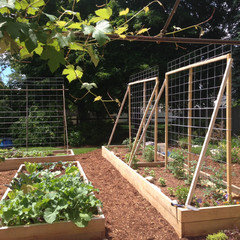
    Here is how they came out….

    This is my first full season using them and I am enjoying them. We actually left the trellises on the right up all winter, with all that snow and they did great.

Sponsored
Custom Home Works
Average rating: 4.6 out of 5 stars10 Reviews
Franklin County's Award-Winning Design, Build and Remodeling Expert