Software
Houzz Logo Print
barbararose21101

Floating cocoons

12 years ago
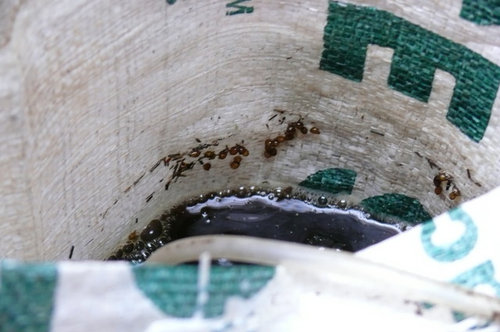
Five pounds of vermicompost that is being vacated, went to a bag and bucket last night. It had been sieved in screen: 1/16th or 2 mm ? almost the same size as cocoons. Many simply fell through with some fine bedding to survive in. I picked out as many as I could . I left the bag open and put a small air stone .weighted with a rock & sock, on the bottom of the bag. Filled the ( 5 gal) bucket with rain water. Added 2 Tbsp molasses.
Checking this morning for "foam" I found cocoons. Picture shows cocoons clinging to the plastic bag. There were more floating around the edge propelled by the bubbling. Some were hatching. I think I learned that an intact cocoon is hard:
actually makes a noise if I drop it. A hatching cocoon is softer and squeezing it (as with tweezers) expels a hatchling.

Comments (26)

  • 12 years ago

    I didn't bother to pick out cocoons before the next batch of compost went in the bag & water. I stood by and collected them promptly as they bubbled up. Obviously they should just go in the new bin. I want to watch, though. From surfing online opinions I think the cocoons will take 3 to 11 weeks to hatch.

  • 12 years ago

    Some of those cocoons hatched.
    I tried watching them in a clear plastic shoe box, but there wasn't enough to see to persevere.
    do any of you "know" or even have any opinion about whether some of the cocoons that come up with aeratng tea are empty shells ?

    If I had a microscope, what would that show me ?

  • 12 years ago


    Someone else, several years back, posted here about collecting cocoons from aerated tea. A flour sifter was used to catch the floaters.

    I believe that any viable cocoons rescued from aerated tea brewing will hatch much sooner than later. Once exposed to brewing and then returned to a good bin, I bet they will hatch in a week or two.

    Leftover tea strainings are often returned to my wormbeds. They love it VERY much and I don't have to worry about wayward cocoons.

    Happy wormin'

  • PRO
    12 years ago

    I would say this is an excellent example of a long term poster having a certain je ne sais pas ce que that gives their longevity a bit more provenance than the average bear.

    The photo of the cocoons make me proclaim hallelujah. What a great photo.

  • 12 years ago

    EQ2
    The only long term poster here is you. (Actually I didn't check MP's history ) That photo has been here almost 3 months. Is this your first view of it ? Bears don't have provenance: not even metaphorically. I suppose a zoo bear might have papers testifying to its ancestry. What ever you intended, I'm glad you like the picture. The next pictures (I may resort to photo bucket) will be the tomato test.

    For readers who've missed that thread:

    18 + determinate tomatoes are potted in same size pots with same potting soil and 6 different feeding plans. Factors not controlled are watering (I don't have enough big saucers, they cost $10) and sun : they all get a lot of sun, but not identical exposure. In addition I have some indeterminate tomatoes who are getting all of everything I think might work. Have blossoms. Picture June soon.

    Mendopete

    I'm mostly putting the washed castings into something where the hatchlings and cocoons will survive. -- but not feeding it -- keeping it moist -- the same kind of bag as in the picture. Today I dumped my oldest "aged" , post-tea bedding that was half shredded newspaper and half horse manure into my cement mixing tray -- to see what could be seen. There were, on hasty sort, 2 or 3 full size worms, one that was big with no band (put it in the yard) quite a few hatchlings and more cocoons.

    In overwhelming and ruthless curiosity, and in the absence of good information, I took some cocoons out in the sun to see how readily they would collapse. They all collapsed readily.
    Nothing learned from that.

    The once-washed bedding had continued to decompose, however. The newspaper is almost unrecognizable. The few worms and hatchlings seemed to do a lot of work in the 3 or so months it has aged.

    BACK TO COCOONS

    What happens to the shell after the worms hatch ?
    Are any cocoons empty ?
    Has anyone looked at a viable cocoon under a microscope adequate to see what's inside ?

  • PRO
    12 years ago

    Yes my first viewing of the picture. Unless I saw it before and did not feel moved to comment upon it or have the energy or time at that moment. I feel a lot less lengthy of a poster than most posters here. Certainly a great number have been vermicomposting for years with a zero after it making me in some aspects a newbie. I like to make obscure references in my posts so that people that catch them make extra connections to the topic. Or something like that. This is what the post would have read without that.:

    That is the best picture of floating cocoons I have ever seen. Actually it is the only one. It is a nice close up and I can really envision how the bubbles brewed them up to the top. I wonder if that is the secret harvesting method that cocoon sellers use. Surely they do not hand harvest each cocoon individually. Now we know the secret too and have the photographic evidence right here. I did not expect to see evidence of that procedure being so successful.

    ~Yogi

  • 12 years ago

    THANK YOU EQ for gracious explanation.
    I collect those cocoons promptly. They bubble up because they are not in an enclosed bag. I think that when we are returning the washed VC to a bin, separating the cocoons is not useful. I'm still playing around, however, experimenting . This batch of VC went in the bucket with no bag at all.
    This is a picture of the cocoons that floated to the sides of the bucket.
    I've tried several ways to retrieve them. So far, the most efficient seems to be to hold a sieve in one hand and a measuring cup in the other: Creaate a little flow of water from the side of the bucket to the collecting cup: they flow in. Then pour the cup contents into the sieve & Repeat ! It still takes time.
    After spending some time with the instructions for the camera, I took the picture and Then ! put the cocoons in with some worms that came with the horse manure. This "bin" is one of those sand sacks because my experience is that the worms are quite content in 'em. Also, it's easy to write on the bags:
    date, content. Disadvantage is tiny scraps of plastic such as swirls in the Great Pacific Garbage Patch.

    I still don't know how many are empty shells. Since I put a lot of cocoons in a little VC, I hope for a clue to "viability".

  • 12 years ago

    I am borrowing a picture from Bentley. I'm pretty sure he won't mind because he wants all of us to compost and to compost with worms.

    I think most of the cocoons in my picture, in the cup, are empty.
    I think Bentley's picture with some cocoons that have dents, look deflated, are empty. Already hatched. What do you think ?

  • 12 years ago

    Those are definitely empty cocoons, except for perhaps the one on the lower right; it looks rather plump and round.

  • 12 years ago

    Good stuff!

    Paul

  • 12 years ago

    In my experience, when I find a worm cocoon in the gravel of my fish tank, it is full and has that creamy color in the middle. When cocoons float to the surface, they are brown, empty, and float because they are filled with air.

    From my observations, viable cocoons sink and empty cocoons float.

  • 12 years ago

    From my perspective, having posted on this site since 2005, "long-term" would apply to my obviously unnoticed participation with the site all these years. Maybe I need to get a catchy hook?

    That said....viable cocoons can both sink or float without regard to the color of them (the darkness indicating the maturity and numbers of the little baby worms inside...the darker, the closer to hatchification (?))

    When I separate VC from worms & cocoons, I keep the separated VC in a small worm bin for several weeks to allow the cocoons to hatch, wormies to mature, and be welcomed into my worm family.

    If this sounds a little overly exuberant on my part.......yeah, maybe.....but, it makes my garden grow.

    chuckiebtoo

  • 12 years ago

    The VC that was in the bucket in the picture had undecomposed newspaper in it.
    Since, thanks to you all, and to common sense, it was still useful, in some way, I saved it in its bag after it had drained sufficiently, and kept it moist with aerated horse manure tea . That was early March '14; it is now mid June '14.
    The VC has ccontinued to decompose and the newspaper is no longer recognizable. There are worms in it: a few mature, more younger.

    The VC & worms are now in the cement mixing tray, drying a little.

    I started with half pound of worms -- I think April '13 ? -- and now have 4 separated populations & am not sure what to do next. Inadvertently I killed the herd that came with the second load of horse manure. Their cocoons or hatchlings are still in the mix.

    I could mix em all together, measure (bulk or weight) the worms and start all new. The advantage would be it's easier to work with VC in warm dry weather. Further, this is when the garden would like the tea.

    How full is optimum in the Inn ? Fully full is too heavy to work with.
    Half full could manage a pound or two cups ? The rest to a vermitrench?
    The trench wouldn't need a bottom, wigglers couldn't tunnel in glacial till.
    I like the trench idea for its end to end feature.

    ??

    Opinions ?

  • PRO
    12 years ago

    "How full is optimum in the Inn ? Fully full is too heavy to work with." If I read your question right I work with the Worm Inn fully full. When the material gets down a couple of inches and I can put some more in I do. I agree it is too heavy to work with. I have emptied the whole thing a few times. Sort of voids the whole flow through idea. Which still does not seem to work as I imagined it would even in the Worm Inn.

  • 12 years ago

    EQ -- I think you don't puree, but put more "intact" food scraps in your bin :
    what is the time sequence of your experience ?
    That is, how long does it take to sink a couple inches and
    how often have you emptied it ?

    What happened to the bread overload ?

  • PRO
    12 years ago

    I think the bread all vanished. Perhaps it turned into good vermicompost. Bread is mostly air.

    "I think you don't puree, but put more "intact" food scraps in your bin" "what is the time sequence of your experience ?" Well the bowling ball sized whole beet I tossed in last fall and clogged the outlet of the worm inn I eventually tossed into a 5 gallon bucket of harvest vermicompost. It is now putting out lots of leaves of what are probably tender, edible beet leaves before most lettuce is available in local gardens. I am not sure of the time sequence of my experience. I do try to have time work for me because it is free. I probably should puree my food additions with fish water and pour it over bedding. A dedicated blender right next to the bin would make that super easy since if I left the cover off so the residue would dehydrate I would not have to spend time washing it. Not pureeing I do have the advantage of I could go months without feeding them and I am sure something would just be starting to rot.

    "That is, how long does it take to sink a couple inches and
    how often have you emptied it ?" After worm bin activity such as stuffing it full of food and bedding I usually forget about it. When I remember it again it is usually down a couple of inches and ready to over stuff again. This is maybe 3 weeks. I have emptied it totally possibly three times. Possibly the whole flow through thing would work if I added egg carton bedding to the blended food and blended it. We should take a forum tour of a massive vermicomposting system. They have those machines that automatically spray a thin layer of food over the surface of the bin. They never show the video of what that worm food is.

  • 12 years ago

    but they do tell us. One used potato slurry, another cow manure slurry.
    I'll look around for a video . . .

  • 11 years ago

    This is a more recent picture of floating cocoons.
    This is an October 2014 batch.
    It is clear enough to be enlarged for detail.
    The white stuff is vermiculite, not springtails.
    I forget how that got there -- probably from rinsing a root in the brewing bucket, or some soil added mindlessly.
    . Not brewing again until I set up a new set up, if soon, to include a seed starting heat mat.

  • 11 years ago

    Jealous of all those cocoons, been leaving my heard undisturbed since it has been cold out so I dont really know what they have been up to. Have tipped up the short catch and release compost sifter tray a few times and they are still there though have not spotted any cocoons there and they are moving pretty slow. Since there is only 4" of material over them its just not much insulation, hoping the fellows under the feeding buckets are partying like its 1999.

    Separating the cocoons does seem interesting and possibly to some advantage like if you wanted to sell them or set someone up with a worm farm of their own. The easier route it seems would be to let them hatch out before using the VC. One of these many threads I saw mention of feeding in an onion mesh sack to draw the new fellows and any stragglers into an easy to extract area. Of course this means another couple of months so longer staging in the process.

    Equinox, you mentioned a dedicated blender. I had been thinking about one of those large hand crank meat grinders for pre processing feed and also for running comfrey leaves through. I did some comfrey earlier this year on my kitchenaide grinder and it made nice loose pellets that ended up spread as mulch.

    Been looking for a big hand crank one to leave out in the garden so preferably stainless steel. If it ends up getting used enough would be a simple matter to put a motor on it. Might not reduce scraps as finely as a blender but well enough for the wormies and would quite likely last forever.

  • 11 years ago

    Somebody from another forum used a garburator. He had a large amount to process, it's outside and didn't mind the noise.
    So, if you are handy or able to draft someone who is handy this is not a bad idea. Might be able to find an old sink and used garburator from somebody renovating his/her kitchen or freecycle. And fit a big garbage can underneath?

  • PRO
    11 years ago

    barbararose21101 there are considerably more cocoons in this picture than in the first one inside the bag. The picture of the spoon of cocoons could use a quarter in the picture for size reference. I almost think it is not a tablespoon but maybe the next size up. I have not seen a picture with that many cocoons in it before. I do not know if full cocoons sink, float or something else. A harvesting method other than one by one picking is good.

    Nexev in 1999 we did not party. We stayed beside our computers to see if the world was going to end. Thus was born the phrase TEOTWAWKI.

    A big, hand crank grinder would be a great idea. I think a poster here posted pictures of theirs a few years ago. My only concern is that a pusher should be used not a hand. The garbage disposal one would be quicker but I would have serious safety concerns. I think a poster also had pictures of this. I hope you find an almost free hand grinder at a tag sale near you. It would seem to be just the thing for a home vermicomposter or even for a restaurant size system. I like your idea of stainless steal to leave it out in the garden. That is really where it belongs and is a great idea. The motor not so much due to the noise and safety.

    I agree that the tiny effort of grinding or even cutting in half or scratching the surface to start rot yields a large benefit of quicker composting.


  • 11 years ago

    There is no point in time in a vermicompost that all the cocoons are hatched. So what I'm showing is that when VC is "brewed" in an open bucket, it is easy to collect some cocoons and get them back to where , when they hatch, the conditions will meet their needs. Since none of us waste anything, especially not VC after brewing, if any cocoons remain, that is, aren't separated this way, but stay in the brew until it's done, they either go back to a "bin", into the garden, or to a sort of incubator where they can hatch in the remaining VC. Left long enough, they will mature, lay eggs, and the no-end-to-it begins again.

    The cup was a quarter cup measuring cup. I am not assuming all those have worms. Some are empty shells.

    The October picture can be enlarged enough to guess which are empty and which have yet to hatch.

  • 11 years ago

    There is no point in time in a vermicompost that all the cocoons are hatched.
    ______________________________________

    Barabara, I had been wondering about this. With a few weeks to hatch then some months before sexual maturity if you were able to lure all of the worms from the VC and move them to a new bed then continue with the lure for a month wouldnt all of the cocoons hatch out with no new ones replacing them?

  • 11 years ago

    Maybe it's a matter of degree. If you have worms and cocoons of all ages, I can't imagine how you'd know when the numbers were minimal. What are you imagining that I am failing to imagine ? You might get closest with burlap "catching " both cocoons and hatchlings.

  • PRO
    11 years ago

    I usually go through harvested vermicompost twice with time span in between before letting it go for planting seedlings. Any escapees I figure are still doing important work in the aging vermicopost making sure it remains in optimum condition. If the process was perfect at getting all of the worms out I'm sure posts would suggest adding a worm or few to the vermicompost to keep it fresh.

  • 11 years ago

    I guess what I am imagining is something like putting the VC into a 5 gallon bucket with a mesh onion sack filled with worm goodness in the middle of it and leaving it for a few weeks. Pull that and dump it back into the active bin and refilling with another load of fresh feed.

    I dont know but it seems to me that doing this two or three times would pull virtually every worm and future worm from the castings.

    This is the part I dont know though as I just dont have the experience the rest of you folks do so I 'imagine' how I think it should work. I can just as well imagine that there will be some hippie stragglers who dont want to hang with the cool kids so they will stay out in the depleted VC and since most everyone else has gone over to greener pastures there is more than enough left to grow and multiply on their own.

    I was just wondering if it was a truism that no VC is ever going to be cocoon free.

    So much of this allows for great thought, so many options and possibilities yet in the end simply ignoring them and letting them do what worms do (provided they have adequate environment) works just fine. Petes Benign neglect is my current mantra. Guilty here of just being a fan though and as such like to discuss them but 'leave them alone' only carries so much discussion so why not ponder some of the possibilities? :)

Sponsored