Software
Houzz Logo Print
motif_gw

muddy castings....please help

17 years ago

Hi I've been vermicomposting for quite a while and every time I harvest the castings... it is really muddy and wet. Everything is digested but its just so muddy... I thought that after it dries it would resemble the pictures I see on the web of this lush black coffee like castings.. but mine is never like that ....even when it dries it is not of this quality... any suggestions? I'm using the Can-O-Worms system. I feed the worms kitchen veggie scraps and newspaper ground up...Is anyone else experiencing this??? Please advise... THANKS!!

Comments (27)

  • 17 years ago

    Do you have your can-o-worms indoors or out? I know it's meant for either, but in my experience it's not ideal outdoors unless it's under cover. Rain can get in at the top, and if you use the optional rain cover, it reduces air flow.

    Also, with the can-o-worms- each time you harvest, clean the trays to make sure none of the holes are blocked. They're not just to allow worms move between layers, they're also the only way for air to move.

    Next, leave the tap at the bottom open with a container under it to catch any drips- this allows free movement of air into the catch tray.

    How much newspaper do you use? It might be worth increasing the amount of newspaper or shredded cardboard, and adding it almost dry, to absorb some of the excess moisture. I know some people may be reluctant to add extra bedding- they want to use all the space for waste food- but having a good carbon: nitrogen balance will actually speed up the composting process and make the worms' work easier. Domestic food waste is quite a dense source of Nitrogen, so adding extra carbon (shredded cardboard/ paper/ woodchip) can really help lighten up the texture of your compost.

    Don't give up! Once you get it going well, the can-o-worms can work really well! Good luck!

  • 17 years ago

    I have not been doing this long enough to know for sure, but I suspect that what you feed your worms will effect the texture of the finished castings. I have read that cardboard produces castings with good texture. I would use less newspaper, and replace some of it with cardboard.

  • 17 years ago

    Both great suggestions. I have mine in my garage year round so I don't have issues with rain or varmints. I do believe its my ratio issue... I mostly put food scraps in I will now increase the paper products to compensate. I do clean the holes in the bins and keep the tap open on the bottom at all times for excess liquid.

    We aren't coffee drinkers and I just thought perhaps people that have the dark coffee like castings are using coffee in their food scraps. I know that Star Bucks will just give you used up coffee grounds from their stores for free...so I'll do both add more coffee grounds as well as paper and cardboard!... hopefully it will make for less muddy gooey castings in the end product. Thanks! I'll keep you posted..
    If anyone else can comment would appreciate... Keep on Worming everyone!

  • 17 years ago

    I have a Can O Worms, too, and I really like it. One of the keys to my compost quality is shredded cardboard. The other key is patience.

    I usually wait until the compost looks mostly done, no visible food scraps, and I take it all out of the bin. I empty the tray into a bucket, along with some cardboard, either shredded in hubby's paper shredder, or torn up by hand. The shredded stuff seems to disappear within a few weeks. If not shredded. the cardboard just absorbs moisture, then the pieces can be put back into the bin as I harvest.

    Big worms sometimes get pulled out immediately, but more often they get left in. The bucket sits on my covered patio, out of the sun to dry out. Every few days I give it a stir, to increase the air flow and evaporation. The worms tend to congregate towards the bottom wet areas.

    When I'm ready to actually harvest the compost, I get a chinette paper plate (the ones that aren't shiny), a small sand shovel, and a plastic spoon. I make a pile of compost on one side of the plate, then slowly scrape compost from the top and sides. Any worms or cocoons go back into the COW. After each little pile is sifted, there are a handful of worms, and they go back into the unit. The paper plate goes into the bin when the process is complete. My compost ends up being fluffy and dry.

    My harvesting is a slow process, but it is also very relaxing. Adding cardboard to the muddy stuff works really well. The excess water gets absorbed, and it really improves the texture of the castings. I usually have a bucket "finishing" every couple of months. This way I always have plenty of room in the bin for more food waste.

    My worms don't get coffee grounds too often. Mostly it goes straight into my veggie bed or under bushes around the house. Since it doesn't need to be composted, it doesn't get to take up space in my COW.

    Good luck with your bin. Once I decided that the worms worked for me, and not the other way around, life became easier. I spent so much time initially worrying about what to feed them, etc, that I drove myself crazy. Now they get whatever I give them, and they eat it!

  • 17 years ago

    The castings will get to that coffee grounds like texture when it dries and is sifted free of big pieces. I set it aside and allow it to dry but mix and break up the clumps every once in a while and when dry enough sift it first through a big holed colander and then a smaller holed colander. The bigger pieces go back in the bin.

  • 10 years ago

    sorry to add a comment so late in this thread -- how are you guys adding shredded cardboard? my castings are also extremely 'muddy and wet'. I have shredded newspaper and regular paper because it's so easy to make those with a standard paper shredder. but how to shred actual corrugated cardboard into the right size/texture? THANK YOU!

  • 10 years ago

    Thank you for the video! I'm going to give it a try (I'm awash in Amazon boxes). I'll also have to google how to oil my shredder - so glad you mentioned that, I wouldn't have known about that.

  • 10 years ago

    Sounds to me like its just a matter of getting the proper balance of greens and browns for your bins. Once the balance has been adjusted Im sure your muddy problems will disappear.

  • 10 years ago
    last modified: 10 years ago

    Just as an FYI for the Amazon boxes I think if you have Prime the tape they use has a plastic fiber of some sort running through it so I would not shred that up or it will end up in your castings.

    Oh and if you have any other questions feel free to post on one of those videos I monitor the comments for suggestions and questions!

  • 10 years ago

    Im not thinking its a lack of cardboard that makes the difference. I add very little of it to my bins and they usually come out soft , moist , yet crumbly. Im just wondering how long you let it go before you harvest that also could be an issue.

  • 10 years ago

    What sorts of things do you add in addition to food scraps and bedding? - I've been using newspaper for bedding. To kickstart the bin I also put a bit of soil/sand, and some coffee grinds. Definitely a newbie at this so really appreciate all the help. I can post a photo of the bin if that's helpful. I don't see any more food scraps, just the muddy castings and a fair bit of newspaper still. Haven't added any new food in a while (I put it in the bin on top with new bedding, there are holes to get up there) thinking that once they are through w/ this layer they will go up and start on the new stuff.

  • 10 years ago

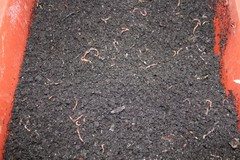
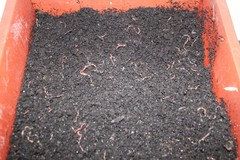
    I have a factory 360 which Ive been using for about 3 years now and it is doing well for me, no problems. I currently am using 3 working trays with 4th tray on top with only dry shredded paper to deter fruit flies. Following is a couple of shots of the bottom tray/harvest tray . It will be the next tray that I harvest , still a good amount of worms in it and it is moist but not muddy. On occasion I go in with plastic forked tool that came with it to stir the mix up to help for aeration and to see how much debris might be in the tray.


  • 10 years ago

    @hummersteve, when you say "how long you let it go before harvest", what are you meaning time-wise? I stopped putting fresh food into the middle bin (where the rather muddy castings are), about 2 weeks ago. There is still a good bit of newspaper in there, but no recognizable food. The words seem to be VERY VERY VERY slowly migrating to the next bin up, which is where I've put the new bedding and the food. I had read that one harvesting method is to move them to a new section or layer, and when the majority have migrated, you can harvest. At this rate they seem awfully comfortable hanging around in the muddy castings. Thoughts or suggestions? I can upload some pics tomorrow if that's helpful.

  • 10 years ago

    If a large number of worms are hanging out in that bin and you have recognizable paper, I'd suggest you let them work longer. I've never had a bin totally devoid of worms (some seem to move up and down through the bottom bin) but the paper is an indicator that the composting process is still underway. Even though you can't recognize food scraps the composting process can still be underway on a microscopic scale. The decomposition of paper along with the composted food stuff will give the worms more to eat.

    In general I try not to put partially decomposed compost in my garden since some articles have said it can draw nitrogen from the surrounding soil while it finishes. I would think you would have the same expectation for compost containing work castings.

  • 10 years ago

    I have found that no matter how long you wait there will still be worms in the harvest tray though if you are lucky it will be minimal which will make your job easier at harvest. I currently have 3 active trays in my factory 360 and in checking them today I found that going from top to bottom each tray had less worms which is what you are shooting for. Even though in the harvest tray there appeared to be no material to process there is still quit a few worms in it. I may give it about another week or two to finish and then harvest regardless. I have a yellow 3 pronged tool which came with the 360 that is handy for stirring up the mix which allows me to see the consistancy of the vermicompost and how much debris is in the bin. Nothing wrong with doing that on occasion.

    As I have mentioned before I use a 1/4" screening box to sift my harvest material, but recently have acquired some 1/8" screening which in my area is hard to find so am looking forward to using it in the next harvest.

  • 10 years ago
    last modified: 10 years ago

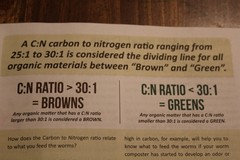
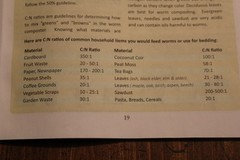
    I have taken a couple photos of an excerpt from my 360 booklet that came with my system. It suggests that you use a 50-50 balance of greens and browns. Following you will see some examples of such along with their ratios. Hope this helps.


  • 10 years ago

    Thanks everyone! Unfortunately the castings are too 'wet' to sift, hopefully the next batch will be a bit fluffier :)

  • 10 years ago

    If you spread out the mucky castings on a cookie sheet or other large pan you can remove many of the worms by hand and the casting will dry to a point you can sift them. Depending on the humidity mine usually takes about a day to get to the right consistency.

  • 10 years ago

    I agree with the recommendations to increase your browns/bedding. Add dry shredded cardboard and newspaper in about the same volume as the vegitable/food waste you give them. Do thus every time you feed them and your vermicompost will have a much higher chance of coming out soft and crumbly like you're wanting. Adding leaf mold (decayed leaves) with each feeding is another good option to increasing your browns/carbon.

  • 10 years ago

    Another item of interest from my 360 booklet. If you want to fatten your worms use 2 cups of oatmeal and 1 cup of cormeal grind the oatmeal into a flour mix together , spread across surface of bin and spray down. I like to use a coffee grinder for the oats, works well.

  • 10 years ago

    @hummersteve, what does fattening your worms do? Is it sort of like protein powder for your worms?

  • 10 years ago

    You might call it a super snack for worms, but I have been feeding an occasional corn meal or oatmeal feeding and when I do that feed doesnt last long perhaps Im not feeding it enough.

  • 10 years ago
    last modified: 10 years ago

    I started a new bin a 10 gal sterling tote from walmart about $5. I have a little bit of everything in it and its been sitting for 2-3 days and Im ready to add some worms at least 1 lb or a little more. Its the first new bin Ive started in at least 3 years. It always helps to some knowledge and experience gained from mistakes made in your beginnings so maybe this one will go along smoothly .

    At first after adding the worms to the new bin they took a little nose dive as expected. But after checking on them they are back up and rumaging thru the added strawberry scraps and cornmeal/oatmeal mix. This is a good thing wasnt sure how they would react immediately , so far so good.

  • 10 years ago

    I perplexed as to how people get muddy castings, too wet bedding, or water coming out the bottom of the bin. I set my bins (Rubbermaid, about 20"x24"x 6" I guess) on a couple of chunks of 2x4 to raise them off the old trays I set them on. All I get coming out the bottom are little piles of compost, dry as sand. Should I be adding water to my bins? When I start a new bin the bedding is as advised in directions - "like a squeezed-out sponge." Adding food waste & coffee grounds seems to be satisfactory. At least I have not had a disaster in 5 years of worm herding and a 2-3 times a year I end up with a good 8 gallons or more of fine, sifted compost. Anything I should be doing or can I stick with, "if it ain't broke don't fix it"?

  • 10 years ago

    Weedlady--- Im in the same boat on all my worm bins homemade or otherwise. Anything that drops out the bottom is mostly dry, yet like you for a few years now I get plenty of nice coffee ground looking VC. We must be doing something right. You are right as my Dad always said "if it ain't broke dont fix it."

  • PRO
    10 years ago

    Muddy castings are a result of too much moisture. When feeding veggie scraps you should add an equal amount of carbons IE. shredded paper, cardboard, peat moss, etc. Add some below the food and then cover the food with the rest. Plastic bins really hold the moisture. You should not need to add much additional moisture after the initial set up. When harvesting take a heavy cardboard box and put some dry sheets of newspaper on the bottom. Dump the contents of the tray in... worms and all. Cover with some more sheets of dry newspaper. Let sit a week in a dark place and then recheck. Your castings should be much dryer. Hope this helps.

Sponsored