Software
Houzz Logo Print
texanconnection

my experiment.

12 years ago
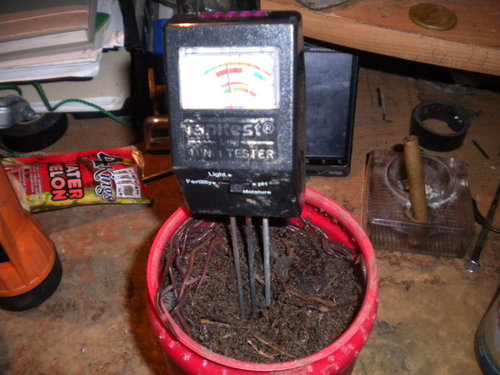
so far. the experiment got a a bit interesting the last cpl days, noticed a bit of a exodus happening. tonight was more than a BIT of exodus,,, ph level is still good but a bit alkaline but still a 7, was 6.5 , a bit lower when started, moisture is good. they have definitely consumed most of the food and its nice castings, (no peat moss remember just manure alfafa hay, and corn meal) Its a small container. the worms were all the away to the bottom not all on top. my guess is they have consumed the food, looking for more, OR, looking for air. I mixed more corn meal in, put them back and we will see what happens, There is a lot of worms in here perhaps to many, but that is what the experiment is for. any thoughts?

Comments (10)

  • 12 years ago

    pic

  • 12 years ago

    this is the 2 containers the other one is mushroom compost, (no Peat ) some corn meal. It is now 5 days old and noticing worms are also coming to the top. ill watch it a few more days.

  • 12 years ago

    Are the worms getting air ?
    It feels to me like the middle of the message.
    What is the overall experiment ?

  • 12 years ago

    I share barbararose's confusion, and repeat her question: What is the experiment? And add, what conditions did you start with? Most of us here at the vermicomposting forum like "experiments", so we look forward to hearing more about yours. We just need a little more "background" information.

    Barbararose - I see holes poked in the upper parts of the plastic tubs. I assume they are providing some "fresh" air.

    Paul

    This post was edited by pskvorc on Thu, Aug 28, 14 at 11:44

  • 12 years ago

    When I first saw that photo, I thought you stuck a multimeter in your worm bin. Thought you were running one of those potato clocks off your worm bin. That would be cool.

  • 12 years ago

    the experiment was for a cpl reasons to see how much castings i could produce in a cpl weeks. and to see what results i would have with just spent mushroom compost to replace the peat moss,
    The mushroom compost worked out well, held moisture as good as peat so id say use it in place of peat (its free around here) BUT it had little food value for the worms, they survived but did not thrive, the other container of just horse manure and alfalfa hay thrived. made some nice castings id say a bit over half the containers.

  • 12 years ago

    @Texan wrote "The mushroom compost worked out well, held moisture as good as peat so id say use it in place of peat (its free around here) BUT it had little food value for the worms, they survived but did not thrive,"

    I've never had access to mushroom compost myself, but I understand it is usually pasteurized/sterilized after being 'used.' Do you know if what you got had been sterlized? It's also effectively had many of its nutrients used up by the mushrooms.

    So my thoughts on using it:
    -Sounds like a fantastic bedding / semi-finished compost - but because it's been sterilized, maybe the worms just take longer to establish themselves? I would think innoculating it by mixing with other rotted food/other 'live' compost/vermicompost would speed things along well.
    -Worms should still eat what nutrients are left and finish it - but if you wanted a 'richer' compost, adding other foods (the usual stuff, manure, whatever) should do the trick.

    Either way though it sounds like you have access to an excellent source of organic materials - i.e. a really great soil amendment - that your process should make rich in soil organisms. On its own may lack a bit the usual N-P-K but lots of ways to remedy that.

  • 12 years ago

    I was thinking about this some more, and it seems to me the pasteurized / sterilized mushroom compost would be a lot like paper and cardboard in that they have low levels of 'living material.' In all cases, not really sterile, but compared to an active compost/vermicompost, a relative desert.

    Worms get in there quickly and love it when there's a whole ecosystem. Eventually they do colonize it, of course, but helping it along by mixing in any kind of living material helps a lot.

  • 12 years ago

    from The Fungus Among Us:

    The air in the pasteurization rooms is sent through a HEPA filter, and the temperature is carefully monitored to make sure that the temperature of the compost doesnâÂÂt go above 160. After the compost cools down to 133, steam is injected into the room and the compost heats up again to 148. This process of pasteurization kills many harmful pathogens, weeds and insects, but does not kill beneficial microbes that aid in the composting process. The steam is then turned off, and the temperature of the compost falls to 118. (Note: contrary to what many people believe, mushroom compost is pasteurized, not sterilized. The sterilization process, which takes place at 250, would kill everything, including the good microbes.)

    Here is a link that might be useful: the making of mushroom compost

  • 12 years ago

    @barbarose wrote "This process of pasteurization kills many harmful pathogens, weeds and insects, but does not kill beneficial microbes that aid in the composting process."

    Could you post this link? I'll be honest, I'm skeptical, this sounds massively oversimplified to me. I simply don't believe that the pasteurization process can possibly be so selective as to kill only harmful pathogens.

    The goal of pasteurization is to kill enough microbes/pathogens to reduce the risks sufficiently for safety _without the negative effects of full sterilization_ (like curdling, harming the underlying product, etc. And while it's true that 'pathogenic' microbes (especially fungi) seem to be destroyed more than 'good' microbes, in the real world, there is no such clear line.

    Wikipedia says one process of pasteurization destroys 99.999% of microbes. I don't know about all the specific processes of mushroom compost sterilization, or what is left - but as my post above put it, I believe it is a certainty that the microbe universe in mushroom compost is a relative desert compared to normal vermicompost. No, it's not sterile, and it may have left mostly 'good' microbes behind (that will eventually fully colonize), but whether it is 99% or 99.9% or whatever, there is a much, much smaller penetration of microbes in pasteurized _anything_. That's the point.

Sponsored
Landscape Management Group
Average rating: 4.9 out of 5 stars33 Reviews
High Quality Landscaping Services in Columbus