Software
Houzz Logo Print
valentinfr

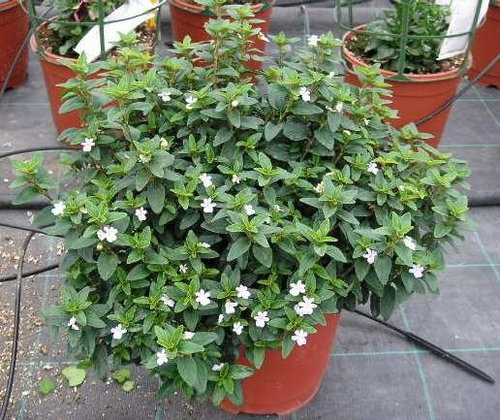
Can anybody identify this shrubby violet ?

22 years ago
Hello,

IÂve got a violet I donÂt know the name. The habit is shrubby, with woody stems. I think it belongs to the section Xylinosium, but I have a few informations on this section.

Can anybody help me ?

Valentin

Image link:

Comments (16)

  • 22 years ago

    I don't know what your plant is, but it isn't a violet. The flowers are shaped like violets, but the leaves aren't those of the violets I've known. I could be wrong, just not familiar with your plant.

  • 22 years ago

    I agree that it is not a violet, but I do not recognize what it is...

    Just in case I am wrong, to check that is it a violet - have a look at where the leaves join the stem. There should be a pair of stipules, like small bits of leaf, maybe quite small. If they do not exist, it is not a violet; if they do exist it *may* be a violet.

  • 22 years ago

    Try posting your photo on the Name that Plant! forum. I am certain someone will know the identity.

    Here is a link that might be useful: Name that Plant!

  • 22 years ago

    I wonder if it might be a species of Teucrium.

  • 22 years ago

    Hello everybody,

    Thank you very much for your help. But IÂm almost sure itÂs a violet species. IÂve got online pictures that give details on the plant morphology, you can see them by following the link below !

    Valentin

    Here is a link that might be useful: Violet pictures

  • 22 years ago

    Salut Valentin !

    These new Violet pictures are showing a plant belonging certainly Viola genus.
    A very interesting one, but unfortunaly I don't know it's name.
    From where did you purchased it ? In the wild or in a nursery ?
    Is'n it from South America ?

    Amicalement
    DenisD_31

  • 22 years ago

    There was another thread on this forum earlier. Could it be the same plant?

    Here is a link that might be useful: Viola -shrubby

  • 22 years ago

    Yes, actually I have already seen this message. It seems to be very close to this species, but the name it has been given, Viola rubella, is very hard to check on internet or in any books...

  • 22 years ago

    Salut

    This is not Viola rubella. I grow it and it is a very tiny plant beside that one.
    I was first thinking it could be Viola elatior but I just went to compare mine with the pretty pictures you sent and they are definitively differents...
    I've been checking the possibility for it to be an Hawaïan violet but it's not the case either...
    The south american track seems to be interesting...

    Nathalie

  • 22 years ago

    It's Viola capillaris, according the the Viola expert to whom I forwarded your photos.

  • 22 years ago

    Wow!

    Thanks very muich for the good pictures - makes all the difference!

    Yes - definitely a violet - and I agree with Natha that S. America would be a good place to focus the search. Failing that, I would consider Taiwan, because of Viola arcuata, which has similar stems and leaves with a similar shape (but they are distinct because of 3 distinct impressed veins), but the flowers are the wrong shape.

    It could always be an inscrutable Japanese cultivar :)

    Whatever it is, congratulations for having such healthy and impressive specimens. Where did you get them from?

    Mike

  • 22 years ago

    Nice goin' carol23!

    V. capillaris Pers is in section Rubellium (hence similarity with V. rubella), and comes from Chile (and maybe a little further afield).

    It has a synonym - V. frutescens.
    It has also been synonymized with V. humboldtii Triana & Planchon, though that was V. capillaris Gingins not V. capillaris Pers. (I have a note from Missouri Botanic Garden, back in the days when it was accessed via gopher).

  • 22 years ago

    A bit more info:

    It occurs in Colombia as well as Chile.

    Further synonyms:
    - V. stipularis Cav.
    - V. stipularis Kunth

    There are two varieties:
    - var. dumetorum (Phil.) Reiche
    (just from Chile; syn. Viola dumetorum Phil.,
    published in Linnaea vol. 28 (1856) p.612,
    not to be confused with V. dumetorum of other authors)
    - var. araucana (Phil.) Reiche
    (just from Chile)

    IOPI do not list V. capillaris Pers., but they do list V. capillaris Gingins, which they give as a synonym for V. humboldtii Triana & Planch (as in my previous post), which they record as occurring in Peru at an elevation of 2000-3500m.
    [ Search for Viola capillaris at www.bgbm.org/IOPI/GPC ]

    Ah - I've found one place where V. humboldtii has been recorded in the wild: Cutervo National Park, in Peru. See www.sacha.org/envir/bosques/cutervo/cutervo.html. The introduction gives a good idea about the environment, "wet and very wet montane and lower montane forests", which should give a clue how best to cultivate this species.

    However, there remains an ambiguity...
    Carol - Please could you ask your violet expert if he/she means V. capillaris Pers. or V. capillaris Gingins ?
    Thanks,
    Mike

  • 22 years ago

    That would be Pers.

  • 22 years ago

    Thnx Carol

  • 22 years ago

    Hello everybody !

    I would like to thank everybody who participated to identify this mysterious plant ! It will be very useful for me. However, itÂs difficult to explain the reasons for which I have this plant... Actually itÂs not my plant. IÂm a trainee in the Netherlands, and I needed the name of this plant for my report. Unfortunately I donÂt know where does it come from !

    Thank you very much !
    Valentin

Sponsored
Foremost Siding & Exterior Design Solutions in Columbus