Software
Houzz Logo Print
vgking

Cassini Probe zeros in on Saturn

22 years ago

This has been a long time in finally coming to light. I've been anxiously awaiting the Cassini arrival to the ringed planet to follow up on the tantlizing tid bits that the 2 Voyagers gave us. Cassini will lock into orbit for a 4 year mission as compared to just the brief flybys of the Voyagers.

*snip*

Cassini launched on Oct. 15, 1997. It took a circuitous route, looping by Venus twice, then around Earth, and in 2000 it swung past Jupiter. With each planet flyby, the spacecraft robbed a little orbital energy from the respective planet to gain speed. The scheme saves fuel and makes the mission less expensive.

Cassini cameras have better detectors than the Voyager cameras did, Porco said, so when the spacecraft gets closer to its target it should produce clearer and sharper views than have ever been seen of Saturn.

"You can expect a real visual feast," Porco told SPACE.com. She said a regular flow of images should start in mid- to late-February.

"We will have very finely detailed images of atmospheric features like storms and waves, ring details that will exceed anything we've seen before by a factor of three to four, and resolution on some of the Saturn satellites fine enough to see features the size of an apartment building, if there are any!" she said. "We will know so much more than we do now."

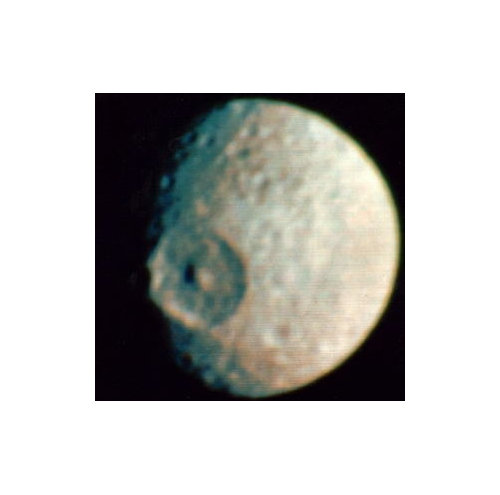
Here's the one pic from Voyager giving us a glimpse of the mysterious moon "Mimas" dubbed "Death Star" by NASA scientists. Just one of many Saturn's moons.

More on Cassini Probe below....

Here is a link that might be useful: Cassini, first probe to orbit Saturn

Comments (56)

  • 22 years ago
    last modified: 11 years ago

    Here's the Latest....

    Donald Savage
    Headquarters, Washington February 27, 2004

    Carolina Martinez
    Jet Propulsion Laboratory, Pasadena, Calif.

    Heidi Finn
    Space Science Institute, Boulder, Colo.
    (Phone: 720/974-5859)

    RELEASE: 04-073

    CASSINI CAPTURES STUNNING VIEW OF SATURN

    Four months before its scheduled arrival at Saturn, the
    Cassini-Huygens spacecraft sent its best color postcard back to
    Earth of the ringed world. The spacecraft is expected to send
    weekly postcards, as it gets closer to the ringed giant.

    The view from Cassini shows Saturn growing larger and more
    defined as the spacecraft nears a July 1, 2004, arrival date.
    On February 9, Cassini's narrow angle camera, one of two
    cameras onboard the spacecraft, took a series of exposures
    through different filters, which were combined to form the
    color image released today.

    "We very much want everyone to enjoy Cassini's tour of this
    magnificent planetary system," said Dr. Carolyn Porco, leader
    of the Cassini imaging science team at the Space Science
    Institute in Boulder, Colo. "And I can say right now the views
    out the window will be stunning," Porco said.

    Cassini was 69.4 million kilometers (43.2 million miles) from
    Saturn when the images were taken. The smallest features
    visible in the image are approximately 540 kilometers (336
    miles) across. Finer details in the rings and atmosphere than
    previously seen are beginning to emerge and will grow in
    sharpness and clarity over the coming months. The thickness of
    the middle B ring of Saturn, and the comparative translucence
    of the outer A ring, when seen against the planet, as well as
    subtle color differences in the finely banded Saturn
    atmosphere, are more apparent.

    "I feel like a kid on a road trip at the beginning of our
    tour," said Dr. Dennis Matson, project scientist for the
    Cassini-Huygens mission to Saturn and its largest moon Titan.
    "We've been driving this car for nearly 3.5 billion kilometers
    (2.2 billion miles) and it's time to get off and explore this
    ringed world and its many moons. I can hardly wait, but in the
    meantime, these weekly color images offer a glimpse of our
    final destination," Matson said.

    In the coming months, imaging highlights will include near
    daily, multi-wavelength imaging of Saturn and its rings;
    imaging of Titan beginning in April; Titan movie sequences
    starting in late May, when the resolution exceeds that
    obtainable from Earth; and a flyby of Saturn's distant moon,
    Phoebe, in June, at a spacecraft altitude of 2,000 kilometers
    (1,243 miles).

    Through Cassini, about 260 scientists from 17 countries hope to
    gain a better understanding of Saturn, its famous rings, its
    magnetosphere, Titan, and its other icy moons. "Cassini is
    probably the most ambitious exploration mission ever launched
    and is the fruit of an active international collaboration,"
    said Dr. Andre Brahic, imaging team member and professor at
    Universite Paris 7-Denis Diderot, France. "It should be the
    prelude of our future, the exploration of our surroundings by
    humanity," Brahic said.

    Cassini will begin a four-year prime mission in orbit around
    Saturn when it arrives July 1. It will release its piggybacked
    Huygens probe about six months later for descent through
    Titan's thick atmosphere. The probe could impact in what may be
    a liquid methane ocean.

    JPL, a division of the California Institute of Technology in
    Pasadena, manages the mission for NASA's Office of Space
    Science, Washington. The Space Science Institute is a non- profit organization of scientists and educators engaged in
    research in astrophysics, planetary science, Earth sciences,
    and in integrating research with education and public outreach.
    Cassini-Huygens is a cooperative mission of NASA, the European
    Space Agency and the Italian Space Agency

    For the first image and other weekly images on the Internet
    each Friday, visit:

    http://www.nasa.gov

    http://ciclops.org

    For information about Cassini-Huygens on the Internet, visit,

    http://saturn.jpl.nasa.gov

    -end-

    * * *

  • 22 years ago
    last modified: 11 years ago

    what a view

  • 22 years ago
    last modified: 11 years ago

    Getting up close...little-by-little

    {{gwi:1370777}}

    March 12

    Cassini Views Clumps in Saturn Ring

    Clumps seemingly embedded within Saturn's narrow, outermost F ring can be seen in these two Cassini narrow angle camera images taken on Feb. 23, 2004 from a distance of 39 million miles (62.9 million kilometers)

    The Cassini images were taken nearly two hours apart using a filter in an onboard camera.

    The core of the F ring is about 31 miles (50 kilometers) wide, and from Cassini's current distance, is not fully resolvable. Contrast has been greatly enhanced, and the images have been magnified, to aid visibility of the F Ring and the clump features. Like all particles in Saturn's ring system, these features orbit the planet in the same direction in which the planet rotates.
    It is not certain what causes these features, though several theories have been proposed, including meteoroid bombardment and inter-particle collisions in the F ring. Scientists have only a rough idea of the lifetime of clumps in Saturn's rings - a mystery that Cassini may help to answer.

    The small dot at center right in the second image is one of Saturn's small moons, Janus 112 miles (181 kilometers) across.

    The Cassini-Huygens mission is a cooperative project of NASA, the European Space Agency and the Italian Space Agency. The imaging team is based at the Space Science Institute, Boulder, Colorado.

  • 22 years ago
    last modified: 11 years ago

    Those rings, they look like race tracks, are intriguing. Maybe they will find out more about them.

  • 22 years ago
    last modified: 11 years ago

    amazing, thanks for the pictures!

  • 22 years ago
    last modified: 11 years ago

    You ain't seen nothing yet folks,
    Here's a teaser peak show from the old Voyagers of the worlds awaiting close-up inspection by Cassini :

  • 22 years ago
    last modified: 11 years ago

    Surfing Titan: Huge Waves Possible on Saturn's Moon

    By Robert Roy Britt
    Senior Science Writer
    posted: 07:00 am ET
    31 March 2004

    Saturn's moon Titan might be one of the most out-of-this world places to hang ten, according to new computer modeling that suggests a given wind could generate waves there that are seven times taller than on Earth.

    Scientists aren't sure if Titan has seas, but they suspect it does based on hard-to-interpret telescopic observations. The oceans would be made mostly of ethane and methane, studies show.
    Because Titan's gravity is about one-seventh that of Earth, any wind-driven waves would behave differently than they do here.

    "Big-wave riding could take on a whole new meaning on Titan," says Nadeem Ghafoor of Surrey Satellite Technology in the UK.

    Ghafoor and colleagues considered several factors -- Titan's gravity, the likely composition and density of the atmosphere and any possible seas, and probable wind speeds -- to generate wave scenarios using modified version of terrestrial ocean computer models.

    The development of waves depends on wind speed and how long and over what distance it blows in one direction, called the "fetch."

    The Titan model incorporates wind speeds up to a modest 12.5 mph (5 meters per second). "We do not know much about the surface winds on Titan, although early models suggest the sustained wind speed at the surface is likely to be low," Ghafoor explained. The model includes fetches up to 620 miles (1,000 kilometers). "Much of the Titan wave growth happens before 100 kilometers [62 miles] is reached, however," Ghafoor said.

    "Waves grow to be up to seven times higher and longer than those on Earth," Ghafoor told SPACE.com. "However because of the lower gravity on Titan, waves on Titan will generally appear to move in slow motion."

    Ghafoor is slated to present the results today at a meeting of the Royal Astronomical Society. He said the computer model is sound, but he allows that the make-up of Titan's surface -- liquid or solid -- involves speculation at this point.

    "Something weird is happening down there, however, and it seems that we may only truly know when Cassini-Huygens arrives in January 2005," Ghafoor said, referring to the Cassini mission to Saturn. The craft carries the Huygens probe, which will plunge through the atmosphere and land on Titan's surface -- whatever it's made of -- early next year. If Huygens lands in a sea, it could float and transmit data for up to two hours.

    The probe has instruments that could measure the height and frequency of any waves and the liquid's composition. With sonar, it could measure the sea's depth. Its camera might even return the first pictures of an extraterrestrial sea.

    "What would we see?" wonders Open University professor John Zarnecki, a participant in the new study and leader of Huygens' Surface Science Package experiment.

    "Well, the waves would be more widely dispersed than on Earth but they will be very much higher," Zarnecki said. "So the surface around us would probably appear flat and deceptively calm, but in the distance we might see a rather tall, slow-moving wave advancing towards us -- a wave that could overwhelm or sink us."

  • 22 years ago
    last modified: 11 years ago

    While we're awaiting Cassini's arrival at Saturn to see worlds not seen before, here's another recent solar system discovery under the eye of Hubble...

    Weird Object Beyond Pluto Gets Stranger
    By Robert Roy Britt
    Senior Science Writer
    posted: 02:07 pm ET
    14 April 2004

    Update: First posted at 1 p.m. ET

    When astronomers announced the discovery last month of Sedna, the most distant known object in the solar system, they were nearly certain it had an unseen satellite. New observations by the Hubble Space Telescope find no moon, however, deepening the mystery surrounding this already strange object.
    Images


    Hubble made 35 images of Sedna on March 16, 2004. Sedna moves with respect to a much more distant background star. The movement is due not to Sedna's plodding orbital pace, but to Earth's quicker motion around the Sun. Astronomers use the resulting "parallax" to determine Sedna's distance. No moon appears in the images.


    Sedna is about three-fourths the size of Pluto. It is so far away that it takes 10,000 years to orbit the Sun. Its discovery has astronomers arguing over whether to call it a planet or a planetoid, and whether to count it as one of many objects in the Kuiper Belt, where Pluto roams, or the first known example of an expected halo of more distant objects called the Oort Cloud.

    Caltech astronomer Mike Brown, who led the discovery, said Sedna's slow rotation rate had him convinced there was an unseen satellite exerting a gravitational tug.

    Here's why: Most objects in the solar system that don't have companions complete a rotation, or day, in a matter of hours. There are many examples of fast-spinning asteroids and similarly whirling large, round Kuiper Belt objects. Pluto, on the other hand, has had its rotational period slowed to six Earth-days by its companion, Charon.

    Sedna spins on its axis once every 20 Earth-days, or perhaps even more slowly, making the presence of a moon practically inevitable, Brown had thought. So shortly after the discovery, Hubble was pointed at Sedna.

    "Much to our surprise, there's no satellite," he told reporters today.

    'Completely baffled'

    "I'm completely baffled at the absence of a moon," Brown said. "This is outside the realm of expectation and makes Sedna even more interesting. But I simply don't know what it means."

    The rotation of Sedna, officially named 2003 VB12, was determined by noting changes in brightness from its surface during repeated ground-based observations over about 3 months. Brown and his colleagues assumed differences in surface composition accounted for the changes. At first they determined the rotation period was 40 days. They later refined that to learn that it's at least 20 days, and possibly still as much as 40.

    After the Hubble observations, the researchers considered that maybe they had not properly analyzed the data. But a "careful reanalysis" leaves them convinced they've determined the possible range of the rotation period accurately.

    "I'm completely lost for an explanation as to why the object rotates so slowly," Brown said.

    There remain some possibilities for a rational explanation.

    There's a small chance that during the Hubble observations, the suspected satellite of Sedna was hidden, lurking either directly behind or directly in front of Sedna. Or a satellite might have throttled Sedna's rotation long ago, then been destroyed in a collision or lost in a gravitational interaction with a planet.

    Or, Sedna might rotate every 25 hours instead of 24 days, a setup that could fool astronomers into drawing their present conclusion. This latter possibility can be confirmed or ruled out with more observations.

    All these scenarios are seen as unlikely. More likely, Brown figures, is that the satellite is darker than expected and simply didn't show up.

    "Even though it's quite large, it could be quite dark," he said. "We still very strongly believe there is or was a satellite."

    Brown said the moon would be about 400 miles wide, or 2.5 times smaller than Sedna and six times fainter. Further attempts to locate the satellite might be made with other telescopes, with fresh expectations for how to look.

    Brown's colleague, Yale University researcher David Rabinowitz, has a slightly different opinion of the results.

    The Hubble observations "rule out a large moon," Rabinowitz said. If there is something there, he said, it is 10 times smaller than Sedna and it's not clear it could have slowed Sedna's rotation rate.

    Refining the diameter

    Brown said the observations of Sedna are equal to spotting a soccer ball at 900 miles away. Hubble was unable to resolve Sedna as a disk, so an exact size can't be determined. But that shortcoming sets an upper limit of about 1,000 miles on its diameter, based on assumptions of how much light it reflects. If Sedna has a brighter surface than assumed, it could be smaller.

    Pluto is 1,413 miles (2,274 kilometers) wide.

    Given Hubble's unsurpassed ability, Brown does not know how Sedna's diameter will be firmly determined until a new generation of telescopes come online in the next decade.

    Meanwhile, astronomers still are not sure where or how Sedna formed or how it came to travel on such a long, looping orbit. While Pluto's orbit is, on average, 39 times the Earth-Sun distance, Sedna roams from 76 to 1,000 times the Earth-Sun distance.

    Answering questions about the strange object's origins, orbit and rotation -- along with similar discoveries of other distant objects -- will help researchers clarify the now-fuzzy picture of the outer solar system.

    -end-

  • 22 years ago
    last modified: 11 years ago

    It's a little over 2 months to go before Cassini enters into orbit around Saturn. Here's a Glimpse of one of the mysterious moons that will get a closer look...

    Strange Shadows: Saturn's Two-Faced Moon
    By Robert Roy Britt
    Senior Science Writer
    posted: 07:00 am ET
    26 April 2004

    {{gwi:1370778}}

    Clear as black and white, Saturn's moon Iapetus is two-faced. One half is dark as coal and the other is as bright as fresh linens. Astronomers have puzzled over the stark difference since late in the 17th Century.

    New radar observations hint at what's going on, but the mystery is far from solved.

    Saturn's outermost large moon, Iapetus, has a bright, heavily cratered icy terrain and a dark terrain, as shown in this Voyager 2 image taken on August 22, 1981. The dark material covers precisely the side of Iapetus that leads in the direction of orbital motion around Saturn (except for the poles), whereas the bright material occurs on the trailing hemisphere and at the poles.

    Iapetus is 907 miles (1,460 kilometers) wide and circles Saturn at a distance of about 2.2 million miles (3.6 million kilometers). Like Earth's Moon, Iapetus' rotation and orbit are in lockstep, both taking 79 Earth-days, so that it always shows the same face to Saturn. That's not the strange part.

    Oddly, the side of Iapetus that always faces forward as it moves along its orbital path -- think of the front of a race car on a circular track -- reflects just 5 percent of the sunlight that hits it. The trailing hemisphere is much brighter, reflecting 50 percent of sunlight.

    Possible causes

    In the early 1980s, Voyager 2 photographed the remarkable dichotomy but did not explain it.

    Astronomers have theorized that perhaps the front face is dark because it picks up debris, just as the front bumper of the race car is peppered with tire rubber, grease and whatever else the other cars cast off. With Iapetus, the debris might be bits of another moon, Phoebe, whose whole surface is relatively dark. The material might be kicked up from Phoebe by small meteor impacts, the thinking goes.

    But dark Phoebe, which orbits backward and is probably a captured asteroid, is not precisely the same color as the dark face of icy Iapetus.

    And there's another puzzling fact: The dark material on Iapetus seems also to be concentrated in the bottoms of some craters. That led to speculation long ago that the chemical or mineral or whatever it is perhaps oozes from within.

    The state of confusion is based on visible evidence. Now scientists have scanned the moon with radar, using the Arecibo Observatory in Puerto Rico.

    The picture is not a whole lot clearer, but some interesting twists emerge.

    First, the bright news

    "It is known that the bright side is mostly water ice, but we find it does not reflect the radar like other icy satellites that we've studied with the radar before," says study leader Gregory Black of the University of Virginia. "The ice on Iapetus appears much less reflective."

    Clean water ice should be radar-bright, so the ice on the front hemisphere of Iapetus must contain some radar-darkening material.

    "We think that most likely this is a bit of ammonia ice mixed in with the water ice," Black told SPACE.com. The frozen concoction would not reflect radar waves as well as clean water ice, he explained, and yet it could still look like clean ice in optical observations.

    The light and dark sides of Iapetus, in a rendering based on Voyager data.
    IMAGE © SCIENCE
    The results were reported last week in the journal Science.

    Astronomers had suspected ammonia might be present in the moons of Saturn, but it has never been directly detected. The radar observations seem to offer the strongest evidence yet for its existence. Curiosities continue, however.

    Now, the dark news

    "Another surprise is that the radar system sees Iapetus as a uniform object, meaning no difference between the light and dark sides," Black said.

    That could mean that on the dark side there is merely a thin coat of some darkening material over the ammonia-laden water ice, like an inch of dirt atop clean snow, Black said.

    "A thin coating would not have much effect on the radar reflection, which sees the underlying ice, and therefore both sides would look the same in radar but differently optically," he said. "This interpretation depends somewhat on what the dark material is made of, but we are not able to answer that question."

    A better picture could emerge when the Cassini spacecraft conducts a thorough examination of the Saturnian system beginning this summer. It is expected to make fresh observations of Iapetus in perhaps one or more close flybys.

    Cassini will improve on the Voyager observations, providing visible and infrared views "that will be better able to determine compositions, in particular that of the dark material, or directly detect ammonia," Black said. The space probe will also focus on the sharp boundary between the light and dark hemispheres, and that could help explain whether the stuff wells up from within or bombards Iapetus from the outside.

    "Cassini will certainly help enormously," Black said, "although I'm not sure I can say if it will solve these issues completely."

    If Cassini does unlock the secrets of the mysterious moon, it will complete a centuries-long circle of investigation.

    The spacecraft is named for Italian astronomer Giovanni Domenico Cassini, who discovered Iapetus in 1671. Cassini later saw that while the moon was visible on one side of Saturn, it disappeared when its orbit took it around to the other side. He correctly deduced that Iapetus kept one face toward Saturn and that it had a split compositional personality.

  • 22 years ago
    last modified: 11 years ago

    {{gwi:1370779}}

    ...it won't be long now....


    Cassini in Saturn's Clutches

    On May 18, the Cassini spacecraft entered the Saturn planetary system, where the gravitational pull of Saturn overtook the influence of the Sun and we crossed the outer limits of the most distant group of the planet's moons.

    In this new image, the craft captured three moons. Prometheus (102 kilometers, or 63 miles across) and Pandora (84 kilometers, or 52 miles across), shepherd the planet's narrow F-ring. Prometheus overtakes Pandora in orbit around Saturn about every 25 days.

    The F-ring is a narrow, ribbon-like structure, with a width seen in this geometry equivalent to a few kilometers. The two small, irregularly shaped moons exert a gravitational influence on particles that make up the F ring, confining it and possibly leading to the formation of clumps, strands and other structures observed there.

    Slightly above the pair and to the right is another moon, Epimetheus (116 kilometers, or 72 miles across). The image was taken on May 1, 2004, at a distance of 31.4 million kilometers (19.5 million miles) from Saturn. The image has been magnified and greatly contrast-enhanced to aid visibility. It was released yesterday.

    Early next month, the spaceship will make its closest approach to Phoebe, the largest member of the outer moon population and perhaps a captured asteroid. The probe will explore Saturn and its moons, including deploying its piggybacked Huygens probe, which will descend through the smog of the largest moon, Titan.

    The Cassini-Huygens mission is a cooperative project of NASA, the European Space Agency and the Italian Space Agency. The imaging team is based at the Space Science Institute, Boulder, Colo.

    Cassini revolved Prometheus and Pandora in an earlier image, too.

    -- SPACE.com Staff

    Credit: NASA/JPL/Space Science Institute

  • 22 years ago
    last modified: 11 years ago

    Dwayne Brown
    (Phone: 202/ 358-1726) June 9, 2004
    Headquarters, Washington

    Carolina Martinez
    (Phone: 818/354-9382)
    Jet Propulsion Laboratory, Pasadena, Calif.

    RELEASE: 04-186

    CASSINI SPACECRAFT NEAR FIRST STOP IN HISTORIC SATURN TOUR

    The most complex interplanetary mission ever launched
    is about to meet one of the solar system's enigmatic moons.
    Cassini will fly by Phoebe, Saturn's largest outer moon, on
    Friday. The closest approach is at approximately 4:56 p.m.
    EDT.

    A final trajectory correction maneuver is scheduled for
    June 16. On arrival date, June 30, Cassini will become
    the first spacecraft to orbit Saturn. Once in orbit it
    will conduct an extensive, four-year tour of the Saturn
    system, including its majestic rings and many known
    moons.

    "The arrival date and trajectory to Saturn were specifically
    selected to accommodate this flyby, which will be the only
    opportunity during the mission to study Phoebe at close
    range," said Dave Seal, mission planner for the Cassini- Huygens mission at NASA's Jet Propulsion Laboratory (JPL),
    Pasadena, Calif. "Phoebe's orbit is simply too far from
    Saturn, at almost 13 million kilometers (about 8 million
    miles), nearly four times as far as the next closest major
    satellite, Iapetus. A later encounter is not feasible."
    "The last time we had observations of Phoebe was by Voyager
    in 1981," said Dr. Torrence Johnson, former Voyager imaging
    team member, Galileo project scientist and Cassini imaging
    team member. "This time around, the pictures of the
    mysterious moon will 1,000 times better, as Cassini will be
    closer," he said. Voyager 2 captured images of Phoebe from
    about 2.2 million kilometers (about 1.4 million miles) away.
    Cassini will obtain images from a mere 2,000 kilometers
    (about 1,240 miles) above the moon's surface.
    Cassini will also collect spectroscopic and radar data that
    could decipher the composition and origin of this distant
    moon. Cassini's Phoebe images, already twice as good as
    returned by Voyager 2, show large craters and variations in
    surface brightness.
    te Phoebe will be heavily cratered in the higher resolution
    images we expect to see in the next few days," said Dr.
    Peter Thomas, a member of the imaging team and a senior
    research associate at Cornell University, Ithaca, N.Y., who
    specializes in studies of small satellites. "The hints of
    different brightness also suggest the highest resolution
    images, several hundred times better, will show a variety of
    materials," he said.
    Discovered in 1898 by American astronomer William Henry
    Pickering, Phoebe is of great interest to scientists. "With
    the instruments Cassini carries, we might learn more about
    Phoebe's internal structure and composition. What we have
    are many unanswered questions: Did it ever melt? Does it
    have evidence of past interior melting? Was it ever an icy
    body? Why is Phoebe in such an odd orbit?" said Dr. Dennis
    Matson, project scientist for the Cassini-Huygens mission at
    JPL.
    Phoebe has a diameter of 220 kilometers (about 136.7 miles),
    which is equal to about one-fifteenth of the diameter of
    Earth's moon. Phoebe rotates on its axis every nine hours
    and 16 minutes, and it completes a full orbit around Saturn
    in about 18 months. Its elliptical orbit is inclined
    approximately 30 degrees to Saturn's equator. Phoebe's
    retrograde orbit means it goes around Saturn in the opposite
    direction of the larger interior Saturnian moons. Previous
    ground-based observations have shown water ice present on
    its surface.
    Phoebe is also unusual as it is very dark. It reflects only
    six percent of the sunlight it receives. Phoebe's darkness
    and retrograde orbit suggest it is most likely a captured
    object. A captured object is a celestial body caught by the
    gravitational pull of a much bigger body, generally a
    planet. Some scientists believe Phoebe might even be an
    object from the outer solar system, similar to the objects
    found in the Kuiper Belt. The Belt is a collection of small
    icy bodies beyond Pluto that were never drawn together by
    gravity to form a planet.
    "The dark and odd-shaped Phoebe may be a piece of the
    building blocks from which some of the planets formed," said
    Dr. Bonnie Buratti, scientist on the Cassini-Huygens mission
    at JPL. "It might hold clues about the early formation of
    our solar system."

    Cassini's first pics of Phoebe, gets a lot better very soon...


    The Cassini-Huygens mission is a cooperative project of
    NASA, the European Space Agency and the Italian Space
    Agency. JPL, a division of the California Institute of
    Technology, Pasadena, manages the Cassini-Huygens mission
    for NASA's Office of Space Science, Washington. JPL
    designed, developed and assembled the Cassini orbiter. For
    the latest images and information about the Cassini-Huygens
    mission on the Internet, visit:
    http://www.nasa.gov/cassini
    For information about NASA and agency programs on the
    Internet, visit:
    http://www.nasa.gov

    -end-

    * * *

  • 22 years ago
    last modified: 11 years ago

    Here's Pheobe!
    Now that's one banged up chunk of rock & ice.
    For those of us who think we've "seen everything" get ready to expand your minds a bit. Pheobe's just the tip of the Saturn tour iceberg.

    {{gwi:1370781}}

  • 22 years ago
    last modified: 11 years ago

    Here's the latest on Phoebe...and to think, this little moon is so far out from Saturn that'll take another 2 weeks for Cassini to get there...

    Saturn's Moon Phoebe: Old, Beaten and Still Mysterious

    By Robert Roy Britt
    Senior Science Writer
    posted: 06:30 am ET
    15 June 2004

    {{gwi:1370782}}

    You have to appreciate Phoebe's rugged mug, a face weathered by time, with deep and shadowed sockets complemented by sharp ridges, a brooding darkness accented by highlights visible upon close inspection. It is a look of survival etched over 4.5 billion years.

    And if preliminary analyses of new images are correct, this tiny moon of Saturn is quite the wanderer, a vagabond of the frigid fringes of the solar system that's been lured inward, grabbed by Saturn's mighty gravity, and turned into an awkward satellite.

    Phoebe was visited Friday by the Cassini spacecraft. The successful flyby exposed the small world in unprecedented detail and portends a rich survey of the Saturnian system, a mission that will include 52 flybys of seven moons.

    Way back

    Phoebe looks a lot like an asteroid. It's just 137 miles (220 kilometers) wide and riddled with craters. It is roughly spherical but by no means perfect.

    Scientists have long suspected Phoebe is instead an object captured from the Kuiper Belt, a more distant region of icy bodies beyond Neptune. There were already clues: Phoebe is oddly dark for a moon and it orbits backward compared to the rotation of Saturn and the paths of the planet's larger moons.

    If Phoebe is from the Kuiper Belt, it could be a very useful, unsullied specimen of the early solar system, an object that gathered itself together before the planets had finished forming and which has changed little since.

    While most asteroids are chips of larger objects, Kupier Belt Objects probably collided less often -- Phoebe may never have been any bigger than it is now. That's important, because it would mean Phoebe is probably too small to have ever had a melted core, so its contents could be pristine, a window to the chemicals and minerals of the solar system at birth.

    The new pictures hint at Phoebe's primordial nature.

    Mostly ice

    Surface features and the way in which light reflects are "subtly different" from asteroids, said Peter Thomas, a senior research associate at Cornell University and a specialist in the study of small satellites. "I can't quantify it yet," Thomas told SPACE.com yesterday. "It's just sort of an impression."

    Some of the bright areas on the small moon may be material from below -- possibly water ice -- that's been exposed by impacts. Thomas said it's too early to know for sure. But if a full analysis shows Phoebe to be composed largely of ice, that would almost guarantee it came from beyond. Asteroids contain little ice and are made mostly of rock and metals.

    "If it turns out there's a lot of ice in this thing, then it's safe to say its not asteroidal," Thomas said. He points out, though, that nobody really knows what a Kuiper Belt Object should look like.

    Carolyn Porco, Cassini Imaging Team leader at the Space Science Institute in Boulder, Colorado, also sees hints of a lot of ice beneath the surface of Phoebe in layers evident along the crater walls.

    "The dark stuff we're seeing is just a coating on the surface," Porco said in a telephone interview. "We think the body is probably ice-rich."

    Firm answers await a full analysis of the many tests run on Phoebe during the flyby.

    Working 'like a charm'

    Meanwhile, as one of the most complex, multifaceted space probes ever built, the $3.3-billion Cassini mission has shown it can deliver on one of its main tasks. The size of a small school bus, it flew within 1,285 miles (2,068 kilometers) of Phoebe at a relative speed of 13,000 mph (20,900 kilometers per hour) while 11 separate instruments gathered data.

    An onboard autonomous target tracker "seemed to work like a charm," Porco said.

    Radar probed the surface down to nearly 8 inches (20 centimeters). Cassini also recorded ultraviolet and infrared light. Phoebe's gravitational effect on the spacecraft was noted. From all this and more, astronomers expect to determine the moon's exact mass and density, create a detailed global surface map, and figure out a lot about what it's made of.

    "The best thing is the spacecraft actually did this complicated encounter," said Thomas, the Cornell researcher. "We're hoping to do this off-and-on for four years. It's very reassuring to know we can."

    Cassini's next major milestone will come at the end of this month, when the plutonium-powered probe settles into its first of 76 planned orbits around Saturn. Early next year it will release the Huygens probe, which will land on the surface of Titan, Saturn's largest Moon.

    The Cassini-Huygens mission is a project of NASA, the European Space Agency and the Italian Space Agency.

  • 22 years ago
    last modified: 11 years ago

    Cassini arrives at Saturn this week.....

    Closing in on Titan

    The Cassini spacecraft beamed back this new, more detailed image of smog-enshrouded Titan on June 14.

    {{gwi:1370783}}

    This view represents an improvement in resolution of nearly a factor of three over the previous Cassini image release about Titan. The observed brightness variations are real on scales of a hundred kilometers or less.

    The image was obtained in the near-infrared through a polarizing filter. The combination was designed to reduce the obscuration by atmospheric haze. The superimposed coordinate system grid in the accompanying image at right illustrates the geographical regions of the moon that are illuminated and visible, as well as the orientation of Titan -- north is up and rotated 25 degrees to the left. The yellow curve marks the position of the boundary between day and night on Titan.

    This image shows about one quarter of Titan's surface, from 0 to 70 degrees West longitude, and just barely overlaps part of the surface shown in the previous Titan image release. Most of the visible surface in this image has not yet been shown in any Cassini image release.

    The image was obtained with the narrow angle camera at a phase, or Sun-Titan-spacecraft, angle of 61 degrees and at a distance of 6.5 million miles (10.4 million kilometers) from Titan. The image scale is 39 miles (62 kilometers) per pixel. The image was magnified by a factor of two using a linear interpolation scheme. No further processing to remove the effects of the overlying atmosphere has been performed.

    The Cassini-Huygens mission is a cooperative project of NASA, the European Space Agency and the Italian Space Agency. The Jet Propulsion Laboratory, a division of the California Institute of Technology in Pasadena, manages the Cassini-Huygens mission for NASA's Office of Space Science, Washington, D.C. The imaging team is based at the Space Science Institute, Boulder, Colorado.

    Image Credit: NASA/JPL/Space Science Institute

  • 22 years ago
    last modified: 11 years ago

    Well after 7 long years of travel....Cassini is there...

    ARRIVAL! Cassini Enters Orbit Around Saturn
    By Leonard David
    Senior Space Writer
    posted: 01:20 am ET
    01 July 2004

    BOULDER, COLORADO -- The Cassini tour bus to Saturn has arrived. After a nearly seven year journey, the spacecraft swung into an orbit around the giant gas globe tonight, ready to spend the next four years performing scientific investigations of the Saturnian system.

    Beginning Wednesday evening, an engine on the nearly six-ton spacecraft throttled up and fired for more than 90 minutes, slowing Cassini down and placing it into an initial orbit around Saturn. That maneuver is called the Saturn Orbit Insertion, or SOI.

    The SOI burn was critical to the success of the mission at Saturn. Cassini approached Saturn from below the planets ring plane, crossing through the large gap between the F Ring and G Ring.

    Saturn's ring system is divided up into 7 major divisions, with the innermost ring to the outermost ring designated as D, C, B, A, F, G and E Ring. Each major ring division is further subdivided into thousands of individual "ringlets". These are made of ice particles and rocky material.

    The spacecrafts main engine was turned to face the direction of travel, and the resulting thrust from the engine acted as a braking device, slowing down the spacecraft as it entered Saturn's orbit.

    Price tagged at over $3 billion, the mission is the most ambitious planetary mission ever conducted.

    More moons?

    Cassinis engine burn lasted 96 minutes, placing the spacecraft into a highly elliptical orbit around Saturn.

    The spacecrafts closest approach to Saturn during its basic four-year tour occurred during the engine firing. The spacecraft's distance from Saturn was about 11,184 miles (18,000 kilometers), or less than a sixth of Saturn's diameter.

    Cassini is now continuing to coast above the rings for approximately one hour and 44 minutes before its descent back through the ring plane.

    As Cassini begins surveying the Saturnian system, ahead for the spacecraft is at least 76 orbits around the ringed planet, including 52 close encounters with seven of Saturn's 31 known moons. Scientists speculate that more moons orbiting the planet may still await discovery.

    Extended mission

    Program managers and scientists have already begun to discuss an extended Cassini mission, beyond the four-year primary mission. That extended mission might last 4 to 6 years, perhaps as much as 8 years if onboard fuel holds out.

    Along with an array of science instruments, Cassini is toting the European Space Agencys Huygens probe. The probes task is to parachute into the thick atmosphere of Titan -- Saturn's largest moon -- in mid-January of next year.

    The Cassini-Huygens mission is an international undertaking led by three space agencies: NASA, the European Space Agency and the Italian space agency, Agenzia Spaziale Italiana (ASI). Seventeen nations contributed to building the spacecraft. The project is managed by the Jet Propulsion Laboratory (JPL) in Pasadena, California.

    Anxious scientists

    Numbers of anxious space scientists have gathered here tonight at the Colorado Universitys Laboratory for Atmospheric and Space Physics (LASP). And for good reason.

    Onboard Cassini is a $12 million CU-Boulder instrument -- LASP's Ultraviolet Imaging Spectrograph, or UVIS. It is one of the 12 scientific instruments that the craft has hauled to Saturn.

    The UVIS instrument package has a set of telescopes to measure UV light reflected by or emitted from Saturn's atmosphere, its rings and its moon atmospheres and surfaces. The data collected can determine their compositions, distribution, aerosol content and temperatures.

    Name plate

    Kip Denhalter, an electronics engineer at LASP helped build the UVIS instrument.

    "Theres a sense of accomplishment. In the case of UVIS, an added feature on our flight instrument is that theres a plate on the back to cover all the cables. All the people that worked on it, our names are nicely engraved on that plate. So weve got our names in orbit around Saturn, Denhalter said. "Its kind of neat to point to Saturn and say Ive got something I worked on out there," he told SPACE.com.

    Alain Jouchoux, operations team leader for the UVIS, said he expects the device to keep working for many, many years far beyond Cassinis initial exploration goal of four years. "It can work forever," he confidently added.

    Best photos in our lifetime

    "Officially, were in orbit," said Jim Crocker, Vice President, Civil Space for Lockheed Martin Space Systems in neighboring Denver, Colorado. "We really needed to nail it and it looks like we did. This will give us a lot of science," he told SPACE.com in a phone interview.

    Lockheed Martin built the spacecrafts propulsion system, 16 thrusters, the nuclear power generators, and assembled a camera that is onboard the Huygens probe.

    Crocker said imagery from Cassini is forthcoming. "These will be the best images of the rings that well see in our lifetime," he added. "Were very happy. Of course this is only the beginning. Weve got four years to go and well be firing up the engine a number of times."

  • 22 years ago
    last modified: 11 years ago

    Oh Man, are we in for a Show. The NASA scientists seem clueless as to what they are seeing already. The rings are simply amazing....
    These pics below are "raw", more in depth detail once refined later.

    {{gwi:1370784}}

    *snip*
    Ringscapes

    Dominating todays JPL press briefing were first close-up pictures of "ringscapes" , along with small sheparding moons that tend Saturns rings.

    In one striking blowup, Porco pointed out what almost looks like straw, clumps of material within Saturns A Ring. "I dont know what this isI literally dont have a clue."

    "The beauty and clarity of these imagesthey are shocking to me," Porco said. "We are seeing structure, literally, that weve never imaged before."

    Porco said that pictures to be taken by Cassini during the next four years will be roughly 300,000 in number, equaling about 100 a day, sometimes more, sometimes less....


    {{gwi:1370785}}

  • 22 years ago
    last modified: 11 years ago

    {{gwi:1370786}}

    Ken - Have you read an explanation for the perturbations in the rings here? Sampleing or conversion error? Actual oscillation in the rings?

  • 22 years ago
    last modified: 11 years ago

    Bill, last I heard was that the "scalloped" shape of this inner ring's margin is caused by one of the sheparding moons, but this was only conjecture by one of the scientists. They're really scratching their heads now. Perhaps we'll learn more about the true nature of gravity by the way these rings behave. Kinda reminds me of when iron filings are sprinkled on a sheet of paper that covers a magnet. These rings may show how gravity fields look? Hard to believe that all this complex structure (and we've only seen a bit so far) is caused by tiny moons embeded within. Too weird! vgkg

  • 22 years ago
    last modified: 11 years ago

    {{gwi:1370787}}

    PASADENA, Calif. (AP) -- Scientists on Saturday released what they called the best pictures yet of the frozen surface of Saturn's enormous moon Titan but said they were puzzled that the Cassini spacecraft hadn't glimpsed any evidence of liquids.

    The latest images of Titan revealed a single set of clouds about the size of Arizona and dark and light shapes across the moon that the imaging team continued to analyze.

    The shots of the moon's surface features were taken during Cassini's first pass Friday at a distance of about 200,000 miles.

    "It's different from anything we've ever seen before," imaging scientist Elizabeth Turtle said. "We're still trying to understand the surface of Titan."

    One indistinct circular shape could be a huge crater, and a linear shape could be a hydrocarbon river or a fault line, scientists said.

    Scientists believe the moon could have chemical compounds much like those that existed on Earth billions of years ago before life appeared.

    Big enough to be a planet in its own right, Titan has an atmosphere 1 1/2 times as dense as Earth's, containing organic -- meaning carbon-based -- compounds. Scientists believe there could be hydrocarbon seas or lakes.

    Turtle said initial data analysis suggested the moon is the site of some type of geologic activity that could include wind and erosion and development of the lakes or rivers.

    Kevin Baines, a member of the visual and infrared spectrometer team, said scientists were disappointed that they hadn't seen evidence of liquids through reflections of sunlight on smooth surfaces of the moon.

    We thought we'd see some flashes, and we haven't seen any. So we're a little perplexed,'' he said after a news conference at NASA's Jet Propulsion Laboratory in Pasadena.

    Among the new pictures released were four images of a cluster of clouds near Titan's south pole that are believed to be composed of methane. They were the only brightly distinct spots on otherwise fuzzy images of Titan.

    "Someone likened it to a melting ice cream sundae," Turtle said.

    Near-infrared images of Titan prompted scientists to question previous theories about the moon's surface. They had thought brighter areas of the moon were thick layers of ice and darker areas were a mixture of substances including hydrocarbons, but they said it appears the opposite is true.

    There will be many more chances to uncover the face of Titan during Cassini's planned four-year tour. The spacecraft will make 45 more flybys of the moon -- coming with 600 miles of Titan at times -- and then send a probe into its atmosphere in January.

    The probe, named Huygens, will send pictures back to Cassini as it makes a 2 1/2-hour descent by parachute through the atmosphere.

    Titan was Cassini's first encounter since the spacecraft began orbiting Saturn earlier this week.

    The $3.3 billion mission, funded by NASA, the European Space Agency and the Italian Space Agency, was launched in 1997. The spacecraft flew 2.2 billion miles on a roundabout route to Saturn.

  • 22 years ago
    last modified: 11 years ago

    Here's some of the latest pics from Cassini. More close ups of these and other moons are ahead as she settles into orbit...
    {{gwi:1370789}}
    A Dominating Crater

    The Cassini spacecraft is putting together an impressive if preliminary image scrapbook of Saturn's moons, including this new view of Mimas.

    Mimas (pronounced MY-mass) is small, just 247 miles (398 kilometers) wide. It sports a crater, named Herschel, that at 80 miles (130 kilometers) wide and 6 miles (10 kilometers) deep is remarkably large in comparison to the moon.

    The photo, released this week, was taken July 3 just after Cassini entered orbit around Saturn. The craft was about a million miles (1.7 million kilometers) from Mimas. Cassini will get closer photos of Mimas later in the 4-year mission, and it will conduct close flybys of several other Saturnian satellites, too.

    Mimas is one of the innermost of Saturn's 31 known moons. It's made largely of ice, astronomers think.

    {{gwi:1370790}}
    A Different Crescent Moon

    The Cassini spacecraft is collecting early images of Saturn's moon in what will be a four-year survey of the whole system. This new view of Rhea, the second largest satellite of Saturn, is one sign of things to come.

    With a diameter of 1,528 kilometers (950 miles) across, Rhea is Saturn's second largest moon. It has one hemisphere covered bright streaks that might be water frost, scientists learned long ago from they Voyager spacecraft.

    Like Earth's Moon, Rhea is heavily crated, the result of ancient impacts by other space rocks. And seen from the right angle, as here, Rhea can show off a crescent phase, just as Earth's Moon does.

    Cassini is slated to fly by Rhea at a distance of only 311 miles (500 kilometers) on Nov. 26, 2005. This view was taken from about 615,000 miles (990,000 kilometers) away.

    {{gwi:1370791}}
    Saturn's Two-Faced Moon

    The Cassini spacecraft has returned its first clear picture of Iapetus, the two-faced moon of Saturn. There are better images to come.

    Iapetus (pronounced eye-APP-eh-tuss) is one of Saturn's 31 known moons. One hemisphere is very dark, and the other is very light, owing to different surface compositions (what you see in this picture is not a shadow!). Scientists don't know what's going on. But Cassini aims to find out.

    The strange moon has a leading hemisphere that appears to be coated with some sort of dark material, and a more reflective trailing hemisphere. The differences are revealed by reflected sunlight -- the same thing that makes all planets and moons visible.

    Iapetus is about 892 miles (1,436 kilometers) wide, or about one-third the diameter of Earth's moon.

    This image was taken in visible light from about 1.8 million miles (3 million kilometers miles) away. During Cassini's four-year tour of the Saturn system, the spacecraft will conduct two close encounters of Iapetus, including one at just 622 miles (1,000 kilometers) from the moon's surface.

    {{gwi:1370792}}
    Spectacular Detail

    Saturn's rings have been seen in many colors. Attempts to highlight the contrast resulted in a garish image from the Voyager mission. Infrared or ultraviolet imagery is colorized so otherwise invisible radiation reflected by the ring particles are pleasing to our eyes.

    This new view from the Cassini spacecraft captures the true colors of the rings, according to astronomers at the Space Science Institute, which manages the probe's camera.

    Cassini was beneath the rings on June 21, about 4 million miles (6.4 million kilometers) from Saturn when it took this picture. It was released yesterday.

    Saturn has several rings separated by distinct gaps. The ring system begins from the inside out in this order: D, C, B, A, F, G, E.

    The brightest part of the rings in this image, curving from the upper right to the lower left, is the B ring. Many bands throughout the B ring have a pronounced sandy color. Cassini's images show that color variations in the rings are more pronounced in this viewing geometry than they are when seen from Earth.

    The rings are made primarily of water ice with, as Cassini showed recently, rock or mud sprinkled in. Since pure water ice is white, it is believed that different colors in the rings reflect different amounts of contamination by other materials such as rock or carbon compounds.

    The Cassini-Huygens mission is a cooperative project of NASA, the European Space Agency and the Italian Space Agency.

  • 22 years ago
    last modified: 11 years ago

    Donald Savage
    NASA Headquarters, Washington August 5, 2004
    (Phone: 202/358-1727)

    Carolina Martinez
    Jet Propulsion Laboratory, Pasadena, Calif.
    (Phone: 818/354-9382)

    RELEASE: 04-259

    SATURN'S SHADOW AND TITAN'S GLOW SHED LIGHT ON A COMPLEX SYSTEM

    The Cassini spacecraft, which began its tour of the Saturn
    system just over a month ago, has detected lightning and a new
    radiation belt at Saturn, and a glow around the planet's
    largest moon, Titan.

    The spacecraft's radio and plasma wave science instrument
    detected radio waves generated by lightning. "We are detecting
    the same crackle and pop one hears when listening to an AM
    radio broadcast during a thunderstorm," said Dr. Bill Kurth,
    deputy principal investigator on the radio and plasma wave
    instrument, University of Iowa, Iowa City. "These storms are
    dramatically different than those observed 20 years ago."

    Cassini finds radio bursts from this lightning are highly
    episodic. There are large variations in the occurrence of
    lightning from day to day, sometimes with little or no
    lightning, suggesting a number of different, possibly short- lived storms, at mid- to high latitudes. Voyager observed
    lightning from an extended storm system at low latitudes, which
    lasted for months and appeared highly regular from one day to
    the next.

    The difference in storm characteristics may be related to very
    different shadowing conditions in the 1980s than they are now.
    During the Voyager time period when lightning was first
    observed, the rings cast a very deep shadow near Saturn's
    equator. As a result, the atmosphere in a narrow band was
    permanently in shadow -- making it cold -- and located right
    next to the hottest in Saturn's atmosphere. Turbulence between
    the hot and cold regions could have led to long-lived storms.
    However, during Cassini's approach and entry into Saturn's
    orbit, it is summer in the southern hemisphere and the ring
    shadow is distributed widely over a large portion of the
    northern hemisphere. This causes the hottest and coldest
    regions to be far apart.

    A major finding of the magnetospheric imaging instrument is the
    discovery of a new radiation belt just above Saturn's cloud
    tops, up to the inner edge of the D-ring. This is the first
    time that a new Saturnian radiation belt has been discovered
    with remote sensing.

    This new radiation belt extends around the planet. It was
    detected by the emission of fast neutral atoms created as its
    magnetically trapped ions interact with gas clouds located
    planetward of the D-ring. With this discovery, the radiation
    belts are shown to extend far closer to the planet than
    previously known.

    "This new radiation belt had eluded detection by any of the
    spacecraft that previously visited Saturn. With its discovery
    we have seen something that we did not expect, that radiation
    belt particles can 'hop' over obstructions like Saturn's rings,
    without being absorbed by the rings in the process," said Dr.
    Donald G. Mitchell, instrument scientist for the magnetospheric
    imaging instrument at the Johns Hopkins University Applied
    Physics Laboratory, Laurel, Md.

    Saturn's largest moon, Titan, is also shining for attention.
    Cassini's visual and infrared mapping spectrometer captured
    Titan glowing both day and night, powered by emissions from
    methane and carbon monoxide gases in the moon's extensive,
    thick atmosphere.

    "Not only is Titan putting on a great light show but it is also
    teaching us more about its dense atmosphere," said Dr. Kevin
    Baines, science team member for the visual and infrared mapping
    spectrometer at Jet Propulsion Laboratory, Pasadena, Calif.
    "What is amazing is that the size of this glow or emission of
    gases is a sixth the diameter of the planet," he added.

    The Sun-illuminated fluorescent glow of methane throughout
    Titan's upper atmosphere -- revealing the atmosphere's immense
    thickness and extending more than 700 kilometers (435 miles)
    above the surface, was expected. However, the nighttime glow,
    persistently shining over the night side of Titan, initially
    surprised scientists.

    "These images are as if you were seeing Titan through alien
    eyes. Titan glows throughout the near-infrared spectrum. If you
    were an alien it would be hard to get a good night's sleep on
    Titan because the light would always be on," Baines said.

    The Cassini-Huygens mission is a cooperative project of NASA,
    the European Space Agency and the Italian Space Agency. JPL
    manages the Cassini-Huygens mission for NASA's Science Mission
    Directorate, Washington.
    For the latest images and more information about the Cassini- Huygens mission, visit
    http://saturn.jpl.nasa.gov
    http://www.nasa.gov/cassini
    -end-

    * * *

  • 21 years ago
    last modified: 11 years ago

    {{gwi:1370793}}

    Colorized Titan

    This new image from the Cassini spacecraft shows Saturn's moon Titan in ultraviolet and infrared wavelengths. It was taken Oct. 26 during a close flyby and released yesterday.

    The image is constructed from four observations acquired through different color filters. Red and green colors represent infrared wavelengths and show areas where atmospheric methane absorbs light. These colors reveal a brighter (redder) northern hemisphere. Blue represents ultraviolet wavelengths and shows the high atmosphere and detached hazes.

    Titan has a gigantic atmosphere, extending hundreds of miles above the surface. The sharp variations in brightness on Titan's surface (and clouds near the south pole) are apparent at infrared wavelengths.

    Scientists are still analyzing images and data from the flyby in an effort to better plan the descent of Cassini's Huygens probe to the surface of Titan later this year.

  • 21 years ago
    last modified: 11 years ago

    Vgkg, That kind of looks like our moon that I missed seeing in eclipse last night....cloudy here.

  • 21 years ago
    last modified: 11 years ago

    Yeah Wayne, it was cloudy here too.
    Speaking of clouds, NASA scientists are finding more mysteries than they expected on Titan. Looks a bit like Earth in this enhanced photo below, but truly a alien world that'll keep the experts scratching their heads for a while yet...

    {{gwi:1370794}}
    The unexplained bright cloud formation is about 20 degrees off the southern axis. The inset shows the Huygens probe landing site. Credit: JPL/Space Science Institute

    New Images of Titan Baffle Astronomers
    By Henry Bortman
    Astrobiology Magazine
    posted: 28 October 2004
    12:17 pm ET

    Instruments aboard the Cassini spacecraft have sent back the most detailed images ever captured of the surface of Saturn's giant moon, Titan. They've also presented scientists with a major mystery.

    There's a huge cloud formation over the moon's south pole, spanning 620 miles (1,000 kilometers) at its widest. That's no surprise; scientists expected it to be there. But they also expected it to be made of methane. And it isn't.

    There's lots of methane in Titan's atmosphere. It was detected many years ago by spacecraft that flew past the ringed planet. So when recent images from the Keck Observatory in Hawaii showed clouds at Titan's south pole, scientists assumed they were methane clouds. According to their model, Titan is so cold that methane can form liquid pools on its surface.

    When this liquid is heated by the sun, it evaporates, forming methane clouds.

    Water clouds on Earth work the same way. The sun heats the ocean, water evaporates and clouds form in the atmosphere. Because Titan's south pole is currently pointed toward the sun, it is receiving the greatest amount of heat right now. So a massive cloud form over the south pole fits the model perfectly - if the cloud is made of methane.

    The problem

    But, according to data gathered by Cassini, the particles that make up the cloud are too big to be methane.

    "I don't believe it," says Chris McKay, a planetary scientist with the NASA Ames Research Center in Moffett Field, California. "What else can they be? It would be like flying over Earth and saying the clouds are not water. If those clouds are really not methane, then a lot of the things we think about Titan are wrong. A lot of things we think about those clouds are wrong - the whole explanation of why they're there."

    The Cassini science team has not yet had time to fully analyze the data sent back by the spacecraft, so they don't yet know what the clouds are made of.

    One possibility, McKay speculates, is ethane. But ethane, he says, is a photochemical product that is produced in the upper atmosphere and rains downward. So it wouldn't make sense that a massive ethane cloud would appear at the south pole.

    Organic goo?

    Another possibility, he says, is that "it's some sort of organic goo. It could be some sort of organic polymer, essentially plastic particles. Maybe little polystyrene foam balls. Who knows?" But, as with ethane, these would form from above. There's no known reason why a massive cloud of them should form at Titan's south pole.

    And so, McKay concludes, freely admitting that his off-the-cuff theory is "based on no data," that the clouds "are formed of methane, and that there's some process which is hiding the spectral signatures of the methane."

    One plausible scenario is that the cloud particles could start out as methane, produced as expected on the ground and carried aloft. Once airborne, however, they become coated with some other substance, perhaps ethane. Further study of the spectral data collected by Cassini, together with lab-based experiments should enable scientists to unravel the mystery, but it will take some time for them to do so.

    Meanwhile, down on Titan's surface, another mystery is unfolding. Recent images have revealed stunning surface detail, never before seen. But, according to Caroline Porco, team leader for the imaging science subsystem, "we don't know exactly what we're looking at." The "don't know" part applies both to the moon's surface composition and to its topography.

    Figuring out what the moon is made of should be relatively easy, using data from Cassini's VIMS (Visual and Infrared Mapping Spectrometer) instrument. Different materials reflect light at different frequencies. Each pixel captured by VIMS records the strength of the light reflected at each of 352 distinct frequencies. Some of these frequencies are visible to human eyes, others are in the infrared.

    By analyzing this spectral data, scientists should be able to figure out Titan's surface composition. The analysis requires intensive computation, matching the observed spectra to standards stored in spectral libraries here on Earth. Early results should be available within a few days.

    Surface mysteries

    Titan's topography will be a tougher nut to crack.

    Because of the global haze layer, Porco says, "we do not see shadows on the surface of Titan. And because we don't see shadow, we can't look at an image and immediately deduce what's up and what's down." There could be massive mountains and deep valleys there, or the surface could be completely flat. At this point, there's no way to tell.

    Titan is unlike Mars and the icy moons of Jupiter, which have little or no atmosphere. So the "techniques that we've used for interpreting airless bodies, all those methods of examining solid surfaces from planetary spacecraft that we have learned over the last half century," don't apply, says Porco. "We can't use that on Titan, because it's a very different environment."

    What scientists can use is a combination of data from several different Casssini instruments, collected over a long period of time. During its 4-year mission, Cassini will make many more close passes by Titan, 45 in all.

    During these future flybys, Cassini will collect both radar data - the first such data was captured during Tuesday's flyby - and stereo images. By integrating these two types of data, the Cassini science team will be able slowly to build up a picture of Titan's topography. That process, however, will take months - or even years.

  • 21 years ago
    last modified: 11 years ago

    Things have been rather quiet on the Saturn front as Cassini continues to settle into orbit for future close encounters with her many moons. Right now all eyes are on Titan :

    Splash, Thud, or Whimper? Cassini's Huygens Probe Rendezvous with Titan

    By Cynthia Phillips
    SETI Institute
    posted: 23 December 2004
    06:34 am ET

    On December 24th, 2004, at 7:08 PM Pacific Standard Time, the Cassini spacecraft will release a probe that has hitched a ride all the way from Earth out to Saturn. The Huygens Probe, named after the Dutch scientist Christiaan Huygens, who discovered Titan and Saturns rings in the 17th century and built by the European Space Agency, will spend 22 days traveling to its rendezvous with Saturns mysterious moon Titan on January 14th. Titan is one of the remaining puzzles of the solar system while Cassinis imaging cameras and radar instrument have begun to reveal the details of its surface, the Huygens probe will be the first spacecraft to venture beneath Titans thick clouds

    Since the Huygens probe doesnt have its own means of propulsion, its release point will be carefully timed so that its trajectory will take it right to Titan. The Cassini spacecraft will change course slightly so that it flies past Titan, but doesnt impact it. Once Huygens is released, it will be in a coasting configuration, with its scientific instruments turned off except for a timer that will wake up the spacecraft just before it reaches Titan.

    Huygens first encounter with Titan will be when it reaches the top of Titans atmosphere. Due to Titans low gravity, its atmosphere is ten times deeper than Earths the outer limits are at 600 km above Titans surface! The probe will wake up when it first detects the outer fringes of atmosphere. As Huygens descends on its parachutes through Titans thick atmosphere, it will use a group of six instruments to study the mysterious moon. Huygens has enough battery power to survive for between 2.5 and three hours, which includes a descent time to the surface between 2 and 2.5 hours, plus at least a few minutes (and up to half an hour) of operating time on the surface, assuming it survives the landing.

    The descent through Titans atmosphere is carefully choreographed, with a series of parachutes deploying at certain intervals to slow the probes downward trajectory. Once the velocity is slow enough and temperatures are safe, the heat shield at the bottom of the spacecraft will be jettisoned and the scientific instruments it was protecting can begin to take data. These instruments include the Gas Chromatograph Mass Spectrometer (GCMS) and the Aerosol Collector and Pyrolyser (ACP), both of which will measure the composition of Titans atmosphere.

    The Huygens Atmospheric Structure Instrument (HASI) will deploy on a boom to measure the structure of Titans atmosphere, including its density, pressure, and temperature at various altitudes, and the Descent Imager / Spectral Radiometer (DISR) camera will begin taking panoramic images as the spacecraft spins on its parachute. DISR is planned to take more than 1100 images during the descent. Shortly before landing, DISR will switch on a special lamp to measure the reflection spectrum of Titans surface, to help determine its chemical composition. Also during Huygens descent, the Doppler Wind Experiment (DWE) will use the shifts in the radio signals sent from Huygens back to Cassini to determine the wind direction and magnitude at various points in Titans atmosphere.

    Once Huygens reaches Titans surface, the Surface Science Package (SSP) will make surface measurements with nine different sensors. Since we do not even know if Huygens will land on a solid or liquid surface, the sensors are designed to take measurements of a wide variety of materials, including both solid and fluid properties. These measurements include such basic physical properties as conductivity, thermal properties, acoustic properties, fluid permittivity, fluid density, and refractive index.

    The Cassini spacecraft has a three-hour window to listen to the signals transmitted from Huygens; after that time has elapsed, Cassinis trajectory will have carried it out of sight of the probe (and the probes battery will be used up soon after). Cassini will then turn its antenna toward Earth and start transmitting what it has received from Huygens. Stay tuned on January 14th and beyond for some amazing discoveries!

  • 21 years ago
    last modified: 11 years ago

    Such complexity! The darn thing can almost do as many things as an SUV at a mall.

  • 21 years ago
    last modified: 11 years ago

    Data from the Huygens Titan probe will be disected for months to come, here's one of the early raw pics.

    Liquid methane sea/shoreline perhaps?


    This composite was produced from images returned yesterday, January 14, 2005, by the European Space Agency's Huygens probe during its successful descent to land on Titan. It shows the boundary between the lighter-colored uplifted terrain, marked with what appear to be drainage channels, and darker lower areas.

    Upcoming Cassini
    2005 Moon Encounters
    Enceladus: Mar. 9
    Titan: Mar. 31
    Titan: Apr. 16
    Enceladus: July 14
    Titan: Aug. 22
    Titan: Sept. 7
    Hyperion: Sept. 26
    Dione: Oct. 11
    Titan: Oct. 28
    Rhea: Nov. 26
    Titan: Dec. 26

    More pics & data at site below:

  • 21 years ago
    last modified: 11 years ago

    Similar, But Different: Huygens Probe Unlocks Another Planet in Our Solar System

    By Cynthia Phillips, Ph.D.
    SETI Institute
    posted: 20 January 2005
    06:46 am ET

    With the successful landing of the European Space Agencys Huygens probe on Saturns moon Titan, we can now bring the number of bodies in the solar system that have been landed on by a spacecraft up to four (or five, if you count the soft-crash-landing of the NEAR spacecraft on the asteroid Eros). The Moon has been the most visited, with robotic landers from the former Soviet Union and from NASA, as well as six successful landings with astronauts in the late 1960s and 1970s. The planet Venus was visited by four successful unmanned landers from the former Soviet Union in the 1970s, and the planet Mars has been visited successfully by a variety of NASA robotic landers starting in the 1970s with the two Viking landers, 1997s Mars Pathfinder, and 2004s Spirit and Opportunity rovers.

    {{gwi:1370796}}

    So what have we learned from this planetary exploration? While orbiting spacecraft can map the surfaces of planets, and provide big-picture geological context, theres no substitute for actually landing on the surface of another world to get an idea of what its really like there. Especially for us humans, its much easier to picture ourselves on the ground of an alien world with pictures taken from the surface than with pictures taken from orbit. You can imagine that youre really there, and sometimes theres just no substitute, scientifically, for a little pretended sightseeing.

    The accompanying image contains landscapes from spacecraft that have landed on three worlds with atmospheres Venus, Mars, and now Titan. Airless bodies like the Moon have a very different surface environment, which is mainly shaped by eons of impact cratering. On airless worlds, this cratering results in a thick, broken-up surface layer called a regolith that appears as a softened, dusty layer a few meters thick or more.

    Planets or satellites with atmospheres, on the other hand, have a whole range of available geological processes that can shape their surfaces. While the surface of the Earth is primarily shaped by liquid water, even in the most arid regions, as well as by the presence of life, drier worlds like Venus and Mars have different landscapes. Even a cold, dry place like Mars, however, shows signs of geological activity produced by liquid water in many places water is such an effective agent of geological change that even relatively ancient, or rare, occurrences may be preserved and appear dominant. The other major geological factor is wind even on Mars, with its relatively thin atmosphere, wind has sculpted the surface, smoothing rocks and distributing dust on a global scale.

    The surface of Mars is, of course, heterogeneous different regions of the surface vary distinctly in appearance and predominant geological activity. Think of the views from the recent Spirit and Opportunity landers, for instance. Still, some regions of Mars look strikingly similar, as in the Spirit and Viking 2 lander images shown here. The surface is strewn with rocks, some of which have been smoothed by the action of water or wind over geological time. The rocks are interspersed with patches of smoother sandy soil.

    Worlds like Venus are much harder to understand. Venus is a planet predominantly shaped by volcanic activity. While we have only a few views of the surface of Venus under its thick clouds (a similar situation to Titan), the view from Venera 9 is strikingly similar to the views of Mars. Rocks are seen, although they are more angular and less weathered than the rocks visible on Mars, perhaps due to the dense atmosphere which limits surface wind speeds on Venus to a few km/hour. Acid rain may also produce some chemical and mechanical weathering of rocks at the surface. Other regions of the surface of Venus have a smoother, more plate-like appearance, perhaps due to a different sort of volcanic activity.

    Perhaps most surprising in our views of worlds with atmospheres is the new view of Titans surface. Titan, with its thick atmosphere, extremely cold surface temperature, and suspected surface composition of various exotic hydrocarbons, would seem worlds away from the comparatively more Earth-like inner solar system. Yet the surface image from Titan, shown here, reveals a surprisingly familiar-looking surface blocks of material, thought to be water and/or hydrocarbon ice, are interspersed with regions of darker, smoother-looking material that appears similar to the dust or soil seen between rocks on Mars or Venus. The ice blocks of Titan even appear to have some erosion at their bases that could be due to fluvial processes.

    It seems unlikely that three worlds that are so different hot, volcanic Venus, with a surface temperature of over 700 K; cold, dry Mars with a surface temperature of about 200K; and even colder, exotic Titan with a surface temperature of about 94K could have surfaces that appear so similar. Yet the similarities are striking the view of Titans surface could easily be mistaken for the more familiar Mars, or even for Venus! In fact, some dry, arid regions of the Earth itself have a similar appearance.

    While our new view of Titans surface might seem almost disappointingly familiar for such an exotic place, it is perhaps an indication of the commonality of geological processes everywhere in the solar system. This fact should be reassuring the action of wind and fluids produces similar results whether the temperature is near the melting point of rock or cold enough to freeze most volatile materials. Material is emplaced onto the surface, whether molten rock or molten ice, and then acted upon by liquids and gases over millions of years, causing it to slowly degrade. Apparently, these processes result in a similar appearance, independent of surface temperature or atmospheric thickness.

    The analysis of the Huygens results is just beginning, and doubtless we will find many ways in which Titan is completely unlike anywhere else in the solar system. Perhaps it is reassuring, then, that we at least think we understand some of the fundamentals, even if the details are completely unknown and probably exotic. The solar system is a pretty amazing place!

  • 21 years ago
    last modified: 11 years ago

    {{gwi:1370797}}

    Titan: A World of Its Own

    By Seth Shostak
    SETI Institute
    posted: 03 February 2005
    06:24 am ET

    OK, everyone anticipated that Titan was going to be interesting, but few expected it to be weirder than Michael Jackson (sigh, this clown can't even escape science newz).

    Two weeks ago, as the Huygens probe parachuted through this distant moons oily, pumpkin skies, a less-than-consumer-grade 0.04 megapixel camera was trained on the landscape ten miles below. It saw a hostile shoreline, riven with tributaries, and what appears to be a (possibly dry) lake.

    Imagine the luck: a shoreline and a lake. Try dropping a penny on a big map of your home state, and see how often it lands on a bit of shoreline topography. Not often, unless you live in Minnesota. The implication is that Titan is pockmarked with ponds; its Minnesota trapped in the mother of all winters. Daytime temperatures are an unpleasant -180 C (-290 F).

    But the cold hasnt immobilized this moon. Titans crater-free surface, the tributaries, the broken topography indeed the whole scene tells you that something is going on here, despite the big chill. Theres geology on the move. This is not Europas frozen rictus, or even Mars gelid, dust-blown desert.

    "This is a place with a combination of stability and dynamic flow," says David Grinspoon, of the Southwest Research Institute. "Its the kind of location where we might find life."

    Life? Now theres a thought. For years, textbooks and talking heads have explained why a mission to Titan was worth the euros because it might reveal something about the start of life on our planet. The claim was that Titans atmosphere is rather similar to Earths early air. So maybe this hydrocarbon-coated moon could help us unravel the genesis of terrestrial biology, at least if atmospheric chemistry was an important factor.

    Well, you can forget that, says Bruce Jakosky, of the University of Colorado. "The reasons we originally looked to Titan are long gone. The putative reducing atmosphere of the early Earth -- one that was oxygen poor and hydrogen rich -- is no longer in fashion." Titan is its own world, and not a time capsule of our own.

    Thats one reason why the existence of life on Titan would be big news. It would be life-as-we-dont-know-it.

    A Tough Environment

    Fair enough. But is it there? Is there really any chance that microbial Titans are tucked away in this moons sticky, cruddy landscape? Most pundits are doubtful. They wave their arms at two major difficulties:

    To begin with, theres no liquid water on the surface. Its frozen harder than a graduate math exam. That seems to be a real problem for biologists. Rocco Mancinelli, of the SETI Institute, notes that "the solvent system for earthly life is water. Sure, there might be lakes of liquid ethane and methane on Titan, but the biological compounds we know about just dont dissolve in those."

    The other problem is the temperature, lower than a lounge lizards moral character. This is not a matter of comfort, but of chemistry. If you recall what was taught you in high school, youll know that chemical reaction rates slow down as the thermometer drops. A quick calculation using the Arrhenius equation suggests that, at 180 C, chemistry is 16 orders of magnitude more sluggish than at room temperature. In other words, even if life cooked up on Earth in five minutes, it will still be another 100 billion years before it might do so on Titan. (Mind you, this calculation is included here merely to draw the ire of chemists, who will undoubtedly e-mail me with a come-uppance. But theres no doubt that cold will be a hindrance to metabolism.)

    Of course, you might solve both problems by going underground. Theres a decent chance that ammonia-water aquifers lurk under Titans surface, and that could be good news for life. "An ammonia-water mixture is, to me, just as exciting as liquid water reservoirs," says Grinspoon. But Jakosky points out that any sudsy, subterranean retreats would be far from the surface, where the food supply might be.

    Food and Warmth

    Which raises the point: what could tiny Titans possibly eat? The surface is choked with hydrocarbon compounds, and while you might prefer to use them for heating your house or fueling buses, they could presumably be food for the right kind of microbes. Grinspoon notes that ultraviolet light from the sun will convert some of Titans methane and ethane-rich upper atmosphere into acetylene. "These energy-rich, big acetylene molecules would fall to the surface and accumulate," he suggests.

    It would be kind of like having wheat fields in the sky. Acetylene manna from heaven. "And if microscopic Titans feed on this stuff, maybe theyd give off some body heat, making their own little liquid water holes."

    Thats not something you see every day: acetylene-powered life, staving off the cold with its own body heat. But if metabolism doesnt provide enough warmth, Jakosky offers some other ideas for beating the sub-zero conditions of the surface. "After all, you have impacts from incoming space rocks that careen into Titan. The impacts will melt the landscape, keeping it locally warm for thousands of years." That might make for episodic surface life, or maybe life that toughs it out in spore form until the next warm spell.

    And then theres the possibility that earlier in its history, Titans atmosphere was thicker (theres some evidence for that, notes Jakosky). If so, maybe there was once more of a greenhouse effect and possibly temperatures salubrious enough to sustain liquid water and spawn life.

    The bottom line is that theres still no bottom line. The up-close-and-personal photos of Titans landscape show rocks and chunks of ice, and nothing that seems to be alive. But quite obviously, that doesnt rule out Titans, either extant or extinct. If someday we find that this anti-hellish world has spawned even the simplest biology, we could claim more than just some diminutive, solar system neighbors. We would have hard proof that life is no delicate flower, no finicky accident resulting from extraordinary circumstances, but a common fact of the universe.

  • 21 years ago
    last modified: 11 years ago

    The author of that last piece was very succulent and informative.

  • 21 years ago
    last modified: 11 years ago

    I too took notice of his poetic Biblical undertones.

  • 21 years ago
    last modified: 11 years ago

    It's been a while since an update here :

    Dolores Beasley
    Headquarters, Washington Feb. 24, 2005

    Carolina Martinez
    Jet Propulsion Laboratory, Pasadena, Calif.

    RELEASE: 05-059

    NASA'S CASSINI CONTINUES MAKING NEW SATURN DISCOVERIES

    NASA's Cassini spacecraft continues making new and exciting discoveries. The findings include wandering and rubble-pile moons; new and clumpy Saturn rings; splintering storms and a dynamic magnetosphere.

    "For the last seven months it has been a nonstop, science-packed mission. It has been a whirlwind, and already we have many new results," said Dr. Dennis Matson, Cassini project scientist at NASA's Jet Propulsion Laboratory, Pasadena, Calif.

    Weak, linear density waves caused in Saturn's rings by the small moons Atlas and Pan have yielded more reliable calculations of their masses. The masses imply the moons are very porous, perhaps constructed like rubble piles. They are similar to the moons that shepherd Saturn's F ring, Prometheus and Pandora.

    Another discovery was a tiny moon, about three miles across, recently named Polydeuces. Polydeuces is a Trojan moon of Dione. They are found near gravitationally stable points, and Saturn is the only planet known to have moons with companion Trojan moons.

    The new findings include refinements in the orbits of several of Saturn's small satellites. One intriguing result is the eccentric and slightly inclined orbit of Pan in Saturn's A ring. The orbit's shape is significant, as it indicates the type of interaction the moon has with the ring material surrounding it. If Pan's orbit remains eccentric due to this interaction, then planets growing in a disc of material surrounding a star may also have eccentric orbits. This may help explain the eccentric paths of planets orbiting other stars.

    Several faint Saturn rings have been discovered in Cassini images. Some lie in various gaps in the rings and may indicate the presence of tiny embedded moons acting as shepherds. Several of the rings are kinked, likely evidence of nearby moons.

    Scientists also found Saturn's winds change with altitude, and small storms emerge out of large ones. For the first time, Cassini images captured possible evidence of processes that may maintain the winds on Saturn. The observations offer a glimpse into the process which transfers energy by convection from Saturn's interior to help sustain strong winds.

    Other results improve the understanding of Saturn's complex magnetic environment.
    "Saturn's magnetosphere is truly unique. It's dynamically similar to Jupiter's, but in places it chemically resembles water-based plasmas surrounding comets," said Dr. David Young. He is Cassini principal investigator for the plasma spectrometer instrument from the Southwest Research Institute, San Antonio.

    Another surprising find was made by the ion and neutral mass spectrometer instrument, which measured molecular oxygen ions above Saturn's ring plane. "This is at first surprising since the rings are made of water ice," said Dr. Hunter Waite, principal investigator for the spectrometer from the University of Michigan, Ann Arbor. "This may have important consequences for the identification of spectral features to use in the search for life on extrasolar terrestrial planet systems," he added.

    The abundance of molecular oxygen on Earth is uniquely tied to biology. But these new measurements at Saturn suggest there are lifeless processes associated with cold icy surfaces that may produce an independent pathway for the formation of molecular oxygen in atmospheres. The findings were published in the journal Science.

    The Cassini-Huygens mission is a cooperative project of NASA, the European and Italian Space Agencies. For information about the Cassini mission on the Web, visit:

    http://www.nasa.gov/cassini

    For information about NASA and agency programs on the Web, visit:

    http://www.nasa.gov

    -end-

    * * *

  • 21 years ago
    last modified: 11 years ago

    Congratulations Jason! It's a Crater!

    Crater Face: 24 Surface Features Named on Saturn's Moon Phoebe
    By Bjorn Carey
    Staff Writer
    posted: 25 February 2005
    11:19 am ET

    {{gwi:1370798}}

    Twenty-four of the largest craters on Phoebe, the small, retrograde outer moon of Saturn have been assigned names by the International Astronomical Union.

    Two image montages of Phoebe, taken in June 2004 on Cassinis first stop on its tour of Saturn, have been released and show the names and locations of the 24 craters identified by the Cassini imaging team as prominent enough to receive names.

    The International Astronomical Union, the international authority for assigning names to planetary surface features, makes use of different naming categories for surface features on each object. That way, when people hear or see a name, they can associate it with the object on which the feature is found. The IAU often start with names associated with the legends involving the being whose name is given to the object itself, then choose an additional category if more names are needed.

    This is what happened with Phoebe, a Titan goddess and Apollos grandmother in Greek mythology. Since her legend is rather short, there were not enough names for all the features that required them.

    "We picked the legend of the Argonauts for Phoebe as it has some resonance with the exploration of the Saturn system by Cassini-Huygens," said Toby Owen, of the University of Hawaii at Manoa. He is the chairman of the International Astronomical Union Outer Solar System Task Group and an interdisciplinary scientist on the Cassini-Huygens mission.

  • 21 years ago
    last modified: 11 years ago

    Here's a round-up of new discoveries :

    Scrutinizing Saturn: Astronomers Get Best Views Ever

    By Bjorn Carey
    Staff Writer
    posted: 01 March 2005
    06:29 am ET

    Ever since the Cassini spacecraft began taking pictures of Saturn and its moons last February, scientists have had plenty of work on their plates. Last week several new images and data from the mission were published in the journal Science.

    Among the findings is the detection of molecular oxygen around Saturns A ring. ( The ring system begins from the inside out in this order: D, C, B, A, F, G, E.)

    Molecular oxygen forms when two oxygen atoms bond together. It is rarely seen beyond Earth, where it is created continuously as a byproduct of photosynthesis in plants.

    On Saturn, where there is no plant life, molecular oxygen must be formed in a different way -- through a chemical reaction between the Suns radiation and the icy particles that comprise Saturns rings, scientists said.

    Scientists studying radiation in the rings of Saturn also found evidence of oxygen. Doug Hamilton of the University of Maryland said the main radiation belts in the rings are comprised mostly of oxygen and water.

    "That is most likely the result of the bombardment of the planets rings and icy moons by the radiation trapped in Saturns magnetic field," Hamilton said.

    Molecular oxygen has also been found above the icy Galilean moons of Jupiter.

    Working in coordination with Hamiltons group, a group of scientists at the Applied Physics Laboratory at Johns Hopkins University found an unexpected radiation belt in the D ring. And they learned that the radiation belts of Saturn are more intense on the night-side of the planet.

    Invisible moon?

    Images of the narrow Keeler gap in Saturn's A ring offer circumstantial evidence of an unseen moon.

    The Keeler gap is narrow, only 26 miles (42 kilometers) wide. Several faint discontinuities, or spikes, in the outer edge of the gap have been discovered and are similar to spikes seen in the core of the inner F ring, which is home to the moon Prometheus.

    Based on the similarity to the features caused by Prometheus in the F ring, it is likely that the newly discovered features are the product of the passage of a yet-unseen moonlet on an eccentric orbit within the Keeler gap. The tiny moon would have a diameter of only a few miles. It was first reported last November.

    New ring phenomena

    An assortment of new ring phenomena was observed on the dark side of Saturns rings immediately after Cassini entered orbit. The new ring variations may be evidence of the clumping and aggregation of ring particles, most likely caused by gravitational effects of Saturn or other bodies.

    Closer looks at gravitational disturbances in the rings could lead to the discovery of new ring-bound moons.

    As the particles comprising the rings orbit Saturn they pass through what are called Pan wakes, wavy features seen in the outer edges of the A ring. They are the result of the tiny moons gravitational pull on the particles in this ring.

    As the particles orbit through the Pan wakes, they are forced closer together than normal and create a ropy appearance. Similar ropy features seen in other regions of the rings could be evidence of hidden moons.

    New rings

    Also, several new faint rings have been spotted in new images from Cassini. Many of these are in various gaps between other, larger rings and may indicate the presence of tiny moons, either coincident with the ring or close by. [NASA has a summary here.]

    One ring, which was reported earlier, lies in the same orbit as the small moon Atlas.

    Porous moons

    Other new data from the inner rings has yielded more reliable approximations of the masses of two of Saturns ring-bound moons, Atlas and Pan.

    The research implies the moons are very porous similar to moons orbiting just outside Saturns rings. The low densities suggest that all the inner moons and satellites were smaller bits and pieces that were gravitationally pulled together; basically orbiting rubble piles.

    Trojan moon

    Late last year it was reported that researchers had found a new moon orbiting Saturn, but recent findings suggest that it is instead a "Trojan moon."

    Trojan moons are companions to larger moons. In this case, the 3-mile-wide (5-kilometer) Polydeuces orbits Saturn in lockstep with the larger moon Dione.

    More to come

    The deluge of images and data from Cassini will continue for the next three-plus years. Early in March, the orbiter will swing past Enceladus, whose surface is relatively young 100 million years or so and has many interesting features.

    The ice that coats it is especially clean, and gives the moon the highest albedo, a measure of light reflectivity, of any body in the solar system. Enceladus has an albedo greater than 90 percent, whereas the Earth and its moon have albedos of 38 percent and 12 percent, respectively.

  • 21 years ago
    last modified: 11 years ago

    Cassini Finds an Atmosphere on Saturn's Moon Enceladus
    By SPACE.com Staff

    posted: 16 March 2005
    03:28 pm ET

    This false-color, close-up look at Enceladus yields new insight into the different processes that have shaped the moons icy surface. Extending through the center of this image, a system of two-mile (three-kilometer) wide rifts and 12-mile (20-kilometer) wide lanes of grooved terrain separate two distinct geological provinces on Enceladus. To the right of the boundary is older, cratered terrain a region peppered with craters of all sizes from six miles (10 kilometers) in diameter, down craters near the limit of resolution. Image Credit: NASA/JPL/Space Science Institute

    {{gwi:1370799}}

    The Cassini spacecraft has revealed that Saturn's icy moon Enceladus has a significant atmosphere.

    The spacecraft unlocked the moons secret during recent flybys, NASAs Jet Propulsion Laboratory announced Wednesday. Scientists, using Cassini's magnetometer instrument for their studies, said the source may be volcanism, geysers, or gases escaping from the surface or the interior.

    When Cassini had its first encounter with Enceladus on Feb. 17 at an altitude of 725 miles (1,167 km), the magnetometer instrument saw a striking signature in the magnetic field. On March 9, Cassini approached to within 310 miles (500 km) of Enceladus' surface and obtained additional evidence.

    The observations showed a bending of the magnetic field, with the magnetospheric plasma being slowed and deflected by the moon. In addition, magnetic field oscillations were observed. These are caused when electrically charged (or ionized) molecules interact with the magnetic field by spiraling around the field line. This interaction creates characteristic oscillations in the magnetic field at frequencies that can be used to identify the molecule. The observations from the Enceladus flybys are believed to be due to ionized water vapor.

    "These new results from Cassini may be the first evidence of gases originating either from the surface or possibly from the interior of Enceladus," said Dr. Michele Dougherty, principal investigator for the Cassini magnetometer and professor at Imperial College in London. In 1981, NASA's Voyager spacecraft flew by Enceladus at a distance of 56,000 miles (90,000 km) without detecting an atmosphere. It's possible detection was beyond Voyager's capabilities, or something may have changed since that flyby.

    This is the first time since Cassini arrived in orbit around Saturn last summer that an atmosphere has been detected around a moon of Saturn, other than its largest moon, Titan. Enceladus is a relatively small moon. The amount of gravity it exerts is not enough to hold an atmosphere very long. Therefore, at Enceladus, a strong continuous source is required to maintain the atmosphere.

    The need for such a strong source leads scientists to consider eruptions, such as volcanoes and geysers. If such eruptions are present, Enceladus would join two other such active moons, Io at Jupiter and Triton at Neptune. "Enceladus could be Saturn's more benign counterpart to Jupiter's dramatic Io," said Dr. Fritz Neubauer, co-investigator for the Cassini magnetometer, and a professor at the University of Cologne in Germany.

    Since the Voyager flyby, scientists have suspected that this moon is geologically active and is the source of Saturn's icy E ring. Enceladus is the most reflective object in the solar system, reflecting about 90 percent of the sunlight that hits it. If Enceladus does have ice volcanoes, the high reflectivity of the moon's surface might result from continuous deposition of icy particles originating from the volcanoes.

    Enceladus' diameter is about 310 miles (500 km), which would fit in the state of Arizona. Despite its small size, Enceladus exhibits one of the most interesting surfaces of all the icy satellites.

  • 21 years ago
    last modified: 11 years ago

    The Cassini Mission and Astrobiology

    By Christopher Chyba
    Carl Sagan Chair for the Study of Life in the Universe; Principal Investigator, NASA Astrobiology Institute team
    posted: 14 April 2005
    06:43 am ET

    For the past year, the SETI Institute has been one of the lead teams in NASAs Astrobiology Institute (NAI), and this week many members of the SETI Institute have been in Boulder, CO for the biennial meeting of the NAI. The SETI Institutes team pulls together a dozen of our scientists and educators in Life in the Universe research, SETI research, and Education and Public Outreach to address some of the most important questions in astrobiology. Chief among these is to understand how the origin and evolution of life depends upon particular planetary environments, and how, in turn, planetary environments may themselves be shaped by biology. We are pursuing these questions by investigating a number of worlds in our own solar system, and by asking similar questions about worlds orbiting other stars.

    Within our solar system, our work starts with the early Earth. As long as Earth remains the only world on which life is known to exist, astrobiology has little choice but to build on our knowledge of terrestrial biology. We must always be aware that life in other places may have found other ways to make its biology work, but exploring terrestrial life nevertheless gives us the starting point for many of the questions we ask.

    Besides Earth, we are paying a great deal of attention to three other worlds in the solar system. (1) Mars, which once clearly had liquid water on its surface, and may still have for at least brief periods. The Red Planet may or may not harbor a subsurface biosphere. (2) Jupiters moon Europa, which almost certainly is host to the solar systems second ocean, with the possibility that that ocean hosts at least microbial life, and (3) Saturns moon Titan, the most mysterious of all, and a body that has recently been explored in detail by the Cassini spacecraft and the Huygens probe.

    All these investigations will impact our SETI searches, because they will help us understand the kinds of planets and moonsand therefore the kinds of solar systemsthat might harbor life. In particular, the Allen Telescope Array (ATA) will soon face the question of whether it should look for artificial signals from worlds orbiting red dwarfs so-called M stars. Planets orbiting these stars face particular challenges to the possibility of liquid water oceans at their surfaces, and whether or not these worlds or their moons provide good venues for life remains controversial. The SETI Institutes NAI team pulls together a team of biologists, climate modelers, planetary scientists, astronomers and SETI researchers to examine these issues in detail over a series of workshops. The outcome will determine whether or not the ATA devotes resources to listening for signals from M stars.

    The decision is a major one, as M stars comprise some 75% of the stars within the thousand or so light-years to be probed by the ATA. In effect, questions about SETI searches have driven our team to ask questions about planetary habitability. As is so often the case, SETI and other forms of astrobiology reinforce each other in important ways.

    Much of our thinking about Mars, Europa and even M-star planets builds on an Earth-based paradigm for life in particular, on a requirement for liquid water. Titan is the one world we are investigating in detail that in most respects falls outside this usual model. At around 180 C, the surface of Titan is too cold for anything other than occasional transient liquid water environments. But it is of great astrobiological interest nonetheless, for at least two reasons. The first is that the chemistry of its current atmosphere in some ways resembles that thought to have existed in the atmosphere of early Earth. Not only should understanding this chemistry help address important questions related to origins-of-life chemistry on early Earth, but it might even help us understand the reasons why early Earths atmosphere slowly became more oxygen-rich over time. Understanding these processes is one of the objectives of the work of Emma Bakes, a Co-Investigator in the SETI teams NAI project.

    The second reason that Titan is of great astrobiological interest is that it appears (well likely know for sure soon) to present us with an example of a world where there is a meteorological cycle based on liquid methane, rather than liquid water. Scientists have long speculated about whether life could be based on some liquid other than water. Life based on liquid hydrocarbons like methane or ethane would have to be extraordinarily different than life based on water; the solution chemistry would be entirely dissimilar to what we know. Such speculations are so difficult to assess that they would never have been sufficient to justify the Titan Huygens probe. But even though we are going to Saturn and Titan for less speculative reasons, the chemistry revealed by the Huygens probe should nevertheless help provide insight into the possibility or the unlikelihood of such truly different forms of life.

  • 21 years ago
    last modified: 11 years ago

    Erica Hupp/Dolores Beasley
    Headquarters, Washington June 28, 2005

    Carolina Martinez
    Jet Propulsion Laboratory, Pasadena, Calif.

    Preston Dyches
    Space Science Institute, Boulder, Colo.

    RELEASE: 05-166

    NASA'S CASSINI REVEALS LAKE-LIKE FEATURE ON TITAN

    Scientists are fascinated by a dark, lake-like feature recently observed on Saturn's moon Titan. NASA's Cassini spacecraft captured a series of images showing a marking, darker than anything else around it. It is remarkably lake-like, with smooth, shore-like boundaries unlike any seen previously on Titan.

    "I'd say this is definitely the best candidate we've seen so far for a liquid hydrocarbon lake on Titan," said Dr. Alfred McEwen, Cassini imaging team member and a professor at the University of Arizona, Tucson. The suspected lake area measures 145 miles long by 45 miles wide, about the size of Lake Ontario, on the U.S. Canadian border.

    "This feature is unique in our exploration of Titan so far," said Dr. Elizabeth Turtle, Cassini imaging team associate at the University of Arizona. "Its perimeter is intriguingly reminiscent of the shorelines of lakes on Earth that are smoothed by water erosion and deposition," she added.

    The feature lies in Titan's cloudiest region, which is presumably the most likely site of recent methane rainfall. This, coupled with the shore-like smoothness of the feature's perimeter makes it hard for scientists to resist speculation about what might be filling the lake, if it indeed is one.

    "It's possible that some of the storms in this region are strong enough to make methane rain that reaches the surface," said Cassini imaging team member Dr. Tony DelGenio of NASA's Goddard Institute for Space Studies in New York.

    "Given Titan's cold temperatures, it could take a long time for any liquid methane collecting on the surface to evaporate. So it might not be surprising for a methane-filled lake to persist for a long time," DelGenio added.

    Despite earlier predictions, no definitive evidence for open bodies of liquid have been found on Titan. Cassini has not yet been in a favorable position for using its cameras to check for glints from possible surface liquids in the south polar region.

    "Eventually, as the seasons change over a few years, the convective clouds may migrate northward to lower latitudes," said DelGenio, "If so, it will be interesting to see whether the Cassini cameras record changes in the appearance of the surface as well," he added.

    "An alternate explanation is that this feature was once a lake, but has since dried up, leaving behind dark deposits," Turtle said. Yet another possibility is that the lake is simply a broad depression filled by dark, solid hydrocarbons falling from the atmosphere onto Titan's surface. In this case, the smooth outline might be the result of a process unrelated to rainfall, such as a sinkhole or a volcanic caldera.

    "It reminds me of the lava lakes seen on Jupiter's moon, Io," Dr. Torrence Johnson, an imaging team member at NASA's Jet Propulsion Laboratory (JPL) in Pasadena, Calif.

    "It is already clear that whatever this lake-like feature turns out to be, it is only one of many puzzles that Titan will throw at us as we continue our reconnaissance of the surface over the next few years," said Dr. Carolyn Porco, imaging team leader at the Space Science Institute in Boulder, Colo.

    Thirty-nine more Titan flybys are planned for Cassini's prime mission. In future flybys the science teams will search for opportunities to observe the lake feature again and to look for mirror-like reflections from smooth surfaces elsewhere on Titan. Such reflections would strongly support the presence of liquids.

    The Cassini-Huygens mission is a cooperative project of NASA, the European Space Agency and the Italian Space Agency. JPL manages the Cassini mission for NASA's Science Mission Directorate, Washington. The Cassini orbiter and its two onboard cameras were designed, developed and assembled at JPL. The imaging team is based at the Space Science Institute in Boulder.

    To view a computer-enhanced image of the feature and a three-frame movie showing the evolution of nearby clouds on the Internet, visit:

    http://www.nasa.gov/cassini

    -end-

    * * *

  • 21 years ago
    last modified: 11 years ago

    Cassini Finds Recent and Unusual Geology on Enceladus

    07.26.05


    NASA's Cassini spacecraft has obtained new, detailed images of the south polar region of Saturn's moon Enceladus. The data reveal distinctive geological features and the most youthful terrain seen on the moon. These findings point to a very complex evolutionary history for Saturn's brightest, whitest satellite.


    Image : This dramatic scene from Cassini illustrates an array of processes on Saturn's moon Enceladus, a once geologically active world. Most of the larger craters appear to have softened from their original, presumably crisp appearance, and are cross-cut here by numerous faults. Image credit: NASA/JPL/Space Science Institute.

    Cassini's July 14 flyby brought it within 175 kilometers (109 miles) of the surface of the icy moon. The close encounter revealed a landscape near the south pole almost entirely free of impact craters. The area is also littered with house-sized ice boulders carved by unique tectonic patterns found only in this region of the moon.

    As white as fresh snow, Enceladus has the most reflective surface in the solar system. Previous Cassini flybys revealed Enceladus, in contrast to Saturn's other icy moons, has lightly cratered regions, fractured plains and wrinkled terrain.

  • 21 years ago
    last modified: 11 years ago

    Puzzling Hot Spot Found on Moon of Saturn
    By Ker Than
    Staff Writer
    posted: 15 August 2005
    06:22 am ET

    In July, NASA's Cassini spacecraft made its latest flyby of Saturn's moon Enceladus, revealing an unexpected hot spot on the moon's south pole.

    The finding flipped everything scientists knew about Enceladus on its head, because what should have been a dead moon appeared to be geologically active and what was supposed to be the moon's coldest region turned out to be its warmest.

    "This is as astonishing as if we'd flown past Earth and found that Antarctica was warmer than the Sahara," said John Spencer, an astronomer from the Southwest Research Institute in Colorado and a co-investigator of the Cassini mission.

    The finding could explain an old mystery concerning Enceladus, but it also presents a new puzzle of its own....

  • 21 years ago
    last modified: 11 years ago

    That's interesting Vgkg, that the rings of Saturn could come from the moon Enceladus spewing out watery material turning to icy material that has coated the whole moon

  • 21 years ago
    last modified: 11 years ago

    I bet the astronomers are really scratching their collective heads over that moon Wayne. It's very small being only 300 miles in diameter (smaller than some asteroids) and nothing that small has ever been thought of as being hot inside. A radioactive core seems odd for that too? must be really exotic source of radiation if true?

  • 20 years ago
    last modified: 11 years ago

    Well since the "other" site is having difficulties I'll just have to bore you folks here with this stuff LOL :

    New View of Titan: Strong Winds, Soft Ground and Lightning
    By Bjorn Carey
    SPACE.com
    posted: 30 November 2005
    05:11 pm ET

    When the Huygens probe touched down on Titan, it landed on a relatively soft patch of material similar to lightly packed snow, researchers announced today.

    But to get to that soft patch, Huygens had to descend through a treacherous atmosphere where winds raged up to 270 mph, temperatures dropped as low as -333 degrees Fahrenheit, and lightning was likely.

    Nearly a year after the probe landed on Saturn's largest moon, scientists are still poring over loads of data. Today, researchers released their newest findings in a series of seven reports published on line by the journal Nature.

    The findings provide a better picture of some of the most basic characteristics of Titan, a smog-shrouded world that had eluded close scrutiny until Huygens and the Cassini mothership teamed up for a series of observations.

    The landing site

    Titan's surface was unveiled as Huygens plunged through the clouds and fired up its Descent Imager/Spectral Radiometer (DISR). While these images did not show the pools of liquid hydrocarbon that many scientists expected, they do show the signs of flowing liquid in the form of brightness variations around the outlines of "ponds" and a "coastline" as well as what appear to be slopes carved by liquid drainage.

    Images taken after landing show several small stones and pebbles and that the general topography of the region is fairly flat, varying only 3 feet or so in height. Images and other instruments ruled out the presence of extensive methane ground fogs in the landing site.

    The surface of the landing site was neither hard nor fluffy soft, instead having characteristics similar to wet clay, lightly packed snow, or wet or dry sand, into which the probe sank a tiny bit after landing. The composition of surface vapors near the probe showed that the surface was wet with methane, which evaporated as the warm probe landed in the cold soil. The surface was also rich in organic compounds such as cyanogen and ethane not detected in the atmosphere.

    Some scientists speculated that a tide had just gone out and the probe landed on the still-wet beach.

    Super-windy

    Scientists had long suspected that Titan's atmosphere was moving around the planet faster than the planet was rotating a physical characteristic known as superrotation and previously observed on Venus. Now, data from the probe's DISR instrument and the Doppler Wind Experiment have confirmed that Titan's methane filled clouds do indeed superrotate.

    While the uppermost clouds about 75 miles above the surface spin around the planet at about 270 miles per hour, wind speeds gradually decline as the near the surface. Here generally weak winds, gusting no more than a few feet per second, were observed in the lowest 3 miles of the probe's descent.

    The probe passed through one other region of near zero wind speeds, from altitudes 62 to 37 miles. Scientists cannot explain this yet.

    Atmosphere

    During its descent, Huygens provided the first in situ look at what chemicals exist in Titan's atmosphere. The atmosphere is mainly nitrogen and methane, but scientists didn't know how these chemicals originated did they arrive in their present form or were they originally part of other molecules and were chemically altered to the states seen today.

    The gas argon 36 was detected by the Gas Chromatograph Mass Spectrometer in very low abundance, and scientists say this indicates that nitrogen was originally present as part of ammonia. Also, the early atmosphere of the planet was at least five times denser with nitrogen than it is now, suggesting that some of the gas has been lost into space.

    Ratios of carbon isotopes also indicate that the atmosphere is also leaking methane, and that there must be some period method for replenishment, although none was observed. Some researchers predicted there would be a large methane surface or subsurface reservoir that replenished the atmosphere, although that too was not seen. Also missing from the observations was the signs of methane rain, which scientists believed showered the planet's surface.

    It could be that cyrovolcanoes similar to terrestrial volcanoes except they spew liquid water and ammonia from subsurface reservoirs could be providing both the atmosphere and the surface with nitrogen and methane.

    "The current theories are that there is a region of water-ammonia mix in liquid form at some depth below Titan's surface this is equivalent to the magma on Earth," study co-author Andrew Ball told SPACE.com. "These are one possible source for renewable methane on Titan."

    Aerosol clumps, freezing temperatures, and maybe some lightning

    The Aerosol Collector and Pyrolyser (ACP) instrument analyzed particles as it passed through the clouds and reported the presence of nitrogen-containing organic compounds, which may include amino, imino, and nitrile groups key components to protein formation here on Earth.

    These particles also clump together, perhaps providing a foundation for cloud formation, and affect temperatures and wind speeds throughout the atmosphere. They also fall as kind of steady organic rain on Titan's surface, the researchers write, and could produce a global blanket with a potential thickness of half a mile or more.

    Researchers also used the Huygens Atmospheric Structure Instrument (HASI) during the descent to measure the atmosphere's temperature from the upper layers all the way down to the surface. Temperature at the surface averaged around -289 degrees Fahrenheit, which is warm enough for the existence of lakes and rivers of liquid natural gas. Atmospheric temperatures ranged from -333 degrees Fahrenheit at the highest elevations 870 miles above the surface to about -154 degrees Fahrenheit in the stratosphere, about 25 miles from the surface.

    The HASI instrument also detected electric activity that is similar to lightning's signature. This was spotted around 37 miles above the planet's surface, which is also the region where the wind speed dropped to near zero.

  • 20 years ago
    last modified: 11 years ago

    Cassini Finds Signs of Liquid Water on Saturn's Moon
    By Tariq Malik
    Staff Writer
    posted: 09 March 2006
    12:57 pm ET

    This story was updated at 2:52 p.m. EST.

    Saturns moon Enceladus may have pockets of liquid water lurking beneath its surface, feeding great jets that spew from the satellite and hinting at the possibility of a habitable environment, researchers said Thursday.

    Observations from the Cassini spacecraft currently studying Saturn and its myriad moons shows Enceladus, one of the brightest objects in the Solar System, to be a geologists dream, with an active plume spewing water and other material spaceward, as well as a hot spot of thermal activity at its south pole.

    "This finding has substantially broadened the range of environments in the solar system that might support living organisms, and it doesn't get any more significant than that," said Carolyn Porco, Cassini imaging team leader at the Space Science Institute in Boulder, Colorado, in an e-mail interview. "I'd say we've just hit the ball right out of the park."

    Porco led one of nine studies of Enceladus, all of which are detailed in this weeks issue of the journal Science, based on Cassinis observations from three flybys past the moon each closer than the last in February, March and July of 2005.

    Enceladus active nature points toward subsurface water reservoirs beneath its icy exterior, much like that believed to churn just under the surface of Jupiters moon Europa, researchers said. But unlike Europa, which researchers believe harbors a vast ocean beneath kilometers of thick ice, Enceladus water may be just below the surface.

    "Whats different here is that pockets of liquid water may no more than tens of meters below the surface," said Andrew Ingersoll, a Cassini imaging team member and atmospheric scientist at the California Institute of Technology, in a statement.

    Plume science

    Cassini caught hard evidence of Enceladus plume since last year, though scientists were unsure of what powers the jets of particles blowing into space. The moon is only the third other body in the Solar System Earth, Jupiters moon Io and possibly Neptunes moon Triton are the others known to have active volcanic processes, researchers said.

    Porcos team found evidence that the jets may erupt from buried pockets of water at temperatures above 32 degrees Fahrenheit (0 degrees Celsius) like a frigid geyser.

    The close proximity of water, rock and the south poles thermal hot spot puts Enceladus on the list of possible harbors for biological activity, some researchers said.

    "Youve got liquid water, and its liquid water interfacing with rockand theres energy," NASA Cassini scientist Candice Hansen-Koharcheck told SPACE.com. "Weve got the very most basic ingredients here, and so that notches it up on the biological potential list."

    Cassinis instruments could help pin down Enceladus liquid water sources in future passes, researchers added.

    "If a wet domain exists at the bottom of Enceladus icy crust, Cassini may help to confirm it," writes Jeffrey Kargel, a research scientist with the University of Arizonas Department of Hydrology and Water Resources, in a related article in Science.

    But the spacecraft, Kargel wrote, will not be able to determine whether subsurface water pockets could offer a habitat suitable for living organisms.

    "Any life that existed could not be luxuriant and would have to deal with low temperatures, feeble metabolic energy, and perhaps a severe chemical environment," Kargel wrote. "Nevertheless, we cannot discount the possibility that Enceladus may be lifes distant outpost."

    Other mysteries

    Cassinis Enceladus flybys also answered other questions surrounding the role of the moons plume in the near-Saturn environment.

    The plume, which a team of researchers led by Hansen-Koharcheck at the Jet Propulsion Laboratory in Pasadena, California believe may have been erupting continuously for 15 years, appears to replenish Saturns E-ring with material and provide the source of oxygen and hydrogen permeating the planets neighborhood.

    "Its definitely the water, theres no doubt about it," Hansen-Koharcheck said, adding that trace amounts of other materials are also present in the plume.

    Cassini deputy project scientist Linda Spilker told SPACE.com that the plume activity on Enceladus is much different from the volcanoes on Jupiters moon Io, where material eventually settles back on the surface once it erupts. Instead, Enceladus spews material directly into space and Saturns E-ring.

    "If you turned Enceladus off, you would probably turn off the E-ring," Spilker added.

    The plumes activity appears tied to the thermal hotspot at Enceladus south pole, the source of that internal heat remains undetermined.

    "We think we can rule out a radioactive related source," said John Spencer, a Cassini scientist with the Southwest Research Institute in Boulder, adding that tidal heating from the gravitational pull of nearby Saturn is a more likely culprit.

    Cassinis next chance to take a close look at Enceladus will occur in 2008, when the probe will swing within 220 miles (350 kilometers) of the small moon, though the probe may have a few long-distance views before then, researchers said.

    "Were all going to have to patiently wait," Hansen-Koharcheck said.

  • 20 years ago
    last modified: 11 years ago

    Encore For Enceladus! Saturn Moon Ripe For Astrobiology Exploration
    By Leonard David
    Senior Space Writer
    posted: 03 April 2006
    06:54 am ET

    BOULDER, ColoradoThe discovery of apparent liquid water reservoirs erupting in Yellowstone-like geysers on Saturns moon Enceladus has produced a gusher of questions.

    One leading unknown to solve: Could liquid water residing within a body so small and so cold provide comfort-level conditions suitable for living organisms?

    NASA announced last month that high-resolution Cassini images of Enceladus show icy jets and lofty plumes that expel large quantities of particles at high speed. Scientists think the jets spout from near-surface pockets of liquid water, super-cold versions of the Old Faithful geyser in Yellowstone.

    In the spring of 2008, Cassini is slated for another chance to look at Enceladus, flying within some 220 miles (350 kilometers) of the perplexing moon. The end of Cassinis "Prime Mission" is June 30, 2008, four years after arrival at Saturn.

    The opportunity exists for placing Cassini in "extended mission" modebut thats only if financial resources allow.

    Fueled by the spacecrafts findings to date, attention is now turning to future observational roles of the interplanetary probe. One leading candidate is a sharper focus on astrobiologyeven a "diving catch" to inspect in detail the makeup of those Enceladus plumes.

    Cardinal goal

    "After what weve discovered with Cassini, if we dont get an extended mission, then theres no hope for anybody," said Carolyn Porco, the Cassini imaging team leader based here at the Space Science Institute. The Cassini Imaging Central Laboratory for Operations (CICLOPS) is the nerve center for the imaging team of the Cassini mission to Saturn.

    The Cassini-Huygens mission is a cooperative project of NASA, the European Space Agency and the Italian Space Agency.

    Cassini scientists should know a year from now whether or not Cassini will be given official approval for an extended mission. Then, within six months to a year after that, they will learn if the money is available to proceed beyond the nominal end of the mission, in mid-2008.

    "In the meantime, we are planning for such an extension ... thinking about what it is we really want and need to do," Porco told SPACE.com. "Certainly, one of the cardinal goals of extending Cassinis tour of the Saturnian environment would be further exploration of Enceladus," she said.

    Microbes in the mix

    Porco said Enceladus interior structure would be determined with close flybys designed to allow for such measurements.

    "We would aim to fly very close over the south pole [of the moon] and through the jets and plume," Porco said, "in order to make more accurate measurements of the composition of the vapor and ice particles." Of course, how close Cassini can get to this action from Enceladus will be ultimately determined by spacecraft safety issues ... "but that would be the goal," she said.

    And what about looking for microbes mixed in with those high-flying plumes?

    "Its not clear that Cassini has the means to determine if the ice crystals themselves contain microbes," Porco explained. "It may require a device with much greater compositional precision than we have, so that may have to be left for a future mission."

    Sounds like a winner

    In charting out further study of Enceladus, Porco said they would also want to refine their remote sensing measurements. They would map the thermal radiation emerging from the south polar region in much greater detail, to see exactly where the warmest places are on the Saturnian moon.

    "We will want to do a better job of determining the composition of the ices comprising the fractures, which contain the simplest organic compounds not found anywhere else," Porco continued. "And we will want to take higher resolution images of the jets to refine our estimates of particle abundance and size, and ascertain in which locales the most vigorous geysers are occurring."

    In short, Porco said, "Cassini is so very well equipped, that it could be the precursor mission for a future landed mission to the south pole of Enceladus. In other words, we could do in the next few years with Cassini at Enceladus what the next orbiter of Jupiter would do at Europa."

    Unlike Jupiters Europa, Enceladus has no intense radiation field that can limit the available time for spacecraft operations. "So, water closer to the surface and more time spent conducting scientific investigations....sounds like a winner to me," Porco said.

    Well-instrumented flagship

    "It is very important for future missions to Titan and Enceladus that Cassini gather as much information as possible on these bodies," said Jonathan Lunine, Professor of Planetary Sciences and of Physics at the University of Arizona in Tucson.

    Exciting new discoveries will be made, and it will be possible to advance significantly the planning of possible future missions to Titan and Enceladus on the basis of what is learned from Cassini, Lunine told SPACE.com. "One could even imagine an extended mission with enough emphasis on Titan and Enceladus," he said, "to constitute a kind of Cassini Astrobiology Mission".

    During last months 37th Lunar and Planetary Science Conference (LPSC) in Houston, Texas, Lunine also underscored another realization stemming from Cassinis take on Enceladus.

    "One of the lessons about this is that we cannot explore the outer solar system without well-instrumented flagship missions," Lunine told the LPSC gathering. Given Cassinis range of science gear, the nature of an Enceladus-spewing plume can be studied, as can the mechanisms that form a plume, he said.

    "Its possible, but not certain, by the end of the [Cassini] mission that there will be a more definitive answer as to whether the plume geyser activity requires liquid water in the Enceladus subsurface," Lunine suggested.

    Key target

    Theres a trio of reasons why Enceladus is very interesting for astrobiology, said Chris McKay, a planetary scientist at the NASA Ames Research Center, Moffett Field, California.

    The moons activity suggests that there must be some sort of subsurface energy source, possibly gravitational tidal effects, McKay told SPACE.com, and that this energy source is concentrated and not a global diffuse heating. This may imply liquid water below the surface, he said.

    A concentrated energy source, liquid water, and perhaps evidence of CH4methanebeing seen, McKay added it up this way: "All together this makes Enceladus a key target for astrobiology. Lets go."

    What additional can Cassini do?

    McKay said that further observations of the plume and more detailed measurements of the dust coming from the plume would be ideal. "Key would be the detection of carbon and nitrogen containing particles," he added.

    Best place to go?

    While the scientist avoids rating Enceladus to Mars and Europaother targets of keen astrobiology interestMcKay noted: "But clearly the Saturn system with organic rich Titan and water-active Enceladus is on the first rank of targets for astrobiology. We should start planning a combined Enceladus lander and Titan balloon mission."

    Carolyn Porco explained that, in her mind, if the goal is to get up close and personal with extraterrestrial bodies of liquid water, then Enceladus appears to be at the moment the best place to go.

    "It has liquid water, two-and-a-half times more heat coming out of the south polar region, per square meter, than the Earth, and simple organics," Porco concluded.

    "Its quite provocative, and is looking very good from the astrobiological point of view."

  • 20 years ago
    last modified: 11 years ago

    Tonite (Tues, 4/4) NOVA on PSB has a special on the Cassini mission (new) and it's recent findings. Check your local listings. 8pm EDT.

  • 20 years ago
    last modified: 11 years ago

    Saharan Sand Dunes Found on Saturn's Moon Titan
    By Sara Goudarzi
    Staff Writer
    posted: 04 May 2006
    02:13 pm ET

    Recent images of Titan, Saturn's largest moon, bear a striking resemblance to some of the deserts on Earth.

    {{gwi:1370802}}

    The pictures, captured by the Cassini spacecraft as it flew by Titan last October and released today, show sand dunes at Titan's equator much like those in the Sahara desert.

    "It's bizarre," said Ralph Lorenz of University of Arizona's Lunar and Planetary Laboratory. "These images from a moon of Saturn look just like radar images of Namibia or Arabia."

    On Earth, all wind is ultimately a result of heat differences produced by sunlight that warms the planet unevenly. Scientists have long assumed Titan is too far from the Sun to have solar-driven surface winds powerful enough to cause sand dunes.

    But they have more recently learned that Saturn's powerful gravity creates tidal effects in Titan's thick atmosphere. This tidal force, almost 400 times greater than that of Earth's moon tugging at our oceans, dominates near surface winds on Titan and sculpts dunes that are up to 330 feet high.

    Rows of sand

    The new images, revealed in the May 5 issue of the journal Science, are evidence that these dunes were built from winds that blow in one direction before switching to another and then back to the first direction and so on.

    The tides cause wind to change direction as they drive winds toward the equator, Lorenz said.

    This back and forth pattern cause the sand dunes to build up in long parallel lines.

    These tidal winds combined with Titan's west-to-east zonal winds create dunes aligned nearly west-to-east everywhere except close to mountains, which alter wind direction.

    Scientists also thought that the dark regions on Titan's equator were in fact seas of liquid ethane that trap sand. But the images reveal something different.

    "If you look at the dunes, you see tidal winds might be blowing sand around the moon several times and working it into dunes at the equator," Lorenz said. "It's possible that tidal winds are carrying dark sediments from higher latitudes to the equator, forming Titan's dark belt."

    Sand formation

    The sand on Titan might have formed when liquid methane rained and eroded the ice bedrock.

    Although it doesn't rain frequently on Titan, when it does rain it really pours. Energetic rain that triggers flash floods may be a mechanism for making sand, Lorenz said.

    The sand could also have come from organic solids produced by photochemical reactions in Titan's atmosphere.

    "It's exciting that the radar, which is mainly to study the surface of Titan, is telling us so much about how winds on Titan work," Lorenz said. "This will be important information for when we return to Titan in the future, perhaps with a balloon."

  • 20 years ago
    last modified: 11 years ago

    Saturn's Moon Did Cosmic Flop
    By Robert Roy Britt
    Senior Science Writer
    posted: 31 May 2006
    03:05 pm ET

    Saturn's moon Enceladus might have rolled over on its side sometime in the past, a suggestion that would account for a strange finding made by the Cassini spacecraft.

    The moon has a hot spot at its south pole, an area of low density where water vapor shoots into space, Cassini discovered. Heat from within is likely created by the varying tugs of Saturns gravity as Enceladus' distance from the giant planet changes during the course of its orbit.

    {{gwi:1370803}}
    Saturn's moon Enceladus backlit by the Sun show the fountain-like sources of the fine spray of material that towers over the south polar region. The image is greatly enhanced and colorized. Credit: NASA/JPL/Space Science Insti

    But why is there a hot spot only at the south pole?

    "When we saw the Cassini results, we were surprised that this hot spot was located at the pole," said Francis Nimmo of the University of California, Santa Cruz. "So we set out to explain how it could end up at the pole if it didn't start there."

    Remember Weebles? They wobble but the don't fall down? A similar imbalance seems to have caused Enceladus' cosmic flop, but with a twist.

    in the June 1 issue of the journal Nature, Nimmo and colleagues explain that hot material from within Enceladus welled up in one location. Hot material expands and is less dense.

    Like all rotating bodies, the moon would be more stable if low-density areas were at the poles and regions of high density were at the equator. So the moon reoriented itself in that manner, the thinking goes.

    There is a way to possibly confirm that the moon flipped. Its former leading hemisphere should have had more impact craters than the trailing hemisphere. If it flipped 90 degrees, the pattern of craters now present would reveal as much.

  • 20 years ago
    last modified: 11 years ago

    Here's the latest from Cassini :

    Patch of Saturn's Moon Resembles Earth

    SPACE.com Staff
    posted: 19 July 2006
    04:47 pm ET
    {{gwi:1370804}}
    A network of river channels is located atop Xanadu, the continent-sized region on Saturn's moon Titan. This radar image was captured by the Cassini Radar Mapper on April 30, 2006. Credit: NASA/JPL

    New radar images of Saturn's moon Titan reveal dunes, hills, valleys and rivers that scientist say look a lot like home.

    But on Titan, which is frigid and shrouded in smog, the features are likely carved in ice rather than solid ground.

    The detailed view is of a bright area on Titan called Xanadu. It's about the size of Australia and has been studied from afar for years. Now scientists are getting a better look with NASA's Cassini spacecraft. Radar is bounced off the surface to generate an image that cannot be made using visible-light observations because the orbiting spacecraft can't see through the moon's thick atmosphere.

    The observations reveal mountains about as high as the Appalachians.

    "Surprisingly, this cold, faraway region has geological features remarkably like Earth," said Jonathan Lunine, a Cassini researcher at the University of Arizona.

    The river channels are likely carved by liquid methane or ethane, as the moon is too cold for water to be liquid.

    "Although Titan gets far less sunlight and is much smaller and colder than Earth, Xanadu is no longer just a mere bright spot, but a land where rivers flow down to a sunless sea," Lunine said.

    Liquid methane might fall as rain or trickle from springs to create the rivers, Lunine and his colleagues figure. Perhaps the rivers carry grains of material that accumulate as dunes elsewhere.

    "This land is heavily tortured, convoluted and filled with hills and mountains," said Steve Wall, the Cassini radar team's deputy leader at NASA's Jet Propulsion Laboratory. "Xanadu has been washed clean. What is left underneath looks like very porous water ice, maybe filled with caverns."

  • 20 years ago
    last modified: 11 years ago

    And I thought that swimming in a mountain lake was cold...burrrr...
    ...bet exxon/mobile is drooling over this find....

    Evidence of Hydrocarbon Lakes on Titan
    By Alicia Chang
    Associated Press
    posted: 25 July 2006
    09:31 am ET

    LOS ANGELES (AP) -- Scientists said Monday they have found the first widespread evidence of giant hydrocarbon lakes on the surface of Saturn's planet-size moon Titan.

    {{gwi:1370806}}

    The cluster of lakes was spotted near Titan's frigid north pole during a weekend flyby by the international Cassini spacecraft, which flew within 590 miles of the moon.

    Researchers counted about a dozen lakes six to 62 miles wide. Some, which appeared as dark patches in radar images, were connected by channels, while others had tributaries flowing into them. Several were dried up, but the ones that contained liquid were most likely a mix of methane and ethane.

    "It was a real potpourri," said Cassini scientist Jonathan Lunine of the University of Arizona.

    Titan is one of two moons in the solar system known to possess a significant atmosphere similar to that of primordial Earth. But scientists have long puzzled over the source of its hazy atmosphere rich in nitrogen and methane.

    Scientists believe methane gas breaks up in Titan's atmosphere and forms smog clouds that rain methane down to the surface. But the source of methane inside the moon, which releases the gas into the atmosphere, is still unknown, Lunine said.

    Last year, Cassini found what appeared to be a liquid hydrocarbon lake about the size of Lake Ontario on Titan's south pole. But the recent flyby marked the first time the spacecraft spied a multitude of lakes.

    Cassini's next Titan encounter will be Sept. 7, when it will be 620 miles away.

    Cassini, funded by NASA and the European and Italian space agencies, was launched in 1997 and took seven years to reach Saturn to explore the ringed planet and its many moons. The mission is managed by NASA's Jet Propulsion Laboratory in Pasadena.

    Cassini's accompanying probe, Huygens, developed and controlled by the ESA, touched down on Titan in 2005.

  • 19 years ago
    last modified: 11 years ago

    Here's an update on those liquid lakes on Titan :

    Saturn's Moon Titan a World of Rivers and Lakes
    By Ker Than
    Staff Writer
    posted: 03 January 2007
    01:01 pm ET

    Images shot last summer by NASA's Cassini spacecraft provide the strongest evidence yet that Titan, a saturnian moon and one of the most Earth-like celestial bodies in the solar system, is dotted with a multitude of liquid lakes.

    {{gwi:1370807}}
    A false-color image of Titan's surface snapped by NASA's Cassini spacecraft on July 22, 2006. The lakes appear darker than the surrounding terrain because of the unique way they scatter radar, which is similar to how water lakes on Earth do it. Credit: NASA/JPL/USGS


    "At the time we first announced it, we were like, 'Well, we think these are probably lakes, but that was about our level of confidence," said study team member Ellen Stofan of University College London and Caltech. "I would say at this point, we've analyzed the data to the extent that we feel very confident that they are liquid-filled lakes."

    Instead of water, however, the Titan lakes [image] are likely filled with methane, and possibly even ethane, organic compounds that are gases on Earth but liquid on the frigid surface of Titan.

    "It's going to behave like water," Stofan said about liquid methane. "It's transparent just the way water is. So if you were standing by the shoreline, you would be able to see down to whatever pebbles or gunk that was on the bottom."

    Titan is the only moon in the solar system to have a dense atmosphere with thin layers of methane and nitrogen cloudsa setup similar to that of early Earth. Atmospheric methane is destroyed by sunlight over time and must constantly be renewed. Scientists thus speculated that lakes or even oceans of methane might exist on, or just beneath, the moon's icy surface and that evaporation from these liquid bodies was replenishing the atmosphere. The first confirmation of this thinking came last July when Cassini's radar spotted more than 75 large, dark patches around the surface of the moon's northern pole.

    "The lakes are basically black in the [radar] data, which is how a liquid would behave," Stofan said. Radar data alone wasn't enough, however. A very smooth deposit of fine soil would also appear black on radar, Stofan explained.

    The clincher that the patches were liquid lakes came from looking at the surrounding terrain. Some of the patches appeared to be fed by sinuous channels, or "rivers," some more than 62 miles (100 kilometers) long. Others appeared to be contained within rimmed circular depressions, similar to crater lakes or volcanic calderas on Earth.

    "The morphological evidence points completely away from it being a smooth deposit of soil or sediment. It's just not consistent," Stofan said. "Combining these two sets of data, it led us to feel very confident about the interpretation that they're actually liquid."

    In a study published in the Jan. 4 issue of the journal Nature, the researchers also suggest that the rivers and lakes are being filled by rainfall from methane clouds or by seepage from beneath the moon's surface.

    "You can think of all the exotic words you want to call ita 'methanofer' because it's not an aquifer. It's a subsurface methane table and not a water table," Stofan told SPACE.com.

    The researchers predict that as the seasons progress, lakes in the winter hemisphere should expand while those in the summer hemisphere should shrink or dry up entirely.

    Cassini is slated to perform 22 more Titan flybys, the next of which is scheduled for later this month.

0
Sponsored