Software
Houzz Logo Print
elease_gw

how about these buildings?

21 years ago

Part of a Newsweek article-low energy ideas.

What are you doing in China?

The China Housing Industry Association has the

responsibility for building housing for 400 million

people in the next 12 years. We're working with them

to design seven new cities. We're identifying building

materials of the future, such as a new polystyrene

from BASF [with no noxious chemicals]. It can be used

to build walls that are strong, lightweight and

superinsulating. The building can be heated and cooled

for next to nothing. And it's silent. If there are 13

people in the apartment upstairs, you won't hear them.

We've designed a luxurious new toilet. The bowl is

like a lotus leaf -- so smooth, axle grease slips

right off. Nothing sticks to it, including bacteria. A

light mist when you're done will be enough to flush

it, so you won't use lots of water. We'll have bamboo

wetlands nearby to purify the waste -- and the bamboo,

which grows a foot a day, can be harvested and used

for wood.

The Chinese are afraid urbanization will reduce

productive farmland, so we'll move farms onto

rooftops. At least, that's what I'm proposing. The

farmers can live downstairs. And when you look at the

city from a distance, it will look like part of the

landscape.

Is it practical to put farms on roofs?

Traditional roofs aren't practical. They degrade from

thermal shock and ultraviolet radiation and have to be

replaced in 20 years. For the Gap's corporate campus

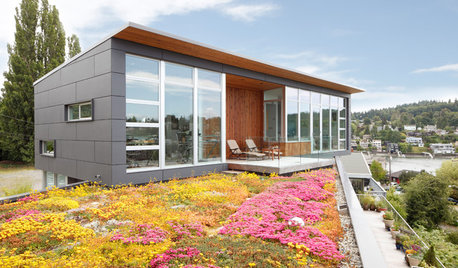
in San Bruno, Calif., we planted a "green roof" of

ancient grasses. The roof now damps the sounds of jets

from the San Francisco airport. It absorbs storm

water, which is important because they have serious

issues with storm water there. It makes oxygen,

provides habitat, and it's beautiful. We also made a

green roof for Ford Motor Co.'s River Rouge plant. It

saved Ford millions of dollars in storm-water

equipment.

How will you fuel the Chinese cities?

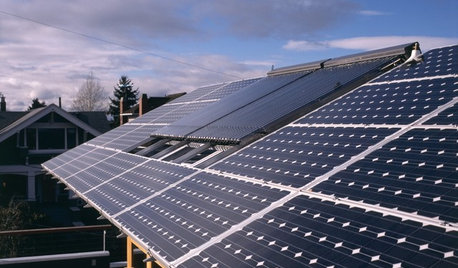
I want to see solar power cheaper than coal, but to

get the speed and scale to do that fast, you need a

place like China. We're not talking about dinky solar

collectors on roofs. Think of square miles of marginal

land covered with them. This could

Comments (9)

  • 21 years ago

    Green roofs are a great idea - and hardly a new one either. However, people who lived in dugouts had different standards than most do now. Traditional green roofs required contstant maintenence, which moderns abhor. Modern high-tech materials are required to resist being flat under a foot or two of bio-mass, and the roof structure must be very massive to resist the tremendous wieght from heavy rainstorms. It's the same parameters as photo-voltaic: very expensive up-front, high-tech, high embodied energy, difficult for the average person to maintain. Also much like modern vehicles - increasingly efficient, but increasingly expensive and requiring ever more specialist ability to repair.

  • 21 years ago

    Pat - re your statement "Traditional green roofs required contstant maintenence".

    I can't quite agree with you, especially when taking into consideration the two 'types' of green roofs. It is true that careful attention must be paid at the beginning - everything from adequate structural support and waterproofing, to soil depth and plant types should be determined long before the first seed is planted. However, once the basic decisions are made and the structure begun, the 'constant maintenance' is not all that constant, consisting primarily of paying attention to water-needs until the plants are established -- unless one chooses the 'EXtensive' parklike type which is indeed considered to be high maintenance, just like any other park or garden; there are good [and widely-published] examples in Chicago of this type. However, once established, the 'INtensive' green roofs take little more attention than any smart homeowner provides - checking the roof surface is still checking the roof surface regardless of whether you are looking for loose shingles or unhappy plants! Leaks are leaks, again regardless of the roof surface, and water drainage is water drainage. Knowledge of correct building practice is required regardless of whether the final roof is composed of asphalt, clay tiles, recycled-products shingles, or soil. Locating and using a good structural engineer should be a requirement of all new buildings. And, other than the possible use of the internet (computers, monitors and other high-tech et ceteras] for the application of enough common-sense to research the appropriate plants, the only "high-tech, high embodied energy" substance/s found in green roofs is in the waterproofing technique, and for residential use those waterproofing materials are often no more high-tech or unusual than properly applying the correct grade of plastic sheeting.

    An appropriate analogy for green roofs might have been to compare them to the bicycle, which now can come with high-tech frames, elaborate suspension, and tires matched to the road surface. But I see no resemblance between the specialised expertise required to design and maintain today's modern car and the widely available knowledge needed for the low-tech, low environmental-impact green roof.

  • 21 years ago

    I have no direct experience with "green" roofs. But I do know quite a lot about ordinary roofs, flat rubber ones included. Extrapolating from this, my experience tells me that a green roof will start leaking within some years, probably about the same as a normal one - ten to twenty years. Having to move soil and plants to fix leaks won't be cheap. Building it so it absolutely cannot leak for longer time periods will not be cheap either. If I were to have one, I would definitely choose the traditional route of sod over woven branches so that one can see what is going on, and intitial cost is quite low.

  • 21 years ago

    Pat- My only personal experience was quite some time ago (in a rural community and long before there were any rules, regs or laws to control building issues). That house was built 'before the war' [meaning before 1939?] and was at least 30 years old at the time I met it. The shed-type roof was sloped 25 or 30 degrees, and quite thick - more than a foot of soil, and covered with several types of grass and vines. The walls were what is now called stackwood-&-cob and about 2 feet thick. I do remember going up into the "attic" and being shown closely spaced, thick timbers and seeing the underside of the roof which was composed of slate - I would guess that the slate had been laid down the same as shingles would be, to permit water to run downwards; the owner said that although he made a point of checking for leaks everytime they had a hard rain, he had never found a leak -- I clearly remember that statement because I had just paid to have my own house re-shingled, which didn't resolve a problem with an unlocated leak, and oboy, was I was envious! So, I don't really have hands-on experience, but I do know that green roofs are possible, viable, can be long-lasting, and do *not* have to be high-tech - although if I were going to have one, be assured there would be a qualified structural engineer involved.

    Live with sod directly over woven branches? - no way, not me! Consider: soaking rains or snow-melt will seep water through the soil to drip past the gaps in the weaving; woven branches will flex with the weight changes directly related to saturation, causing soil bits/mud to drift down as the flexing occurs; insects can easily make their way through the soil and into the living area; and to be viable, the soil must always maintain at least a modicum of dampness, which would not only increase the humidity of the living area, but probably be sufficient to support molds, mildews, and fungi; and that same mildewy dampness will cause those supporting branches to quickly deteriorate (not to mention the probability of making the residents ill).

    Given my druthers, I'd go for a monolithic house!

  • 21 years ago

    container gardens would be better.
    Schools should be growing their own food as part of the curriculum, as well as all institutions.

    Farmers should grow for their communitites and be supported by the communities.

    Bring back the small farmer and close the doors of supermarkets.

    Farmer markets are the best! Put a face to the person who grows your food and know who they are.

    I love the idea of a collaboration with other cultures.
    Diversity is good.

    thank you for the article Elease. I am for any People (no matter who) getting their hands in the dirt and growing some plants for food.

  • 21 years ago

    Meldy, if a thick bed of sod and soil can absorb enough water to keep a roof from leaking for over thirty years, then it ought to keep woven branches dry. The weight issues are another matter, I'll agree. Apparently it worked in the prarie dug-outs. Back to the pitched slate with a foot of soil and plants on top: why bother? Well-laid slate is a hundred year roof, and looks darn fine to boot. It must have been quite some trick to keep the soil intact on a 25 degree slippery slope until the sod was well-established as well.

  • 21 years ago

    Pat - I think the sod may have been for insulative purposes, and/or protecting the slate from wind-damage; the house was surrounded by trees. More likely insulative, as one of his points in using stackwall construction was for the insulation value. At the time I saw it, I didn't think to ask the owner about the reason for the 'double' roof, and a couple decades ago the house was destroyed to make way for another 6-lane highway. I really don't remember much more than what I've already noted and I doubt there is any way to find out; this was a sort of 'underground' construction even back then; one had to be a friend or a trusted friend of a friend to even hear of it, much less actually get to see it. Rammed earth, superdobe, straw bale, papercrete, and stackwall construction techniques are only now slowly coming to be accepted by the "experts"; remember: 50+ years ago, it wasn't at all acceptable to know of those methods, and often risky to put into practice.

    I thought you may have been referring to prairie dugouts; some time ago I read a diary by a pioneer who lived in one for a few years, which is why I mentioned mud and bugs! I have always been more fascinated by SB construction which is so lasting in comparison to the dugout - although I've also been reading a good bit about compressed earth walls, which are probably similar to adobe in durability. I wonder if the Chinese are planning to adapt something like Khalili's superadobe(sp?) - it certainly seems to be ecologically acceptable, financially possible, and apparently the constructions are durable and meet most engineering specifications.

    Here is a link that might be useful: Khalili articale

  • 21 years ago

    Well, earth and sod are certainly very cheap and effective insulators. I wasn't thinking about that angle before. That probably makes the extra labor and/or cost well worth it.

  • 21 years ago

    Pat - did I express the slope wrong? It looked gentler than what is now common around here for houses; I would guess it was possibly a 4- or 5-in-12 rise, I used a protractor against a local tool shed that appeared to match my memory of the slope. Yeah, I wish I knew for sure how he managed the soil but I would guess that he used the method of laying rolls of sod on top of a layer of soil; at least that is how one of my 'green' friends sodded the roof of a garage/workshop. The grass sod was unrolled horizontally, with each following row butted to the preceding; that sod was laid over something he called 'pond liner' which friend was concerned to protect from possible punctures. Last I heard, that roof was still no-leaks.

    re your most recent post: Cost of materials is usually quite, quite low (often nearly free) in earth/green buildings (cost of interior finish is similar to stick construction, of course). Labor? Ah, that's the catch! Which is why so much of earth-construction is DIY, with the cost of labor being whatever value you put on your muscle-power but little extra out-of-pocket cash. Although it's only fair to say the reverse is true for many types of monolithic buildings - labor required is skilled [but not too difficult to learn quickly]; and materials cost is comparatively expensive but still not as costly as basic stick-construction. The resulting issue in either case is to have a building that is low in environmental impact for construction materials, low in mechanical requirements for construction (not so for blown-crete & similar monolithic methods), and high in comfort with low maintenance expenses - maintenance also meaning seasonal heating/cooling costs which are usually astoundingly low due to the high insulative values of the construction. For the fun of it, you might enjoy 'daycreek.com' which has an ongoing journal of one guy's real-life experience with this type of building -- he doesn't hesitate to mention prices, problems, and what he learned as he learned it. It's also interesting to read in regards to a real-life solar-power system -- he pulled no punches in saying what happened, as it happened while he was dealing with the local public power company.

Sponsored
Peabody Landscape Group
Average rating: 3.5 out of 5 stars8 Reviews
Columbus' Reliable Landscape Design & Contracting