Software
Houzz Logo Print
dhparker

Range hood options?

13 years ago
Hello,

I'm doing some kitchen remodelling and plan to purchase a 30" Wolf range GR304. I know my current Microwave OTR will not cut it and would be looking to get a range hood with enough power/CFM to meet the range requirements.

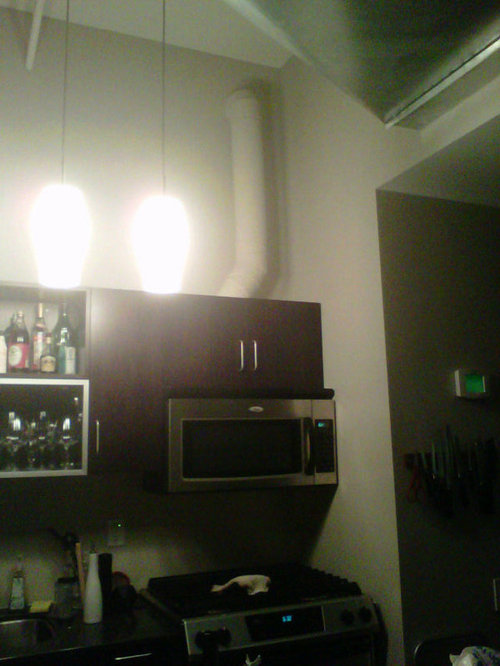
I live in a converted warehouse condo - and my current OTR venting system appears to go into the same venting system as my bathrooms (see picture below) - not externally (at least from what I can determine).

Has anyone heard of this and can I just install a regular "external" venting hood - or do I need to look into a recirculating option?

Dave

Comments (7)

  • 13 years ago

    That vent, like your bathroom vents, have to exit the building, and, probably do.

    You should check to see if this kitchen vent stays the same diameter until it leaves the interior space. If it does, what looks to be a 8" duct should be sufficient to vent your new hood.

  • 13 years ago

    Check with your condo about what's allowed. However ideal external venting may be, it may not be allowed -- and/or the idea of appealing" such a rule may not be practical.

  • 13 years ago

    Try to get more solid information on your present hood setup after it exits your unit into the common elements and what are its capabilities if any, for improvement. Approach your condo management and board of directors to sound out on a low key if others have preceded you on a similar quest and been totally rebuffed or have muddied the waters and got everyone's back up.

    A Vent-a-Hood ARS or similar $$$ recirculating unit works best with slower air movement in a non open concept cooking area.
    Proceed with caution.

  • 13 years ago

    I'm no expert but you should check the installation instructions on the range, I don't think it can be placed directly next to a wall/combustible surface (unless you're moving it from its current location).

  • 13 years ago

    I was going to say the same thing - I don't think you can put that Wolf range next to a wall.

  • 13 years ago

    As with many gas stove makers, Wolf's installation instructions say that there should be at least 6 inches of horizontal distance between the edge of the stovetop and an adjoining combustible wall surface. From the picture, you have combustible wall surfaces at the back and right side of the stove. On the back of the stove, Wolf says you must install one of the risers (the thin backsplash vent) if you have a combustible surface back there. I suspect that the maker of your present stove has something similar in its installation instruction. For the sidewall, you would have to put something non-combustible. Tile is typically used for these applications.

    For the meantime, I strongly recommend you get something non-combustible on the backwall and sidewall ASAP. I would go this weekend to one of the local big box hardware stores and buy some range-hood backsplash plates. HD and Lowes (and our local hardware stores) have them in sizes ranging from 24" up to 42" wide and about 24" tall, and they come in various finishes including stainless. Hereabouts, they run somewhere between $30 and $70 each, depending on size, finish, brand and store. (You can spend a lot more and get ones that are as tall as 54 inches). You can mount them to the walls with drywall screws. Mount them so the bottom edge is a couple of inches lower than the stovetop. Cheap and serviceable protection/insurance for the interim.

    (BTW, the back and sides of residental stoves are insulated well enough that you do not need to tile or plate below the cooktop level.)

    I'm not sure what you meant by saying that the rangehood vents to the same system used for the bathrooms. That initially made me concerned that somebody tied the rangehood vent into the plumbing system's DWV. (DWV = "drain waste vent"). This would be such a bad idea (not to mention a big code violation) that I doubt they did it. Its a bad idea because of the possibility of backdrafting sewer gas through the connection. To me, it seems much more likely that the OTR/rangehood venting ties to the same tubing as the bathroom fans use and that tubing probably uses the same material as the DWV and goes out through the roof of the building. Check with your condo folks to see what you can find about that. You may have external venting on the rooftop where it can be hard to see without going up there. As Tjdabomb and laat say, you probably already have a system for external venting a rangehood.

    Looking at your kitchen's layout, I also have to ask if you have considered induction? There will be a lot less waste heat to worry about and less concern about flammable surfaces, For the cost of a Wolf 304, you can get just about any induction range you'd like and have a considerablesum left over.

    But, maybe 208/240v service is not available to the kitchen?

    This post was edited by JWVideo on Sat, Jan 12, 13 at 14:04

  • 13 years ago

    My understanding is that sheetrock is considered non-combustible, but I'm not an expert on that subject.