Software
Houzz Logo Print
cheryl_hays3290497

Exhaust Fan - AGAIN!

14 years ago
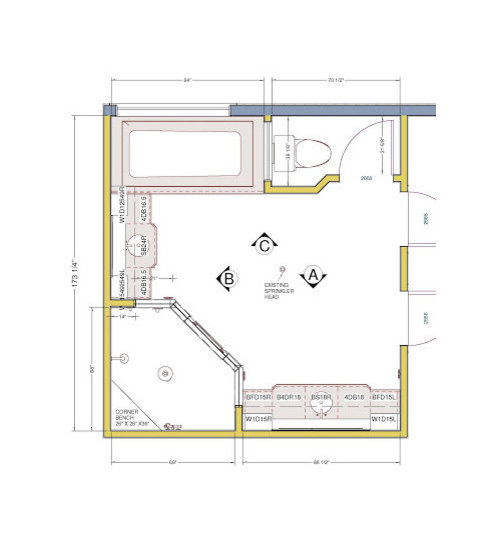
So I read through all of the prior posts about in-line exhaust fans and nothing actually answered my question!

I have decided on Fantech fans based on my designer's rec and those found in this forum.

We are remodeling and have 2 existing exhaust vents on the exterior siding from the master bath's 2 existing fans.

The question is do we get a small fantech (110CFM) for the potty room and a larger dual-grill version (270CFM) for over the shower & over the tub (bain ultra)? There will be a 6" soffit around the shower, so I worry that the air won't clear as quickly as if it we all just open to the room.

Alternatively, we could block one of the existing external vents and just use the 270 CFM dual grill model...one in the potty room and one centered between shower and tub.

Long story short - I like the idea of the 2 fans, but don't want to overdo it in terms of capacity! we are doing radiant floors, but don't want to lose all the heat to the outside!

Ideas???? The total bathroom size is roughly 13.5'x14.5'x8'.

Thanks!

Comments (11)

  • 14 years ago

    I know you have your heart set on all those fans, but the truth of the matter is you only need a total of 104.4cfm for the entire room.

    13.5 x 14.5 = 185.75sq.ft

    195.75sqft x 8' vertical = 1566cu.ft.

    1566cuft x 4 air exchanges per hour = 6264cu.ft/hr

    6264cu.ft/hr divided by 60 minutes = 104.4cfm

    anything greater than that is a total waste of energy

  • 14 years ago

    I didn't see those last 2 calculations on the site I found to calc size of fan needed. somehow I figured I'd need about 100cfm for my 13 x 8 bathroom!

  • 14 years ago

    i am having exhaust fans installed in my master bath. i got one fan with two ducts for one in the main bath and one in WC. one thing to note if you go this route is that you might need to have a maintenance door, according to my contractor.. so this might be something you have to plan out the location of.. single fans can be serviced at the point of the duct..

  • 14 years ago

    We are putting the motor in the attic so access is not a problem.

    Based on what I have seen, any bath over 100sf should not use the CFM by SF method mentioned above. I need 200CFM based on the following:
    50CFM shower
    50CFM potty
    100CFM jetted tub
    (50 for a regular tub)

  • 14 years ago

    I don't know where your getting your information but it is absolutely wrong. If you put in the 250cfm as listed that will take all the air out of an 1875sq.ft house and push it right out the stack every hour..so you can expect your furnace or AC unit to be running double time....but it's your house, do it you way...no skin off my nose,,,i only work these problems out for a living.

  • 14 years ago

    FWIW, chays' method is from the Home Ventilating Institute (HVI), an industry group. I'd put a separate fan, 50cfm, in the toilet room and a 100 cfm in the main room and put both on timers. Let the main room fan run for at least 1/2 hour after a shower and maybe more after a bath, so make sure your timer goes to 60 minutes. My timer maxes at 30 mins, which I think is suffcient for a shower.

    Also, a fan cools a room significantly - you might consider a fan with a heater built in, placed above where you'll be standing to dry off.

    You can get more technical while sizing a fan by adding in duct details - if your duct is long or has some bends, you might want to address it. Panasonic has some sizing tools:

    http://www.panasonic.com/consumer_electronics/ventilation_central/howtosize.asp

  • 14 years ago

    Oops - typo. I meant 150 cfm in the main room. To elaborate, some folk recommend 8 air exchanges/hour. My install does about 6 exchanges/hour and like I said, leaving the fan on for 30 mins takes out all the humidity and the shower dries pretty well. There is indeed a balance between energy efficiency and getting your bathroom to dry out. Seems to me, if you're not using tile and grout at all, drying would be less important. If you're using modified or epoxy grout with tile, I'd say drying is still a little less important. It's all about clean grout for me.

    My wife was turning the fan off as soon as she dried off after a shower - a clear mirror was all she was thinking about. But to get the shower to dry, you need to let the fan run.

  • 14 years ago

    Your right, some folks recommend fans capable of 8 air exchanges per hour, and when the homeowner comes back and says they still have problems with excess humidity those same self appointed experts will tell you to get a bigger fan....BALONEY!!!!!

    What most homeowners can not get in their heads is that nature abhors a vacuum. I don't care if you have a jet engine for an exhaust fan, the fan can only push out an amount of air equal to what is entering the room.

    In most residential bathrooms all they have is a higher gap at the bottom of the door to allow air to enter. In fact, in most bathrooms you can actually stand in the bathroom and listen to the fan, then open the door and listen to it, and you will instantly hear the difference in how the fan is working.

    Four air exchanges per hour is more than adequate if the fan is working at normal efficiency, which means you must have a duct or other means to allow air to enter the room and the ducting from the fan must be correctly sized and installed, however if you don't have a means for air to enter the room, and if your ducting is the typical small diameter flex duct just tossed willy nilly across the attic your fan does not run at peak efficiency. In all likelihood it is not even running at minimal efficiency.

    When we design the fans system for institutional shower rooms such as those in a high school locker room with upwards of 36 showers all working at once, we only design for 4 exchanges per hour, but you can sure bet that we design rigid ducting that is properly sized for not only the cfm of the fan, but compensating for the length of the run and we install dedicated return air ducts that will allow and equal or greater amount of air to enter the room.

  • 14 years ago

    Yea, I was wondering where the air was coming from when the bathroom door was closed, as I didn't hear any difference with the door open vs. closed. Turns out, I can feel air coming from under the door, a very narrow 1/16" slot - (it just clears), and through the heater grate. Combined, the total air flow must be somewhat close to what the fan wants. And probably why the bathroom cools down so much when the fan is on and why I think a heater/fan combo is a good idea.

    You have to wonder too about the HVI; not a particularly uninterested group. Maybe larger fans are more profitable - but who knows.

  • 14 years ago

    we ordered a panasonic light/fan 110 cfm and our contractor had us return it for the same thing with a built in heater. Our bathroom is about 10 x 12, he did the math and said all we need is 110 cfm but said we would regret it if we didn't get the one with the heater.

  • 14 years ago

    and what if you don't have a bathroom door? it's open to a short hallway (maybe 4.5') which is open to the bedroom.

Sponsored
Daniel Home
Average rating: 4.8 out of 5 stars20 Reviews
Premier Interior Design Team Transforming Spaces in Franklin Co, Ohio