Software
Houzz Logo Print
randgalt

Salamander cooking

19 years ago

I plan on getting a Bluestar Salamander. However, I can't find anything on the net or any books that describe how to use them. I'm sure I'll find great ways of using it, but there must be some sort of "Salamander Cookbook". How do the pros learn?

Comments (16)

  • 19 years ago

    A salamander is a high-powered broiler. Just check out broiler cooking.

  • 19 years ago

    The caterer I work for calls it a "cheese melter" and that's about all she uses it for.

  • 19 years ago

    I remembered I have a copy of the CIA's textbook (the thing weighs like 10 lbs!). Flipping through, it talks a lot about using a salamander for various things.

    FYI

  • 19 years ago

    randgalt,

    No serious steakhouse ues salamanders for steaks-they use grills.

    Broilers and salamanders are dry heat cooking methods. Grills supply heat from below, whiele salamanders apply heat from above.

    The big difference is that salamanders produce no grill marks and no taste from the fat dripping onto the coals/lava rocks. Grills produces the flavor from the smoke and the grill marks. This is part of the taste of a steak.

    Unless you currently use the broiler in your oven a lot, a salamander is probably more of a conversation piece that a useful tool. Sure, pro cooks use them, but let's remember why: Pro ovens do not contain a broiler.

    The other reason that pro's like salamanders is that it: 1) frees the oven up for other things and 2) the salamander, operating at eye level, is easy to monitor while you are doing other things and since the time a plate of food is in the salamander is typically short, it needs a lot of monitoring.

  • 19 years ago

    I'm such a loser. I had a great vision of the Geico gecko in a chef's toque and full apron forking steaks onto the barby.

    I DO know what a salamander is, but I've never used one. Much more experience with geckos...

  • 19 years ago

    cpovey: What steakhouses are you referring to? The best steakhouse in the world (IMHO) is Peter Luger in New York. Steakhouses like Luger's (Ruth's Chris, et al) use salamanders/broilers not grills.

    Ruth's Chris: http://www.ruthschris.com/
    "U.S. Prime steaks, broiled to perfection at 1800 degrees"

  • 19 years ago

    cpovey: more on salamanders...

    My broiler is not infrared nor can it produce 1850 degrees of heat. Even if it did, however, an oven is a much larger space. The purpose of a salamander is to broil in a small space where the item being cooked is in near-direct contact with the extreme heat.

    The type of steak I'm interested in does not have a smokey flavor nor does it have grill marks. If you've never eaten at the type of place I like you might know what I'm referring to.

  • 19 years ago

    I am lost here. I have eaten at Ruth Chris and while the steak was thick I didn't see anything that special about it. It was steak. So what is it about the way Ruth Chris steaks are and what the salamander will do that sets it apart from a regular broiler?

  • 19 years ago

    Ruth's Chris is not the best. I don't really like any of the chains (Morton's is OK). Where do you live? I can look on Zagat and find the best place in your area.

    All steak lovers should make a pilgrimage to Peter Luger in New York. http://en.wikipedia.org/wiki/Peter_Luger

  • 19 years ago

    randgalt

    Thanks for offering to look for a place. I eat at Rc a few years ago, but I no longer eat meat so don't need to find a place for steak. My local newspaper food critic didn't think to much of Mortons either, however I have heard about Peter Luger.

  • 19 years ago

    I found a good link that shows how a salamander is used to cook steak: Click here. Scroll down the page a bit to see it.

  • 19 years ago

    Randgalt,

    You seem determined to get a salamander for your kitchen, and that is your prerogative. You don't need to justify the purchase for us.

    However, you should know that a salamander is not used in large restaurants to broil steaks and other large items -- they use upright broilers for that.

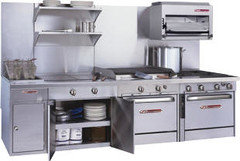
    Also, a salamander is mounted at eye level (as seen

    ). The link you provided mistakenly referred to a "salamander", when in fact it was a
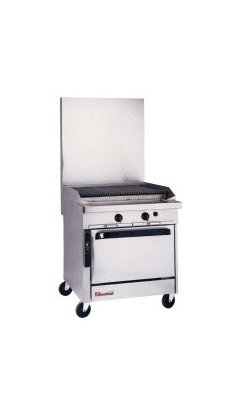
    (waist level, look for the knobs below the Vulcan tag) in the first picture, and an upright broiler in the second picture (see "Steaks getting the broiler treatment."). There is no salamander in view...

  • 19 years ago

    This thread is getting silly. Salamanders are not, in fact, always mounted at eye level. They can be on the counter, or installed as part of the range, like the one in my commercial Vulcan range (installed by previous owner) in my home. They function in the same way as the above mentioned upright broilers just on a smaller scale. The specs of the charbroiler and the Bluestar salamander are parallel. The Bluestar salamander is hella hot, and would probably make very good steaks with a good char and no gray ring--pink to red clear through. Whether or not there's enough volume or space to justify the purchase is something that only randgalt can answer. I personally think that for the volume of cooking I do, a good infrared broiler in a conventional range (Bluestar or Wolf AG) would probably suffice. My salamander is not used often because of 3 preschoolers in the house, as it is right at their poking level. It is pretty cool, though. I think I would use it more if it were mounted higher, both for improved ventilation and safety. Mark Bittman wrote a column in the New York Times earlier this year about how the broiler was the most essential part of a kitchen. It was an interesting read.

  • 19 years ago

    I'm not justifying the purchase. I'm just trying to explain how they're used. In top steakhouses, they use overhead, infrared broilers to make steak. This is a fact. You can call them what you like, but a salamander is equal to one of these devices.

  • 10 years ago

    I have two salamanders (an indoor and an outdoor one). The indoor one is more convenient but you'll need a rather large hood to get rid or the hot air. I've got mine mounted under a 54" 1500 CFM hood.

    Just a note, there's a lot of expenses involved with an indoor salamander that make the outdoor versions (i.e. Salamangrill) much cheaper. Besides the salamander, I needed a shelf, a fireproof metal backwall, the high air flow exhaust hood, and a make-up air system slaved to the exhaust. The salamander ends up being only about 1/4 your total costs here if you count labor and installation of these items as well.

    You use a salamander just like a broiler or a very high temperature grill. If you want to cook things slower (thicker cuts of meat), either turn the temperature down or move the surface further away from the heating elements.

    A warning: salamanders cook very fast... at least twice as fast as a "normal grill". You can grill a typical piece of salmon to "well done" in 2-3 minutes on full heat. Make sure you keep an eye on your meat when you're starting to use the salamander so you don't end up burning all your meat.