Software
Houzz Logo Print
angryrooster

Prep for tile install. Please shed some light!

17 years ago

I had someone come quote for the tile install, he asked that we put a thin sheet of durrock up on top of the existing wall in the toilet room so the tile would install/grab better then if installed over a painted wall. I am only doing the back wall behind the toilet. Fine easy enough, can do... then in the vanity area we have same issue but putting 2nd layer of something is not doable cause then it will be higher then shower area that is on the same wall so he said no problem we will scratch it. What does that mean?

Next when we went to pick up the Naxos marble I asked the expert there about install and he suggested that we take drywall mud and skim coat the entire surface of this vanity area so that the thinset has something to grab onto. Is this right? Do both these things mean the same scratch and skim coat. Cause when the guy told me scratch I had envisioned kinda tearing up the wall. Which now I am not crazy about cause the guy warned me at the store this marble is very shear and to have the installer back butter the tile really well.

So what do you think about me putting a thin coat of drywall mud up in the vanity area so the tile will grab?

Comments (9)

  • 17 years ago

    I'm no expert, but...

    The tile will stick better to the durrock than a painted surface. Regular drywall/greenboard works too. Not sure about a painted surface though. By scratching he might be rough the surface up?

    If you're doing marble, you 'might' be better of taking that drywall down behind the vanity and install cement backer board. Marble is a lot heavier too.

    I'll wait for one of the experts to chime in.

  • 17 years ago

    No doubt the thinset will stick better to the drywall mud than the painted surface. But the question is will the drywall mud stick to the painted surface. That is going to be the weakest link. I would think you would want to sand the painted surface before doing either. Removing the drywall and replacing with cement board might be the best way.

  • 17 years ago

    No doubt the thinset will stick better to the drywall mud than the painted surface.

    Aw, hell no!! Drywall mud can and will reimulsify. Normally, there's not enough of it on an area to make a difference. But if you're going to coat an entire surface with it before tiling, it, you can expect that area of tile to come back down at some point in the future.

    As for putting the durock over the painted wall, it depends on how well the paint is holding. I would have no problem going over painted sheetrock, so long as the paint shows no sign of age and/or peeling. I would NOT go over a painted floor, because then that tile will be subjected to pressures not seen on vertical work, but for a wall, it's fine.

  • 17 years ago

    Bill, this area behind the vanity had a huge end to end almost to the ceiling mirror so I just looked at it again and it's white in color but it has a lot of tooth to it, like it is rough to the feel. Not slick like paint. I thought it was just plastered but I just took my sanding stick to it and nothing pours off it like it is just plaster. So i am thinking it probably got a quick primer on it at construction. So now i am confused. AGAIN! What do you think the guy meant by scratch it? And what should I do now? If I put a surface over top this surface it will bring it up at least 1/4 in and then when I rock the shower there will be a difference. Now the tile going up in the shower is 1/2 inch and the marble is 3/8 so we would only have really 1/8 inch difference if I paid attention in school. TIA

  • 17 years ago

    Oh just re read what you wrote about pealing paint. This bathroom when we moved in was only 8 years old and it had some real funky pealing paint all over bathroom especially around the top 12 or so inches of the walls. It was weird, someone suggested it was wall paper glue that was left behind after removing wall paper. So it wasn't peeling in sheets but was tiny like dry skin. Well I guess I have a sanding job on my hands as for the rest of the bathroom. But still would like info on the vanity area.

  • 17 years ago

    Whatever's there should be pulled out and wallboard (either sheetrock or cement board) installed in its place. If it neds to be shimmed out, then do that. But this sounds like it's being gerry-rigged, and that's doomed to failure. What he means by "scratching" is putting on a "scratch coat" of thinset-- flat troweling a little bit on, and the roughing it up somehow-- either with a piece of wire, or the notch of the trowel, and then allowing that to harden and dry, and then come back, spread more thinset over that, and set the tile. That's all well and good, so long as what he's putting the scratchcoat over isn't going to let go! Of course, if that were the case, I don't think he'd feel the need for the scratchcoat.

    Let me add this disclaimer, though-- if that IS plaster, and not drywall compound, THEN the scratchcoat would make sense, because plaster tends to pull the moisture out of thinset too quick, as in before it has a chance to bond to the tile, so scratching the face of he plaster with thinset and allowing to dry, and then setting over that, would make sense.

  • PRO
    11 years ago
    last modified: 11 years ago

    "So what do you think about me putting a thin coat of drywall mud up in the vanity area so the tile will grab?" - I think that is a really bad idea.

    I found this old post searching what info was online (Houzz/Garden Web) in relation to "Scratch Coats". There is so many versions of a scratch coat it is hard to tell what one is right or wrong for each job your tackling.

    Installing tile over drywall mud (finish, all purpose or joint) is a bad idea. Installing tile over drywall that has not been covered with drywall mud is often OK as long as the area is not in the shower or around the tub.

    Installing tile over painted drywall is done all the time but the strength of this assembly relies totally on how well the paint was applied and what type of paint there was.

    Your question (top of page) was answered well I think by the fellow coming to look at the job. Adding a 1/4" of cement board would make for a much stronger wall than skimming out an old wall with fresh drywall mud.

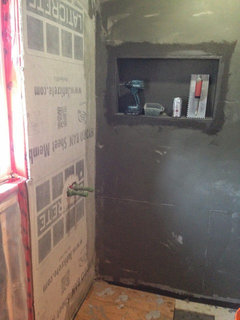
    I put a few pictures together showing a simple scratch coat and hopefully this will help you understand what a cement board (CBU) sheet look like scratch coated.

    No Curb or No Dam Shower's featuring Barrier Free Bathrooms (No-Hob): Preparing · More Info

    The CBU is Wonderboard lite. The thin-set Laticrete 253 Gold. The waterproofing membrane on the left wall (Laticrete Hydro Ban Sheet Membrane) and the inside of the niche was done wit Ardex 8+9.

    I realize the post is years old but it is the first hit on a google search....

  • PRO
    11 years ago
    last modified: 11 years ago

    Well done Jean. Your installer did not steer you in the wrong direction. The prep for glass tile is often twice the work as the instal of the tile itself.

    Any finished pictures you care to share?

Sponsored
High Point Cabinets
Average rating: 5 out of 5 stars21 Reviews
Columbus' Experienced Custom Cabinet Builder | 4x Best of Houzz Winner