Software
Houzz Logo Print
fotostat

Tips on patching some holes

19 years ago

I have a couple of things I would like to cover up. The people I bought my condo from painted it right before selling it, they did a good job and I like the color so I would like to stick with it. There are a few things that they didn't do, however.

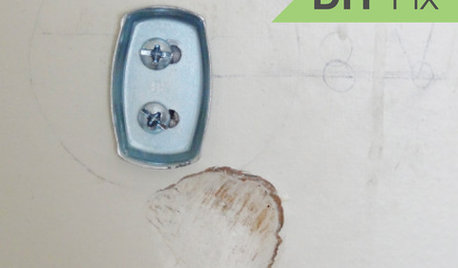
They left the old phone plate (the really BIG type) on the wall in the kitchen, there is a 2" X 3" hole behind it plus a couple of 3/8" holes from the anchors. They left the wall plate for the old television antenna, another 2" X 3" hole. They also left the old wall plate for cable television (it's been abandoned for new RG-6 wiring) which has small 5/8" hole plus two screw holes. The last thing is some type of large dent in the wall, I scraped it out and found it to be an old repair. Other than that the whole place looks great so I would really like to get away without painting it, I would end up ruining it.

So to repair these holes I assume I could get away with just buying some Sheetrock brand joint compound? I am in the construction trade and this is all I see the tapers use. I assume the little holes can just be gone over with the mud, while the big holes need to filled in with something? The walls are very thick,they are made of plaster with rock-lath behind it so filling the hole with a piece of sheetrock might not build it up enough. Any tips?

As for paint, I do not know the color that they used, it's just some type of off-white. I have the wall plate that was painted, I was told I could take it to Home Depot and they will use the computer to match it exactly. Is that true? Will it be that easy to match the paint? Again, the paint on my walls is relatively new, less than a year old.

Any help would be greatly appreciated.

Comments (13)

  • 19 years ago

    As I am sitting here watching my guy Tony Stewart in the #20 Home Depot car I have to say that Home Depot is the last place on earth that I go for matches. See if you can contact the old owners & ask what was used. Thats the easiest way otherwise if you don't have the exact same brand & finish a touch up will be noticeable. If the finish on the walls is eggshell or anything shinier than flat a touch up will show also so you should roll out the entire wall if you are looking for perfection.

    As a painter I use a dry mix like Durabond for patching holes. All you do is add water & mix it to the consistency that you want. You can mix it thicker than regular joint compound for larger holes with less sagging. For the big holes you can screw in a piece of drywall for starters & make up the difference with your patching compound. Use some fiberglass mesh tape if you like also.

  • 19 years ago

    Thanks for the reply!

    I've tried to contact the old owners, but they've moved far away and are unlisted. So I am stuck having to match the paint myself.

    Who should I go to to match the paint other than Home Depot? I only suggested them because I assume they would have the money for the more expensive equipment. Would a smaller paint store be able to analyze and match the paint better?

    How do I screw in a piece of drywall for the bigger holes?

    As for rolling the entire wall, I just can't do that. Each hole is on a different wall, I would have to repaint 4 large walls. I'm not good at cutting and probably not that good at rolling either. The walls would certainly look better with a tiny patch than a crappy paint job across the hole thing. I've never really painted before, but I am sure it's not something you could just jump into and be a professional. I would need a lot of practice before I could do a decent job, and I would rather that practice not be on my living room and kitchen walls.

    Thanks again!

  • 19 years ago

    I normally have much better luck with matches at local paint stores. Most of them have color eyes too but the best color matchers I know can do it without a machine. My local paint dealers also keep records of what was used under my clients & my name. Who knows you could get lucky just by asking.

    Since you have plaster/lathe walls for the bigger holes just cutting a piece of drywall to fit in the hole & use some drywall screws to screw it into the lathe. If you can't screw into it even at an angle then use some fiberglass tape on the edges & make sure to get plaster in between the drywall patch piece & the original plaster. It will prolly take a few skims of plaster to get it nice & smooth. Just don't put it on so heavy that you have a ton of sanding to do.

    Maybe this is one of those times where ya call your buddy in a different trade & see if you can get him to do it for a good price or trade some work.

    Good luck!

  • 19 years ago

    I use the Sheetrock brand Easy Sand 20 or 45. I am pretty sure that most tradesmen are calling that stuff Durabond these days generically even though Durabond is really a different product. The Easy Sand is better because at least you can sand it a little.....Durabond dries rock hard and is hard to sand. What I usually do is mix up some Easy Sand 20 for the first two coats and put it on light and then top it off with Sheetrock Plus 3 because the Plus 3 is really easy to sand and is really lightweight so if you put heaping mounds of mud on you won't need a belt sander to get it off when it dries. That is usually what most novice patchers do and as painters we see it a lot....homeowners think they are saving their painters time by patching the holes before they arrive to start but really they just create more work for us. Just remember that any ridge of mud has to be sanded smooth and several light coats are better than a few heavy ones. Also, make sure that you push the holes into the wall before you patch...you want the holes to be indented. I usually use the back side of a screwdriver for this to create my crater before patching. Anything that is sticking out higher than the surface of the wall before you patch is going to show.

    Also, don't think that you can go to a paint store and get a perfect match. That's probably impossible....they can probably get it close, but without knowing the exact color, brand and sheen that was used, expect your touch ups to show a little. The only real solution is painting entire walls or finding out the paint that was used. I'm surprised that they didn't leave some behind....most people do.

  • 19 years ago

    Thanks for the info!

    One more question, when painting the patch, should I use a roller instead of a brush so you won't see the brush strokes? I have one of those little rollers that seems to be the perfect size to cover my patch.

  • 19 years ago

    Yep exactly. Always try to match the texture of what is on the wall if you can for the best chance of touchups blending in.

  • 19 years ago

    Good news, I found the previous owner and she told me the paint brand and color (Sherwin Williams Linen White) so I'm all set! Thanks guys!

  • 19 years ago

    paintguy, one more question.

    I know exactly what you mean, how all tapers call the Sheetrock brand powder by the name "Durabond".

    In my instance (patching a few small holes) what is the benefit of using the durabond first instead of just using a couple coats of normal pre-mixed spackle?

    I ask because it would be a pain mixing that dusty durabond in my condo and would be nice if I could avoid it. However, if it's a much better way, I am willing to go thru with it.

  • 19 years ago

    You can just use the premixed. The benefits to using the Durabond aka Easy Sand are that it dries hard and it dries fast. If you fill a huge hole with the premixed it may take forever to dry and then that just means you have to wait longer for the next coat. The repair will not be as hard as if you used Durabond but that doesn't matter to me and it probably won't matter to you either unless you plan on whacking your wall in that exact spot for some reason.

  • 19 years ago

    Knowing that, I will just use the pre-mixed stuff. I will wait a day between coats to make sure it's dry.

    Thanks again!

  • 19 years ago

    If you mix Easysand or Durabond about as thick as peanut butter it hardly shrink on hardening.
    These compounds are plaster based, and harden by chemical reaction.
    Normal pre-mix mud hardens by drying out, and has significant shrinkage.

    If you add too much water to the setting compounds they can have shrinkage also, but keep them at the low end of water (just enough to handle) and they work very well.

  • 19 years ago

    brickeye, if I were to take my time with the normal premixed mud, do it over many days, would I be able to keep up with the shrinkage and fill it in after it happened?

    I am in no rush, I could put a coat on every other day for the next week or more.

    Would that be alright?

  • 19 years ago

    Yes that would be alright but all of my advice is wrong anyway :)