Software
Houzz Logo Print
chris11895

Making slipcovers - anyone have expert tips?

15 years ago

Hi,

I am very interested in learning how to make slipcovers and wondered if anyone on here does this and can share some of their tips and knowledge. My biggest concern is making them washable. A friend of mine made one that looked nice but she said it didn't fare very well after a couple of washes. In one book I found they recommend using a serger. These look really complicated to me, is this the best way to go? Lastly, if you make them, how did you learn? Did someone teach you? Did you take a class? Just do trial and error through reading? Thanks in advance for any help!

Christine

Comments (17)

  • 15 years ago

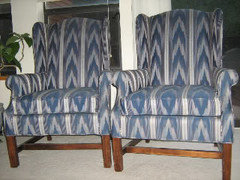
    Last year I decided to get 2 FREE wingbacks off CL. Then DH complained they didn't go with the bedroom decor....so I purchased printed linen for $2 a yd to go with the oriental rug and slip covered them. :0) I knew how to sew, that was my qualification for attempting this:
    Tips:
    1) I used newspaper to make a pattern of each section.
    2) I piped everything to get a nice finished product.
    3) I put a zipper in the back, so I could get them on & off easily.
    4) I matched up the flowered pattern on the fabric, so it flowed well. :0)

    Before & After

  • 15 years ago

    I just made mine bu laying the fabric on the chair, pining it to the chair and then cutting. There's a lot of going back and forth from fitting to the chair and sewing. Use big seam allowances in case you need to adjust and very longzippers. If you are doing a good job of fitting, it can be tight to put on. I agree with the previous poster that piping makes very nice edges. It is more than worth the extra trouble. In the end, a little bonded quilt bat can disguise the piping from the underneath layer, or make certain places fit a little better. If you plan to wash them and they are made of cotton, prewash the fabric so that they won't shrink and pucker. A good spray with scotchguard will also keep them looking good longer. I did check a book out from the public library, but there is no pattern that will fit all chairs.

  • 15 years ago

    Pink & Polka dot has a tutorial and an e-book. I've never made slips but wouldn't hesitate to follow her directions. See if this helps you get started.

    Here is a link that might be useful: The Laziest Slipcover Tutorial EVER!

  • 15 years ago

    This past week, I too attempted to make covers for 6 parsons chairs. It took longer than I thought as all 6 were not EXACTLY the same size - they were close but not exact. Anyway, I found an old sheet and basically made my own pattern by placing the sheet directly on my chair and cutting it out as I laid it over the back, and chair seat. I also left about 1 1/2" to allow for adjustment . I will try and post some pictures tomorrrow

  • 15 years ago

    Fabric choice is key with slipcovers. If you want them to be washable, pre-wash fabric first. Don't pick a loose weave fabric or fraying will happen. Also, some lightweight cottons will wrinkle-ALOT.
    Learning to slip: watch a video, get a book or watch a tutorial online. There is definetly an order to the assembly. You will also learn the terminology/structure of a chair.Cording makes your seams stronger and makes the project more professional.
    Serger: I own a serger, but wouldn't use it to sew seams on a slipcover-if you make a mistake, you can't rip out a seam very easily. You could serge the edges of large sections of fabric to avoid fraying.
    Finally, 1st project advice: KEEP IT SIMPLE! A simple chair-wingbacks can be tricky. Fabric that doesn't require matching will help you keep your sanity.The hardest part for me is the arm of the chair-I make a pattern from muslin in this part to avoid costly mistakes.
    Hopefully, I haven't scared you too much. Good luck!

  • 15 years ago

    You don't have to get a serger if you don't own one. I have always just sewn the seam, trim it down to approx 1/4" with scissors and then go over the edges with the zigzag stitch. Stops the edges from unraveling the same way the serger does.

  • 15 years ago

    I think it's out of print now, but Sunset published "Slipcovers & Bedspreads." I'd try to find it at a library or through a used book store.

    It has very clear, simple, step by step instructions on how to make a slipcover. The method fits the fabric directly on the piece of furniture, which helps to accommodate changes in the shape of the arms or back due to use. There are some handy instructions on how to estimate fabric yardage and the like.

    I've made a few slipcovers using this book and I have only average sewing skills. But the slipcovers came out very nice.

  • 15 years ago

    I've had material for a slipcover for too long and have not started-- one of my big concerns is HOW to prewash such a big piece of fabric. Do I cut out sections but overestimate, and then wash?

    I have sewn some simple clothes and it seems like when I prewash, I always have to do something with the ends (do a zig zag stitch on them-- together) or else it all gets unraveled in the wash.

    Prewashing is a pain-- I would love tips for this!

  • 15 years ago

    Honestly, I haven't prewashed, but I have another thought: measure off a piece of fabric (perhaps 1/2 yd or 1 yard), measure accurately, then throw that piece in the washer and dryer and re-measure. This way, you will KNOW what kind of shrinkage you are dealing with.

  • 15 years ago

    Prior to washing my fabric, I cut it into six yard sections after reading somewhere to do that, and then washed each section by itself. Worked out really well.

  • 15 years ago

    TY for the tips!

  • 15 years ago

    Some laundromats have triple and quadruple load machines. Depending on the weight of your fabric, you might be able to use one of those.

  • 15 years ago

    Prewash & dry the fabric a couple times, it can continue to shrink after just one time. When you iron the fabric try not to stretch it, i.e. don't iron across the bias. When I wash many yards of fabric I place the ironing board next to the bed so the excess can rest on the bed and not on the floor.

    Go with lighter weight fabric not heavy upholstery. If you have the time make a trial one first out of cheap muslin fabric before you proceed to more expensive fabric.

    For your first attempt at slipcovers maybe you shouldn't even attempt welting, that can make the layers so thick at the corners your machine may go out of alignment trying to sew it all together. I haven't made slipcovers but I've made quilted handbags with welting and it ruined my machine, even after service it's still not back to normal and I'll have to bring it back for more extensive and expensive repairs.

    You don't need to use a serger but you should at least overlock the seams with your sewing machine. I just had a pair of chair slipcovers made and the seamstress didn't use a serger or bother to overlock and the first time I washed it the seams unraveled something awful. I spent 2 hours angrily trimming them with scissors. Now I have to overlock it myself if I want to wash these again. The fabric (100% hemp) was heavy and prone to unravel.

    The other mistake she made was to make the slipcover too tight. I ripped seams trying to get it back on the chair. I hope you're comfortable sewing zippers too, a good slipcover will have a zipper.

    Nicole, your slipcovers look amazing! You must be an experience sewer. I'd like to try my hand at slipcovers one day but I think I'll start with an ottoman cover. ;-)

  • 15 years ago

    You said your friend's slipcover didn't fare well after washing. What do you mean by that? Did it shrink or did parts of it looked pulled or stretched?

  • 15 years ago

    miss mustard seed's blog has a very nice multiple part video tutorial. I've watched them all and taken notes, but I haven't gotten around to the actual work yet! LOL

    Here is a link that might be useful: miss mustard seed