Software
Houzz Logo Print
anna_bannana

Vent Hood Advice, Please!!!!!!!!

17 years ago

We are remodeling the kitchen and overall it has been enjoyable to figure out which appliances are the best fit for our kitchen. Well, until it came to the hood!! I have never had one before and am having lots of trouble figuring out what to get. I read many posts here and became more befuddled by CFM, duct size, internal/external blowers.....

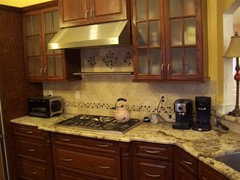
We are planning 30" induction cooktop and under cabinet hood. The plan is to have the duct go through the kitchen wall, make a 90* turn and go out the garage wall. We don't do greasy/high-heat cooking...but the floorplan is open and want to avoid sending cooking smells all over the house!

We are picturing something in stainless with a classic look. Any advice on CFM, brand, etc would be very welcome!

Comments (20)

  • 17 years ago

    600 CFM should meet your needs - if the duct work isn't already in, get at least an 8" duct. The deeper the hood you get, the better. Although I don't have any personal experience with them, Kobe has a lot of models you could check out. Other brands people like are Broan, Vent-a-hood and Modernaire.

  • 17 years ago

    What precisely do you mean by "deeper the hood the better"? By depth do you mean the distance between the front and back of the hood (assuming wall-mounted)? Or by depth do you mean, from the bottom of the hood (i.e. the cook-top end) to the actual vent intake area?

    There is also the question of capture area and angle of hood. That is, how far does the hood extend over the cook-top and is it flat or hooded.

    It strikes me that a flat hood is a contradiction in terms, though many prefer it for the sleekness of the design. One needs a true hood that is angled to capture the flow of smell, grease and heat and directs it toward the actual vent intake.

    I too am vent hunting so all advice is welcome.

    The stoves we are considering (and I prefer that word to range) will have a cook-top producing up to 60,000 BTU so 600 cfm is a minimum. I may have to put up with more noise than I would like since power and efficiency of air movement is the priority. My stove will be 30" wide so the hood would have to be that, at a minimum. A wider hood would be better, but the cost of changing the cabinets (we are not remodeling the kitchen, but simply changing some details) is too great.

    The hood should be at least 30" above the cook top to allow the easy movement of tall pots.

    In following the various threads on the subject no product has impressed me so far. Vent-a-hood seems to have the power and a reasonable price, but cleaning it seems a bother. A lot of the fancy hoods are flat which strikes me as a crucial design flaw.

  • 17 years ago

    Weissman and vivremanger, thanks for the info.

    Best by Broan and Broan both have some attractive hoods. Any experience as far as their performance, especially the Best by Broan?

  • 17 years ago

    I have a 900 cfm broan Elite hood with the remote blower and I really love it!! The blower can be mounted in-line or on the roof or outside wall so it reduces some of the noise in the kitchen. you will still hear noise, but it's air movement noise. The fan is fully adjustable so you can turn it down as much as you need it. On high, it makes a fair amount of noise but nothing as bad as the cheap-o hood I used to have. It has two halogen lights at the front and two warming lights at the rear.

    One thing to keep in mind is you may need to oversize your hood. Since your pipe has to bend, that bend will reduces your CFMs so you may need a larger blower to make up for it.

  • 17 years ago

    In general, the recommendation is that your hood be 6" wider than your cooktop/range and as deep as possible. In our case, we have a 36" cooktop (electric) installed in a standard depth cabinet (24"). So, our vent hood is 42" (36"+6") and 24" deep.

    The "extra" width creates a better capture area...steam, smoke, etc. does drift slightly when rising so it helps if you have an extra 3" on each side. As to the depth, you want to completely cover the front burners as well as the back. If you don't some of the steam, smoke, etc. will rise in front of the hood and not be caught.

    I have a 600 cfm Vent-A-Hood that I'm pleased with.

  • 17 years ago

    So beautiful, Buehl! Good to know about the width too. I guess we should be looking at a 36" hood.

    I saw a Vent-a-Hood at a local kitchen place a few weeks ago, thought it would be *the one*.... then read some not-so-good feedback (too loud, did not move air as well as desired) about them here and had second thoughts. I'll take another look at them now!

  • 17 years ago

    When talking about Vent-A-Hood and other mid-to-high end hoods, effectiveness is usually influenced more by the installation than the hood itself; with noise, it's both the installation and the location of the fan. The major factors affecting effectiveness & noise:

    * Number of turns: Every turn increases noise & decreases effectiveness. Try for angles > 90o. 90o angles reduce effectiveness by quite a bit. (Don't even think of an angle o!)

    * Length of duct run: The longer the run, the less effective and the noisier it will be

    * Size of duct: If you use duct that is smaller than recommended, your hood will be noisier & less effective

    * Location of fan: Internal fans (the ones in the hood directly over the cooking surface) are louder than external or remote fans (located outside)


    When I brown beef or fry bacon, odors no longer travel to the rest of the house...I don't even smell them in the rest of the kitchen. That's pretty darn effective if you ask me!

    High is a little loud, but it does not hinder conversation nor is it louder than the TV in the kitchen (someone complained that their hood was louder than their TV turned to max volume). Yes, if I want to listen to the TV while cooking w/the fan on high I do have to turn the TV up, but it's across the kitchen and when I'm standing in front of the cooktop the noise of the fan is right there (no, the TV volume is not at maximum). Even high is quieter than my old hood. My old hood was noisy & not very effective...it only had a 4" duct so it couldn't have been moving much air!

  • 17 years ago

    This is so helpful! Looking forward to quieter and more effective venting with the new kitchen.

    I can't figure out why a smaller duct size was mentioned by our kitchen expert?! Will discuss the larger duct diameter and maximizing the angle as much as possible when it makes the turn.

  • 17 years ago

    I have had a Ventahood for the past couple of years (looks like the one in the photo buehl posted; I can check the specs if you like) and it's worked very well since that time.

    But last night, when I hosted a fried chicken party for 20, my VAH really amazed me. I think I spent an hour frying chicken, and I wasn't sure how well the hood would do in those conditions. When I cleaned up late last night, there was a surprisingly little amount of grease on the backsplash. (There was grease all over the cooktop, but that was my fault.) Even better, when I came downstairs this morning, there was no grease/fry smell at all in the first floor of the house. I didn't expect that.

    In terms of noise, my experience matches buehl's.

  • 17 years ago

    We're having the same questions. My husband called Broan Tech Support (not Customer Service), and they were very helpful. We're looking at the 400cfm power pack, which mounts inside a wood hood. The Tech said that for this model a 6" duct should be no more than 50 feet. Also, you count 90 degree elbows as the equivalent of 11 feet of duct. Their sugestion was that if you had to go up, over, and up again (like most people do), use a total of two 45 angles to replace the two 90 angles (NOT four 45's). Two 45 elbows are equal to only 9 feet of duct.

    Call them on layouts, they are very helpful! Good Luck!

  • 17 years ago

    Sleevepresto...when you say 45o, I'm guessing it's what I call a 135o angle (180o - 45o = 135o). So, are elbows measured by the outside angle?

  • 17 years ago

    Yes, they're measured by the outside angle. I think we're saying the same thing. A 90 makes a right angle, a 45 is a more gentle bend. Go to Lowes or HDepot and look at duct pieces, you'll see exactly what these look like.

  • 17 years ago

    a 45ð elbow is so named because it makes the pipe turn 45ð. If you drew a line along the centerline of the elbow it does turn 135ð, but they use 45ð really to describe what direction it causes the pipe to take. 90ð causes the pipe to make a sharp right angle turn.

  • 17 years ago

    Thank you sleevepresto. Between Gardenweb and Tech Support, I now have faith that I will figure this out!

  • 17 years ago

    Nope, didn't know about baffles vs mesh filters.
    Thank you!!

  • 17 years ago

    I have a Best by Broan and am happy with it. It seems pretty powerful. We usually run it on low to medium and it is pretty quiet - a bit louder at full speed. We are using the baffles and a 10" duct with an external blower -- which is right over the other side of the kitchen, so I'm not sure that it makes a huge difference. I recently looked at their site and saw that they now have the option of having variable speed fan and lighting levels. Mine has only on and off for the lights -- that's one thing DH had to give on. The lighting is very bright -- excellent work light, and we have other dimmable lighting. I need my vent to vent and lights to work by more than mood lighting, but he'd want the new one. ;-)

  • 17 years ago

    lascatx, how many CFM is your vent blower?

    Thanks for all the info and help everyone!
    I hope to decide within a few days.

  • 17 years ago

    Just saw this. Mine is 1200 cfm at full speed. I turned it up while making popcorn yesterday. It is so much quieter at 1200 cfms than my old downdraft was at whatever its one speed was -- and I'm sure it wasn't 1200 or anything near it.

  • 17 years ago

    How fortutitous! One of my goals this afternoon was to finally make a hood decision! thanks