Software
Houzz Logo Print
chrisk327

Hoods

16 years ago

Ok, I'm a little new to some of this stuff, but I'm putting in a new kitchen in my "new" house.

we had a micro hood in the past house, works great as a microwave, but not so much as a hood. I can vent to the outside in my new kitchen, so I'm considering a real hood. I guess I'm also planning on a normal freestanding 30" range.

So I'm looking at "chimney" style stainless hoods and ones with glass. Do I go 30 inch for the hood and put cabinets right up to it on the left and right? Do I back away a few inches from the hood before the cabinets? Do I go 36" on the hood?

I want it to look "right" but don't want to waste too much space if I can help it.

Comments (8)

  • 16 years ago

    You may consider going with a slightly oversized hood - 36" for a 30" range if you want better pickup.

    Leaving a small gap between the cabinets and hood sides is also a good idea.

  • 16 years ago

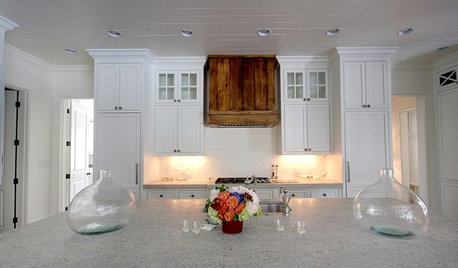
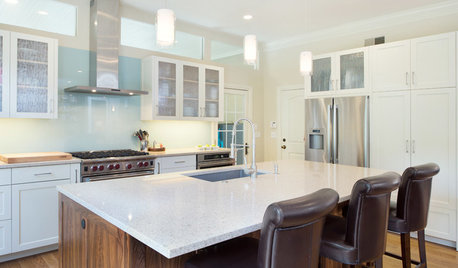
    Hi, I had the same questions when I was looking into hoods for my kitchen. You don't have to leave any space between the hood and cabinets, although most people do leave an inch or more, mainly for aesthetics. While most people say to get a hood larger than your range, most of us can't give up the cabinet space. If you get a good quality hood, a 30"size hood over a 30" range should work fine. Here's mine, a 30" Zephyr Savona over a 30" gas range. I did leave an inch on either side of the hood between the cabinets as I was bringing the back splash tiles up to the ceiling and liked the continuous look it gave.
    {{!gwi}}

  • 16 years ago

    If you have the space, going 6" wider than the range is supposed to be a good thing. (Never having had a hood, can't vouch for this one way or the other, though!) We aren't doing this because we have an odd-sized range and going 6" wider than it puts us in a hard-to-find/costly size range. Our appliance shop walked us through calculating enough CFMs to compensate for it, though. (There are some formulas based on the specifics of your stove and your kitchen space.) It seems to be easy to find 30" and 36" hoods, though, so you're fine.

    We're using a chimney hood and putting shelves and hanging systems alongside it for spices, oils, etc. (things used for cooking)---this allows us to go shorter at the base of the hood and longer as you move up the wall to maximize the space, if you can visualize that. They do also make hoods that are designed to be enclosed by cabinets, though, which seems like a smart idea if you want to maximize your cabinet space around it.

    As a newbie to hoods and ventilation, this was probably the single biggest thing I needed my local appliance stores for, too. I could get the gist of refrigerators and such by looking at online specs, but really needed to be able to actually turn on a hood and hear what a specific sound rating was, or feel what the difference between types of filters was. I felt a lot more confident in our decision after a couple of trips to look at things in person (and a couple of very knowledgeable salespeople who were able to explain how hoods work with respect to air flow through a space). Highly recommend a trip to see them in person!

  • 16 years ago

    Definitely finalize your choice of stove before choosing your hood. (I detect a little waffling in that "I guess" in your post?) If you are considering anything other than a standard 30" stove, you'll want to know that sooner rather than later.

    It is fine to go with a 30" hood above a 30" stove but our kitchen designer encouraged us to ask in appliance showrooms about the pros and cons of going bigger. Clearly, any salesperson who works on commission is going to say that bigger is better (since 36" are more expensive) and yet physics actually backs them up in this case. It is easier for a hood to draw steam and grease up and out when the pots and pans are closer to the center of the hood.

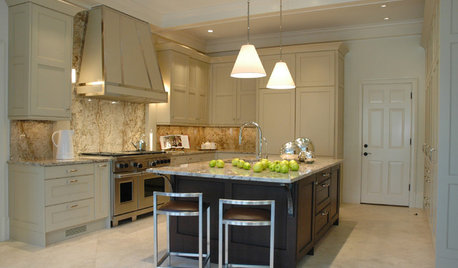
    Here's our 36" GE profile hood over a 30" stove... {{!gwi}}From Finished Kitchen -- East Bay

    You can see that we did not leave an inch or two on either side. We've only been using it a few weeks, but so far it seems fine.

    You could buy a wider hood and still be unhappy, though, because even wider hoods are sometimes underpowered. Find out how many cubic feet per minute each hood displaces, and how many different speeds it has. Our hood is rated at 450 cfm, with four speeds. (We fondly refer to them as spring breeze, sailing weather, Nor-easter, and Jet Engine).

    There are also "sones" ratings, and all other things being equal, lower sones means the fan is quieter... but I've never met a regular kitchen hood that could really clear the air without making some noise.

    Bottom line: look into CFM ratings when comparing vent hoods.

  • 16 years ago

    Oh, and I meant to mention.... one other issue that affects how the vent hood works is how high it is above the cooking surface.

    The specifications that came with our hood actually said it needed to be hung between 24 and 30 inches above the cooking surface. We ended up putting it a bit higher (32 inches) because my husband, the primary cook, is 6 feet tall and we didn't want him to knock himself out on the corner of the hood while bending over to check the progress of something on a back burner. We knew this might make the fan less than 100% efficient, but we figured that we had a few CFM to spare.

    The optimal height varies across vent hood models.

  • 16 years ago

    I'm not really waffling on the size of the stove. Basically was planning a normal range with a microhood, until my uncle (a custom cabinet maker) told me I'm really missing the boat on the hood, it will really make the look of our kitchen.

    the I guess part was more between slide in vs free standing. I think we'd just do freestanding as I think I'd rather have what I'm used to.

    thanks for the info, I think we're going to go 30 inch over 30 inch with no real space, the example pics look good to me at least. space would be good, but then I think I end up with cabinet size issues for the space. I don't want to lose the "look" but I've sacraficed the cabinet over the stove doing this, i'd rather not lose more.

  • 16 years ago

    I used 30" over 30" but I didn't want my uppers so close to the stove top (dh has fire phobia ever since his dad burned their kitchen down with an unattended gas stove) so I used shorter uppers flanking the hood. My hood is mounted a tad high but the power is great, I don't have any problems capturing the effluent from stir-frying or cooking greasy burgers.

  • 16 years ago

    Another thing you should be considering are the cabinets next to the hood. If you have the cabinets with double doors, you need some space in between the hood and the cabinet for the doors not to hit the hood. All other things being equal, a 36" hood will give you better capture than a 30" one.