Software
Houzz Logo Print
sue_brunette

Help me choose a hood insert

I'm having trouble finding an insert to fit my 42" wide hood. My cabinet maker will be building the mantle style hood so I need to find an insert. I will have a 36" induction cooktop so I know I don't need a ton of CFM. Our building code requires active make up air if the cfm is over 300. My concern is that most of the inserts I find with 300cfm or less don't seem like they could do the job. The actual filter or baffle area seems so small. I had been set on a Kobe insert which got good recommendations here but unfortunately it has 385-700 cfm. I did see a Vent-a-Hood model that was 300 cfm but have mixed feelings about them. Maybe it just seems silly to me to pay so much for a 300 cfm hood when I could get a more powerful, and quieter, one for less or similar cost.

We plan to vent straight up through the attic to exhaust at the roof so the vent run won't be very long.

Other concerns: the insert has to be at least 30" above the cooktop for code and due to the style of hood, it is more likely going to be 32" above. Will a 300 cfm insert that has a small filter area(aprox. 25 x 7 or 26 x 9)set at 32" high be effective enough? My counter tops will also be deeper than standard at 29" at the cooktop.

Am I worrying too much about this? I currently do not have a hood over my stove and can't stand the smell of foods hanging around the next day. I would be very unhappy if my new hood doesn't pull the odors out effectively, but don't want to have to go to the expense of adding active make up air if it won't be necessary. It certainly doesn't help that there are not many places that have hood inserts to look at and actually hear them on.

Those of you with 300 or less cfm hoods, how effective are they for you? How big is the actual filter area? How high above the cooktop are they mounted? Help!

Comments (10)

  • 16 years ago

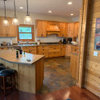
    How high above the cooktop are they mounted? Your range spec should dictate that. Ours had to be 36" (lowest part of wood hood) from top of range grate. Our inspector measured it. The vent sits a few more inches higher inside the wood hood. I went with a 1600 cfm vent (prestige fan and blower) - love it and it's so quiet (external motor). I had my hood built 54" by 27" for my 48" BS. The vent is then centered inside of the hood. I believe the width is most important (6" wider than range) and then the forward capture area. The vent is inside the wood hood so it doesnt have to take up all the area inside. Not a great pic with details but you get a little idea what mine looks like.

  • 16 years ago

    300 cfm is not generally that useful. Rule of thumb seems to be overpowered is better than underpowered. I don't know much about make-up air--check on the appliance forum for more about that--but it's odd that they require it for 600 cfm, which is kind of the standard lower size for a proper hood for a full sized stove. I think someone said the regular ventilation for the home should suffice, but again, I don't really know the facts.

    Viking and Best by Broan both offer 42", and Modern Aire will make custom custom sizes.

  • 16 years ago

    Oops! I meant to say that the rule of thumb is better to have higher powered on a lower setting, then lower powered on a higher setting because of the way hoods draw. Again, that's over my physicsgeekdom limit to say why, but it's something to keep in mind.

  • 16 years ago

    Thanks for the responses so far. I guess my dilemma is trying to avoid the expense of adding make up air yet still having a hood that functions well. Granted I will have an induction cooktop, so it isn't like I need to worry about the high power of a gas range. Unfortunately the code here in MN requires make up air for anything over 300 cfm. I have tried to get more info from some HVAC people but other than being told that they would need to calculate the draw of the hood, other fans in the house and such, I am feeling flustered. My cooktop info states that there is a 30" minimum required between cooktop and upper cabinets/hood and I believe that is also the minimum allowed by code here too. With the way my hood is designed, the insert will have to be a few inches higher, probably at 32" above cooktop. I know the farther away it gets, the less effective and if I only have a 300 cfm hood to begin with, who knows what the actual cfm will be. Grr. Estimates on active makeup air solutions are at least $2000. This shouldn't have to be so complicated.
    Does anyone have a 300 cfm hood mounted 32" above their cooktop that works well? Guess I should post over on Appliances or HVAC forums as well.

  • 16 years ago

    My old hood was 600 cfm and top quality, though mounted high because of a window. I often had to run it at full tilt for one burner on an underpowered gas stove. (I installed the hood--the only top quality appliance in the kitchen that came with the house.) I don't think the extra few inches were the issue as much as general suckage.

    I do understand the need for the make-up air in MN, where you have houses sealed against heat loss, and opening a window isn't always an option. Heated make-up air is probably necessary for function, not just the archanities of the building code. But you also do want the suckage. Forgetting for a minute the particulates that the hood pulls up, the grease, moisture, and aerosolized bits, think of the odors! Do you want to be living with the odor of frying giblets and oysters at Thanksgiving, and have them still be lingering come Christmas, when they'll be overlaid with mulling spices bubbling on the stove, and mixed with the cinnamony-oily smell of buñuelos, or whatever y'all eat for New Year's? And never be really able to get rid of it until Spring?

    Okay, I'm a ventilation freak, and while I enjoy the smell of yumminess while it's cooking, I can't abide stale cooking odors. If none of that bothers you and your family, you can continue to try doing without. Unfortunately, 300 cfm hoods are mostly made for low powered, 30" ranges. There is the Vent-a-Hood, and they claim that theirs is the equivalent of a slightly more powerful one, but for the inspector's sake it's rated at 300. But it's also supposed to be mounted a lot lower, so how effective it will be at the height you plan is in question.

    Before you make any decisions, it's worth getting one of those HVAC people out for a consultation. Don't be penny wise/pound foolish.

  • 16 years ago

    plllog, I actually am thinking more like you in regards to the vent hood. I hate the leftover smell of food cooked the day before and would prefer to err on the side of more power than less. My husband on the other hand figures anything is better than what we have now, which is nothing. I tend to look at things from the point that it would be better to spend a little more money and do it right, than try to get by with less and regret it after the fact. But yowza, I never thought it would be quite this difficult to try and get all the pieces to work together. In order to pass inspection, I have been told that opening a window is not considered an option. It just seems unrealistic that in order to avoid needing expensive makeup air you need 300 cfm or less, but in getting 300 cfm or less, those hoods have to be mounted so low that it doesn't even meet code. Who figured this stuff out anyway? Must be the same drunken irishmen that planned the streets in St.Paul. (No offense meant to anyone, just a local joke). I guess it is indeed time to call in a professional for a consultation. First thing on my list for Monday.

  • 16 years ago

    we used an abacca and have been very happy. Controls for lights and fan speed are easily accessible. not inexpensive but VERY good

    Here is a link that might be useful: finished kitched

  • 16 years ago

    Hockeychik, good luck with the consult. I hope you'll find out that it's not as big a deal as it sounds like.

    The thing about the 300 cfms is that they're not strong enough to do much good at normal height.

    I'm with you on the do it right the first time and be done with it. :)

    For code, the reason you need the makeup air when you have adequate suckage is that in a modern, sealed, house, you can suck the air right out of the house. I don't know if you can actually get it down to suffocation levels if you try, but it can play merry hob with other appliances, and stuff. It also pulls in drafts from wherever they can sneak in and then you have all that cold air fighting your heating.

    Where I live, it's not an issue because you can just crack open a window, even in the worst weather. (We hurl curses when our lows get down to 40°F.) In MN, in the Winter, few people will do that. The heated makeup air keeps the pressure in your house normal and keeps you comfortable and conserves energy.

    I know it seems stupid, but there really are valid reasons for it.

  • 16 years ago

    my dealer cost on magnum hoods inserts is about $450 to $750 many places on the net sell a lot of hoods for about the price I can get them. Rangecraft.com has a huge selection of them and that is all they do they know their stuff. They do not sell over the net they use kitchen dealers. You could call them to get some general questions answered.

    Here is a link that might be useful: Yosemite Magnum Hoods

Sponsored
Wannemacher Interiors
Average rating: 5 out of 5 stars26 Reviews
Customized Award-Winning Interior Design Solutions in Franklin Cnty OH