Software
Houzz Logo Print
emperormko

Grafted Citrus

11 years ago

I've been reading from this site for quite some time and have done many different things in the garden with the help of you guys. At the moment my task in the garden is citrus trees. I'm grafting to wild seedlings found under 20+ year old trees( In this case they come from under 1 tangerine tree and 1 Valencia orange tree) anyways I had a couple questions.

1) How long should they remain covered after grafting? Some are still alive like the day I attached them together, but seeing how it's out of season I don't know if it'll wait until spring to send out new growth or if it'll grow new shoots no matter. (Failed rootstock sprouts upon failure still).
2) Is defoliating natural in grafting? I normally remove all but the top four to five leaves, but on about half of my plants they're losing even those leaves on their own after grafting. One of my defoliated scions appear to be trying to send out a bud but it also has shoots coming from under the bud union. Has that one failed or could it be successful but with immediate suckers?

My goal is to have at least one of every citrus variety I can find. So far I have Lime, Navel, Tangerine and Valencia orange. My next plants for grafting are still Meyer Lemon and grapefruit.

I haven't seen posts like this one here on gardenweb, but if there are some then sorry for the repeat post.

Hopefully everyone elses gardens are having as nice as year as mine :)

Comments (24)

  • 11 years ago

    Citrus scions don't need any leaves. The stems are green with Chlorophyll and will generate their own food and won't loose the moisture that leaves loose. Keep on plugging and you should do fine with some of them. When I was grafting Meteor sour cherries i dug up roots from around the periphery and grafted them to twigs off the same tree with reasonable success.

  • 11 years ago

    I am led to believe that the graft will hold on my first citrus tree graft but it leads me to two more questions when is it safe to remove the (what I used was electrical tape)? and will these plants wait until spring to grow more? it appears the graft is holding since it was grafted right before thanksgiving and it still has all four healthy looking leaves. The weird thing is that it has not even put up new shoots. I'm going to try repotting it into a 1 gallon pot this week, hopefully that should promote new growth.

  • 11 years ago

    It would help to know the procedure you used, how many days, you have tried after grafting and the temperature at which these grafts have been subjected to. All these determine how long before unwrapping a graft.

    But poncirusguy is right about citrus grafts not needing any leaves. In fact, leaves will dry out the scion way too much. The scion should have dormant buds when grafted.

  • 11 years ago

    I used plumber Teflon tape and I will leave it on until the scion sets growth or dies next spring/summer. The tape will have enough stretch to allow growth at the graft union.

  • 11 years ago

    I'm going to have to take pictures but for now i'll explain in text.
    These citrus were grafted right after thanksgiving. This fall has been relatively warm (80) except the initial October cold front. I have been using cleft grafts. I know when a lot of the smaller ones fail because they send out shoots under the graft. I haven't done too bad with Valencia scions that still have all their leaves, so long as I keep them covered. As of now they have been sitting inactive (grafted but not growing) for about two + months.
    The process is as follows:
    1) Cut rootstock at a 180 degree angle
    2) Cut a slit into rootstock top from center straight down about .5 in
    3) Trim the scion wood until it is under 6 in and has 3-4 leaves
    4) Trim area of scion to form a thin wedge where it will be attached to the graft
    5) Insert scion wood into cut made into root stock
    6) Line up cambium layers between cutting and rootstock and see that they fit snugly
    7) Tape it up ( I use electrical tape)
    8) Cover with a 1 gallon jug (cento italian pepper jar or pickle jar)
    9) Leave for an undisclosed amount of time until you see new growth coming from the scion wood

    1. unwrap the grafts tape and uncover the rootstock with the jap
    2. Replant into pots

    As of now of my citrus worked is at step 9.

    Am I forgetting anything? As of so far they have been working well just slow to grow (doesn't help that it's January now, lol).

  • 11 years ago

    I would use Teflon plummer's/pipe thread tape. It seals out air much better. Has no sticky to its surface. It can be left on much longer with out choking the tree. It is cheaper than grafting tape. You can buy it at any store except maybe a bridal shop or State Liquor Store.

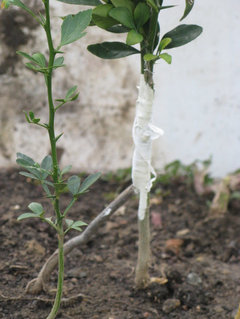
    Other wise your "road map" sounds perfect. See my bend graft pictured 2 posts up. The rootstock is poncirus trifoliata and the scion is nagami kumquat

  • 11 years ago

    Kumquats seem to almost grow wild here in north central florida, so I am going to be experimenting with them too come soon, I want to try each citrus mixed with kumquat, should be an interesting experiment.

  • 11 years ago

    Emperormko

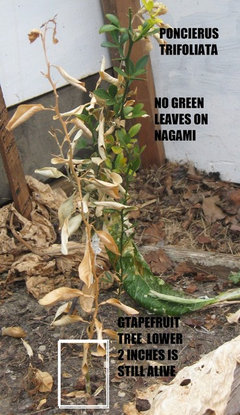
    I wish you the best of luck on your breading. Make sure to use meiwas as the nagami is way to tart. This is a current picture of my bend graft pictured above between my nagami and poncirus trifoliata. There are no green leave on anything other than the PT. The cover blew off the night it dropped to -4 F and went through another night of -1 F

  • 11 years ago

    I think I will do the same grafting technique you described above, Emperorko. Using poncirus trifoliata roostock that is about an inch in diameter.
    I haven't done any grafting, and will probably practice before on a different part of the rootstock.
    My questions is for collecting scion wood. I want to graft meyer lemon. I plan to graft after the last frost. But for collecting budwood is it important to collect it and properly store while dormant. Or could I remove scion wood from plant, and attach it immediately afterwards?

  • 11 years ago

    I've found that the fresher the better in what i've done personally. It won't get under twenty often by me so this is as good a time as any for me to graft them here. The key to the grafting here in my area is to make sure it is covered by a glass or plastic Jar (the grocery bags just never work as cover) for what seems to be about two months.

  • 11 years ago

    Poncirusguy why use such long scion wood? My shorter ones seem to hold a graft much better (at a higher percentage) and most of the time don't even lose their leaves.

  • 11 years ago

    Many say that a Meyer lemon grafted to a poncirus trifoliata does not work over years. The Meyer lemon does well but poisons the PR then the whole tree dies. An inter-graft works but that is two grafts. If this is to be a container tree then a rooted cutting does fine. Almost all tree do better on their own roots if the conditions meet those roots need. The graft is alwas a week link and prone to failure.

  • 11 years ago

    I have only done bud grafting with the exception of the bend graft shown in my first picture 0 posts up. Thewhite area is the fusion area between the nagami and poncirus. Both trees have their toots and tops. When it is clear the graft has taken I will cut off the PT top and then later sever the nagami roots. The lower picture is just a picture showing cold damage to the grapefruit rootstock seedling, nagami tree, and the two PT rootstock still alive. The actual bend graft in the lower picture is hard to see.

  • 11 years ago

    How are you setting the jar onto the graft? I'm on the coast in SC, so am not to different, but will probably wait a few more weeks before attempting to graft.
    I planted the poncirus trifoliata rootstock last fall, and then learned what a root stock is.
    It's over 6 ft tall in the ground. Is there an convenient way to order scion wood, that wood graft well with this root stock?

    If I don't do meyer lemon, what would be a good choice?

  • 11 years ago

    If I don't do meyer lemon, what would be a good choice?

    That's like asking someone to name your kid. What we like might not be what you like. Like for me a meyer is the most retarted fruit possible. If I want a tart lemon it's lisbon (what I own) or eureka. For a sweet lemon it's New Zealand lemonade (buying as soon as four winds has them again). The meyer doesn't fit either the sour or sweet category.

    But people love the meyer.

  • 11 years ago

    I think almost anything will do fine. I hear satsumas are great on PT. If you order budwood they may be able to tell you what not to order for PT. I do believe that grapefruit do well on PT.

    Of all my citrus in containers my PT is by far the best and is trouble free.

  • 9 years ago

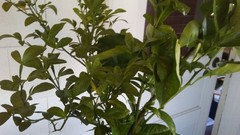
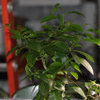
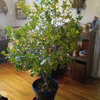
    I have a question (I think I already know the answer). SOme of my plants experienced some die back and the new growth has smaller leaved than the others (Pic below shows small leaves on left side, large leaves which I believe is the Valencia scion portion). Is this small leafed area in fact growth from the rootstock? Or is it simply because it is younger growth?


    Assuming its growth from the rootstock, how difficult is it to graft a named variety back on? I have some apple grafting experience with success but have never tried a citrus. This valecia I could simply prune off the small leave producing branches but I have another that has all died except this small leaf type of growth. What is the rootstock? WIll it flower and fruit?


    Any advice is appreciated. My problem is bringing the trees in doors during the winter (I live in Boston). I cant seem to get the watering right and keep killing them ( or nearly killing them). This year I am trying having them on a glassed in porch which istn heated but doesnt really freeze. Hoping they will hardly require any water at all and really slow down. I have seed starting heat mats under them to provide some warmth as I hear they hate cold wet feet.


    thank you

  • 9 years ago

    Can you post a picture of the trunk from the soil to above the graft line (8-inches)

  • 9 years ago

    those three leaved branches on the orange look like rootstock to me.

    Trifoliate Orange, I believe

    Trifoliate orange doesn't flower except for randomly, and over many many years, and the fruit is undesirable with seeds and sourness.

    I dont know how grafting would go... still procrastinating my attempts. The only problem may show up where the citrus is growing that part of the plant. You graft and that branch is now the lowest and won't grow.

    I'd cut back all the branches with three leaves, and grow whatever is predominantly there.

    Or, try to grow a trifoliate orange plant and make a cocktail citrus from one from day one.

  • 9 years ago
    last modified: 9 years ago

    Kinda hard to tell but it looks like the original graft is still alive.


    (along with rootstock)

  • 9 years ago

    The stems with 3 leaves must be removed. It will not produce fruit of any value.

  • 9 years ago

    Thank you, the 3 leaf ID helps a ton. Now I know what is rootstock. can anyone help with grafting? Can I graft just like I would an apple in spring?


  • 9 years ago

    Yes you can. Start studying on citrus grafting now.