Software
Houzz Logo Print
cheesestandsalone

Combination cooktops - rationale?

11 years ago

Hello! I'm in the early, early stages of planning a total gut and remodel on the kitchen in my forever house. With all options on the table (not a single firm decision made yet...) I've been looking at all kinds of appliance configurations (cooktop and oven wall, range, even Aga a potential (not strong) option, because why not?) and am wondering...has anyone done the more esoteric combination cooktop modules from Wolf/Miele/etc? I love the idea of some induction and some other stuff, like a grill - we do TONS of grilling and it would be fantastic to have an indoor grill in the winter - BUT, man, the expense! For the $1500 or so these modules run, wouldn't it make more sense to invest in a single, 30 or 36" cooktop (thinking induction) and spend the money on a good or great grill/griddle cast iron pan, a fancy steamer, deep fryer, crockpot? What's the advantage to a built-in? Are they easier to maintain or clean? Is there a performance gain?

Comments (16)

  • 11 years ago

    You hit the nail on the head as to why these aren't more popular. You're paying a ton for functionality that can be found elsewhere for much less, and in some cases functionality that people use so rarely they couldn't justify a built in appliance for it.

  • 11 years ago

    I have a 30" induction cooktop and a 15" wok burner from Miele. I am fully aware that this is an expensive setup but works best for my lifestyle. It will be installed in January. It will replace a 48" Dacor gas rangetop. I wanted the advantages of induction cooktops, a wok burner for Asian cooking and the power outages that we normally get. I also have a grill outside which I have used during power outages without issue. I cook a lot and the 30" induction cooktop was a perfect fit because of the large burner location. On the 36"' I found it hard to use the smaller burners when using a large pan in the middle.
    Good luck!

  • 11 years ago

    Homepro, that makes sense if you're doing a ton of something specific like wok'ing. I was also thinking about power outages...happiness is a warm Aga? :) But to Hvtech's point, the modules are expensive for a particular single function, and if the function is cooking when the power is out, the money might be better spent on a back-up generator, or going solar on a new panel we have to do to support another project.

    We have a kamado-style grill on the way that should be able to maintain temps in the cold/wind, but I'm not going out there to light it, fiddle with the vents to get the temp set, put my food on it, turn my food, check for doneness, etc. when it's 20 degrees out there. Hate. Hate. Hate. the cold. That's really the only reason to consider a built-in grill. So...if I get the same results from a grill pan on an induction hob as I would from a built-in, I've probably ruled out a modular in-counter grill.

  • 11 years ago

    Cincy,
    I am from Michigan so I know the cold well I have a Komodo Kamado and I go out in extreme weather to light it. The food that comes off it is just too good:-). The temperature setup is rock solid once set when I light the unit. I use a looflighter but will consider a flame thrower next. I just don't have anywhere to store the tank.
    I have a small generator that can run 70% of the house but it is only 3000watts and will not run the AC in the summer or the Induction cooktop. I recognize its limitations but heat and Internet were a priority since I work 50% from home.
    Solar with backup batteries is the ultimate goal. I am looking at an electric car in the next year to replace my v8 suv.

  • 11 years ago

    Cincy --

    Adding to what already has been said about an indoor grill -- and living in the Northern Rockies where it can be just as cold as at homepro's place in Michigan and where I am this very evening braving the cold to use a gas grill and a smoker --- several additional aspects occurred to me. You may want to consider them in your planning.

    1. With an indoor grill. you will need to spend a lot more money for kitchen ventilation (bigger, wider, etc.) and a lot more on a make-up air (MUA) system. That may affect allocations within your budget.

    2. Also, it seems to me that a grill is pretty much an upside-down broiler (or vice versa). What I use my grill for is making a lot of stuff at once. "A lot" meaning enough to feed 15 or 20 at a time. For smaller amounts, the oven broiler does (it seems to me) pretty much the same thing.

    3. Obviously, a "grill pan" is not the same thing as a grill, but you certainly can make some tasty food on one. Some folks here are very pleased with built-in griddles and grills, but I find them a pain to clean. My personal preference would be something like a Chef King griddle (14" x 23" with vertical handles). Bring it out when you want to use it, store it when you are not using it, and easier to clean There have been a couple of threads on induction and large griddles with induction both here and over in the cookware forum on chowhound.com if you want to research that subject further.

    4. If you are considering burner spanning griddles/grill pans for an induction cooktop, manufacturers have started producing induction cooktops which allow considerable flexibility for of that kind of function. This is sometimes called "Flex-zone." Brands I recall reading about recently here are the current Bosch 800-series and Benchmarks and the latest Wolf cooktop. There may well be others, but that's what I recall at the moment and it may be enough to help with searches if you are interested in researching that subject further.

    5. I'm drawing a blank on threads about combining induction and gas modules, but I know I've seen several on the subject. IIRC, pillog built such a combo several years ago and has posted about it. Kaseki (I think) has combined a Kenmore induction cooktop with an induction wok burner on the side. That may help with further searching.

    6. Like homepro, I also have a 3kW generator and also have a home office. When I was stove shopping three years ago -- around the time of super-storm Sandy -- my thought on having an induction range being out of commission because of downed power lines during inclement weather was this: while I could not run any kind of electric stove off the generator , I could certainly use my propane-powered camp stove in the kitchen underneath my range hood and the range-hood easily runs off my generator.

  • 11 years ago

    Thank you all! Plllog, what you say makes sense. We've already got several outdoor grills and a smoker (kamado-style - not a BGE but similar), which we use almost nightly - until winter hits. Our porch is a freakin' hike through 3 large rooms to get to the deck. I'll brave the elements for long, slow cooks (like ribs or brisket in the kamado) but not for steaks or seafood or anything that needs a close eye kept on it. So, the real choice is between a broiler or broiler-style element (grill domino, cast iron grill pan on cooktop, oven broiler, salamander, George Foreman-type standalone) or putting an actual fireplace in the kitchen. To JWVideo's point, no matter what we do, we need to take exhaust/venting into account. I'll tell you what, though - an indoor BBQ is an awfully intriguing idea! Since we're assuming we'll have to open up to the roof to accommodate some sort of exhaust solution (we'll already have the hood up, so to speak...*rimshot*) the incremental cost of a chimney might not be prohibitive. And also, how awesome would that be? Holy moly, that would be cool. And fantastic to have in the winter. Especially when the power goes out, since the corner it would go in would also allow it to heat the bedrooms. NICE.

    Great information on specific brands/makes for bridging induction burners! Thank you all again - this is going to be so much fun!!!

  • 11 years ago

    If you do a kitchen barbecue, you can add features, too. I saw a wood burning one once that had a barbecue opening on the front and a pizza oven on one side. I'm not sure how the firing worked though I think the pizza oven was above the barbecue opening. I had some friends who used a built-in wood burning stove not only to heat the room, but also to heat hot water which circulated in pipes, both to feed the bathrooms, and to add warmth to the rooms they passed. These ideas can be adapted to gas. If you search for people who are doing these things, I'm sure you can get more detailed ideas.

    Not to pop the bubble, because I can tell you're excited about the possibility, but one thing to consider is that cooking at high heat, using wood/smoke, charring, and possibly even cooking over a direct gas flame, can create chemicals in the food that aren't all that great for you. Perhaps your inclement Winters are a good rest time? Maybe a time to develop an equal passion for stews and braises? Just an alternate rationale to consider...

  • 11 years ago

    Noted! We also like some char on asparagus and zucchini, and from what I've read, no carcinogens are formed when you grill veggies. So we'll go with that. :) And who knows? A fire is so cozy and comforting in the winter, I could see myself using it for long cooks on indirect heat just like we'd use the kamado.

    And wood-fired pizza...yowza...we deal with a lot of food intolerances/allergies and alternate flours, so every little bit that adds to "normal" flavors for gluten-based/grain-based foods is awesome.

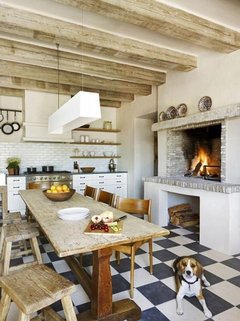
    You're gonna have to try a lot harder to burst this bubble. It'll probably take getting an actual estimate on what it's going to cost. :) Also, I found this picture, which I showed to DH, and he kinda sorta fell in love too. Plus now he really wants a dog (can't get, see allergies above.)

  • 11 years ago

    So - was chatting with DH last night, and we had another idea. If we built out the deck to wrap all the way around the back of the house, we could swap a window for a door and put the grill etc. just outside where the new kitchen will be. Cost is probably roughly the same ($4-6kish?) and a larger deck makes more sense in this neighborhood than a kitchen fireplace. So now we're focusing more on cooktop/wall oven (induction or gas?) vs. range (probably gas.) DH has his heart set on gas, but neither of us has ever cooked on induction so we're open. Thinking about picking up a plug-in to play with and get a feel for how they work...

  • 11 years ago

    Trying a plug in is definitely a good idea, but remember they run off 120 volts not 240 so they may not perform the same as a cooktop. I would also see if you could find a showroom that has one live you could try out. Definitely don't dismiss induction without trying it. Areas that seem to be more difficult with induction are wokking and canning. They certainly aren't impossible, but introduce some complications. I don't do much of either (in fact, I haven't done ANY of either since I got my induction range earlier this year) so I won't be of much help in this area but if you do either on a somewhat frequent basis, you should read past threads on this forum and learn from the experts.

  • 11 years ago

    On trying a portable induction cooktop, there have been several threads which might be useful to you. In case you haven't already seen it, I've linked below to the most recent one that I know of.

    Here is a link that might be useful: portable induction cooktops for trying-out induction

  • 11 years ago

    I like the wrap around deck idea. :) Very normal. And good for a dash out in weather, and dash back in. Your inspiration picture sure is pretty, though. :) The ones I've seen are just red brick columns in '60's-'70's modern kitchens. You should be able to char a nice pizza in your kamodo too. Maybe try a steel?

    Re dogs, I get no beagle, but poodles and a few other curly breeds are way low on the allergy scale.

    Since you're set for grills, I definitely recommend induction. Do try it out. It's as, if not more, responsive, and so much easier. The only thing is it won't do as good a job heating your kitchen in the Winter. OTOH, you won't need as many gobs of conditioned make-up air to vent it either. :)

  • 11 years ago

    Thank you everyone again! So much! Thanks for the threads on plug in induction burners. The awesome appliance store has a few induction ranges that are live, and the guys there are more than happy to let us play on them. They also told me they'd be happy to hook up whatever else so we could compare. We don't wok much, so yeah. DH's desire to be able to melt lead at home may not be matched by his willingness to engineer/pay for the corollary exhaust solution. We'll see, though. He's still excited that our Vitamix can turn rocks to sand, even though our weekly meal planning rarely necessitates sand (and if it did, there are easier ways to get sand, even in Ohio.)

    He still wants the beagle. Not just any beagle, but that particular beagle in the picture. No need to crush his dreams this early in the process, right? :) Maybe we can install one of those whole-house air filters...

  • 11 years ago

    You'll still need conditioned make-up air with induction. Just not nearly as much. :)

    So arm yourself with facts:

    • Melting point of lead (stovetop): 625ð F. (technical is 3.5ð less)
    • Temperature to melt glass: 1400-1600ð F. depending on composition.
    • Temperature to caramelize sugar: 186-350ð F. depending on whom you ask (sugar doesn't technically melt, so it's a matter of deciding which kind of pseudo-melt you want on your crème brûlée).


    {{gwi:2134042}}
    $45 on Amazon plus a canister of butane gives you a nice portable 2700ð F. to melt the world with. Maybe buy your husband one now so he can play with fire, and let him go into the cooktop testing with an open mind. :)

  • 11 years ago

    plllog, that is AWESOME. I'm all over it. :)