Software
Houzz Logo Print
oldgardenguy60

Wher to get seed?

11 years ago
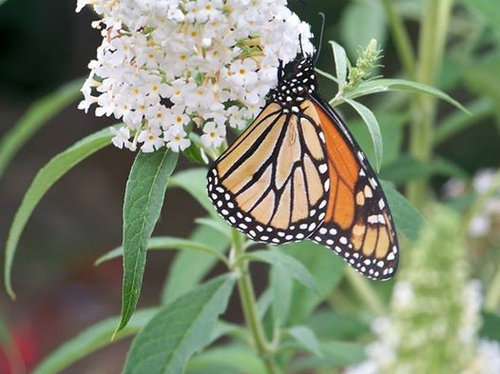
Live 50 miles west of St. Louis what type and where can I get some seeds to do some milkweed planting , I had several Monarch s visiting my Butterfly bush last summer would like to add a place for them to lay eggs


Comments (16)

  • 11 years ago

    I have Butterfly Weed (Asclepias tuberosa), Tropical Milkweed (Asclepias currassavica). Balloon Plant (Gomphocarpus physocarpus), and a few Purple Milkweed (Asclepias purpurascens seeds I can send you. I may be able to get some Common Milkweed (Asclepias syriaca) from a friend to send you as well. Send me a message with your mailing address if you are interested.

  • 11 years ago

    Will the Monarchs lay eggs on these?

  • 11 years ago

    Yes, all of them. In my garden, the Tropical, Balloon, and Common are the hosts most used by Monarchs. The Butterfly Weed is used more as a nectar source by the adult Monarchs, but they will also lay eggs on it. The caterpillars will eat it, but the other milkweeds are a more nutritious food source for the cats.

  • 11 years ago

    Here is a list of retail seed sources for a wide variety of milkweed species. http://monarchbutterflygarden.net/milkweed-plant-seed-resources/

  • 11 years ago

    flutterby64 would love to give them a try. A couple of ?s do they need full sun and should I direct sow or start indoors 1st and do they reseed them selves.

    address = R Hays 714 edith st Washington Mo 63090

  • 11 years ago

    I'm subscribed to the following butterfly gardening blog. You might find some of the blogger's information helpful since he is in St. Louis. Best of luck getting started growing milkweed. Let me know if you would like some of the seeds I offered.

    https://butterflygardening.wordpress.com/

  • 11 years ago

    Tropical milkweed and balloon plant are not native to the US.

    Tropical milkweed should not be planted. It has been shown to help spread the monarch butterfly parasite Ophryocystis elektroscirrha. It also has been shown to confuse migrating monarchs because it dies back later than native milkweed.

    Missouri Wildflowers Nursery is west of you. They have native milkweed seeds and plants. This webpage shows you which milkweeds are native to Missouri and has a link to Missouri Wildflowers Nursery.

    Missouri Native Milkweed Species

    Prairie Moon Nursery has a good selection of native milkweed seeds. I bought packets of seed from them last year for 5 different species of milkweed. Search "asclepias" on their website to see what is available.

    Prairie Moon Nursery

    There is a native landscaping workshop happening in St Louis this Saturday. Monarchs will be discussed.

    February 28: Partners for Native Landscaping Workshop, St. Louis


  • 11 years ago

    Thanks all for the info on the milkweed. I know Monarch #s are way down just want to do whatever I can. In 2006 on a late summer day I had between 200 -300 Monarchs on a very large buddleia bush, they stayed for about 24 hours and then were gone have never seen them in a mass like that since.

  • 11 years ago

    Garden Guy

    Sounds like you were in the migration path that year. How exciting that must have been! When I lived in Dallas, a butterfly gardening friend of mine called me all breathless one October morning saying "Get over here quick! It looks like a river of Monarchs flowing above my house!" I got there as quickly as I could but I missed them. Would have loved to see it.

  • 11 years ago

    As I understand it, Tropical milkweed can promote the spread of OE in areas where tropical milkweed does not freeze and die during the winter. The plant infected with OE survives the winter and is used by the next season's Monarchs thus perpetuating the OE. Tropical milkweed cannot survive outdoors in zone 6a winter in the St. Louis area. It does not even survive my 7a winter here in northern Arkansas. Perpetuating OE on overwintering plants can be prevented by starting over with new, fresh Tropical milkweed seedlings each spring.

    Planting native milkweed, such as Common and Purple, is very important no doubt. However, I have found that relying totally on native milkweeds to feed my cats is a problem because many natives have healthy, edible foliage only for a short time. The natives drop their leaves in the heat of summer, the time I need mw most, leaving me with nothing to feed the cats. My choices are to let the cats starve or to have Tropical as a backup food source.

    That being said, I am increasing my Common mw planting because it was such a fantastic food source last year. I raise my cats indoors, so I pick leaves and bring them in to feed them. A single Common leaf was so large it fed as many cats as 10-15 Tropical leaves saving me time & effort. Once picked the Common stayed fresh longer than Tropical, and the plant provided healthy, edible leaves well into September. It grew so large and its leaves were so huge I was able to raise the majority of my 150 cats on the one plant. For these reasons, I am planting more Common in hopes of reducing my need for Tropical. (The drawback to Common is that it spreads, so it needs to be planted in an area where it can either be contained or allowed to spread freely.)

    It seems to me there are ways to use Tropical mw responsibly with my goal being to provide as much food as possible and at the same time, minimize the threat of OE & delayed migration. (1) I can use Tropical strictly as a back up food source by growing it in an enclosed area. By preventing their access, Monarchs are not delayed in their migration. (2) I can pull up the tropical once migration time in my area has passed eliminating delayed migration and OE.

  • 11 years ago

    Tropical milkweed helps spread OE for multiple reasons.

    OE infected monarchs have been shown to prefer tropical milkweed over other milkweeds. "Self-medicating" is the buzz term that caused many of us to start planting tropical milkweed. But tropical milkweed is not a cure. It gives monarchs higher tolerance and higher resistance to OE versus other milkweeds. OE infected caterpillars have a better chance of making it to adult. OE infected butterflies live longer. OE is spread by the butterflies.

    Tropical milkweed versus swamp milkweed shows the biggest difference when comparing non-migrating adults. When raised on tropical milkweed, non-OE butterflies live 26 days while OE infected ones live 18 days. When raised on swamp milkweed (A. incarnata), non-OE butterflies live 34 days while OE infected ones live 11 days. Number of days represents the average # of days.


  • 11 years ago

    KC, Interesting information, some of which is new to me. Questions: (1) Does Tropical mw growing in its native range have the same OE issues you listed? If not, why not? (2) "It [Tropical] gives monarchs higher tolerance and higher resistance to OE versus other milkweeds." When you say "higher resistance", does this mean that Tropical gives Monarchs some protection against contracting OE? (3) Does the OE problem apply strictly to "Tropical" A. curassivica or does it also apply to other non-natives such as Gomphocarpus physocarpus?

    Would you please site the source materials for the information in your last post? I am very interested in reading it.

  • 11 years ago
    last modified: 11 years ago

    I don't think I have found any research about OE south of the border. I have tried to find detailed info about tropical milkweed and monarchs in Mexico because people make claims about what is happening down there. Unfortunately, I have found nothing that supports or contradicts their info. Not exactly the safest place to be hanging out these days to do research.

    Your answers about resistance, tolerance, and G. physocarpus can all be found in this research. The answer about G. physocarpus is not what was expected.

    "FOOD PLANT DERIVED DISEASE TOLERANCE AND RESISTANCE IN A NATURAL BUTTERFLY-PLANT-PARASITE INTERACTIONS"

    Evolution: International Journal of Organic Evolution

    Volume 66, Issue 11, pages 3367–3376, November 2012

    http://onlinelibrary.wiley.com/doi/10.1111/j.1558-5646.2012.01693.x/abstract

  • 11 years ago

    I again tried to find research about OE in Mexico but came up empty. I did find info on something I've wanted for a long time. Some people like to claim that migrating monarchs don't have a problem with tropical milkweed because a bunch of them lay eggs on it in Mexico instead of heading for the US first. If they do, they apparently don't bother to migrate north after that because scientists can tell what the monarchs were eating and they don't find tropical milkweed. Linking a free research paper here:
    Hostplant - derived cardenolide fingerprints as labels of spring migration strategy and a test of the “oogenesis - flight syndrome” in monarch butterfly arrivals to Michigan

    Another reason not to plant tropical milkweed is it complicates things for scientists trying to figure out where monarchs were raised. One study assumed the tropical milkweed monarchs were probably wedding releases from butterfly farms. I read another study on whether monarchs heading south were stopping in Florida and never leaving. They were able to tell which ones were the migrants because they had been raised on milkweed not found in Florida. With more and more tropical milkweed being planted across the US, this kind of research will become less factual since some will actually be migrants.


  • 11 years ago

    flutterby64(7a) Thanks for the seeds look for a box in the mail on Monday a thank you gift from the garden Best wishes in the garden this year God Bless

Sponsored
River Mill Construction
Average rating: 5 out of 5 stars2 Reviews
Delaware County's Customer Focused General Contractor