Software
Houzz Logo Print
jane__ny

Florida Butterflies.

11 years ago
last modified: 11 years ago

I have posted before. I live in Sarasota, Florida and have a very small yard. This is new to me and I'm still so confused. Monarchs and a bright yellow butterflies seem to continue breeding over the winter. We've had some cold nights.

I've raised and released at least 8 Monarchs and a few of the yellow butterflies. They seem to remain in my yard. Most of my nectar plants have died off and I am starting seeds, but there is nothing for them now.

I have Milkweed still growing and flowering and keep finding monarch caterpillars which I can raise, but there isn't enough nectar flowers. I bought some snapdragons, geraniums, they don't seem interested. I don't know what to plant in winter. I have a few Pentas which they visit and poke weed? Not many flowers.

Is there anything I can plant now to feed them? The butterflies keep laying eggs and I've counted over 10 baby caterpillars but there isn't enough nectar food. I have tons of Milkweed growing.

I need advice from people living in warm areas. There must be something that will flower over the winter months to feed them. The Monarchs do not migrate here and just stay in the yard and keep laying eggs.

Thanks,

Jane

Comments (122)

  • 11 years ago

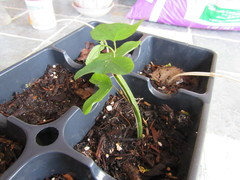
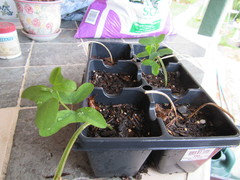
    msmorningsong(SW FL 10A), Hi, I haven't gone to the nursery as of yet. Here are the pictures of my seedlings, I think they are too small yet to find out the name. My Dutchman's Pipe is starting to flower, I will post the picture, so I can find out which one it is.


  • 11 years ago

    I had a great day today. I walked outside at 7 AM and saw a beautiful Ruby-throated male hummingbird feeding on my large purple porterweeds.

    Later I saw a Pipevine Swallowtail. I hadn't seen one in about a month. I saw him or another like him several times during the day. Next I saw my first skipper of the year, then later I saw two Red Admirals mating and finally an Eastern Black was laying eggs on my green fennel.

    For the past month or so I've been seeing lots of Fritillaries, Sulfurs and Monarchs. It looks like it's going to be an excellent year for seeing butterflies.

    It's nice to have a place to share. Most of the people I know could care less about butterflies and hummingbirds.

  • 11 years ago
    last modified: 11 years ago

    tom123-gw >> "It's nice to have a place to share.
    Most of the people I know could care less about
    butterflies and hummingbirds."

    When you and I talked, that was our context.
    Chances are that persons who are in this particular minority
    probably have other minority things in common also.
    It is for that reason that I pass along to other central Floridians that
    this Saturday April 25 the organization Vegetarians of Central Florida
    www.vegcf.org ( I was among the founding organizers)
    is conducting its 10th annual Central Florida Earth Day Festival
    www.cfearthday.org/
    in downtown Orlando. Quite large in area and in number of tents.


  • 11 years ago

    They eat the rind, too. So, peel the fruit unless it was
    grown and supplied using the organic practices.


  • 11 years ago

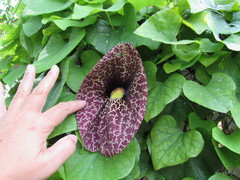
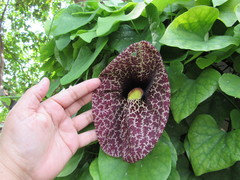
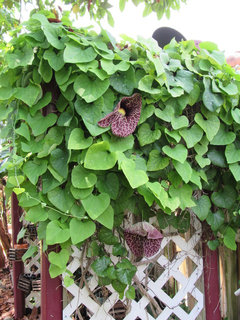
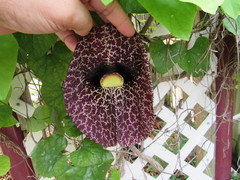
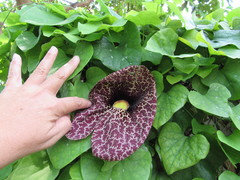
    MY Dutchman's Pipe just flowered, can anyone tell me the one I have, and if it's good for the Pipevine Swallowtail

    ??


  • 11 years ago
    That one won't attract pipevine swallowtails. Just the Polydamas (gold rim swallowtails) caterpillars. I have them as well. They will devour it all up. I have three of those vines. I hope mine grows back. I finally found a plant that's for pipevine swallowtail at a green thumb festival last weekend. Yes! So hard to find. Hope it'll grow!
  • 11 years ago
    Also it's called calico flowers
  • 11 years ago

    It looks like an Aristolochia elegans to me. Elegans If so, it will be excellent for the Gold Rims or Polydamas and not for the Pipevines. I have found that the Pipevines will lay their eggs on this vine, but the cats won't develop. Perhaps others have had different experiences.


    Again, the best vine in my experience is the tomentosa. The fimbriata also does well and can be grown easily in pots. They will attract both the Polydamas and the Pipevines and both will do well on them.

  • 11 years ago

    I was afraid that it was going to be that one. I have been searching on the internet, and that's the one it looked like to be. I do get a lot of Polydamas cats on it, and they do eat it completely, but it does come back as you can see in the pictures. Going to look for seeds to the tomentosa right now. I don't think the Pipevine that I saw in my yard, laid any eggs, she came in and out very fast. I haven't seen another one yet. I did plant the Fimbriata, but that one takes forever. The ones I had previously, are only about a foot long, and that little vine has been there for over a year already. The Polydamas cats do like the Fimbriata a lot, I was always changing the cats to the calico flowers. Thank you very much for answering me, angelimperfect36(9) &
    tom123_gw(9b).


  • 11 years ago
    The plant I got is called Aristochia trilobata. Got it in three gallon :).
  • 11 years ago
    Look at davesgarden.com it
    Shows four vendors have this plant. One is in Texas.
  • 11 years ago
    last modified: 11 years ago


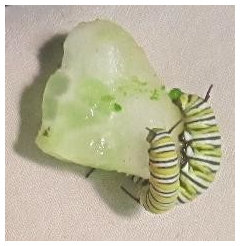
    Photo from four days ago; they are very small.
    I have collected many more caterpillars since then.
    All immediately go for cucumber.
    They eat a significant amount.
    They grow.

    Starting this afternoon, after four 24-hr days,
    one of first two caterpillars became motionless.
    Although there is no way to know the reason,
    given that this happens sometimes even in the
    best of circumstances,
    I use the event as the basis on which to suggest that
    the EXCLUSIVE feeding of cucumber be for a maximum
    of three CONSECUTIVE days.

    That was a test of the extreme situation.
    I am confident that, in tmes of critical milkweed shortage,
    we can extend greatly the food supply by ALTERNATING
    cucumber and milkweed,
    in many possible timing /amount scenarios.

  • 11 years ago

    angelimperfect36(9), I will look for it there and see.
    four(9B (near 9a)), I always go running to Home Depo when I run out of milkweed. Right now, I have a lot planted. Recently planted some new seedlings, and tomorrow I'm planting more seeds. This time, I'm planting the native seeds I have. Lets hope this time I have better luck with them. Today I bought a Firebush Hamelia Patens at Home Depo, it was a good size. I have a very small one, taking forever to grow. The butterflies love this bush, and this is the native one of FL. http://www.floridata.com/ref/H/hame_pat.cfm


  • 11 years ago

    The Hamelia Patens is a winner. The Zebra Longwings love it and others visit it also. The hummingbirds really like it too. Be aware, however, that it will get very big and it will spread and throw out seeds. In my garden they are space thugs. I have one that is now almost twenty feet high. A freeze will kill off the tops and delay flowering, but we have not had a hard freeze where I live in Central Florida for three years or so. Mine are now blooming and will continue to do so until early winter.

  • 11 years ago
    last modified: 11 years ago

    I bought 2 of the non native one first, didn't know there was another one. Those have not had a problem with spreading. I think in the 5 years, more or less, that I have them, have only seen 1 seedling, and it does get a lot of visitors a day, from butterflies to bees. I haven't seen too many hummingbirds in my yard, except for 1. I do have a lot of plants for them too, hopefully, they'll come this year. I also have the Chinese Hat plant, which is also great for hummingbirds. I bought it at Fairchild's Tropical Gardens, their plants get lots of hummingbirds on it.

  • 11 years ago

    Where do you live again, ily68? I think the further south one lives the more the Hamelia Patens grows. I live about twenty miles west of Orlando in Clermont. We have not had a freeze in about three years, so these plants have just zoomed. Most of the ones that I have were called "dwarf" but they are now well over ten feet high and just starting to bloom profusely. The "native" that I have is really a small cluster that reaches perhaps to twenty feet now.

    I purchased a yellow Chinese Hat Plant at the Leu Garden plant sale. I would guess that the red one will get more visits, but I wanted a yellow for the color. Supposedly these plants also get very big. Mine has held blossoms on it since I purchased it, which is now about six weeks ago.

    I have many different hummingbird plants. (I'm looking at a hummer right now out my office window visiting a Schumannii Cuphea.) By the way, the Schumannii is one of the best hummingbird plants that I have. It spreads and blooms constantly as long as there isn't a frost. Schumannii

  • 11 years ago

    I live in Miami, FL. We don't get much cold over here. We did get about a week of cold last year, but normally we don't. I have gone to Orlando in the winter time, and it has been colder up there. The Schumannii Cuphea, is one that I am looking for. I've seen it at Fairchild's, but haven't seen it for sale anywhere. My Chinese Hat plant, has a more orange flower than red. This is the one I saw at Fairchilds with a lot of hummingbirds on it. It does get big, but my mom is always trimming the plants more than I would like. I am trying to find more native plants to plant, but sometimes getting native plants is hard. You don't find too many people selling them.


  • 11 years ago

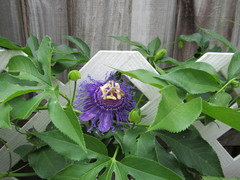
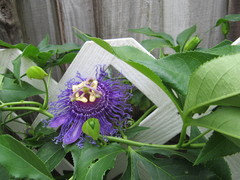
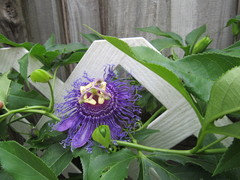
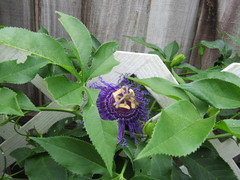
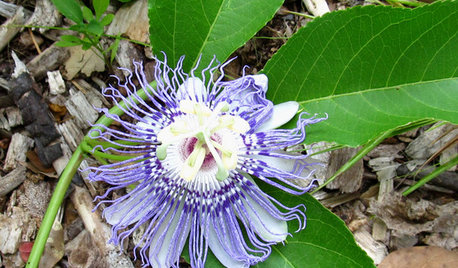
    My yard has a lot of Zebra Longwinds in it, maybe about 20 or more throughout. I finally saw 1 Polydamas getting nectar. The Lady Margaret passionvine I bought, had apparently the wrong tag on it, it just flowered, very pretty flower, but not the Lady Margaret. Any one know which one it is??


  • 11 years ago

    I just did a search, and it looks like Purple Passion-Vine (Passiflora incarnata). I wanted this one too. Hopefully the next one I buy, will be the Lady Margaret.


  • 11 years ago

    Looks like the Maypop to me. I think the other name for it is Incarnata or just Purple Passion Vine.


  • 11 years ago

    It was a surprise, but a very beautiful one.


  • 11 years ago

    Unless it came from a native plant provider, then it is
    more likely to be the cultivar Incense of P. Incarnata
    than straight species incarnata.

    My many-year experience with Lady Margaret is that
    both kinds of butterfly completely ignore it for egg laying;
    and that Frittiary on very rare occasion will drink a little nectar.
    Hummingbirds, on the other hand, drink it every day.


  • 11 years ago
    last modified: 11 years ago

    I bought it a nursery, they have a butterfly area. They sale a lot of butterfly plants. My 1st Lady Margaret was loved in my yard. I had both gulf and longwings on it. Twice they cleaned all the leaves, and it was pretty big. The 3rd time around, it didn't come back. I did talk to another person there, and she told me she bought the Maypop there. That was when I bought the blue one. I might not know it is the Maypop or the Incense of P.Incarnata but, it does have cats on it, mostly the Gulf. As long as it's getting cats on it, I'm fine with it.

  • 11 years ago
    last modified: 11 years ago

    Can you eat the fruit of the Incense of P. Incarnata?? I know you can eat the Maypop fruit. My Edulis does have fruit on it right now, but it hasn't flowered. Even though I didn't get my Lady Margaret, the Edulis might be the right one.

  • 11 years ago
    last modified: 11 years ago

    I eat all the P. incarnata var. Incense fruits (innards thereof) that contain anything half-way palatable, which is one in twenty. In all cases, the amount is a mere bit. The best ones, three per year, are exquisite. Flavors progress from nearly tasteless, to lemon, to lemon-orange, to orange-pineapple, to orange-banana, to hint of passionfruit, to passionfruit. Correlation between good flavor and darkness of innards.

  • 11 years ago

    Thank you for letting me know. I must try it when it does produce fruit. Right now I'm getting fruit from the Edulis. I think I heard, that I need to let the fruit drop, not to take it from the tree. I'm watching for that one now. I've never tried passion fruit before, will try this one.


  • 11 years ago


    Photo taken today.
    Dwarf type of Hamelia Patens, mentioned earlier.
    I grow mine as topiaries; they have no opportunity to exceed dwraf size,
    should they be so inclined
    They do not multiply.

    Topiary aside,
    I read that the ratio of flowers to the rest of the plant is higher for dwarf type
    than for standard H. Patens.


  • 11 years ago
    last modified: 11 years ago

    They are pretty, I have 2 of them. I bought them before I knew they weren't native. They do get a lot of butterflies & bees on them, so I won't be cutting them. I have it in the middle of my back yard, so I can look at it through the kitchen window, the family room, and the porch. I recently planted 2 of the native one, but they're smaller. I can't see the native ones from my house, they were planted at the back of the yard.

  • 11 years ago

    I have two and rarely ever see a butterfly on them. I have so many butterflies yet they rarely go to these flowers. Mine are not the dwarf variety.

    Jane


  • 11 years ago
    last modified: 11 years ago

    On my property the Zebra Longwings, which are the ones circled above, love the Hamelia Patens. I have both the Hamelia Patens var. patens, which is often called "standard" or "native" and the Hamelia Patens var. glabra which sometimes is called "dwarf" and other times "firefly." The glabra is certainly not a dwarf. Both of the Hamelia Patens are over 15ft high in my yard.

    There are other types of Hamelia Patens. This is an interesting article about them.

    They are excellent hummingbird plants, which is the main reason I planted them.

    Most butterflies use them, but there are other plants that are superior all-around butterfly attractors. For the Zebras, though, they are excellent.

  • 11 years ago

    jane__ny(9-10), My friend has the one you have, not in her yard, but the yard behind her house. The tree bent and appears in her yard. I did get seedlings from her, but they were taking to long to grow. Hers is always full of butterflies. I bought the non native first, and it's always full of butterflies. The native ones that I did buy, are about 2 feet tall. The dwarf one, is the non native one. I can't tell you how big it gets, because my mother is always trimming everything. You might have something they like more in your yard. This article says why it's important to plant native ones, http://www.hoeandshovel.com/2013/07/firebush-native-or-non-native.html

    tom123_gw(9b), In my yard, all the butterflies go on it. I did read an article that said there really is no dwarf one, but that the non native one, you can keep to 3 to 4 feets. My mother loves to trim plants, so mines will never grow to 15'. My native ones, haven't gotten too big yet, put them in the back of the yard so they can grow big. I'm running out of room for trees, have to many fruit trees. We planted too many mangoes and avocados.

  • 11 years ago

    To readers who have (or have had) Firecracker, Ruselia equisetiformis:
    Which of your butterflies do (did) drink it repeatedly?

    I have a new one, flowers ready for the drinking, no takers yet.
    Saw a ZLW go over and around, to get at a less obvious Tasselflower
    a few inches away. Twice in succession.
    The tubes strike me as rather long.


  • 11 years ago
    last modified: 11 years ago

    I have this plant. I have only heard about it as a hummingbird plant. It gets some visits by hummers, but I can't remember any by butterflies. I would think, however, that the sulfurs would use it. They have a long proboscis. I have the same experience as you, Miguel. The butterflies pass it up for other nearby flowers. In my case the plants that I have near are purple porterweeds and the Cuphea Schumannii. It is similar to the Hamelia Patens, so I would imagine that the Zebras would use it also. Wish I could remember butterflies using it, but I can't.

  • 11 years ago
    last modified: 11 years ago

    Good to know about Sulphurs' long proboscis.
    Encouraging also because here they go exclusively for the
    similarly-shaped and -appearing Salvia coccinea.

    Last evening I observed that a Zebra drinking from a Hamelia flower
    had its face jammed against the opening; giving me to think that
    Zebra is one kind not to expect on the Rusellia.

  • 11 years ago

    Just saw a hummingbird visit the Ruselia equisetiformis. She has been visiting this plant frequently lately. Have not seen butterflies visiting it yet, but I will look for them.

  • 11 years ago

    ily68 >> "an article that said there really is no dwarf one"

    Apart from any difference or lack of difference in overall plant size,
    the dwarf H. Patens' leaves are dwarves.

    The two plant types also typically differ in color of flowers.

  • 11 years ago

    Yes, the leaves are different in size. I have both planted at my house. The native one has little hairs on the leaves, while the non native doesn't. Right now, I see more action on the non native than I do on the native one. Might have to do with the size of them. My non native one is about 6' tall, while the native one is only 2' tall. I see a lot of butterflies on the non native one, but mostly the longwings. I do have 3 types of passionvines. This article talks about them, http://www.floridanativenurseries.org/info/plants/the-hamelia-mess/

  • 11 years ago

    Even though the author objects to "dwarf" in referemce to even the
    compacts that he cites, 8 feet vs 15 feet in height is more than significant.
    Helpful to buyers to know that there are compact versions of both
    var.patens and var.glabra; and that the likelihood of getting a compact
    hinges on the appearance of "Calusa" or "Compacta" on the label.

  • 9 years ago
    last modified: 9 years ago


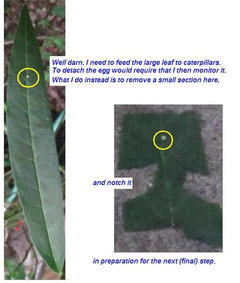
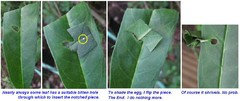
    This was to follow up on my mention of not having to sacrifice eggs,
    in the process of feeding monarch caterpillars.

  • 9 years ago

    Jane's (jane__ny) laments come to mind as I continue to see the
    Monarchs' current preference during these last several days.
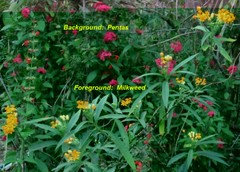
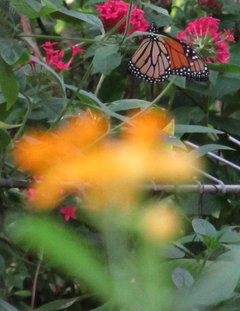
    First, the setting :


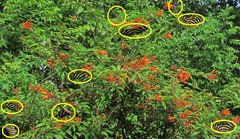
    And the Monarchs? (one in frame) :


  • 9 years ago

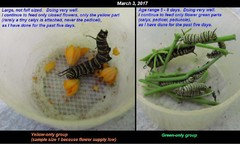
    My current experiment in floraphagy:

  • 9 years ago

    Porterweed was mentioned a number of times.
    Mine are tall and wide. Dark blue flowers.
    Tonight I pruned.
    Question to anyone who has done it : How strong /weak is the likelihood
    that these cuttings grow if they were to go directly (i.e. rootless) into ground?

  • 9 years ago

    I haven't tried putting them directly into the ground, but I have put them in water and they got roots.

  • 9 years ago

    I have never done it, but the success would be clearly enhanced if they were put in a shady spot, and watered every day. Now is a good time to try it, because of the humidity and rain. Normally, they root easily in my experience.

  • 9 years ago

    Thanks.
    Ily68 and Tom, I think that I will combine the approaches, which means
    to leave the cuttings in water longer than I always do (to fully hydrate),
    wait for a mere bit of roots, then jam the cuttings into the ground,
    not caring about the certain breakage of such small amount of roots.


  • 9 years ago

    Still no roots in water. ( I don't care.)

    ______________
    Perhaps readers here would like to see the amount of activity
    close to the patio door all morning long, every sunny day.
    URL of the video file is
    www105.zippyshare.com/v/q20NVEa9/file.html
    Although it can be played in the hosting website page,
    for me it stopped & resumed every second;
    so, download file instead (name activity2.mov).
    Colors look ok when played by QuickTime player;
    quite poor when played by VLC player.

  • 8 years ago
    last modified: 8 years ago

    Well, the freezes took out very many leaves,
    so, creative feeding is necessary again.
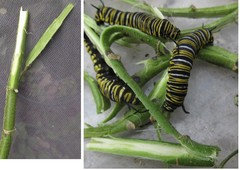
    This is a variation on the feeding of stems.

    The tender stems are eaten, as are edible parts of moderately tough stems.
    Yet some food still is available, by better exposing the inside of
    the skin of otherwise impossibly tough stems, or completely separating it.
    (More exposure causes it to dry sooner. Becomes inedible sooner.)

  • 8 years ago

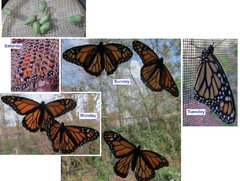
    Ok, here are the guys that were carried through
    by the above-pictured supplemental food.


Sponsored
Whisler Home Improvement
Average rating: 5 out of 5 stars9 Reviews
Franklin County's Committed Home Improvement Professionals