Software
Houzz Logo Print
djthomp28

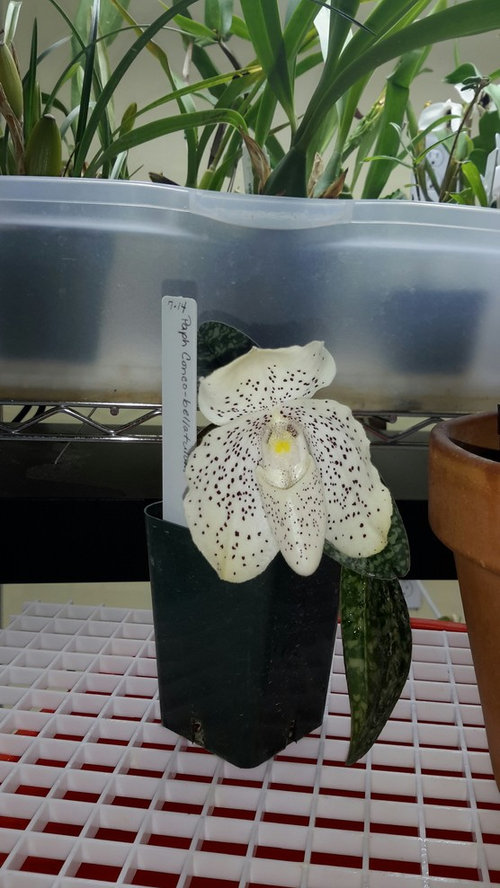
Paphiopedilum conco-bellatulum

Paphiopedilum conco-bellatulum can be found as a man-made hybrid or a naturally occurring one. My understanding is that the manmade hybrids are still referred to as conco-bellatulum while the offspring of the naturally occurring hybrid is called Paphiopedilum wenshanense. I have read there are some differences in the flowers of the natural hybrid and the man-made hybrid. However, I have not found the specific details about the differences so I am not sure how tell them a part.

Well mine came with Paphiopedilum conco-bellatulum on the tag, and I am going with that as the name.

This has been a pretty resilient plant for me. It is coming back strong after I overdosed it with lime last year. My learning from that was to keep better notes.

Comments (11)

  • 11 years ago
    last modified: 11 years ago

    Hi Darlene, here is a pic. of Paphiopedilum wenshanense exhibited at a local orchid society in November by a guy who has a very large collection of Paphs.

    The RHS Checklist has this as a current accepted orchid species, not a hybrid.

    Sorry about the link. Paphiopedilum wenshanense

  • 11 years ago

    Hi Arthur - I was hoping you would respond. Maybe people are no longer referring to either as a hybrid or at least the RHS is no longer. I think the idea of differentiating between man-made and natural hybrids is a little odd. But I figured I would just roll with it. Thanks for the link also. The one pictured seems to have a deeper cream color and larger spots than mine. Possible more of the P. concolor color is coming through.


  • 11 years ago
    last modified: 11 years ago

    It's certainly a lovely plant no matter who it's parents are (or aren't) or...whatever. That's (in my book) acceptable variation from a cross to still be siblings.

  • 11 years ago
    last modified: 11 years ago

    The gods have spoken.... The RHS say that Paph. Conco-bellatulum is a hybrid and it was registered way back in 1891 while they have Paphiopedilum wenshanense on their species list, described by a botanist in 2000. (Doesn't count at all what is said at the University of Google)

    As far as the natural hybrids go, I have Den. xsuperbiens with the tag like that because (I think) it was collected from the wild and given to my son when he was a Junior orchid grower ages ago.

    If the cross is redone by human hand the x should go, and the label should be Den. superbiens. Note that the RHS are using lower case to denote a natural hybrid.

  • 11 years ago

    Awesome! Thanks for the update Arthur. I am pretty sure mine is man-made so Conco-bellatulum it is. Still feel odd to have a species name and a hybrid name for a plant that is genetically the same. But what are you going to do?

  • 11 years ago

    Sorry if I missed something there Arthur, but shouldn`t it then be Den. Superbiens (upper case S) for the human made plant??

    Eve

  • 11 years ago

    Eve, this nomenclature stuff is difficult. Here is the Entry from the RHS Database.

    GenusDendrobium

    Epithetsuperbiens

    Synonym FlagThis is not a synonym

    Registrant NameThis is a natural hybrid

    Originator NameThis is a natural hybrid

  • 11 years ago

    Hmm, I am not much into the nomenclature but my understanding of the basics always was that (man made) hybrid names start with an upper case letter and species with a lower case letter and natural hybrids have the lower case x prefix, right??

  • 11 years ago

    "not much into nomenclature" You are into it more than 90% of orchid growers, to them it is rocket science. As for the Right?? I am just a humble orchid grower and I just cut and pasted the above from the RHS Hybrid Register.

    Go to the species checklist and the x appears again x superbiens. Together with the details of the botanist who described the plant.

    A better example is Dendrobium Delicatum which is widely grown here and the nurseries keep selling seedlings which they hope will be better than existing plants. It is always listed with the capital letter. Again, most orchid growers would not know that it occurs in the wild as a natural hybrid.

  • 11 years ago

    Another beauty!


  • 11 years ago

    This is a division on a larger plant. So this division is up for trade if anyone is interested.

0
Sponsored
Hope Restoration & General Contracting
Average rating: 4.7 out of 5 stars35 Reviews
Columbus Design-Build, Kitchen & Bath Remodeling, Historic Renovations